




Blog
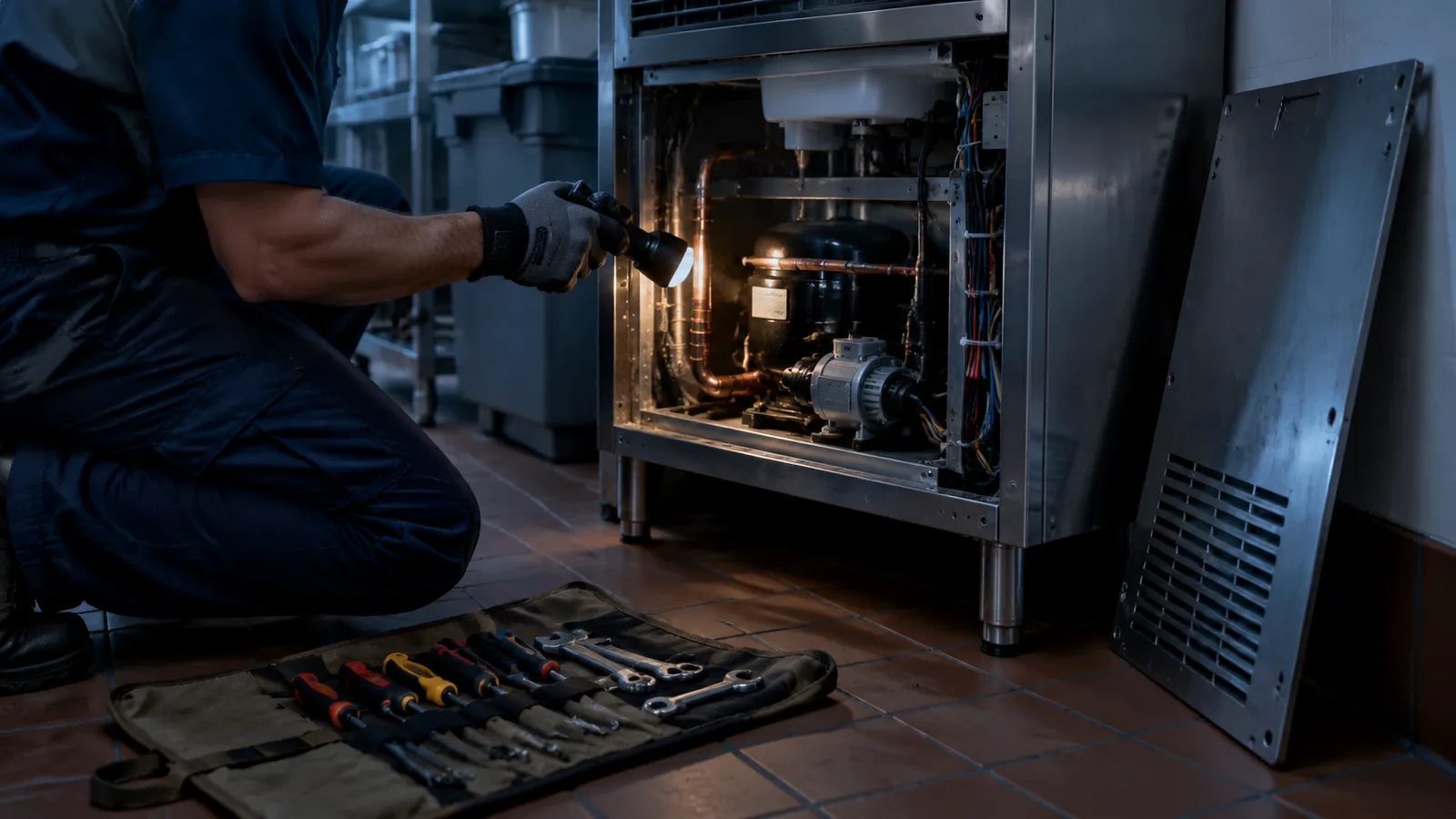
Ice machine troubleshooting for commercial kitchens: a symptom chart, a 5-minute check when the machine stops, safe staff fixes and when to call a tech.
Good ice machine troubleshooting starts with the symptom, not the part. A machine that is dead, one that runs without making ice, one that freezes into a solid block and one that leaks onto the floor all point to different causes, and most of them start with simple checks: power, water, the bin, the room and the condenser. This page is a symptom router for commercial kitchens, bars and hotels. Find what your machine is doing in the chart, run the safe first checks, then follow the link to the full guide for that problem. Anything inside the sealed refrigeration system belongs to a certified technician.
Part of our commercial ice maker buying guide series.
Before you touch anything: three safety rules
- Switch off and unplug before you open a panel. OSHA’s rules on controlling hazardous energy exist because equipment that restarts during service injures people. If the machine is hard-wired, switch off the breaker and tag it so nobody turns it back on while you work.
- Close the water supply before you disconnect a line or filter housing.
- Leave refrigerant work to a certified technician. Under the EPA’s Section 608 rules, technicians who maintain, service or repair equipment that could release refrigerant must be certified. Staff should never cut, braze or “top up” a sealed system, and should not chip ice off the evaporator with a knife or pick.
Ice machine troubleshooting chart: symptom, first check, next step
“Staff” means a trained employee working with the power off and the manual open. “Tech” means a qualified service technician or the manufacturer’s support line.
| What you see | Check first | Common causes | Who fixes it |
|---|---|---|---|
| Machine is completely dead: no lights, no sound | Outlet, breaker, power switch, plug | Tripped breaker, switched off, loose plug, blown fuse, failed control board | Staff for power; tech for fuses and boards |
| Machine stopped mid-service but the display is on | Bin level, alert on the display, timer settings | Bin full, water shortage, a timer or schedule pausing production, a protection trip | Staff, then tech if a protection trip repeats |
| Runs, but makes little or no ice | Water supply, filter, condenser airflow, room temperature | Closed valve, clogged filter, scale, dirty condenser, hot room, refrigeration fault | Staff, then tech for refrigeration |
| Ice forms on the evaporator but will not drop | Scale on the evaporator, level, ice thickness setting | Scale, machine not level, thickness set past the manual’s range, harvest valve or sensor fault | Staff, then tech for valves and sensors |
| Evaporator iced over into a solid block | Water flow, room temperature, scale | Low water flow, a cold room, scale, a failed sensor or valve | Staff to thaw safely and clean; tech for parts |
| Output has dropped, especially in summer | Room and water temperature, condenser, clearances | Rated output falls as room and water warm up; blocked airflow | Staff, then tech if output stays low |
| Cubes are small, thin, hollow or uneven | Water flow, filter, scale, thickness setting | Restricted water, scale on the water system, setting changed, machine not level | Staff, then tech for valves |
| Water on the floor or in the bin | Drain line, door seal, supply fittings | Blocked drain, loose fitting, stuck inlet valve, condensation | Staff for drains and seals; tech for valves |
| New or louder noise | Fan blades, panels, level | Loose panel, debris in a fan, a worn pump or fan motor, compressor trouble | Staff for loose panels; tech for motors and compressor |
| Ice tastes, smells or looks wrong | Last cleaning date, filter age, what is stored near the bin | Overdue cleaning, old filter, odors absorbed from the room | Staff, following the manual’s cleaning procedure |
| A code or alert on the display | The code list for your exact model | Depends on the model | Look it up first, then staff or tech |
Ice machine stopped working? A 5-minute first check
Work through these in order before you book a service visit.
- Power. Is the switch on and the outlet live? Check the breaker and any GFCI outlet on the circuit. If a breaker trips again right after you reset it, stop and call a technician.
- The display. Note any alert or code before you switch anything off, and take a photo of it. A reset can clear the message you need.
- The bin. A full bin or a bin sensor blocked by an ice bridge stops production by design. Level the ice pile and clear the sensor area.
- Water. Is the supply valve open? Has someone changed the filter or shut off the line for other work? A machine that cannot fill cannot make ice.
- Timers and settings. If the machine has a production timer or schedule, check that it has not paused production for the current hours.
- The room. Feel the air around the machine. A hot, closed space or a blocked condenser can trip protections or stall output.
If all six look normal and the machine still will not run, check the model’s code list, then call a technician.
Symptom by symptom: where to go next
Each problem below has a full guide with causes, safe checks and repair limits.
It runs but makes little or no ice
The usual suspects are the water supply, a clogged filter, scale, a dirty condenser and a hot room, roughly in that order. Our guide to an ice machine not making ice walks through each step and shows where staff checks end and technician work begins.
Commercial ice machine not harvesting ice
If you can see ice on the evaporator but it never drops, the harvest step is failing. Scale on the evaporator holds cubes in place, a machine that is not level can fill unevenly, and an ice thickness setting pushed past the manual’s range can make the slab harder to release. When the cycle keeps running on top of unreleased ice, the evaporator can freeze into one block. The ice machine freezing up guide covers how to thaw it without damage and what to check before restarting.
Output dropped in hot weather
This is often physics, not a fault. Output is rated at standard room and water temperatures, and a machine in a hot room fed with warm water makes noticeably less ice than its headline number. See ice machine performance in hot weather for the checks, and how long an ice machine takes to make ice for normal cycle and recovery times.
Water on the floor or in the bin
Confirm it is a leak and not condensation, then follow the water from drain to supply fittings to inlet valve. The ice machine leaking water guide lists seven causes and what each one looks like. If the drain was never routed correctly in the first place, the commercial ice machine installation guide covers drains and air gaps.
Cubes are small, thin, hollow or uneven
Thin or hollow cubes usually mean the evaporator is not getting enough water during the freeze, from a partly closed valve, a tired filter or scale in the water system. Uneven cubes across the grid can also mean the machine is not level. Check whether someone has changed the ice thickness setting before you assume a part has failed, then descale and sanitize. Our guide on how to clean a commercial ice machine covers the full routine.
New or louder noises
Some sound is part of the cycle: water running over the evaporator, a valve clicking and cubes dropping into the bin during harvest. Our explainer on how commercial ice machines work describes what happens at each stage. Rattling often means a loose panel or debris near a fan. Grinding, squealing or a new compressor hum needs a technician.
Ice tastes, smells or looks wrong
Off tastes, musty smells and cloudy ice usually trace back to an overdue cleaning, an old water filter, or ice absorbing odors from food stored nearby. Start with a full clean and sanitize using the products your manual names, and replace the filter if it is past its date. We are also preparing a separate guide to ice that tastes or smells bad.
Display alerts and error codes
Codes differ between brands and between models from the same brand, so a code list for another machine can send you in the wrong direction. Use the code list in your own manual or from the manufacturer. For Smartool equipment, the Smartool fault diagnosis page lists display codes and symptoms for its ice makers, soft serve machines and freezers, with each fix marked as safe for trained staff or technician work.
Some alerts are not faults at all. The BF500 split ice maker and the BF360 both have smart alerts for water shortage and a full bin, shown on an LCD display, so staff can tell a supply problem from a normal bin-full stop. Both product pages also list protection against overheating, compressor overload and overcurrent, and an operating temperature range of 5–38°C (41–100°F). If a protection trip repeats, or the room is outside that range, fix the cause before restarting. For the meaning of a specific BF code, use the fault diagnosis page or confirm with your sales rep.
What staff can fix and what needs a technician
Agree on this split before something goes wrong, so nobody books a service call for a closed valve or opens parts staff should not touch.
| Trained staff, power off, manual open | Qualified technician |
|---|---|
| Reset a breaker once and check the outlet and switch | A breaker or fuse that trips again, wiring, control boards |
| Open the water valve, replace a filter cartridge | Inlet or harvest valves, water pumps, float switches |
| Clean the condenser and restore clearances | Fan motors, compressor and anything in the sealed refrigerant circuit |
| Run the cleaning and sanitizing cycle the manual describes | Refrigerant leaks, charging and recovery (EPA Section 608 certification) |
| Level the machine, clear a bin sensor, adjust settings | Sensors and thermistors that test faulty |
| Clear a blocked drain at the bin outlet | Drain lines rerouted inside walls or under floors |

On air-cooled machines, a condenser packed with kitchen dust and grease is a common cause of slow ice and overheating trips, and cleaning it is a staff job with the power off. Use a soft brush or vacuum along the fins, never a screwdriver or pressure washer.
Write it down before you call for service
A good service call starts with good notes. Record these before you phone a technician or the manufacturer, and keep them in a log beside the machine:
- The model and serial number from the data plate.
- Any display code or alert, with a photo.
- When the problem started and what changed: a filter swap, a move, a heat wave, a new drain.
- Room temperature near the machine and whether the condenser area was clear.
- A short video of the symptom, such as the noise, the leak or ice that will not drop.
- The date of the last cleaning and filter change.
A log also shows patterns: three freeze-ups in a month point to a different cause than one freeze-up after a power cut.
When troubleshooting points to replacement
Sometimes the honest answer is that the machine has reached the end of its useful life. Repeated compressor trouble, refrigerant leaks that keep coming back, and repair quotes that approach the price of a new unit are the usual signals. Our guide on when to replace a commercial ice machine includes a scoring worksheet you can fill in with your own repair history. For problems that reach across your whole cold line, from walk-ins to prep tables, see our overview of common commercial refrigeration problems.
If you replace, look for features that make troubleshooting easier: clear water and bin alerts, a cleaning function and a code list you can look up. Compare models in the Smartool ice machine range.
Ice machine troubleshooting: common questions
Why did my ice machine suddenly stop working?
Most sudden stops are power, water or a full bin. Check the breaker and switch, the water valve and the bin level, then read any alert on the display. A safety protection can also stop the machine when it overheats.
Why is my ice machine not working when it has power?
Look at water and settings first. A closed supply valve, a clogged filter, a timer that has paused production, or a bin sensor blocked by ice can all leave a powered machine idle. If those are fine, the cause may be a valve, sensor or board, which is technician work.
How do I reset a commercial ice machine?
Follow the reset steps in your model’s manual. Reset buttons and power-cycle steps differ by brand and model. Write down any display code before you reset, because the reset may clear it.
Can staff add refrigerant to an ice machine?
No. Low refrigerant means there is a leak, and finding, repairing and recharging it is work for an EPA Section 608 certified technician.
If your current machine keeps failing and you are weighing a replacement, tell us your daily ice demand, room conditions and site layout. We will help you choose a model and answer your maintenance questions when you request a factory-direct quote.
Factory-direct from Smartool
Planning a commercial equipment purchase?
Share your site conditions, daily output and budget. Our team will match a model, send the spec sheets and quote factory-direct pricing.

Written by
Senior Engineer, Smartool
Jason is a senior engineer at Smartool. He works on the commercial ice machines, soft serve and slushy machines, and refrigerated prep tables Smartool builds for restaurants, bars, hotels and dessert shops. His guides look at equipment from the engineering side: how to size a machine for a site, what it needs for power, water and airflow, and how to keep it running through busy service. He also helps buyers match the right model to their kitchen before they request a quote.
.elementor-76528 .elementor-element.elementor-element-5c7a0d0{--display:flex;--flex-direction:column;--container-widget-width:100%;--container-widget-height:initial;--container-widget-flex-grow:0;--container-widget-align-self:initial;--flex-wrap-mobile:wrap;}.elementor-76528 .elementor-element.elementor-element-5c7a0d1 .elementor-toc__header-title{text-align:start;}.elementor-76528 .elementor-element.elementor-element-5c7a0d1 .elementor-toc__header{flex-direction:row;}.elementor-76528 .elementor-element.elementor-element-5c7a0d1{--item-text-hover-decoration:underline;}
On this page
Need pricing for your project?
Get a factory-direct quote on commercial ice makers, soft serve and slushy machines, and refrigerated prep tables.
✓ Model matching and spec sheets for your site
✓ US office in City of Industry, CA
✓ Talk to an expert: +1 (872) 221-0051
Browse by topic
Ice Machine Guides
Soft Serve & Ice Cream
Slushy & Frozen Drinks
Buying & Sourcing
Compliance & Maintenance
Related posts

Commercial Ice Machine Troubleshooting: Symptoms & Fixes
Ice machine troubleshooting for commercial kitchens: a symptom chart, a 5-minute check when the machine stops, safe staff fixes and when to call a tech.

How Does a Soft Serve Machine Work? Parts Explained
How a soft serve machine works: hopper, freezing cylinder, dasher, refrigeration and controls, plus what each part means for output, texture and cleaning.