




Blog
Commercial Refrigeration Problems: Causes, Checks and Fixes
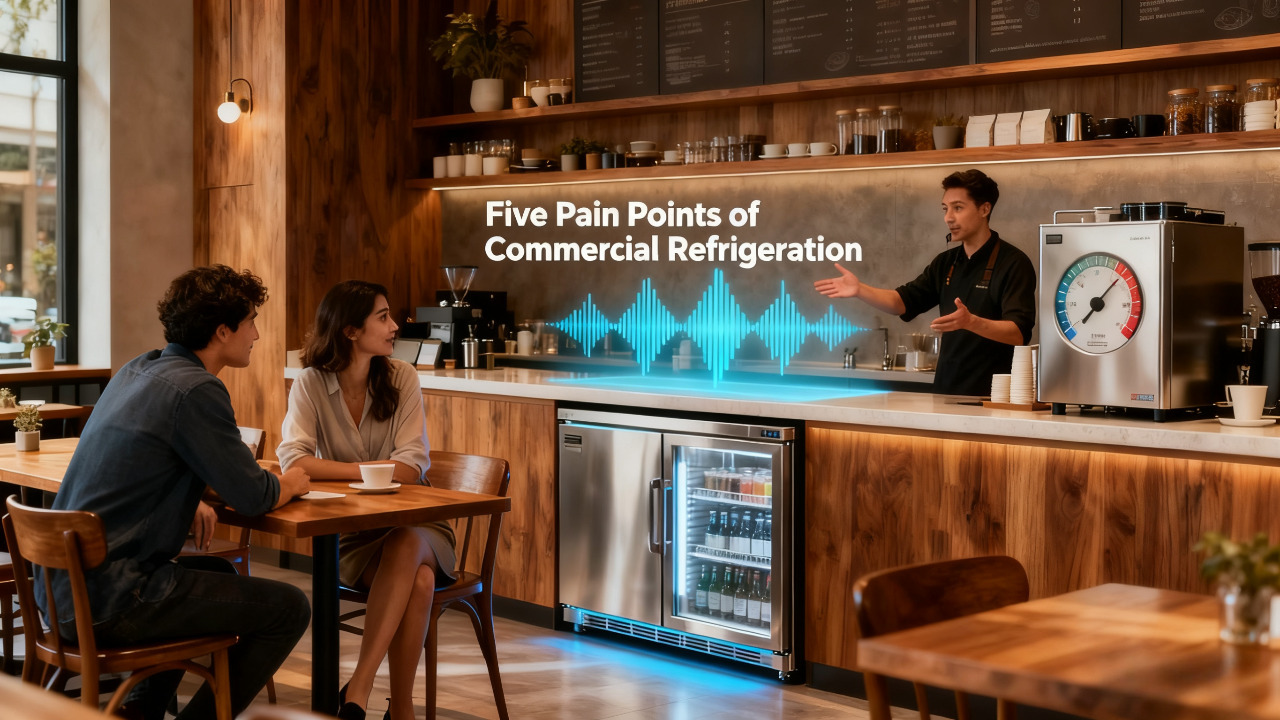
The most common commercial refrigeration problems in restaurants, bars and cafés trace back to six causes: restricted airflow around the condenser, overloading and long door-open times, skipped cleaning and scale, poor water quality, an unsuitable electrical supply, and equipment sized for an average day instead of the peak hour. They show up as warm prep pans, ice machines that fall behind, soft serve that will not set, slush that stays liquid, frost, leaks and new noises. Very few of these failures are sudden; most give weeks of warning before a busy Saturday exposes them.
This guide covers ice machines, soft serve machines, slush machines and refrigerated prep tables together, because they usually share the same kitchen heat, the same circuits and the same cleaning crew. It focuses on diagnosis, prevention and knowing when a problem belongs to a technician.
Common Commercial Refrigeration Problems by Symptom
| Symptom | Equipment | Likely root cause | Operator-safe first check | Escalate when |
|---|---|---|---|---|
| Pans or cabinet running warm | Prep table, reach-in | Blocked vents, overfilled pans, open lid, worn gasket, dirty condenser | Probe-thermometer reading vs. display; lid and doors closing; clearance around vents | Temperature stays high after loading and airflow are corrected |
| Ice production falls behind | Ice machine | Hot intake air, scale on the evaporator, restricted water flow, machine undersized for peak | Room temperature; air clearance; water valve open; filter change date | Machine runs but harvests slowly or not at all |
| Small, cloudy or hollow cubes | Ice machine | Low water pressure, clogged filter, mineral buildup | Filter date; supply valve fully open | Problem continues after a filter change and cleaning cycle |
| Soft serve too soft or runny | Soft serve machine | Mix below minimum, drawing faster than rated hourly output, hot air around the condenser | Mix level; operating mode; vent clearance; serving pace during rush | Cylinder does not freeze within the first-batch time |
| Slush will not freeze | Slush machine | Mix ratio outside supplier spec, room above rated range, lids off | Mix preparation; lids seated; room temperature | Compressor does not start or auger stalls |
| Frost or ice on evaporator | Prep table, reach-in | Doors propped open, damaged gasket, humid kitchen air | Door habits; gasket condition | Frost returns quickly after defrost |
| Water on the floor | All | Clogged drain line, bin drain, condensate overflow, full drip tray | Drip tray; visible drain kinks | Water near electrical components |
| New rattle, squeal or hum | All | Loose panel, fan obstruction, motor or compressor wear | Items touching the fan guard or cabinet | Noise comes from the compressor or fan motor |
| Breaker trips | All | Shared or undersized circuit, extension cord, voltage mismatch | What else runs on the circuit | Any repeat trip: stop using the unit |
Six Root Causes Behind Most Commercial Refrigeration Problems
1. Restricted ventilation and kitchen heat
Every refrigeration system moves heat from inside the cabinet, cylinder or evaporator to the room through its condenser. When the condenser is dusty, pushed against a wall, or pulling in hot air from a fryer line, the compressor runs longer to hold temperature, output drops and wear rises. The unit may still feel cold, which is why this problem hides until demand peaks.
Rated operating ranges make the limit concrete. Smartool’s BF500 and BF360 ice makers list an operating range of 5–38°C (41–100°F), while the RLC18-1 and RL18-3 slush machines list 10–32°C (50–90°F). A kitchen that passes those numbers on a July afternoon needs airflow changes before it needs a repair; the guide to protecting a commercial ice machine from summer heat covers placement and clearance in detail.
2. Overloading and door-open time
Rush periods change how equipment is used. Pans get heaped above the fill line, prep table lids stay open, reach-in shelves get packed against the evaporator fan, and soft serve gets drawn faster than its rated hourly output. The equipment specification was fine; the operating pattern outgrew it.
For prep tables and reach-ins this is also a food safety issue. USDA guidance is to keep cold food at or below 40°F, because bacteria multiply fastest between 40°F and 140°F. Check your local health code for the cold-holding limit inspectors apply, and verify it with a probe thermometer rather than the unit display.
3. Skipped cleaning and scale
Dust on condensers, grease on fan guards, scale on ice machine evaporators and residue in soft serve cylinders all build up slowly. By the time ice production slows or temperatures drift, efficiency has already been lost for weeks. A written schedule with sign-off works better than good intentions; the commercial ice machine cleaning guide gives a routine for ice equipment, and the soft serve machine troubleshooting guide covers texture and freezing faults linked to cleaning.
4. Water quality and supply
Ice machines are water-treatment equipment as much as refrigeration equipment. Hard water leaves scale that insulates the evaporator and slows harvest; low pressure or a clogged filter produces small or hollow cubes. Track filter change dates on the unit, and after any plumbing work confirm the supply valve is fully open before assuming the machine has failed.
5. Electrical supply
Frozen dessert and frozen drink equipment draws serious current. The RL18-3 slush machine lists a rated current of 14.5A at 120V, and the SW52REL-TF soft serve machine is rated at 3000W on 110V. Put two machines like these on a shared circuit, or run one through an extension cord, and nuisance trips, low voltage and hard compressor starts follow.
Match the nameplate voltage and current to a suitable dedicated circuit before installation, and have a licensed electrician confirm it. OSHA’s general electrical requirements state that listed or labeled equipment must be installed and used according to the instructions included in its listing or labeling, which in practice means following the manufacturer’s electrical specification.
6. Equipment sized for the average day
An ice machine that covers a normal Tuesday can still run out during a hot weekend, because rated output is measured in mild conditions and falls as room and water temperatures rise. Smartool publishes both figures for its split-type ice makers, which makes the gap easy to plan around:
| Model | Output at 21°C (70°F) air / 10°C (50°F) water | Output at 32°C (90°F) air / 21°C (70°F) water | Capacity lost in heat |
|---|---|---|---|
| BF500 | 500 lb ±5% per 24h | 375 lb ±5% per 24h | About 25% |
| BF360 | 360 lb ±5% per 24h | 275 lb ±5% per 24h | About 24% |
Size from your peak-day ice use under summer conditions, then add headroom. If an existing unit is both undersized and aging, replacement can also cut operating cost: ENERGY STAR reports that certified commercial refrigerators and freezers are on average 20 percent more energy efficient than standard models.
Pre-Peak-Season Refrigeration Checklist
Run this four to six weeks before your busiest season, while there is still time to book service and order consumables.
| Task | Who | What “done” looks like |
|---|---|---|
| Clean condensers, air filters and fan guards per the manual | Trained staff | No visible dust or grease; clearance restored around vents |
| Check displayed temperature against a calibrated probe thermometer | Kitchen manager | Readings logged for every cold-holding unit |
| Inspect door gaskets and lids | Trained staff | No tears or gaps; doors close on their own |
| Run the ice machine cleaning cycle and replace water filters | Trained staff | Filter date written on the unit |
| Clear drains and empty drip trays | Trained staff | Water drains freely; no standing water |
| Confirm circuits and plugs for every unit | Manager, electrician if in doubt | No extension cords; no shared circuits between high-draw units |
| Run a full-demand test day | Manager | Ice bin recovery, soft serve pace and prep temperatures recorded under rush load |
| Book a professional inspection of refrigeration and electrical systems | Qualified technician | Written findings for high-risk units |
| Confirm support contacts, warranty status and parts lead times | Owner or purchasing | One-page escalation sheet posted near the equipment |
Prep tables and reach-ins have their own failure patterns; Smartool’s refrigerator and prep table troubleshooting guide lists them by symptom.
When to Stop and Call a Technician
Operator checks end where tools, panels and refrigerant begin. Power the unit down and contact the manufacturer’s support team or a qualified technician when you notice:
- Hissing, oily residue at tubing joints, or ice forming on refrigerant lines
- A compressor that short-cycles, will not start, or runs constantly without cooling
- A burning smell, scorched plug or repeated breaker trips
- Error codes that return after a normal reset
- Water leaking near electrical components
Sealed-system work is regulated: EPA requires Section 608 technician certification for technicians who maintain, service, repair or dispose of equipment that could release ozone-depleting refrigerants. Unauthorized repairs can also void coverage, so check what your warranty requires first; the guide to commercial equipment warranty and service terms explains what to have in writing.
For slush equipment specifically, the slushy machine problems guide separates quick operator fixes from faults that need service.
Preventing Repeat Problems When You Buy
Many recurring refrigeration problems are decided at purchase: a unit sized without heat derating, a machine that needs a circuit the site does not have, or equipment with no alert when water or mix runs low. When you replace or add equipment, compare these details on the spec sheet, not just the headline capacity.
| Smartool model | Rated performance | Electrical | Built-in safeguards listed on the product page |
|---|---|---|---|
| BF500 ice maker | 500 lb/24h (375 lb at 32°C air, 21°C water) | 110–120V/60Hz, 1050W | Water-shortage and ice-full alerts, automatic cleaning, compressor overload protection |
| BF360 ice maker | 360 lb/24h (275 lb at 32°C air, 21°C water) | 110–120V/60Hz, 700W | Water-shortage and ice-full alerts, automatic cleaning, overcurrent protection |
| SW52REL-TF soft serve | 48–52 L/h; 8L hopper, 2.0L cylinder | 110V/60Hz, 3000W | Hopper precooling to ≤10°C, material level alarm, voltage alarm |
| RL18-3 slush machine | 3 × 16.5L cylinders; first batch 50–75 min | 120V/60Hz, 1500W, 14.5A | Motor speed, current overload and compressor overload protection |
| TSP47FC-2 prep table | 15 cu ft, 6 pans, 0–5°C range | R290, fan-cooled | Auto defrost, auto-closing doors |
Compare full model lineups on the commercial ice maker machines and commercial ice cream machines category pages.
Frozen drink and cold prep options sit on the commercial slushy machines and refrigerated prep table pages.
Smartool’s after-sales policy for North America includes a 3-year full-machine and compressor warranty, free video guidance and phone consultation, and on-site service in major cities by reservation. If peak-season problems are pushing you toward new equipment, request a quote with your peak-hour demand, room temperature and available circuits, and the team will match models to those conditions.
About Lumi Guo
View all posts by Lumi GuoLeave a Reply
Related posts
5 Real Costs of Choosing the Wrong Refrigeration Product Line for Distributors
Many distributors, when reflecting on their operations, often attribute the problems to market chang...
How does Smartool help distributors reduce after-sales disputes?
For distributors, after-sales disputes are often the most underestimated, but most resource-intensiv...
One thought on “Commercial Refrigeration Problems: Causes, Checks and Fixes”