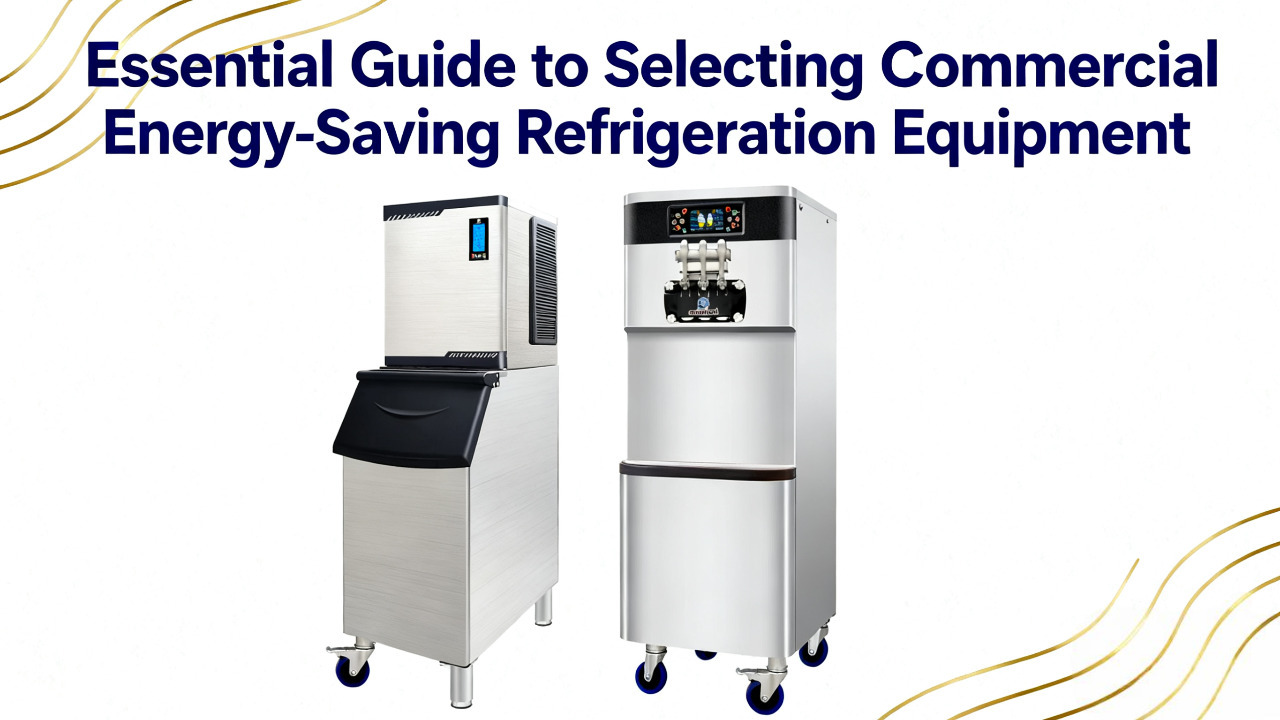
Compare commercial ice makers by kWh per 100 lb, not wattage. DOE and ENERGY STAR limits, air vs water cooling, and a worksheet to estimate annual power cost.
An energy efficient ice maker uses fewer kilowatt-hours per 100 pounds of ice than the federal limit for its equipment class, ideally at or below the ENERGY STAR limit. That metric, kWh/100 lb, is the number to compare between machines. Wattage on a spec sheet tells you what circuit to provide, not how efficient the machine is, and daily output changes sharply with room and water temperature. This guide explains the federal and ENERGY STAR limits, the energy-versus-water trade of air and water cooling, and how to estimate annual electricity cost before you buy.
How commercial ice maker efficiency is measured
Federal rules express efficiency as maximum energy use in kWh per 100 lb of ice and, for water-cooled machines, maximum condenser water use in gallons per 100 lb. Both limits are formulas based on harvest rate (H), the pounds of ice a machine makes in 24 hours under the DOE test procedure. Machines are grouped by process (batch cube machines or continuous flake and nugget machines), configuration (ice-making head, self-contained or remote condensing) and cooling method (air or water). The full tables are published in 10 CFR Part 431, Subpart H.
Two consequences follow for buyers:
Compare within a class: a self-contained undercounter machine has a looser limit than an ice-making head with the same output, so a kWh/100 lb figure only ranks machines of the same type.
Check the conditions: output quoted at about 70°F air and 50°F water will always look better than output at about 90°F air and 70°F water, so ask which conditions sit behind every capacity and energy figure.
DOE and ENERGY STAR limits for an energy efficient ice maker
Batch-type (cube) ice makers manufactured on or after January 28, 2018 must stay within the DOE maximums below. The ENERGY STAR column shows the stricter voluntary limit for the same air-cooled classes. H is the harvest rate in lb/24 h.
Air-cooled batch equipment type
Harvest rate (lb/24 h)
DOE maximum (kWh/100 lb)
ENERGY STAR maximum (kWh/100 lb)
Ice-making head
Under 300
10 − 0.01233H
9.20 − 0.01134H
Ice-making head
300 to under 800
7.05 − 0.0025H
6.49 − 0.0023H
Ice-making head
800 to under 1,500
5.55 − 0.00063H
5.11 − 0.00058H
Ice-making head
1,500 to 4,000
4.61
4.24
Remote condensing (not remote compressor)
Under 988
7.97 − 0.00342H
7.17 − 0.00308H
Remote condensing (not remote compressor)
988 to 4,000
4.59
4.13
Self-contained
Under 110
14.79 − 0.0469H
12.57 − 0.0399H
Self-contained
110 to under 200
12.42 − 0.02533H
10.56 − 0.0215H
Self-contained
200 to 4,000
7.35
6.25
Worked example: an air-cooled ice-making head rated at 500 lb/24 h may use no more than 7.05 − (0.0025 × 500) = 5.80 kWh/100 lb under DOE rules. To qualify under the ENERGY STAR Version 3.0 commercial ice maker criteria, the same machine must reach 6.49 − (0.0023 × 500) = 5.34 kWh/100 lb and use no more than 20 gallons of potable water per 100 lb of ice.
Where the federal rulemaking stands
The DOE automatic commercial ice makers rulemaking page lists a 2023 proposal for amended energy conservation standards and a later proposal on water use. In a May 16, 2025 Federal Register proposal, DOE moved to rescind the amended condenser water-use limits for water-cooled machines and return them to the statutory formulas. The energy limits in the table above are the ones in the current eCFR. Check the DOE page before a large purchase, because a final rule can set new limits for equipment built after its compliance date.
What ENERGY STAR certification adds
ENERGY STAR is voluntary and covers air-cooled batch and continuous machines in ice-making head, self-contained and remote condensing designs. According to ENERGY STAR’s commercial ice maker overview, certified batch-type models are about 10 percent more energy efficient and 20 percent more water efficient than standard models, saving about 700 kWh and $150 a year. Certified continuous-type models are about 16 percent more energy efficient, saving about 1,350 kWh and $170 a year.
To confirm a particular model, search the ENERGY STAR certified commercial ice machine finder by brand and model number. A model that does not appear there is not ENERGY STAR certified, even if it meets DOE limits.
Air-cooled vs water-cooled: trading energy for water
A water-cooled condenser rejects heat into water instead of kitchen air, which can reduce energy use and keep heat out of a crowded back room. The price is water. For a 500 lb/24 h water-cooled ice-making head, the federal condenser water limit is 200 − (0.022 × 500) = 189 gallons per 100 lb of ice. A machine at that limit making 500 lb a day could send roughly 945 gallons a day through its condenser, before counting the potable water that becomes ice.
Every ice maker produces less as room and water temperatures rise, because the condenser has less temperature difference to work with and each freeze cycle takes longer. Smartool publishes output at both conditions for its split-type ice makers, which makes the effect easy to see:
Model
Output at 21°C (70°F) air / 10°C (50°F) water
Output at 32°C (90°F) air / 21°C (70°F) water
Drop
BF500
500 lb/24 h ±5%
375 lb/24 h ±5%
25%
BF360
360 lb/24 h ±5%
275 lb/24 h ±5%
About 24%
When a compressor keeps drawing power while making a quarter less ice, energy per pound goes up. Placement is the cheapest fix. The FEMP air-cooled ice machine purchasing guidance calls for sufficient clearance around air-cooled units and notes that, for ice-making heads, a smaller bin is more energy efficient. Our guide to protecting a commercial ice machine from summer heat covers ventilation and placement checks.
Sizing works the same way. An oversized machine fills a bin with ice that slowly melts, and an undersized one runs flat out every hot afternoon. Start from peak-day demand, as shown in our bar ice machine sizing guide, and size against hot-weather output rather than the headline number.
Annual electricity cost worksheet for commercial ice machines
Use rated kWh/100 lb whenever you have it, because it ties cost to the ice you actually use. Use nameplate power only as a ceiling for circuit planning and budgeting.
Method A, rated efficiency: annual kWh = (average lb of ice per day ÷ 100) × kWh/100 lb × operating days. Annual cost = annual kWh × electricity price.
Method B, nameplate ceiling: annual kWh = rated input in kW × 24 hours × operating days. Actual use is lower, because the machine stops making ice when the bin is full.
For price, use the blended rate from your utility bill. As a national reference, the EIA Electricity Monthly Update put the average commercial-sector price at 14.19 cents per kWh in June 2026. Both tables below use that rate.
Method A example
Inputs
Annual kWh
Annual cost at $0.1419/kWh
Air-cooled ice-making head at the DOE limit
500 lb/day × 5.80 kWh/100 lb × 365 days
10,585
$1,502
Air-cooled ice-making head at the ENERGY STAR limit
500 lb/day × 5.34 kWh/100 lb × 365 days
9,746
$1,383
Your machine
Your average lb/day × rated kWh/100 lb × days open
—
—
In this example the ENERGY STAR-level machine uses about 840 kWh less, roughly $119 a year, which is the same order of magnitude as ENERGY STAR’s own batch-type estimate. Real ice use drives the result: a machine averaging 300 lb a day instead of 500 cuts every Method A figure by 40 percent.
Method B ceiling
Inputs
Annual kWh ceiling
Annual cost ceiling at $0.1419/kWh
Smartool BF500
1,050 W rated power × 24 h × 365 days
9,198
$1,305
Smartool BF360
700 W rated power × 24 h × 365 days
6,132
$870
Method B does not measure efficiency and should not be compared against the Method A rows. It answers a narrower question: the most a machine could add to the bill if it never stopped. That is useful for budgeting a new location before you know real ice demand.
Operating habits that keep kWh per pound low
Keep condenser airflow clear: clean the air filter and condenser surface on the interval in the manual, and never stack boxes against the vents.
Descale and sanitize on schedule: scale on the evaporator slows freezing and harvest; follow a routine like the one in our commercial ice machine cleaning guide.
Follow the maintenance intervals: the ice machine maintenance guide lists the recurring tasks that keep production steady.
Treat hard water: filtration matched to local water quality slows scale buildup between cleanings.
Match production to demand: use a production timer so the machine fills the bin before the rush instead of running all night; the BF500 and BF360 both include a 48-hour timer plus ice-full and water shortage alerts.
Keep heat sources away: fryers, ovens and dish machines next to an air-cooled unit raise its operating temperature.
Call a technician for system work: if output stays low or the machine runs constantly after cleaning, contact Smartool support or a qualified refrigeration technician rather than adjusting refrigerant, wiring or controls.
Smartool ice makers for energy-conscious operations
To frame payback for a new installation, run your sales and operating assumptions through the Smartool ROI calculator, and ask for rated kWh/100 lb and DOE certification data for the model you shortlist.
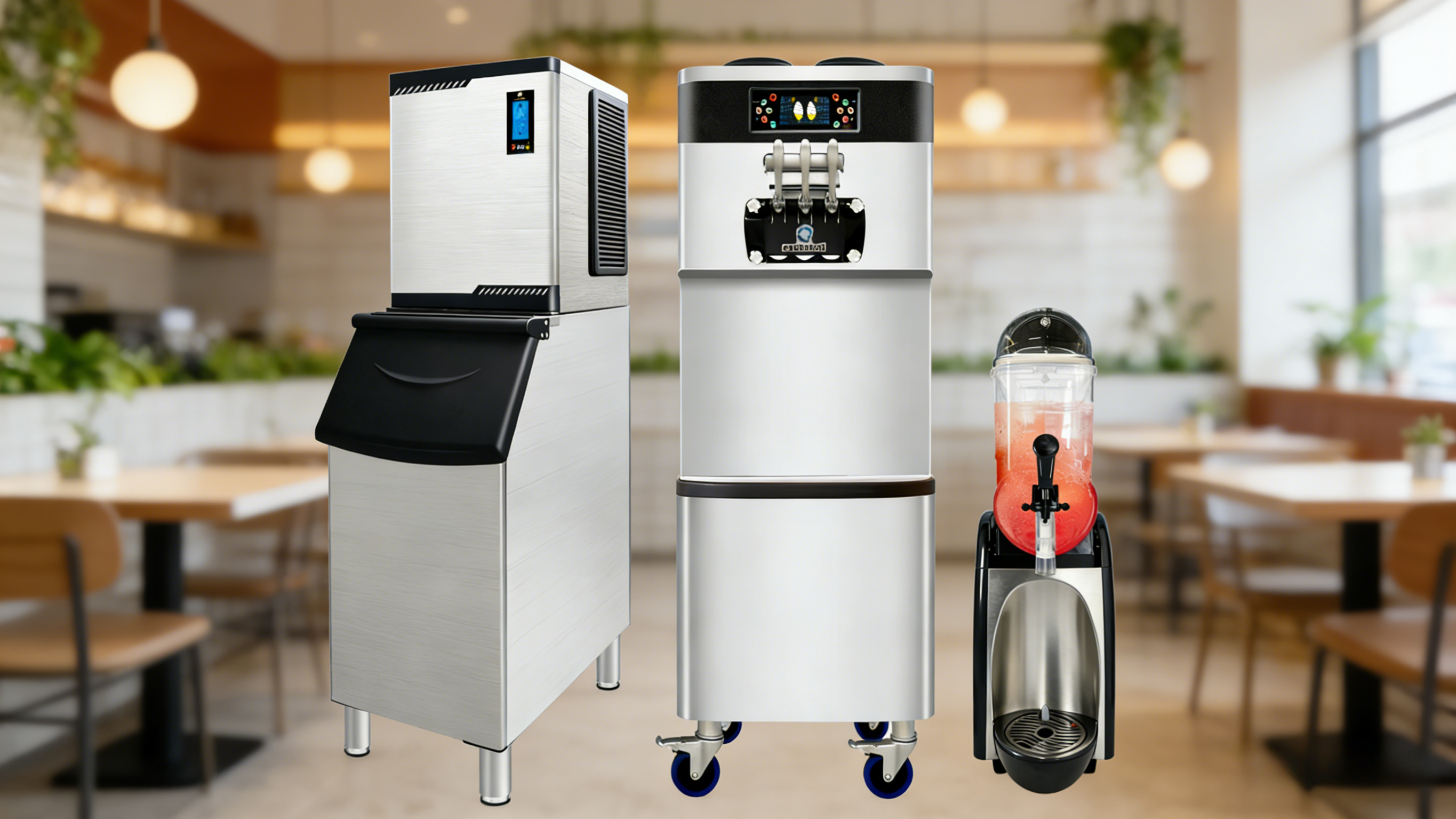
Ice makers are rarely the only refrigeration load. Soft serve machines and refrigerated prep tables have their own efficiency factors: mix temperature and freezing cylinder recovery for soft serve, door openings and pan loading for prep tables. The SW52REL-TF soft serve machine, for example, runs two independent refrigeration systems on R290 refrigerant. The safety, sanitation and energy documents to request for each type are covered in our commercial kitchen equipment certifications guide.
Energy efficient ice maker questions from buyers
Is a lower-wattage ice maker more efficient?
Not necessarily. A smaller machine draws fewer watts because it makes less ice. Efficiency is energy per 100 lb of ice, compared within the same equipment class and test conditions.
Does a water-cooled ice machine save money?
It depends on water and sewer rates. Water cooling can cut electricity use, but a single-pass condenser can use far more water than the machine turns into ice. Where no cooling tower loop is available, federal guidance points to ENERGY STAR air-cooled models.
How do I check whether a model meets DOE standards?
Ask for the DOE certification data. Manufacturers and importers submit certification reports to DOE’s Compliance Certification Database; request the basic model number and rated kWh/100 lb, then compare it with the limit for that equipment class.
Comparing ice makers for a new or growing location? Request a Smartool ice machine quote with your peak-day ice demand, room conditions and available circuits.
Factory-direct from Smartool
Planning a commercial equipment purchase?
Share your site conditions, daily output and budget. Our team will match a model, send the spec sheets and quote factory-direct pricing.
Jason is a senior engineer at Smartool. He works on the commercial ice machines, soft serve and slushy machines, and refrigerated prep tables Smartool builds for restaurants, bars, hotels and dessert shops. His guides look at equipment from the engineering side: how to size a machine for a site, what it needs for power, water and airflow, and how to keep it running through busy service. He also helps buyers match the right model to their kitchen before they request a quote.
Jason is a senior engineer at Smartool. He works on the commercial ice machines, soft serve and slushy machines, and refrigerated prep tables Smartool builds for restaurants, bars, hotels and dessert shops. His guides look at equipment from the engineering side: how to size a machine for a site, what it needs for power, water and airflow, and how to keep it running through busy service. He also helps buyers match the right model to their kitchen before they request a quote.
.elementor-76528 .elementor-element.elementor-element-5c7a0d0{--display:flex;--flex-direction:column;--container-widget-width:100%;--container-widget-height:initial;--container-widget-flex-grow:0;--container-widget-align-self:initial;--flex-wrap-mobile:wrap;}.elementor-76528 .elementor-element.elementor-element-5c7a0d1 .elementor-toc__header-title{text-align:start;}.elementor-76528 .elementor-element.elementor-element-5c7a0d1 .elementor-toc__header{flex-direction:row;}.elementor-76528 .elementor-element.elementor-element-5c7a0d1{--item-text-hover-decoration:underline;}
On this page
Need pricing for your project?
Get a factory-direct quote on commercial ice makers, soft serve and slushy machines, and refrigerated prep tables.
✓ Model matching and spec sheets for your site ✓ US office in City of Industry, CA ✓ Talk to an expert: +1 (872) 221-0051