




Blog
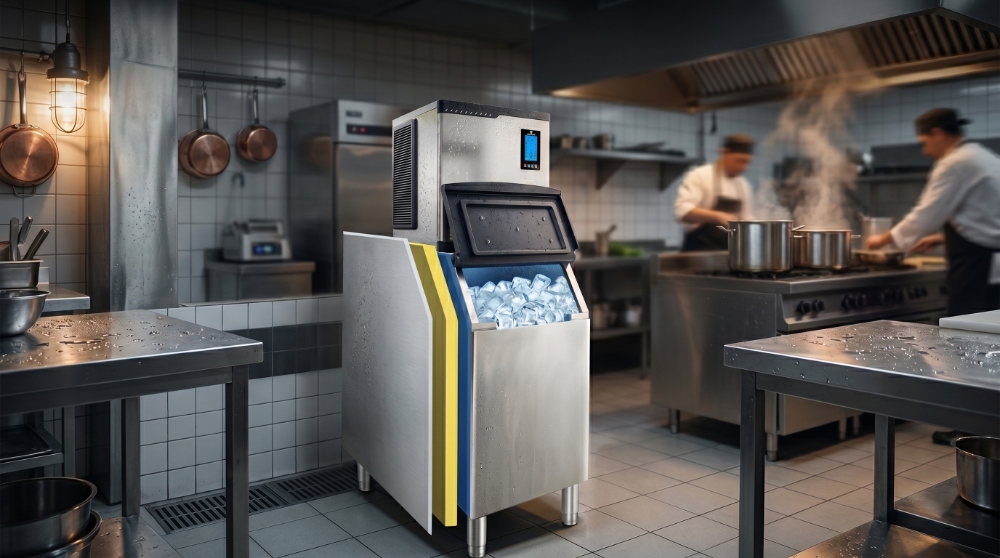
Why ice output drops in summer heat, how to read 90°F/70°F ratings, operator-safe checks, when to call a technician, and a pre-summer checklist to use.
An ice machine not making enough ice in hot weather is usually running into physics, not breaking down. Hotter room air slows the condenser, warmer supply water carries more heat into every batch, and ice melts faster once it drops into the bin. Published two-condition ratings, such as those for Smartool’s split-type heads, show output falling by roughly a quarter between 70°F and 90°F rooms. The fix is part site work, part routine checks, and part planning capacity for your hottest week. A shortfall far beyond the hot-weather rating is the point where a technician needs to look at it.
Ice Machine Not Making Enough Ice in Hot Weather: The Four Causes
Output in summer falls for four connected reasons. Knowing which one dominates at your site tells you whether to move the machine, clean it, change how staff use it, or add capacity.
Hot air slows condenser heat rejection
An ice machine moves heat from water into refrigerant and then releases it at the condenser. When the air around the condenser is hotter, less heat leaves per minute, condensing pressure rises and the compressor works harder for each pound of ice. Blocked grilles, clutter stacked against the cabinet, and warm discharge air drifting back into the intake all make the air hotter than the room thermometer suggests.
Warmer supply water adds heat to every pound
Before water can freeze, it has to be cooled to 32°F. Water arriving at 50°F needs about 18 BTU per pound removed before freezing starts. At 70°F it needs about 38 BTU. Add the 144 BTU per pound it takes to freeze water, and each pound of ice made from 70°F water carries roughly 12 percent more heat than ice made from 50°F water. Supply lines running through hot ceilings or next to hot water pipes push that number higher.
Freeze and harvest cycles stretch out
With more heat to remove and a condenser that sheds it more slowly, each freeze cycle takes longer. Fewer cycles fit into 24 hours, so daily output drops even when every component is working correctly.
Ice melts faster in the bin
A warm room also attacks ice that is already made. Bin doors left open, scoops left inside, and frequent small withdrawals during a rush let warm air in and turn stored ice into meltwater. The machine may be producing to its rating while the bin still looks short.
Read the Rating Before You Judge the Output
Capacity figures mean little without their test conditions. DOE’s 2019 test procedure notice for automatic commercial ice makers explains that AHRI 810 rates machines at 90°F ambient air and 70°F supply water. It also notes that many machines actually sit in conditioned spaces closer to 70°F air and 50°F water. The federal ice maker test method in 10 CFR 431.134 incorporates AHRI 810 and ASHRAE 29 for measuring harvest rate, energy and water use.
Some manufacturers publish the cooler 70°F/50°F figure as the headline number. Smartool publishes both conditions for its split-type heads, which makes the summer loss easy to see:
| Model | Output at 21°C (70°F) air / 10°C (50°F) water | Output at 32°C (90°F) air / 21°C (70°F) water | Daily loss | Average per hour, cool vs hot |
|---|---|---|---|---|
| BF500 | 500 lb ±5% per 24 h | 375 lb ±5% per 24 h | 125 lb (−25%) | 20.8 lb vs 15.6 lb |
| BF360 | 360 lb ±5% per 24 h | 275 lb ±5% per 24 h | 85 lb (−23.6%) | 15.0 lb vs 11.5 lb |
Both air and water temperature change between the two ratings, so the loss reflects the combined effect. To check your own machine, collect and weigh the ice from a timed period, such as four hours, on a hot day and scale it to 24 hours. A result close to the hot-condition rating means the machine is doing its job and the answer is capacity planning. A result well below it points to the symptoms in the next section.
Symptom, Likely Cause, What to Do
Use this table to match what staff see with the most likely heat-related cause. The last column marks where operator checks end.
| What you see | Likely cause | Operator action | Escalate when |
|---|---|---|---|
| Bin runs out mid-afternoon but refills overnight | Peak demand above hot-condition output, bin melt | Keep the bin door closed, bank ice before service, run the capacity worksheet below | Measured output is well below the hot rating |
| Output down all day, air behind the unit feels hot | Blocked clearance or hot-air recirculation | Clear the space around the cabinet, move heat sources or the machine, improve room ventilation | No recovery after the room and clearance are corrected |
| Dust or grease visible on the condenser grille | Dirty condenser | Power off and brush the condenser on the manufacturer’s schedule | Overheat alerts or shutdowns continue after cleaning |
| Thin or small cubes, water shortage alert | Low water flow from a clogged filter or inlet screen, or a partly closed supply valve | Open the supply valve fully, check the inlet screen, change the filter on schedule | Alert persists with good supply pressure |
| Machine stops and restarts on its own | Overheat or overload protection tripping | Power down, restore airflow, check the room is inside the rated operating range | Any repeat trip |
| Ice sticks, frost on lines, hissing, oily residue, burning smell, breaker trips | Refrigerant, sensor, valve, electrical or compressor fault | Stop using the machine and do not open panels | Immediately |
Placement and Ventilation Fixes That Recover Output
Site problems cause most hot-weather shortfalls, and they are the cheapest to fix. Smartool’s ice machine maintenance guide recommends more than 30 cm (about 12 in) of clearance at the back and sides, with the machine kept away from heat sources.
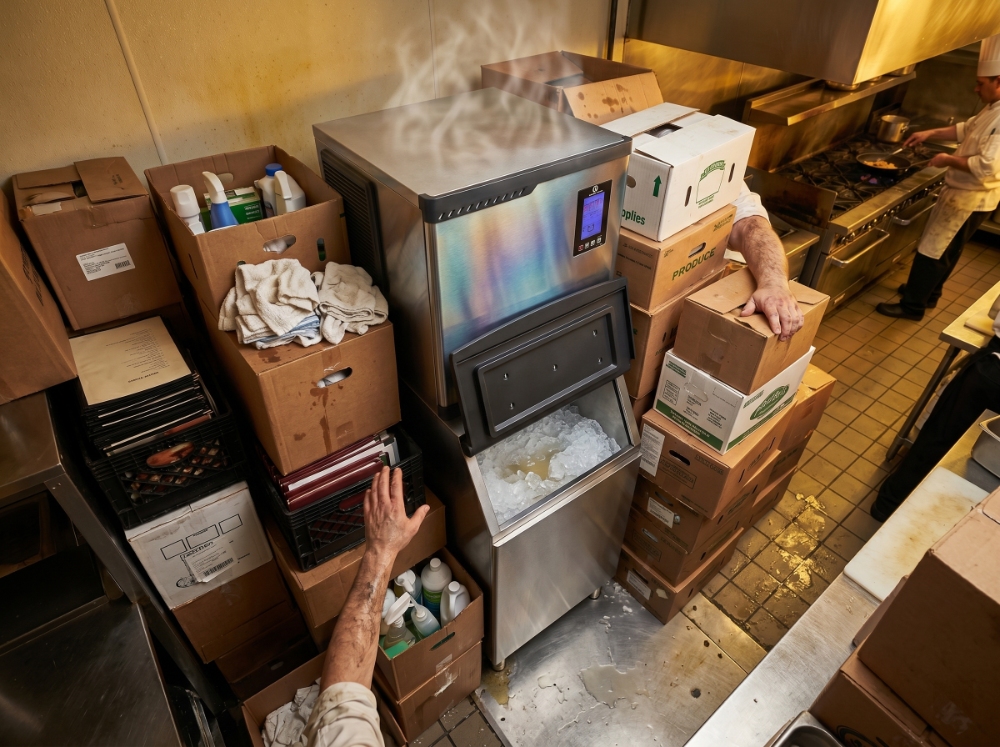
- Clear the envelope. Cup sleeves, cleaning supplies and produce boxes stacked against the cabinet trap discharge air. Mark the clearance zone on the floor so it stays empty during deliveries.
- Break hot-air loops. Alcoves, closets and spaces under low shelving let the machine breathe its own exhaust. Open the space or move the unit.
- Separate from cooking heat. Fryers, ovens, dish machine vents and sunny windows can run the air at the machine far above the room average. Measure temperature at the condenser intake, not across the room.
- Stay inside the rated range. Every machine lists an operating ambient range. If a storeroom or bar back runs above it in July, the fix is a cooler location or conditioned air, not more cleaning.
- Protect the supply water. Where you can, have a plumber route the cold water line away from hot pipes and uninsulated ceiling spaces.
When no indoor location stays cool enough, the answer is a design change rather than an operator fix. DOE’s FEMP guidance on air-cooled ice machines notes that remote-condensing units discharge ice-making heat outside the conditioned space. Our air-cooled vs water-cooled ice machine comparison walks through remote and water-cooled options and their costs.
Operator-Safe Checks Before You Call for Service
These checks need no tools beyond a brush, a thermometer and the manual. Smartool’s ice maker troubleshooting guide separates user checks such as water supply, filter screen and room temperature from engineer checks such as the inlet valve, refrigerant leaks and sensors. Keep that line in place.
- Clearance and room temperature: check that the zone around the cabinet is empty and record the air temperature at the condenser intake during a busy service.
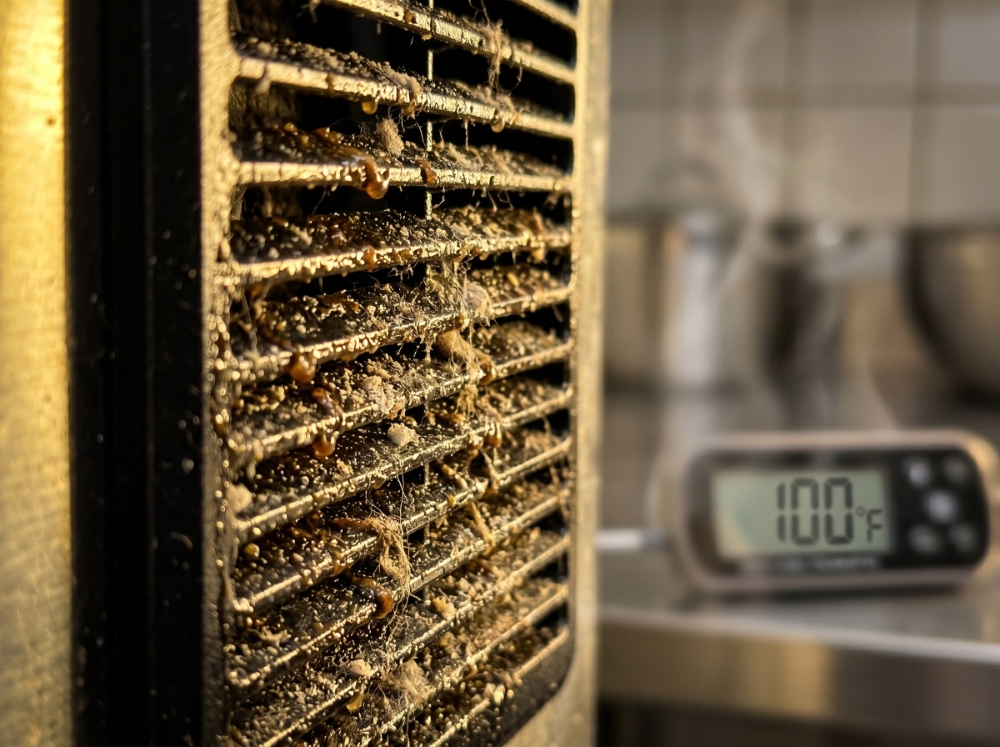
- Condenser dust: with the power disconnected, brush dust off the condenser fins on the schedule in your manual. Smartool’s guidance is every two weeks in dusty kitchens and monthly elsewhere.
- Water supply and filter: make sure the supply valve is fully open, the inlet screen is clear and the filter cartridge is within its rated life.
- Bin door and gasket: keep the door closed between withdrawals and report a gasket that no longer seals.
- Scoop discipline: use one scoop, store it outside the ice, and pull larger batches less often instead of opening the bin for every drink.
- Cleaning program: scale and slime slow freezing. Follow the manual and our commercial ice machine cleaning guide for cleaning and sanitizing intervals.
If a symptom does not match the table above, the Smartool fault diagnosis system lists 21 ice maker problems with suggested solutions. Use it to describe the issue accurately, not as a guide to opening the machine.
Stop and Call a Qualified Technician or Smartool Support
Some hot-weather symptoms are not operator territory. Power the machine down and call for service if you see any of the following:
- Refrigerant signs: hissing, oily residue at fittings, unusual frost patterns, or ice that stops forming evenly across the evaporator.
- Electrical signs: tripped breakers, a burning smell, warm or damaged cords and plugs.
- Compressor signs: repeated overload trips, loud knocking or buzzing, or a compressor that runs without making ice.
- Anything that needs panels removed: valves, pumps, sensors and wiring inside the cabinet.
Refrigerant work is regulated. Under EPA’s Section 608 technician certification rules, technicians who maintain, service, repair or dispose of equipment that could release ozone-depleting refrigerants must be certified.
For Smartool machines, the Smartool after-sales policy provides free video guidance and phone consultation, on-site service in major cities by advance reservation, and video diagnosis with mail-in parts for remote areas. Have the model, room and water temperatures, your timed output measurement, any alerts on the display, and a short video ready. Repairs with non-original parts fall outside warranty coverage under that policy.
Pre-Summer Checklist for the May to September Peak
Demand for ice climbs through May and stays high into September. Work through this list before the first hot week and keep it on the wall next to the machine.
| When | Check | Who |
|---|---|---|
| April | On a warm day, record air temperature at the condenser intake and cold water temperature at the nearest tap | Manager |
| April | Run the capacity worksheet with last summer’s peak-day demand and the hot-condition rating | Manager |
| Late April | Clear and mark the clearance zone, relocate stored boxes and supplies | Operator |
| Late April | Brush the condenser with power disconnected, change the water filter, clean the inlet screen | Trained staff |
| Late April | Complete a full cleaning and sanitizing cycle per the manual | Trained staff |
| Before May | Book a technician inspection covering refrigerant, electrical and compressor checks | Qualified technician |
| Weekly, June to August | Look at the condenser grille, bin door gasket and alert history; weigh one timed harvest | Operator |
| Heat wave days | Bank ice before service, limit bin openings, check that the room stays inside the operating range | Shift lead |
| September | Review output logs and service records, then decide on added capacity before next season | Manager |
Plan Capacity for Your Hottest Week
If your timed harvest matches the hot rating and you still run short, you need more ice, not more maintenance. Work from three numbers:
- D: peak-day ice demand in pounds, from last summer’s records or, for drink-driven operations, the method in our bar ice machine sizing guide.
- H: output at 90°F air and 70°F water, or at your own measured conditions.
- B: usable ice already banked in storage at opening, after melt.
Shortfall = D − H − B. If the result is above zero, add a machine, move up a size, or cut the heat at the site. The table shows hot-condition output for single and paired Smartool heads, before any bin carryover.
| Setup | Hot-condition output per 24 h | Average per hour |
|---|---|---|
| One BF360 | 275 lb | 11.5 lb |
| One BF500 | 375 lb | 15.6 lb |
| Two BF360 | 550 lb | 22.9 lb |
| BF500 + BF360 | 650 lb | 27.1 lb |
| Two BF500 | 750 lb | 31.3 lb |
Each figure carries the ±5% tolerance of the published ratings. Two machines also add redundancy, which matters when a single failure in August would leave the bar without ice.
Smartool BF500 and BF360 in Hot Kitchens
Both heads in the Smartool commercial ice maker lineup are specified for the conditions summer brings. The Smartool BF500 500 lb split-type ice maker is rated at 375 lb per 24 hours at 32°C (90°F) air with 21°C (70°F) water. It draws a rated 1,050 W on AC 110–120V/60 Hz.
The BF360 360 lb split-head ice maker delivers 275 lb at the same hot condition on a 700 W rating. Both models share several features that matter in summer:
- Operating ambient range: 5–38°C (41–100°F), with climate classes SN, N and ST.
- Protection: overheat, compressor overload and overcurrent protection.
- Alerts: water shortage and ice-full alerts on an LCD display.
- Controls: automatic cleaning function, 12-level adjustable ice thickness and a 48-hour timer.
- Support: three-year machine and compressor warranty in North America, one year of parts and labor, and free video or phone guidance when output drops.
Compare them with the rest of the range on the commercial ice maker machines page.
Size for July, Not for April
A machine that keeps up in spring can fall a quarter short in a July heat wave, and nobody finds out until the bar runs dry. Measure your room and water temperatures, run the shortfall math, and request a quote for a commercial ice machine with those conditions so the recommended setup is sized for your hottest week.
Factory-direct from Smartool
Planning a commercial equipment purchase?
Share your site conditions, daily output and budget. Our team will match a model, send the spec sheets and quote factory-direct pricing.

Written by
Senior Engineer, Smartool
Jason is a senior engineer at Smartool. He works on the commercial ice machines, soft serve and slushy machines, and refrigerated prep tables Smartool builds for restaurants, bars, hotels and dessert shops. His guides look at equipment from the engineering side: how to size a machine for a site, what it needs for power, water and airflow, and how to keep it running through busy service. He also helps buyers match the right model to their kitchen before they request a quote.
.elementor-76528 .elementor-element.elementor-element-5c7a0d0{--display:flex;--flex-direction:column;--container-widget-width:100%;--container-widget-height:initial;--container-widget-flex-grow:0;--container-widget-align-self:initial;--flex-wrap-mobile:wrap;}.elementor-76528 .elementor-element.elementor-element-5c7a0d1 .elementor-toc__header-title{text-align:start;}.elementor-76528 .elementor-element.elementor-element-5c7a0d1 .elementor-toc__header{flex-direction:row;}.elementor-76528 .elementor-element.elementor-element-5c7a0d1{--item-text-hover-decoration:underline;}
On this page
Need pricing for your project?
Get a factory-direct quote on commercial ice makers, soft serve and slushy machines, and refrigerated prep tables.
✓ Model matching and spec sheets for your site
✓ US office in City of Industry, CA
✓ Talk to an expert: +1 (872) 221-0051
Browse by topic
Ice Machine Guides
Soft Serve & Ice Cream
Slushy & Frozen Drinks
Buying & Sourcing
Compliance & Maintenance
Related posts

Ice Machine Freezing Up? Causes, Safe Checks and Fixes
Ice machine freezing up? Learn the six common causes, what staff can safely check, what needs a technician, and how to prevent repeat freeze-ups.

How to Use a Margarita Machine or Slush Machine
How to use a margarita machine or slush machine: setup, mixing and filling, freeze time, consistency, dispensing, refills and the closing routine.
8 thoughts on “Ice Machine Not Making Enough Ice in Hot Weather? Fixes”
Comments are closed.