




Blog
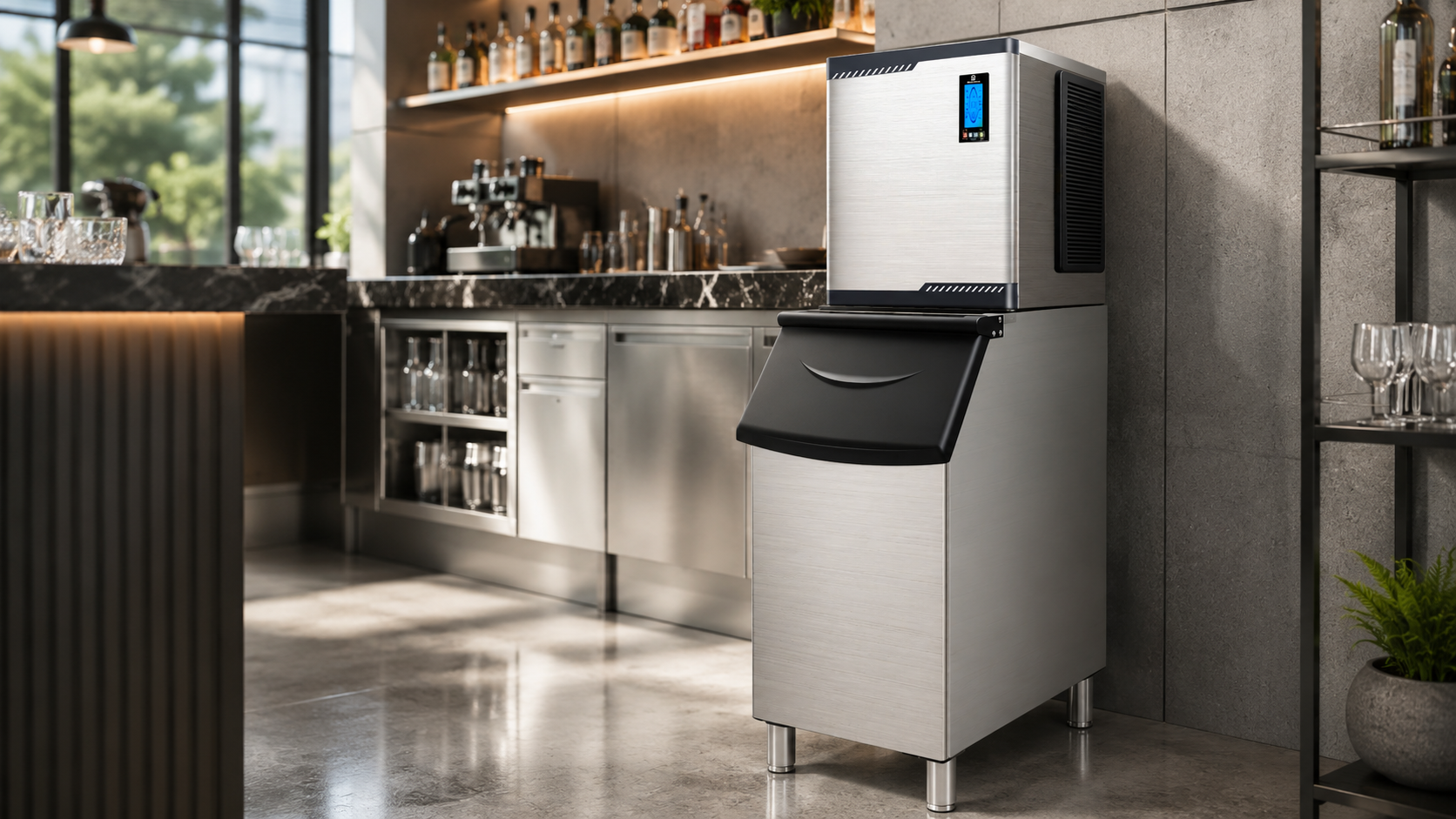
A commercial ice maker is a heavy-duty piece of equipment that runs 24/7. It is the heartbeat of your beverage service and food preservation. Unlike a standard kitchen appliance, this machine directly impacts your daily overhead and operational flow. If the machine fails, you end up buying bagged ice at a premium, which kills your profit margins. To find the best commercial ice machine for your specific needs, you need to look past the marketing fluff. This guide provides seven specific questions that reveal how a machine will actually perform in your business.
Question 1: What Is the Real Ice Output Under Your Actual Operating Conditions?
Most suppliers quote the “maximum capacity” of a machine. This number is usually based on a cool room (70°F) and very cold intake water (50°F). In a real kitchen, temperatures are often much higher.
When the air around the machine hits 90°F and the water coming out of the pipes is 70°F, ice production can drop by 20% to 30%. If you buy a machine rated for 500 lbs but only get 350 lbs during a summer heatwave, your business will suffer. Always ask for the performance data based on AHRI Standard 810 (90°F air / 70°F water). This is the industry benchmark for real-world performance.
You should also ask about peak demand capacity. How much ice can the unit produce in your busiest four-hour window? If the supplier only talks about the 24-hour maximum without mentioning ambient temperatures, consider it a red flag. You need a machine that keeps up when the kitchen gets hot.
Question 2: Is This Machine ENERGY STAR Certified?
Energy costs are a permanent part of your monthly expenses. Choosing an energy-efficient commercial ice maker is one of the easiest ways to keep those costs under control over the next decade.
ENERGY STAR certified commercial ice makers (primarily air-cooled models) are generally more energy- and water-efficient than standard units, though actual savings vary by machine type, usage, and operating conditions. These machines undergo independent third-party testing to prove their efficiency. To verify a supplier’s claim, ask for the certificate number and check it against the official database.
Be careful with the details: currently, ENERGY STAR only certifies air-cooled machines. If a supplier tells you a water-cooled model is ENERGY STAR certified, they are giving you incorrect information. While certified machines might cost more upfront, the utility savings usually cover that extra cost within two to three years.
Question 3: What Type of Cooling System Does the Machine Use?
The cooling system determines how much water you use and how much heat the machine pumps back into your building. There are three main types: air-cooled, water-cooled, and remote condenser.
- Air-Cooled: These are the most common. They use fans to cool the machinery. They are easy to install and use less water, making them the standard choice for most restaurants.
- Water-Cooled: These units use a constant stream of water to cool the system. This can use ten times more water than an air-cooled model. Unless you are in a very high-heat environment with no ventilation, these are usually a poor financial choice due to high water bills.
- Remote Condenser: The part that makes heat is installed outside or on the roof. This keeps your kitchen cool and quiet, but the installation is more expensive and requires a professional technician.
Ask the supplier to justify their recommendation based on your specific floor plan and ventilation. If you are sourcing directly to save on startup capital, consider evaluating a commercial ice maker factory direct model that fits your layout requirements.
Question 4: What Refrigerant Does It Use, and What Is Its GWP Rating?
Refrigerants are the gases used to create the cold temperatures needed for ice. Global Warming Potential (GWP) is a scale that measures how much environmental damage these gases cause if they leak.
Many older refrigerants like R-404A have high GWP ratings and are being phased out globally. If you buy a machine using old gas, you might find it impossible or very expensive to get it repaired in a few years. Look for modern, low-GWP alternatives like R290 (propane) or R744 (CO2). These have a GWP of 3 or less and are future-proof.
If a supplier doesn’t know the GWP rating or says it doesn’t matter, they are not keeping up with industry regulations. Choosing the right gas now ensures your machine stays compliant with environmental laws for its entire lifespan.
Question 5: How Much Electricity and Water Will This Machine Consume Monthly?
Don’t look at the total wattage of the motor; look at the kWh per 100 lbs of ice. This tells you exactly how much power it takes to actually make the product you need.
Ask the supplier for a monthly cost estimate based on your local utility rates. A good supplier should be able to show you a simple calculation:
- Your daily ice needs.
- The power used per 100 lbs.
- The cost of electricity.
Water consumption is also a double-sided cost. You pay for the water coming in and the sewage going out. Make sure you know the difference between “potable water” (water that becomes ice) and “condenser water” (water used for cooling). High water consumption can quietly eat your profits every single month. Comparing these metrics across two or three different commercial ice makers will help you see which one is truly the most affordable over time.
Question 6: What Are the Maintenance Requirements, Warranty Terms, and Service Support?
A machine that is hard to clean will eventually break down. Ice makers are prone to lime-scale buildup and mold, which can reduce efficiency by 20% if left unchecked.
- Ask if the machine has a self-cleaning or auto-sanitizing cycle. This saves your staff hours of manual scrubbing.
- Regarding the warranty, a common warranty structure for commercial ice machines includes around 3 years of parts and labor coverage for the full unit, along with extended coverage of up to 5 years for major components such as the compressor and evaporator. However, coverage details vary by brand and may include parts-only limitations or restricted labor terms.
- The brand of the compressor inside the machine is a major quality indicator. Ask if they use components from reputable, global manufacturers.
- Finally, check their service network. If the machine breaks on a Saturday, how long will it take for a technician to arrive? A great machine is useless if the nearest repair person is three states away. Avoid any supplier who only offers verbal promises instead of a written warranty and a clear list of local service providers.
Question 7: Can You Provide a Live Demo, Real Customer References, or a Trial Period?
Before you spend thousands of dollars, you should see the machine in action. This is the final check to ensure the supplier is being honest about the unit’s performance.
A live demo allows you to hear the noise level and see the ice quality. If you can, bring a watt meter to check the power draw.
Asking for customer references is also vital. Call a business similar to yours, like another local cafe or hotel, and ask them how the machine handles a busy shift.
Some suppliers offer a trial period. Even a 30-day trial allows you to see if the ice production matches your peak demand. If a supplier refuses to provide references or a demo, they might be hiding flaws in their equipment. Professional suppliers expect these requests and should be happy to provide them.
Commercial Ice Maker Quick-Reference Buyer’s Checklist
Use this table as a cheat sheet when talking to different equipment dealers to compare their answers.
| Question | Ideal Answer | Red Flag |
|---|---|---|
| Real output at ARI? | Provides data at 90°F air / 70°F water | Only quotes “up to” max capacity |
| ENERGY STAR certified? | Yes, provides certificate or DB link | “Equivalent” or self-claimed |
| Cooling system type? | Air-cooled for most standard setups | Pushing water-cooled without a heat issue |
| Refrigerant & GWP? | R290 or R744 (GWP ≤ 3) | Using R-404A or high-GWP gases |
| kWh per 100 lbs? | Clear metric based on ARI 810 | Only lists motor voltage/amps |
| Warranty & Service? | Written 3/5 year terms + local techs | Verbal only; “ship it back for repair” |
| Demo & References? | Arranged easily and transparently | Refused or deflected immediately |
Choosing Your Commercial Ice Maker Machine with Confidence
Asking these seven questions changes the dynamic between you and the supplier. You are no longer just a buyer; you are an informed partner. While the upfront price of a machine is important, the Total Cost of Ownership (TCO) is what really matters for your bottom line.
An efficient machine that costs 20% more today but saves you 20% on utilities every month will pay for itself very quickly. It also provides peace of mind, knowing that you won’t run out of ice during your busiest hours or face a massive repair bill for an outdated refrigerant system. Take your time, demand the data, and use the checklist to ensure you get the best value for your business.
Frequently Asked Questions
Q1: What is the most important factor when buying commercial ice makers?
The most important factor is the real-world ice production capacity. You must ensure the machine produces enough ice during your hottest months and busiest hours, not just under perfect laboratory conditions.
Q2: Is ENERGY STAR certification necessary for a commercial ice maker?
While not a legal requirement, it is the best proof of efficiency. It ensures the machine meets strict standards, which helps lower your long-term operating costs and supports environmental sustainability.
Q3: How often does a commercial ice maker need to be cleaned or serviced?
You should descale and sanitize your machine every 3 to 6 months. If you have hard water, you might need to do it more often. Regular cleaning prevents scale buildup, which keeps the machine running efficiently and prevents early mechanical failure.
Q4: What causes unexpectedly high electricity bills from a commercial ice maker?
High bills are often caused by dirty condenser coils, which force the machine to work harder. Other causes include poor ventilation, using a water-cooled system in an area with high water rates, or an old machine using outdated, inefficient technology. Always ensure there is enough space around the machine for air to circulate.
Related posts
How to Clean a Commercial Ice Machine Step by Step (2026 Guide)
Get rid of slime and mold in your commercial ice maker. Follow our step-by-step instructions to ensure health compliance and clear ice quality.
The Hidden Costs of Cheap Ice Machines Every Business Owner Should Know
High repair costs and emergency bagged ice wipe out any upfront savings on budget ice makers. Discover the true 5-year total cost of ownership here.