




Blog
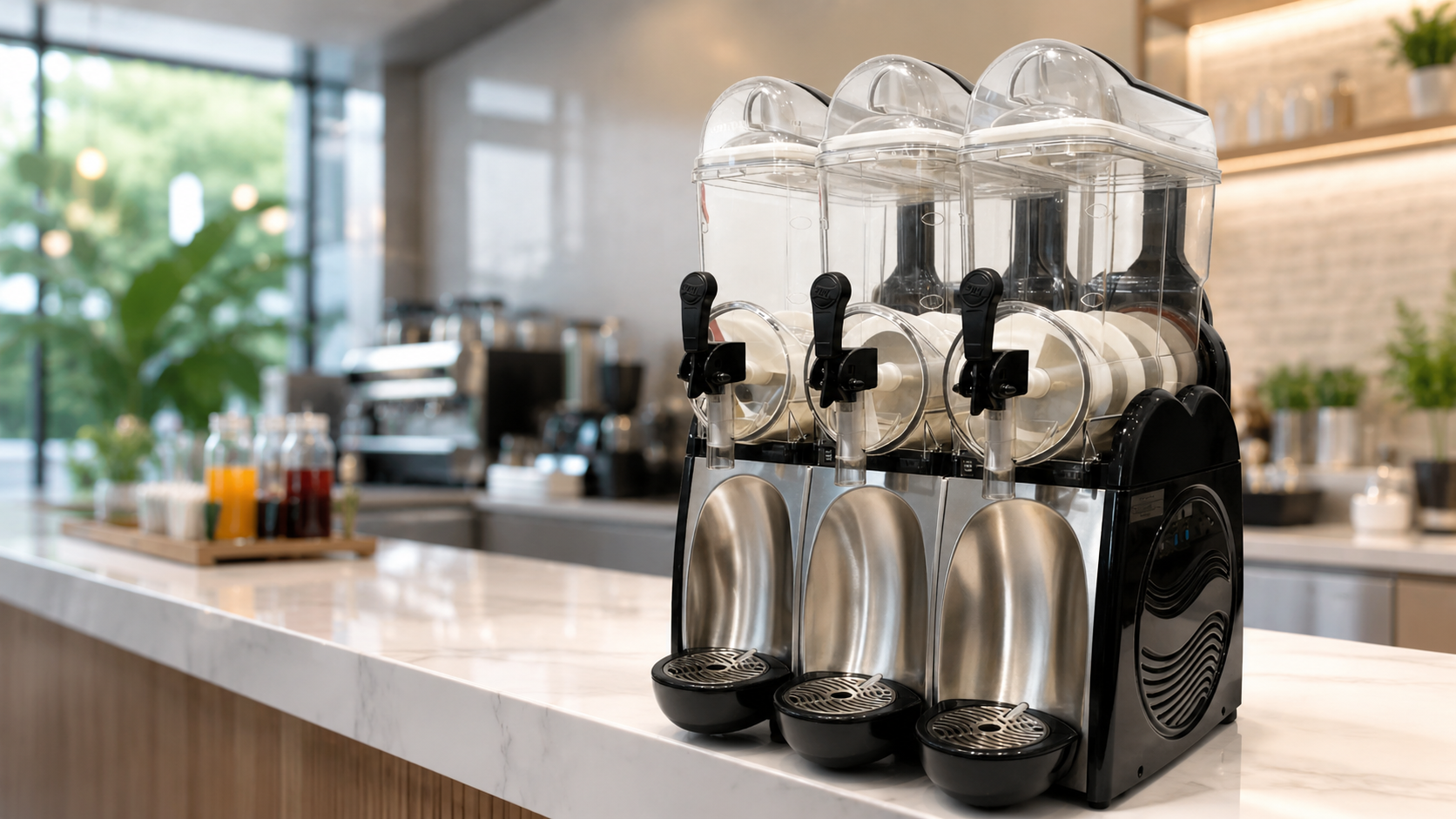
Size a commercial slush machine to your peak hour with a cups-per-load worksheet, then compare tank count, cooling specs, amps and cleaning across 3 models.
The best commercial slush machine for your business is the one that still has frozen product in the tank at the end of your busiest hour, runs on the circuit you already have, and comes apart easily enough that staff really do clean it every night. Tank count, cooling capacity and rated current tell you more than the brand on the front panel. This guide covers each decision in the order a buyer should make it. It includes a cups-per-load sizing worksheet, a cost worksheet and a side-by-side comparison of Smartool’s single, dual and three-tank models.
Five Numbers That Decide Which Slush Machine Fits
Before comparing brands, collect five numbers from your own operation. Every line on a slush machine spec sheet maps to one of them.
- Peak-hour cups and cup size: determine how much tank capacity you need.
- Flavors on display: determine the number of tanks and whether each tank needs its own temperature control.
- Circuit at the outlet: limits rated power and rated current.
- Counter width, depth and shelf clearance: limit dimensions, weight and ventilation space.
- Minutes available at closing: decide how much disassembly and cleaning design matters.
How to Size a Commercial Slush Machine for Your Peak Hour
A slush machine works like a freezer with a buffer. The tanks hold product that is already frozen, and once staff draw it down, fresh mix has to freeze again before it pours at full texture. That is why daily cup counts mislead. A café selling 150 cups spread across the day never stresses a machine, while a concession stand selling 150 cups between two games can empty the same machine in under an hour.
Start with the frozen inventory each machine holds. Convert tank volume to US fluid ounces (1 liter is 33.8 fl oz and 1 gallon is 128 fl oz), then divide by your cup size.
Sizing Worksheet: Cups per Full Load
| Model | Tanks and capacity | Total fl oz | 12 oz cups | 16 oz cups | 20 oz cups |
|---|---|---|---|---|---|
| RLC18-1 | 1 × 16.5 L | 558 | 46 | 34 | 27 |
| RL18-2 | 2 × 4.7 gal | 1,203 | 100 | 75 | 60 |
| RL18-3 | 3 × 16.5 L | 1,674 | 139 | 104 | 83 |
The worksheet uses liquid volume at a full fill, rounded down. In service you top up a tank with pre-chilled mix well before it runs dry, so count on fewer cups per rush than the table shows.
Now compare those figures with your rush. At 70 cups of 16 oz slush in the busiest hour, the single-tank RLC18-1 (34 cups) runs out halfway through. The dual-tank RL18-2 (75 cups) covers it with almost no margin, and the three-tank RL18-3 (104 cups) covers it with room for a slower-selling third flavor. When the numbers are close, size up. Recovering from a warm refill takes far longer than a rush lasts: Smartool lists first-batch formation times of 40–60 minutes for its single-tank model and 50–75 minutes for its three-cylinder model.
Match the Machine Type to the Drinks You Sell
“Slush machine” covers several different designs. Buying the wrong type is harder to fix than buying the wrong size.
Granita and Pour-Over Slush Machines
This is the most common countertop format. Staff pour premixed syrup and water into a clear tank, a refrigerated cylinder chills it, and an auger keeps the ice crystals moving so the drink stays pourable. Pour-over machines need no water line or CO2, which makes them the default for cafés, snack bars, convenience stores and mobile bars. All three Smartool models in this guide are pour-over machines.
Autofill Machines
Autofill units draw mix from a bag-in-box system or a water line and top up the tank automatically. They save refills at very high-volume self-serve stations, but they need pumps or plumbing and a more permanent installation.
Frozen Carbonated Beverage (FCB) Machines
FCB systems freeze syrup, water and CO2 under pressure to make fizzy frozen soda. They are a separate, pressurized equipment category with their own CO2 supply and service needs. A granita-style machine cannot make carbonated slush.
Frozen Cocktail Machines
Alcohol lowers the freezing point of a mix, so cocktail programs need extra cooling capacity and adjustable consistency to hold a softer, colder product. Our guide to choosing a commercial margarita machine covers batch strength, Brix and state liquor rules.
Dairy-Based Frozen Drinks
Milkshake and frozen cappuccino bases are perishable and need more frequent full cleaning than fruit slush. Before you pour a milk-based mix into any machine, confirm with the manufacturer that the machine is intended for dairy.
Tank Count and Independent Temperature Control
More tanks mean more flavors and more frozen inventory, but they also add width, weight, amperage and cleaning time. A more useful question is how your sales split. If one flavor makes up most of your volume, running it in two tanks can serve customers better than adding a third flavor. Our comparison of single, double and triple tank slush machines works through that math with real rush numbers.
On a multi-tank machine, check whether each tank has its own temperature or consistency control. The RL18-3 three-cylinder slushy machine has separate electronic temperature control on each of its three 16.5 L tanks. That lets a tart lemonade slush and a sweeter fruit blend run at different settings side by side.
Freezing Performance Specs Worth Reading
Spec sheets mix useful figures with filler. These are the numbers that predict how a machine will behave during service:
- First-batch formation time: the minutes from room-temperature mix to serving texture. It tells you how early to switch the machine on, and roughly how long a tank is out of product after a warm refill.
- Compressor cooling capacity: the heat the refrigeration system can remove, which is a different figure from total electrical draw. The RL18-3 has 1,111 W of cooling capacity against 1,500 W of rated power, and the RLC18-1 has 490 W against 500 W.
- Discharge temperature: the product temperature at the tap. The RLC18-1 and RL18-3 spec sheets give ≤ -1 °C (about 30 °F).
- Operating ambient range: a machine rated for rooms of 10–32 °C (50–90 °F) will struggle on an unshaded patio in July.
- Noise level: matters at a front counter or bar. Smartool’s single-tank and three-tank models are rated at ≤ 65 dB.
- Refrigerant: both of those RL18-series compressors run on R290 (propane), a flammable refrigerant. Any sealed-system service belongs with a qualified refrigeration technician.
Mix chemistry affects texture as much as the machine does. Sugar concentration, measured in degrees Brix, largely controls how firm the slush sets. Checking each batch takes seconds with a refractometer, and Washington State University’s guide to measuring Brix with a refractometer shows the basic method. Follow the mix manufacturer’s ratio instead of diluting to stretch syrup.

Electrical, Placement and Ventilation Requirements
Most countertop slush machines in the US run on 120 V, but current draw varies widely. The RLC18-1 is rated at 5.3 A and the RL18-3 at 14.5 A. Slush machines run for hours at a stretch, and the National Electrical Code (NFPA 70) sizes branch circuits for loads that run three hours or more with headroom above the nameplate current. In practice, that puts a 14.5 A machine on a dedicated 20 A circuit rather than a shared kitchen outlet. Have a licensed electrician confirm the circuit before delivery day.
Smartool’s installation guidance for its slush machines calls for a dedicated 15–20 A circuit, a level counter, at least 4 inches of clearance at the sides, and a room below 90 °F for normal freeze times. Keep the condenser intake away from fryers, ovens and direct sun, and leave about 8 inches (20 cm) between the back of the machine and the wall.
Weight is easy to overlook. A filled three-tank machine combines its own net weight (57.2 kg, or about 126 lb, for the RL18-3) with nearly 50 liters of mix, which adds roughly another 110 lb. Check that the counter can carry the load, and measure the height under any shelving so staff can lift the lids to refill.
Cleaning Design Decides Whether Cleaning Happens
Sugar residue in the dispensing valve is where most sticky taps, drips and off-flavors start. The FDA Food Code, the model most state and local health departments adopt, ties cleaning of beverage dispensing nozzles and enclosed components to the manufacturer’s specified frequency. That makes the cleaning schedule in the manual the standard an inspector will hold you to.
Before buying, check the manual or the machine itself for:
- A hopper, dispensing valve and agitator that come off without tools
- Seals and O-rings you can reorder from the supplier by part name
- A removable drip tray with a full-tray indicator (the RL18-series machines have a red pop-up button)
- A cleaning mode that runs the auger with water. Smartool’s single-tank and three-tank models have one-touch cleaning
A realistic routine is daily disassembly and washing of the hopper, valve and agitator, plus a weekly check of the seals and condenser. Smartool’s slushy machine maintenance checklist sets out the daily, weekly and seasonal steps. When a machine acts up anyway, our slush machine troubleshooting guide sorts problems by symptom.

Certifications and Listings to Request
Certification answers two separate questions: is the machine electrically safe, and is it built to be sanitized?
- Electrical safety: look for a listing mark from a recognized testing laboratory such as UL, Intertek (ETL) or CSA. OSHA’s Nationally Recognized Testing Laboratory program maintains the list of recognized labs.
- Food equipment sanitation: the NSF/ANSI food equipment standards set requirements for materials, design and cleanability. NSF/ANSI 6 covers dispensing freezers and NSF/ANSI 18 covers manual food and beverage dispensing equipment, so ask which standard a certificate was issued under.
Ask for the certificate or file number and look it up in the certifier’s online directory. Our ETL vs NSF certification guide explains how the two marks differ for commercial refrigeration equipment.
Total Cost of Ownership Beyond the Sticker Price
The purchase price is a one-time cost. The recurring lines below decide what the machine really costs each year:
| Cost line | How to estimate it | Example input |
|---|---|---|
| Electricity (upper bound) | Rated kW × hours powered per day × days open × your rate | RL18-3: 1.5 kW × 12 h = 18 kWh per day at most |
| Mix and cups | Cost per serving × annual servings | Supplier price sheet |
| Cleaning labor | Minutes per close × hourly wage × days open | Time one full clean with your own staff |
| Wear parts | Seals, O-rings and valve parts replaced per year | Supplier parts price list |
| Downtime | Peak-hour cups × margin per cup × hours out of service | Your POS data from the busiest week |
Rated power is a ceiling, not actual consumption. Once the product is frozen the compressor cycles, so the real kWh figure comes in lower. To turn kWh into dollars, use your utility bill rate or the state average commercial price in the U.S. Energy Information Administration’s electricity price table.
Service coverage belongs in the same worksheet. Before comparing quotes, read the Smartool warranty and after-sales policy for on-site service, remote diagnosis and parts support.
Smartool Commercial Slush Machines Compared
Smartool builds three countertop pour-over slush machines for 110–120 V service. The table uses each model’s product page specifications. You can also browse the full range of Smartool commercial slushy machines.
| Specification | RLC18-1 | RL18-2 | RL18-3 |
|---|---|---|---|
| Tanks | 1 | 2 | 3 |
| Capacity | 16.5 L (4 gal) | 2 × 4.7 gal | 3 × 16.5 L (49.5 L) |
| Voltage | AC 120 V / 60 Hz | 110 V / 60 Hz | AC 120 V / 60 Hz |
| Rated power | 500 W | 860 W | 1,500 W |
| Rated current | 5.3 A | — | 14.5 A |
| Compressor cooling capacity | 490 W | — | 1,111 W |
| First batch formation | 40–60 min | — | 50–75 min |
| Noise | ≤ 65 dB | — | ≤ 65 dB |
| Dimensions (W × D × H) | 545 × 276 × 885 mm | — | 545 × 676 × 885 mm |
| Net weight | 25 kg | — | 57.2 kg |
| Controls and cleaning | LED display, one-touch cleaning | LED-lit tanks, drip tray alert | Independent electronic temperature control per tank, one-touch cleaning |
| Intended drinks | Slushies, frozen margaritas, cocktails | Slushies, cider slushes, margaritas, frozen cocktails | Slushies, frozen margaritas, cocktails |
The RLC18-1 single-tank slushie machine suits one signature drink at a café counter, food truck or catering station. At 5.3 A it leaves headroom on a standard 120 V circuit.
The RL18-2 dual-tank frozen drink maker is built for mobile bars, restaurants and events that want two drinks on display, such as a frozen margarita next to a non-alcoholic fruit slush. Its LED-lit tanks help the product sell itself.
The RL18-3 is the high-volume option for convenience stores, cinemas, concession stands and hotel pool bars, with three independently controlled tanks and the largest frozen inventory of the three. For multi-location rollouts or distributor stock, the Smartool slushy machine factory-direct program quotes pricing for multi-unit orders.

The Best Commercial Slush Machine for Each Type of Operation
| Operation | What drives the choice | Tanks | Smartool fit |
|---|---|---|---|
| Café or bakery counter with one signature drink | Tight counter, steady but modest rush | 1 | RLC18-1 |
| Food truck or catering station | Standard outlet, limited space, one menu item | 1 | RLC18-1 |
| Restaurant or mobile bar with two frozen drinks | Cocktail plus non-alcoholic option, moderate rush | 2 | RL18-2 |
| Convenience store, cinema or concession stand | Visible variety, sharp rushes, impulse sales | 3 | RL18-3 on a dedicated 20 A circuit |
| Hotel pool bar or resort | One cocktail and two non-alcoholic flavors | 3 | RL18-3 on a dedicated 20 A circuit |
Commercial Slush Machine Buying Questions
How many cups does a 4-gallon slush machine hold?
A 16.5 L tank holds about 558 fl oz of mix at a full fill: roughly 46 cups at 12 oz or 34 cups at 16 oz. Plan on fewer per rush, because staff should refill before the tank runs dry.
How long does a commercial slush machine take to freeze?
From room-temperature mix, Smartool lists 40–60 minutes for the single-tank RLC18-1 and 50–75 minutes for the three-tank RL18-3. Pre-chilled mix and a cooler room shorten the wait. A hot room or a dusty condenser lengthens it.
Can a regular slush machine make margaritas?
It depends. The manufacturer has to list alcoholic drinks as an intended use, and the batch strength has to suit the machine’s cooling capacity. Alcohol lowers the freezing point, so an overly strong batch may never set.
What should I check before a slush machine is delivered?
Confirm the circuit rating at the outlet, measure counter width and depth plus the height under any shelving, and plan airflow around the condenser. Also pick a spot for the drip tray that staff can reach without moving the machine.
Get a Slush Machine Quote Matched to Your Peak Hour
Send us your busiest-hour cup count, cup size, flavor lineup and the circuit at the install location, and we will recommend the tank count and model that fits. Request a commercial slush machine quote from Smartool.
Factory-direct from Smartool
Planning a commercial equipment purchase?
Share your site conditions, daily output and budget. Our team will match a model, send the spec sheets and quote factory-direct pricing.

Written by
Senior Engineer, Smartool
Jason is a senior engineer at Smartool. He works on the commercial ice machines, soft serve and slushy machines, and refrigerated prep tables Smartool builds for restaurants, bars, hotels and dessert shops. His guides look at equipment from the engineering side: how to size a machine for a site, what it needs for power, water and airflow, and how to keep it running through busy service. He also helps buyers match the right model to their kitchen before they request a quote.
.elementor-76528 .elementor-element.elementor-element-5c7a0d0{--display:flex;--flex-direction:column;--container-widget-width:100%;--container-widget-height:initial;--container-widget-flex-grow:0;--container-widget-align-self:initial;--flex-wrap-mobile:wrap;}.elementor-76528 .elementor-element.elementor-element-5c7a0d1 .elementor-toc__header-title{text-align:start;}.elementor-76528 .elementor-element.elementor-element-5c7a0d1 .elementor-toc__header{flex-direction:row;}.elementor-76528 .elementor-element.elementor-element-5c7a0d1{--item-text-hover-decoration:underline;}
On this page
Need pricing for your project?
Get a factory-direct quote on commercial ice makers, soft serve and slushy machines, and refrigerated prep tables.
✓ Model matching and spec sheets for your site
✓ US office in City of Industry, CA
✓ Talk to an expert: +1 (872) 221-0051
Browse by topic
Ice Machine Guides
Soft Serve & Ice Cream
Slushy & Frozen Drinks
Buying & Sourcing
Compliance & Maintenance
Related posts

Can You Make Milkshakes in a Slushie Machine?
Slushie machine milkshake recipe: why dairy stays out of the bowl, five shake-style bases with milk or soft serve added at the cup, and when to switch.

How Long Does an Ice Machine Take to Make Ice?
A cube ice machine makes a batch in about 10 to 25 minutes, but filling a bin takes hours. See cycle times, refill math and how to time your machine.
3 thoughts on “Best Commercial Slush Machine: How to Choose for Your Volume”
Comments are closed.