




Blog
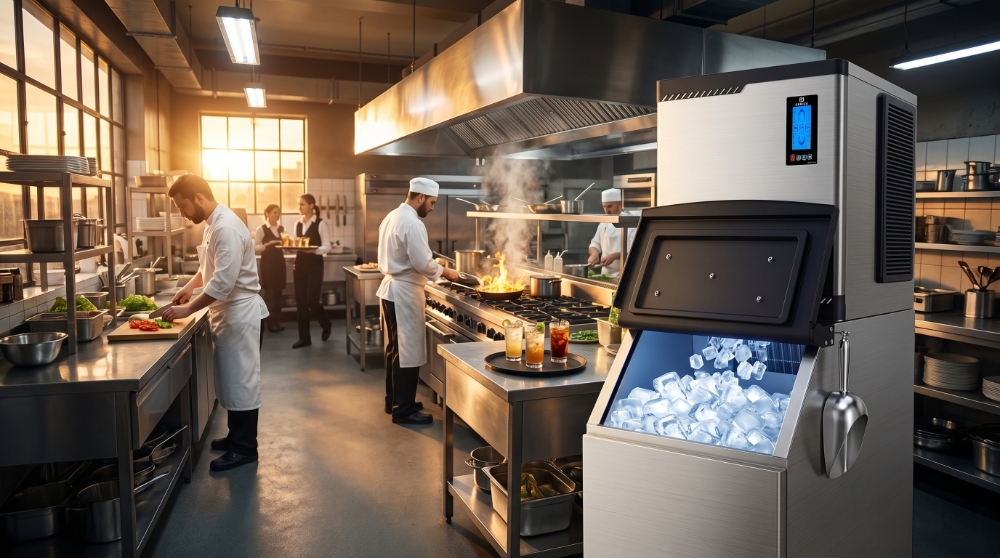
When to replace a commercial ice machine: DOE lifespan data, 7 replacement triggers, a repair-or-replace scoring worksheet and a timeline to beat summer peak.
Knowing when to replace a commercial ice machine is less about a single breakdown and more about a pattern: the machine no longer covers peak demand, outages and bagged-ice runs keep coming back, energy and water use lag current equipment, sanitation stops holding up, or parts and refrigerant work get hard to source. Age tells you when to start watching for that pattern. This guide gives you the federal lifespan benchmark, a trigger checklist, a scoring worksheet and a timeline for having the new machine running before the May–September peak.
Commercial Ice Machine Lifespan: The Federal Benchmark
When the Department of Energy set efficiency standards for ice makers, it needed a lifespan number for its cost analysis. In the DOE 2015 final rule for automatic commercial ice makers, the agency described a general consensus among industry stakeholders that typical equipment lifetime is about 7 to 10 years, with an average of 8.5 years. The same record notes literature citing lifetimes of 20 years or more, and a comment that continuous-type machines may run shorter than batch types.
That range is a planning benchmark, not an expiry date. The conditions that push a machine toward either end are mostly under the operator’s control:
- Water quality and filtration: scale builds on evaporators and water components faster in hard water.
- Room heat and airflow: a machine that runs in a hot, cramped corner works harder for every pound of ice.
- Cleaning discipline: skipped cleaning cycles leave scale and biofilm that shorten component life.
- Duty cycle: a head that runs near full output all summer accumulates wear faster than one sized with headroom.
Smartool’s ice machine maintenance guide sets out the operator routine behind the longer end of the range: daily exterior wipe-downs, clearance at the back and sides, condenser brushing with the power off, and water-system cleaning with a food-grade ice machine cleaner.
When to Replace a Commercial Ice Machine: 7 Triggers
Each trigger below is something a manager can observe or pull from records. None requires opening the machine. Write down what you find; the worksheet in the next section turns these notes into a score.
1. Capacity no longer covers peak demand
The menu grew, a patio opened or a banquet room started booking, and the bin runs empty before the rush ends. Note the days and times the bin ran out last summer. Remember that published output is rated at set room and water temperatures; hot-weather output is lower. If the shortfall comes from demand growth rather than a fault, repair will not fix it. Rework the numbers with the bar ice machine sizing guide before buying.
Record: dates the bin ran out, covers or drinks served those days, kitchen temperature near the machine.
2. Recurring downtime and bagged ice spend
One service call is maintenance. Several in a year, especially during peak months, means you are paying twice: once for the technician and again for bagged ice, the staff time to haul it and the freezer space it takes. Pull service invoices and bagged-ice receipts for the last 12 months and total them. That figure goes straight into the repair-versus-replace math.
Record: number of outages, days down per outage, invoice totals, bagged-ice spend.
3. Energy and water use behind current equipment
Amended federal efficiency standards apply to ice makers manufactured in or imported into the U.S. on or after January 28, 2018, so the manufacture date on the nameplate tells you which rules the machine was built to. Voluntary programs go further: ENERGY STAR certified commercial ice makers have to beat those federal limits, so an older machine with no certification is the likeliest place for hidden utility cost.
An older machine that also shows rising utility bills without a change in production is a candidate for replacement, because the operating cost gap continues every day it runs.
Record: manufacture date, ENERGY STAR status of the current unit, 12 months of electric and water bills.
4. Refrigerant rules and refrigerant-side failures
EPA’s Technology Transitions program under the AIM Act limits the refrigerants new equipment can use. In EPA’s HFC restrictions by sector table, self-contained batch ice machines up to 1,000 lb per 24 hours and continuous machines up to 1,200 lb carry a GWP limit of 150 with a January 1, 2026 compliance date. Larger self-contained machines and remote systems face listed HFC prohibitions from January 1, 2027.
These rules do not force a working machine out of service. EPA’s frequent questions on the HFC phasedown state that there is no requirement to stop using equipment already in use, that existing systems can be repaired, including major components such as a compressor, and that sales restrictions begin three years after the manufacture and import dates.
What the rules change is the purchase decision. A replacement bought now will be built for the new limits, while an older machine that develops a refrigerant leak or sealed-system fault needs work under EPA’s Section 608 refrigerant management rules, which prohibit venting refrigerant during servicing, repair or disposal. Ask the technician for a written diagnosis and whether the refrigerant and parts are readily available.
Record: refrigerant type on the nameplate, any refrigerant-side repair quoted, technician’s note on availability.
5. Sanitation that no longer holds up
Ice is food, and a machine that cannot be kept clean is a liability no matter how much ice it makes. Warning signs an operator can see: slime or scale returns within days of a full cleaning cycle, the bin liner or door gasket is cracked or pitted, panels are corroding, or cubes come out cloudy and misshapen after cleaning. If a health inspector has written up the machine and cleaning per the manual does not clear the problem, move this trigger to the top of the list. The commercial ice machine cleaning guide covers the routine to try first.
Record: date of last full cleaning, how fast buildup returned, inspection notes, visible surface damage.
6. Parts and manufacturer support
A repairable machine is only repairable if parts arrive before the weekend. Ask your service company or supplier how long the pending part takes and whether the model is still supported. A discontinued model with long lead times turns every future failure into a multi-day outage.
Record: part lead time quoted, model support status.
7. The same fault keeps returning
A machine that fails in the same way after each repair usually has a deeper problem than the last part replaced. Smartool’s ice maker troubleshooting guide separates the checks an operator can make (water supply, filter screen, room temperature, scale) from the ones that belong to an engineer (inlet valve, refrigerant leak, sensors, pump, hot gas valve). Do the operator checks, then hand the rest to a qualified technician and ask for the diagnosis in writing.
Record: fault description, dates, what each repair replaced.
Repair-or-Replace Scoring Worksheet
Score each variable 0, 1 or 2 from your records. The score bands are a planning convention to make the decision consistent across locations; adjust them to your own tolerance for downtime.
| Variable | What to use | 0 points | 1 point | 2 points |
|---|---|---|---|---|
| Age | Nameplate manufacture date vs DOE’s 7–10 year typical range | Under 7 years | 7–10 years | Over 10 years |
| Peak capacity | Days the bin ran out last peak season | None | A few hot days or events | Routine shortfall at peak |
| Downtime and bagged ice | Outages and bagged-ice receipts, last 12 months | None | One outage | Two or more outages, or regular bagged ice |
| Repair economics | Annualized repair cost vs annualized replacement cost (formula below) | Repair clearly lower | Roughly equal | Repair higher |
| Energy and water | Manufacture date, ENERGY STAR status, utility bills | Built to 2018 standards, bills stable | Built before 2018, no rise in bills | Built before 2018, bills rising |
| Refrigerant side | Technician’s written diagnosis | No refrigerant-side work | One refrigerant-side repair quoted | Repeat leak or sealed-system failure |
| Sanitation | Condition after a full cleaning per the manual | Clean surfaces, clear ice | Needs extra cleaning to stay clean | Buildup returns fast, damaged surfaces or inspection finding |
| Parts and support | Supplier lead time and model status | Parts in stock | Lead time longer than you can wait | Discontinued or unsupported |
- 0–4: repair, keep logging and rescore after the next service call.
- 5–9: approve only essential repairs, get replacement quotes and schedule the swap before the next peak.
- 10–16: replace; put repair money toward the new machine.
- Override: a 2 on sanitation, or a sealed-system failure on a machine already past 7 years, calls for replacement pricing before any repair is approved.
How to calculate the repair economics line
Put both options on a per-year basis instead of comparing a repair quote to a sticker price:
- Annualized repair cost = (repair quote + expected bagged ice and lost sales during the outage) ÷ years the technician expects the repair to keep the machine running.
- Annualized replacement cost = (installed price − utility rebates − resale or trade-in) ÷ expected service life, minus expected yearly energy and water savings. With no better figure, use DOE’s 8.5-year average for service life.
Our breakdown of how much a commercial ice machine costs to buy and run lists the installation, energy, water and maintenance inputs for the replacement side.
A worked example
A nine-year-old cube head (1) ran short on Saturday nights through July (1) and went down twice last summer (2). The compressor repair quote works out roughly equal to replacement on a per-year basis (1). It was built before 2018 and the electric bill has crept up (2). The technician quoted one refrigerant-side repair (1). It still cleans up well (0), and the part is two weeks out (1). Total: 9. The operator approves nothing beyond essential service, collects quotes in winter and installs the new machine in April.
Planning the Replacement Before the May–September Peak
Emergency replacements in July get whatever is in stock and whoever can install it this week. Working backward from May gives you a choice of model, a proper site check and time to fix utilities. The timeline assumes a May peak; shift it for your season.
| When | Stage | What to do |
|---|---|---|
| November–December | Decide | Score the machine, pull 12 months of invoices, bagged-ice receipts and utility bills, photograph the nameplate. |
| January | Specify | Set peak-day ice demand, choose the ice type, size to the hot-condition output rating, and survey the circuit, drain, water filtration and ventilation clearance. |
| February | Quote and compare | Request spec sheets, warranty and parts availability terms, service coverage for your city and lead times from at least two suppliers. |
| March | Order and prepare the site | Confirm delivery date, book the plumber and electrician for any changes, and arrange refrigerant recovery and disposal of the old unit. |
| April | Install and commission | Install per the manual, clean and sanitize before the first ice, train staff on alerts and the cleaning cycle, and watch output for two weeks. |
| May–September | Run the peak | Log bin run-outs and kitchen temperature so next year’s decision starts with data. |
Two choices deserve a fresh look rather than a like-for-like swap. First, the ice type: if the menu has changed, the guide to types of ice machines and ice shapes matches ice to each station. Second, heat: if the old machine struggled every summer, move the new one or improve ventilation using the hot-weather ice machine output guide.
Replacing With a Smartool BF500 or BF360
For operations that serve square cube ice, Smartool’s split-type heads are built for this kind of planned replacement. The BF500 500 lb split-type square ice maker suits high-volume bars and restaurants, and the BF360 360 lb split-head ice maker fits smaller menus. Both publish a hot-condition rating, which is the number to size against.
| Specification | BF500 | BF360 |
|---|---|---|
| Output at 70°F ambient / 50°F water | 500 lb ±5% per 24 h | 360 lb ±5% per 24 h |
| Output at 90°F ambient / 70°F water | 375 lb ±5% per 24 h | 275 lb ±5% per 24 h |
| Voltage / power (90°F ambient) | 110–120V, 60Hz / 1050W | 110–120V, 60Hz / 700W |
| Ice | Square cubes, 12-level thickness adjustment | Square cubes, 12-level thickness adjustment |
| Operating ambient range | 41–100°F | 41–100°F |
| Sanitation and monitoring | Automatic self-cleaning, water shortage and ice-full alerts, 48-hour timer | Automatic cleaning, water shortage and ice-full alerts, 48-hour timer |
| Protection | Controller overheat, compressor overload, fuse overcurrent | High-temperature, compressor overload, overcurrent |
| Warranty (North America) | 3-year machine and compressor; 1-year parts and labor | 3-year machine and compressor; 1-year parts and labor |

Support terms address the triggers above. Under Smartool’s after-sales policy, a new machine in North America carries three years of machine and compressor coverage and one year of parts and labor, plus on-site service in major cities by advance reservation with response usually within 48 hours, and video diagnosis with mail-in parts for remote areas. Both heads run on a standard 110–120V supply; check the spec sheet for circuit, drain, bin and clearance before you order.
The full lineup of factory-direct commercial ice makers and the commercial ice maker machines category show current models.
If you need to present the replacement case to an owner or finance team, the ROI solutions page is the place to start.
Replacement Questions Operators Ask
How long does a commercial ice machine last?
DOE’s rulemaking record puts the typical lifetime at about 7 to 10 years, averaging 8.5 years, with some machines lasting much longer. Water quality, room heat, cleaning and how hard the machine runs decide where a given unit lands.
Do the new refrigerant rules mean I have to replace my ice machine?
No. EPA allows existing equipment to keep running and to be repaired. The rules restrict what new equipment can be manufactured, imported and eventually sold, which matters when you buy the replacement.
Is repair ever the right call on an older machine?
Yes. A machine past 7 years that still meets peak demand, cleans up well and needs an inexpensive, readily available part can score low on the worksheet. Repair it, keep logging and rescore after the next call.
Should the new machine match the old one?
Not automatically. Re-size to today’s peak demand at hot-condition ratings, confirm the ice type still suits the menu, and check that the site’s circuit, drain and ventilation match the new spec sheet.
What should I ask the technician before deciding?
- Which system failed, and is it the same fault as last time?
- How many years will this repair realistically buy?
- Are the refrigerant and parts readily available, and what is the lead time?
- What else looks worn and likely to fail in the next year?
Once your worksheet points to replacement, send us the score, your peak-day demand and a photo of the current nameplate. Request a quote for a replacement ice machine and we will recommend a BF model and a delivery date that lands before your busy season.
Factory-direct from Smartool
Planning a commercial equipment purchase?
Share your site conditions, daily output and budget. Our team will match a model, send the spec sheets and quote factory-direct pricing.

Written by
Senior Engineer, Smartool
Jason is a senior engineer at Smartool. He works on the commercial ice machines, soft serve and slushy machines, and refrigerated prep tables Smartool builds for restaurants, bars, hotels and dessert shops. His guides look at equipment from the engineering side: how to size a machine for a site, what it needs for power, water and airflow, and how to keep it running through busy service. He also helps buyers match the right model to their kitchen before they request a quote.
.elementor-76528 .elementor-element.elementor-element-5c7a0d0{--display:flex;--flex-direction:column;--container-widget-width:100%;--container-widget-height:initial;--container-widget-flex-grow:0;--container-widget-align-self:initial;--flex-wrap-mobile:wrap;}.elementor-76528 .elementor-element.elementor-element-5c7a0d1 .elementor-toc__header-title{text-align:start;}.elementor-76528 .elementor-element.elementor-element-5c7a0d1 .elementor-toc__header{flex-direction:row;}.elementor-76528 .elementor-element.elementor-element-5c7a0d1{--item-text-hover-decoration:underline;}
On this page
Need pricing for your project?
Get a factory-direct quote on commercial ice makers, soft serve and slushy machines, and refrigerated prep tables.
✓ Model matching and spec sheets for your site
✓ US office in City of Industry, CA
✓ Talk to an expert: +1 (872) 221-0051
Browse by topic
Ice Machine Guides
Soft Serve & Ice Cream
Slushy & Frozen Drinks
Buying & Sourcing
Compliance & Maintenance
Related posts

Ice Machine Freezing Up? Causes, Safe Checks and Fixes
Ice machine freezing up? Learn the six common causes, what staff can safely check, what needs a technician, and how to prevent repeat freeze-ups.

How to Use a Margarita Machine or Slush Machine
How to use a margarita machine or slush machine: setup, mixing and filling, freeze time, consistency, dispensing, refills and the closing routine.
One thought on “When to Replace a Commercial Ice Machine: Lifespan & Triggers”
Comments are closed.