




Blog
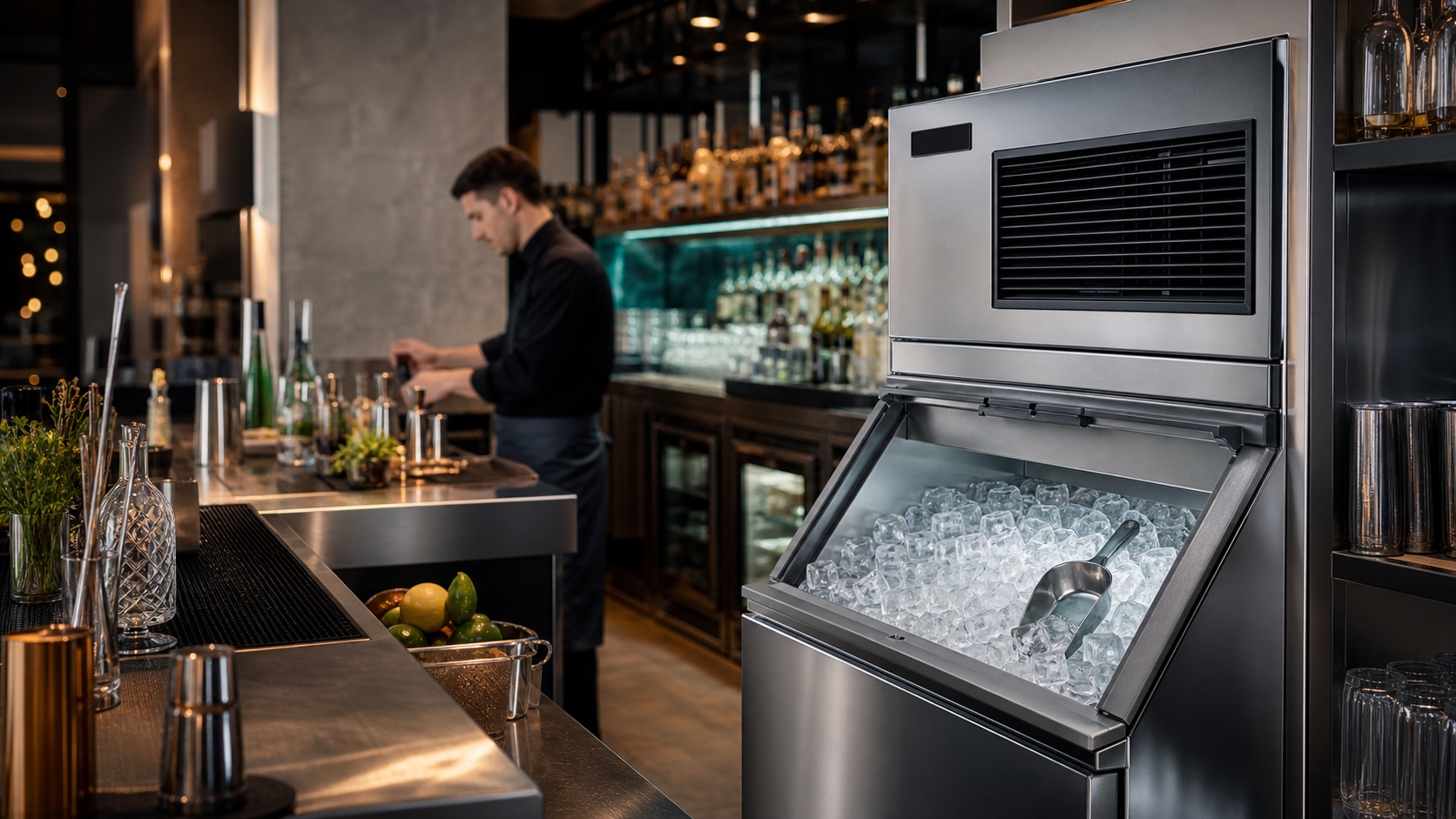
Size a bar ice machine from peak-hour drinks, ice per drink, banked storage and hot back-bar derating, with a fill-in worksheet and three worked examples.
A bar ice machine is sized for the busiest service window, not for the day’s total. Work out how many pounds of ice the bar pulls during its peak hours and subtract what the machine can make in those same hours. The gap is ice that must already be in storage when the rush starts. Then make sure the machine can rebuild that stock before the next rush, using its rating at the room temperature it will actually see. The worksheet below does that math, and three worked examples run it with real Smartool model ratings.
Why Per-Seat Rules Miss the Bar Ice Machine Problem
Per-seat rules of thumb produce a daily total. Bars rarely fail on the daily total. They fail at 10:30 on a Friday, when the wells run dry while the machine is still partway through a harvest.
Commercial ice makers are rated by harvest rate, which DOE’s federal rules for automatic commercial ice makers define as the pounds of ice produced per 24 hours. Divide by 24 and a 360 lb machine averages 15 lb an hour. The same rules describe batch-type machines as alternating freezing and harvesting periods, so that hourly figure arrives in drops, not a steady stream. The bars in the examples below pull between 16 and 74 lb of drink ice an hour at peak.
Sizing therefore comes down to four numbers: ice per drink, drinks in the peak window, ice banked in storage before the peak, and machine output at the real room temperature.
Ice per Drink by Drink Type
No published standard sets pounds of ice per cocktail. Glassware, scoop size and house style decide it. The table gives starting assumptions for the worksheet, and they are meant to be replaced: tare a kitchen scale, build five of each drink the way your bartenders do, and weigh the ice that goes into the tin and the glass.
| Drink type | What the ice does | Starting assumption (lb per drink) |
|---|---|---|
| Beer, wine, spirits served neat | No ice | 0 |
| Spirit on the rocks | Serve ice in a rocks glass | 0.25 |
| Highball, Collins or well mixed drink | Serve ice in a tall glass | 0.40 |
| Soft drink or water, 16 oz glass | Serve ice | 0.35 |
| Shaken or stirred, served up | Shaker or mixing-glass ice, discarded after straining | 0.30 |
| Shaken, served over fresh ice | Shaker ice plus fresh serve ice | 0.55 |
| Blended or frozen drink | Blended into the drink | 0.50 |
| Melt, spills and scoop waste | Allowance on all drink ice | +15% |
Two uses of ice sit outside the per-drink numbers. The first is well stock: the ice each underbar well holds when the rush begins. A working well never runs down to zero, and whatever is left is dumped at close, so that stock counts as demand.
The second is chilling ice for beer tubs, bottle displays and bucket service. The FDA Food Code 2022 states that ice used to cool the outside of packaged beverages or equipment coils may not afterward be used as food. That ice gets its own line in the worksheet and never goes back into a glass.
The Bar Ice Machine Sizing Worksheet
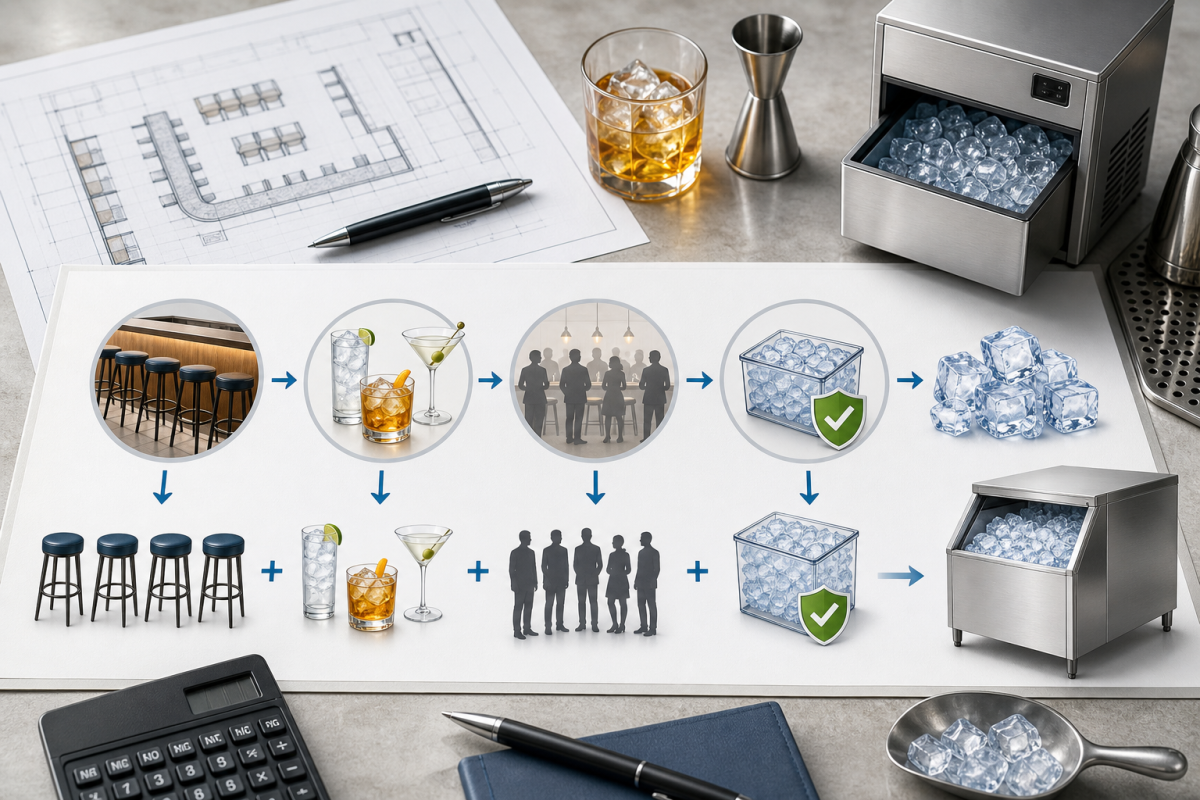
Fill in one column per service pattern, such as a weeknight, a Friday and a private event. Lines 1 to 9 describe demand. Lines 10 to 12 test a machine against it.
| Line | Input | Where the number comes from |
|---|---|---|
| 1 | P: peak window, hours | POS sales by hour |
| 2 | D: drink ice per peak hour, lb | Drinks per hour of each type × lb per drink |
| 3 | M: melt and spill allowance | Assumption, 15% |
| 4 | W: well stock at start of peak, lb | Weigh one full well × number of wells |
| 5 | C: chilling ice for tubs and displays, lb | Weigh one filled tub × number of tubs |
| 6 | E: peak-window demand, lb | P × D × (1 + M) + W + C |
| 7 | R: ice used the rest of the day, lb | Same method for off-peak hours and kitchen use |
| 8 | G: daily demand, lb | E + R |
| 9 | B: planning buffer | Assumption, 20% |
| 10 | H: machine output per hour, lb | 24-hour rating at your room condition ÷ 24 |
| 11 | S: ice made during the peak, lb | H × P |
| 12 | K: ice banked before the peak, lb | (E − S) × (1 + B) |
A machine passes when all three checks hold:
- Daily check: the 24-hour rating at your room condition is at least G × (1 + B).
- Storage check: usable storage capacity, taken from the spec sheet of the bin or storage you pair with the machine, is at least K.
- Recovery check: H multiplied by the hours between close and the next peak covers K plus any ice pulled during those hours.
Use the Hot Rating When the Machine Shares a Warm Room
Back bars run warm. Glass washers, lighting, bottle coolers and a full room all add heat to the same air. Ice machine output falls as room air and incoming water get warmer, so a 24-hour rating measured in a cool test room overstates what the machine delivers beside a busy bar.
Published ratings for commercial ice makers are built on AHRI Standard 810 for rating automatic commercial ice makers, which sets the test and rating requirements behind the numbers on a spec sheet. When comparing machines, compare them at matching air and water temperatures. Smartool lists two ratings for each split-type model, which makes the derating visible:
| Model | 24h output at 21°C (70°F) air / 10°C (50°F) water | Per hour | 24h output at 32°C (90°F) air / 21°C (70°F) water | Per hour | Change |
|---|---|---|---|---|---|
| BF360 | 360 lb ±5% | 15.0 lb | 275 lb ±5% | 11.5 lb | −23.6% |
| BF500 | 500 lb ±5% | 20.8 lb | 375 lb ±5% | 15.6 lb | −25% |
Use the 32°C figure on line 10 whenever the machine will share a room with bar equipment in summer. Keep the 21°C figure for a conditioned back room. Both models list an operating range of 5–38°C (41–100°F), so a space that climbs past that during service is the wrong place for the head. The guide to protecting a commercial ice machine in summer heat covers airflow, water temperature and operator checks for hot months.
Three Worked Bar Sizing Examples
All three examples use the drink assumptions above, a 15% melt allowance and a 20% buffer. The drink counts are illustrations; replace them with your own sales data.
Neighborhood Bar: 40 Seats, 4-Hour Peak
From 8 pm to midnight the bar sells about 70 drinks an hour: 30 beers and wines, 25 highballs, 10 spirits on the rocks and 5 soft drinks. That is 14.25 lb of drink ice an hour, 16.4 lb with the melt allowance, or 65.6 lb across the peak. One underbar well starts service with 30 lb, and the rest of the day uses about 60 lb.
- Peak-window demand (E): 65.6 + 30 = 95.6 lb.
- Daily demand (G): 155.6 lb, or 187 lb with the buffer.
- BF360 in a warm back-bar space (275 lb rating, 11.5 lb an hour): makes 46 lb during the peak, so K = (95.6 − 46) × 1.2 = 60 lb banked by 8 pm.
- Same model in a 21°C storeroom (15.0 lb an hour): makes 60 lb during the peak, so K = 43 lb.
- Recovery: 19 hours from a 1 am close to the next 8 pm peak at 11.5 lb an hour gives about 218 lb, well above the 60 lb bank plus 60 lb of daytime ice.
Verdict: a BF360 covers this bar even on its hot rating, 275 lb against a 187 lb requirement, provided the storage paired with it holds at least 60 lb of usable ice. A BF500 only earns its place here if a cocktail program is on the way.
High-Volume Cocktail Bar: Three Stations, 3-Hour Peak
From 9 pm to midnight the bar sends out 150 drinks an hour: 60 shaken drinks over fresh ice, 35 drinks served up, 35 highballs and 20 waters or soft drinks. That is 64.5 lb of drink ice an hour, 74.2 lb with the melt allowance, or 222.5 lb across the peak. Three stations each start with 30 lb in the well, and the hours before and after the peak use another 180 lb.
- Peak-window demand (E): 222.5 + 90 = 312.5 lb.
- Daily demand (G): 492.5 lb, or 591 lb with the buffer.
- One BF500: 500 lb at 21°C already falls short of 591 lb before heat is considered.
- Two BF360 units: 720 lb at 21°C but 550 lb at 32°C, which fails on a hot night.
- BF500 plus BF360: 860 lb at 21°C and 650 lb at 32°C, so it passes both. At the hot rating the pair makes 27.1 lb an hour, or 81 lb during the peak, so K = (312.5 − 81) × 1.2 = 278 lb.
- Recovery: 19 hours from a 2 am close to 9 pm at 27.1 lb an hour yields about 515 lb, enough for the 278 lb bank plus roughly 120 lb used between 5 pm and 9 pm.
Verdict: split the load across two machines. The pairing passes the hot check, and a fault on one still leaves the bar with ice. Storage becomes the constraint, so plan at least 278 lb of usable capacity loaded by 9 pm and enter the real capacity from the spec sheet of the storage paired with each head.
Hotel Lobby Bar Plus Banquet Reception
The lobby bar uses about 120 lb a day on its own worksheet. The banquet question is a 250-guest, two-hour reception. Assume two drinks per guest, split into 300 mixed drinks and 200 wines and beers, plus one water glass per guest and four beverage tubs at 40 lb each.
- Drink ice: 300 × 0.40 + 250 × 0.35 = 207.5 lb, or 238.6 lb with the melt allowance.
- Chilling ice for the tubs: 160 lb, kept apart from drink ice.
- Event demand: 398.6 lb in two hours, all of it staged before doors open, so K = 398.6 × 1.2 = 478 lb.
- Daily demand: 518.6 lb, or 622 lb with the buffer. A BF500 plus BF360 covers that at 21°C (860 lb) and at 32°C (650 lb).
- Recovery: at the pair’s cool-room rate of 35.8 lb an hour, filling 478 lb of storage takes about 13.4 hours, before counting the lobby bar’s own draw.
Verdict: daily capacity is the easy part; recovery sets the plan. With a lunch event and a dinner event five hours apart, the pair makes only about 179 lb in between. The second event needs its ice banked earlier, which roughly doubles the storage, or it needs bagged backup or more production. Run the worksheet once per event, not once per day.
| Example | Peak or event demand | Daily demand with buffer | Machine plan | Ice banked before peak |
|---|---|---|---|---|
| Neighborhood bar | 95.6 lb | 187 lb | BF360 | 60 lb warm room / 43 lb cool room |
| High-volume cocktail bar | 312.5 lb | 591 lb | BF500 + BF360 | 278 lb at hot rating |
| Hotel bar plus banquet | 398.6 lb | 622 lb | BF500 + BF360 | 478 lb per event |
Underbar or Back-of-House: Where a Bar Ice Machine Should Sit
Placement changes line 10 of the worksheet and the bartender’s workflow at the same time.
Undercounter Units at the Bar
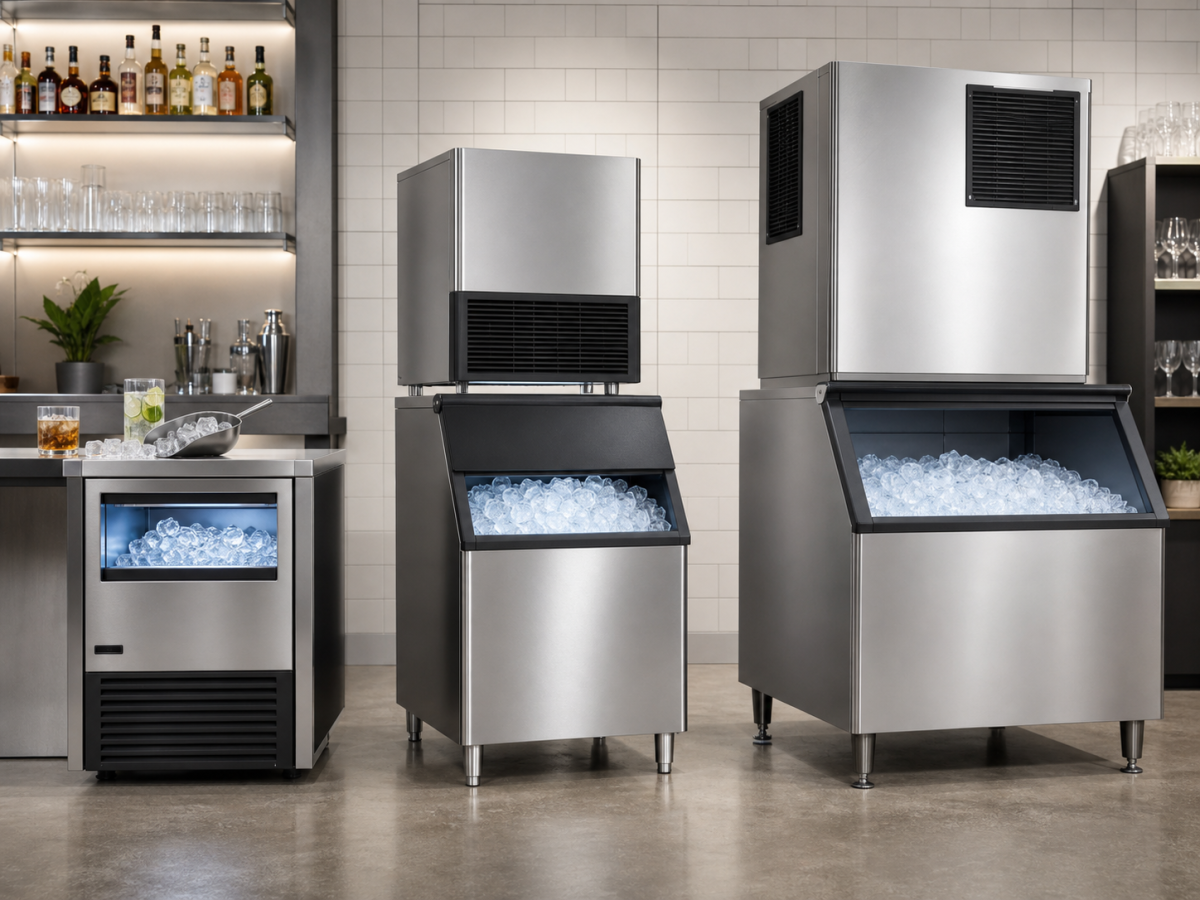
A self-contained undercounter unit makes and stores ice in one cabinet beneath the bar top, so ice is within arm’s reach. The trade-offs are compressor heat and noise in the bartender’s space and a storage compartment whose size is fixed by the cabinet. The BF360 and BF500 are split-type machines, not undercounter units. The comparison of modular and undercounter ice machines explains how the configurations differ on footprint, drains and service access.
Production in a Back Room
Putting the machine in a storeroom or service corridor moves heat and noise away from guests, and a conditioned room lets you plan on the cooler rating. Both BF models list noise at or below 65 dB measured 1 m from the front. The cost is labor: staff carry ice to the wells, so budget for dedicated, clearly marked ice totes and a carrying route that stays clear of the dish area.
Clearance, Drain and Power
- Airflow: the FEMP guidance on energy-efficient air-cooled ice machines notes that air-cooled units need clearance for airflow and lose efficiency when inlets or outlets are blocked. Smartool’s ice machine maintenance guide calls for more than 30 cm (about 12 in) at the back and sides, away from heat sources.
- Drain: map a drain path for the machine and for the storage before shelving or millwork goes in, and check the drain connection points on the spec sheet.
- Power: both models run on 110–120V/60Hz. Rated power is 700 W for the BF360 and 1050 W for the BF500 at 32°C ambient; have an electrician size the circuit from the spec sheet.
- Access: leave room to open panels for routine cleaning and service visits.
Cocktail Ice vs Well-Drink Ice
For most bars one good cube does nearly all the work. Hard, dense cubes chill a shaken drink without shattering into slush and hold up in a highball without watering it down too fast. Both BF models make square cubes with 12-level adjustable thickness, so the cube can be matched to the bar’s glassware and drink style.
Two menu styles need a separate plan. Crushed, nugget or flake ice for juleps, tiki drinks and swizzles comes from a different machine type or a crusher, and large clear cubes or spheres for spirit service are usually cut or bought separately. The guide to types of commercial ice machines maps each shape to its uses and explains which machine makes which ice.
Where the BF360 and BF500 Fit a Bar
Both are split-type models in Smartool’s range of factory-direct commercial ice makers. Plan storage, drain and ventilation for each from its spec sheet, then use the worksheet to decide between one machine and a pair.
| Specification | BF360 | BF500 |
|---|---|---|
| Product description | Split head model | Split type ice maker |
| 24h output, 21°C air / 10°C water | 360 lb ±5% | 500 lb ±5% |
| 24h output, 32°C air / 21°C water | 275 lb ±5% | 375 lb ±5% |
| Ice | Square cubes, 12-level thickness | Standard square cubes, 12-level thickness |
| Electrical | 110–120V/60Hz, 700 W | 110–120V/60Hz, 1050 W |
| Operating range | 5–38°C (41–100°F) | 5–38°C (41–100°F) |
| Controls and alerts | LCD, 48-hour timer, water-shortage and ice-full alerts | LCD, 48-hour timer, water-shortage and ice-full alerts |
| Cleaning | Automatic cleaning function | Automatic self-cleaning function |
| Noise | ≤65 dB at 1 m | ≤65 dB at 1 m |
| Warranty | 3-year commercial warranty | 3-year commercial warranty |
- BF360: the BF360 360 lb split-head ice maker suits a bar whose buffered daily demand stays under its 275 lb hot rating, like the neighborhood bar above, or under 360 lb in a conditioned room.
- BF500: the Smartool BF500 500 lb split-type ice maker fits buffered demand up to 375 lb in a warm space or up to 500 lb in a conditioned back room.
- Pairs: above those figures, combine machines as in the cocktail bar and hotel examples, and compare the full range of commercial ice maker machines.
Bar Ice Machine Sizing Questions
Is a Pounds-per-Seat Estimate Good Enough?
No, not on its own. Per-seat figures give a rough daily number and say nothing about when the ice is used. Two bars with the same seat count can use very different amounts at the peak, depending on drink mix, table turns and standing guests. Use the per-seat number as a cross-check on the worksheet, not a replacement for it.
One Large Machine or Two Smaller Ones?
It depends on recovery and risk. Two machines mean two sets of drains, power and storage to plan. In return, a fault on one no longer leaves the bar without ice, and the pair can be sized to pass the hot check, as the cocktail bar example shows.
Should the Machine Build Stock Overnight?
Yes, when the storage can hold it. The recovery check depends on overnight production, and the same FEMP guidance recommends running ice machines during off-peak hours where possible to reduce electricity demand charges.
How Often Does a Bar Ice Machine Need Cleaning?
Follow the manufacturer’s manual and your local health code, and look over the ice zone during every closing routine rather than waiting for a scheduled cleaning. The commercial ice machine cleaning guide separates cleaning from sanitizing and sets out an operator routine.
Turn Your Worksheet Into a Machine Recommendation
Fill in lines 1 to 12 for your busiest night, note the room temperature where the machine will sit, and send the numbers to Smartool. The team will match them to a BF360, a BF500 or a paired setup and provide the spec sheets you need for storage, drain and ventilation planning. Request a commercial ice machine quote with your peak window, drink mix and site details.
Factory-direct from Smartool
Planning a commercial equipment purchase?
Share your site conditions, daily output and budget. Our team will match a model, send the spec sheets and quote factory-direct pricing.

Written by
Senior Engineer, Smartool
Jason is a senior engineer at Smartool. He works on the commercial ice machines, soft serve and slushy machines, and refrigerated prep tables Smartool builds for restaurants, bars, hotels and dessert shops. His guides look at equipment from the engineering side: how to size a machine for a site, what it needs for power, water and airflow, and how to keep it running through busy service. He also helps buyers match the right model to their kitchen before they request a quote.
.elementor-76528 .elementor-element.elementor-element-5c7a0d0{--display:flex;--flex-direction:column;--container-widget-width:100%;--container-widget-height:initial;--container-widget-flex-grow:0;--container-widget-align-self:initial;--flex-wrap-mobile:wrap;}.elementor-76528 .elementor-element.elementor-element-5c7a0d1 .elementor-toc__header-title{text-align:start;}.elementor-76528 .elementor-element.elementor-element-5c7a0d1 .elementor-toc__header{flex-direction:row;}.elementor-76528 .elementor-element.elementor-element-5c7a0d1{--item-text-hover-decoration:underline;}
On this page
Need pricing for your project?
Get a factory-direct quote on commercial ice makers, soft serve and slushy machines, and refrigerated prep tables.
✓ Model matching and spec sheets for your site
✓ US office in City of Industry, CA
✓ Talk to an expert: +1 (872) 221-0051
Browse by topic
Ice Machine Guides
Soft Serve & Ice Cream
Slushy & Frozen Drinks
Buying & Sourcing
Compliance & Maintenance
Related posts

Ice Machine Freezing Up? Causes, Safe Checks and Fixes
Ice machine freezing up? Learn the six common causes, what staff can safely check, what needs a technician, and how to prevent repeat freeze-ups.

How to Use a Margarita Machine or Slush Machine
How to use a margarita machine or slush machine: setup, mixing and filling, freeze time, consistency, dispensing, refills and the closing routine.
9 thoughts on “Bar Ice Machine Sizing: Worksheet and Worked Examples”
Comments are closed.