




Blog
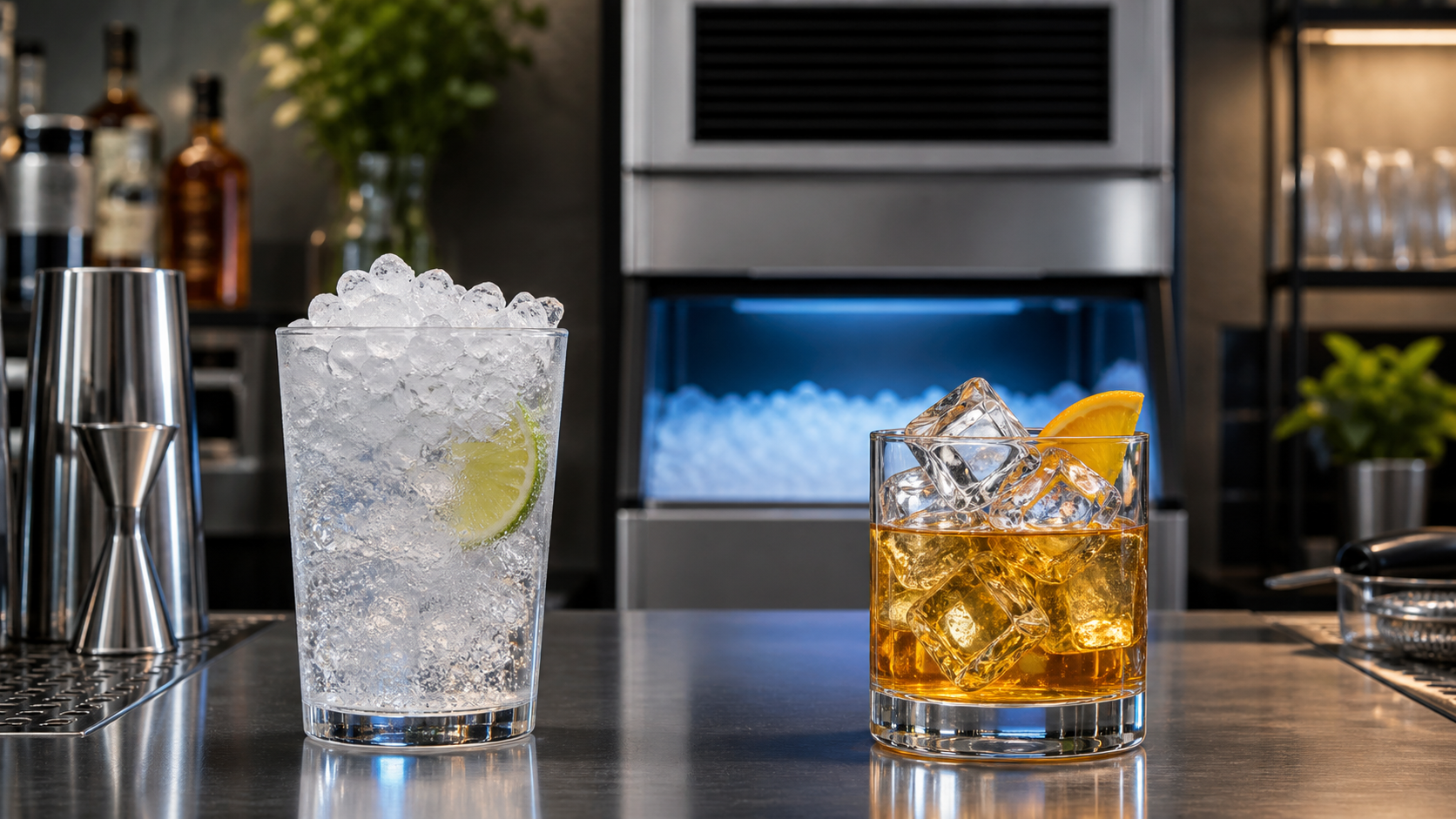
The types of ice machines used in foodservice split along one basic line: batch machines that freeze ice on a cold evaporator and release it in cycles, and continuous machines that scrape ice off a refrigerated cylinder with an auger. Batch machines make the cube family — full cube (often sold as square ice), half or dice cube, crescent and gourmet ice. Continuous machines make flake and nugget ice. Pick the ice first, because the ice decides the machine. Cabinet style and cooling method come second.
Two Ice-Making Methods Behind All Types of Ice Machines
Federal efficiency rules sort equipment the same way operators should. In the federal definitions for automatic commercial ice makers, a batch type ice maker has alternate freezing and harvesting periods, while a continuous type ice maker freezes and harvests ice at the same time. Everything else about the ice — hardness, melt rate, how it pours — follows from that difference.
Batch machines: evaporator plate or grid, then harvest
A pump circulates water over a refrigerated evaporator divided into cells, or sprays it up into inverted cups. Ice builds in thin layers. Water that has not frozen keeps moving and carries away air and some dissolved minerals, which is why batch ice comes out hard and fairly clear. When the ice reaches set thickness, the machine switches to harvest: the evaporator warms briefly, the ice lets go and drops into the bin, and a new freeze cycle begins.
Continuous machines: refrigerated cylinder and auger
Water fills a vertical, refrigerated cylinder. A thin layer of ice forms on the inside wall, and a slowly turning auger scrapes it off and pushes it upward. If the ice leaves the top loose, it is flake ice. If the auger forces it through a restricted extrusion head, the flakes compress into pellets — nugget ice. Because this ice carries some unfrozen water, the federal test rules rate continuous machines with an ice hardness factor, the latent heat per pound of harvested ice compared with fully frozen ice.
Ice Machine Ice Types, One by One
Names vary between manufacturers, so read spec sheets for the actual shape and size rather than the marketing label. The six families below cover almost everything a commercial buyer will see.
Full cube and square cube ice
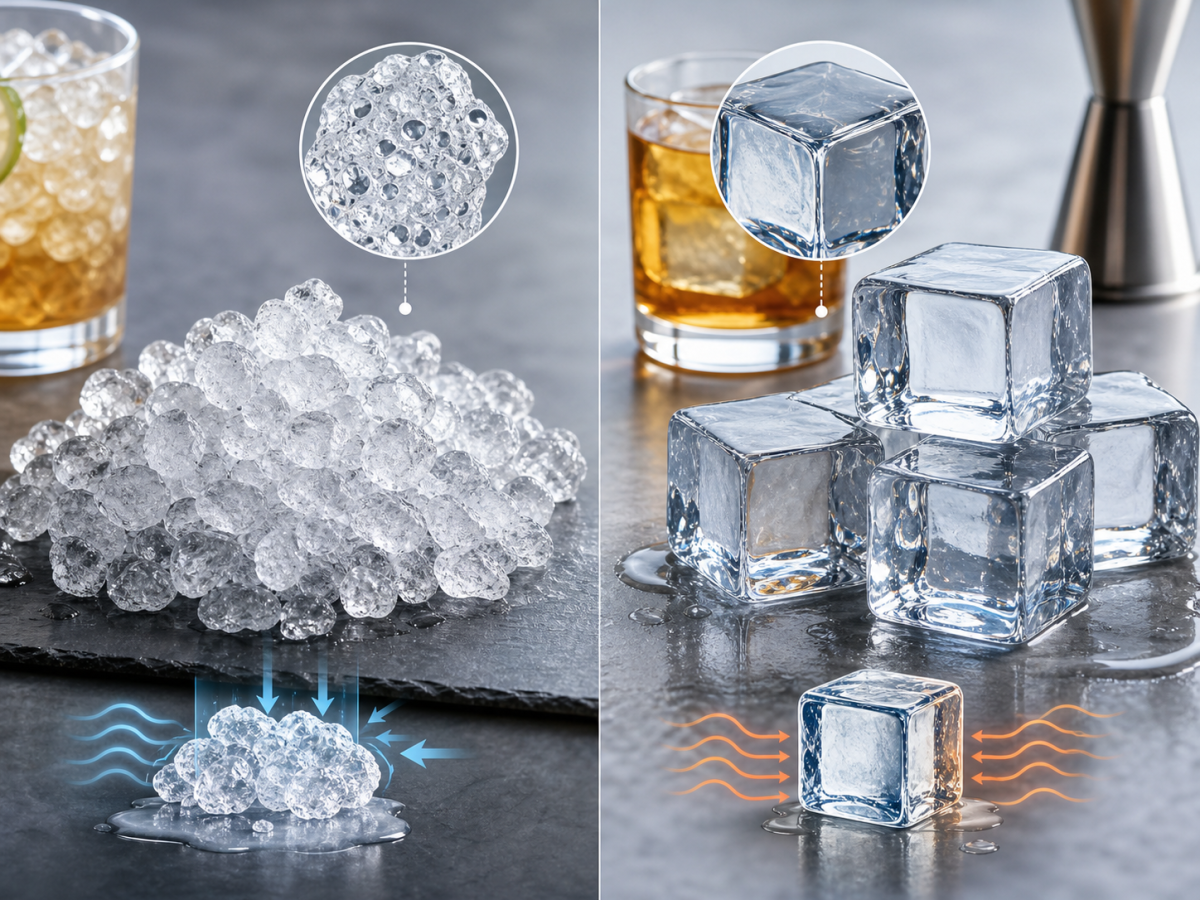
Full cube ice is the dense, fully frozen block most people picture in a glass of soda or a rocks drink. “Square ice” is the common name for the same family. It has the slowest melt of the everyday shapes, holds up when shaken in a cocktail tin, stores well in bins and bags, and stacks with visible gaps in a glass, so drinks carry more liquid. Its hardness is also its limit: full cubes are harder on blender blades and can bridge in dispensers built for smaller ice.
On batch machines with adjustable harvest thickness, cube size is not fixed. A thicker setting leaves more ice mass per cube; a thinner setting releases lighter cubes sooner. Operators with mixed menus can test settings against their own glassware.
Half cube and dice ice
Half cube (also called dice or regular cube) is made the same way on a grid with smaller cells. More pieces fill the glass, which packs tighter around the liquid, chills faster and reduces the pour. Smaller pieces also flow through self-serve dispensers and break down more easily in blended drinks. The trade-off is a faster melt than full cube, so it suits high-turnover drinks better than slow-sipped ones.
Crescent cube ice
Crescent ice has one flat side and one rounded side. A crescent cube ice machine freezes water against a vertical evaporator where each cell forms the curve, then harvests the batch like any cube machine. The rounded profile lets liquid flow around the ice with less splashing, which is why crescent ice is common in beverage dispensers, iced coffee and tea service, and bagged ice. It is hard ice with a solid core, so melt behavior sits close to full cube.
Gourmet, top-hat and octagon ice
Gourmet ice is the premium end of the cube family: large, very clear pieces shaped like a top hat, a thimble or an octagon, usually frozen by spraying water up into inverted cups. It melts slowly and looks good in a rocks glass, so it belongs in spirit-forward cocktail programs, hotel lobby bars and catered events where presentation matters. It is a poor fit for dispensers, blenders or anyone who needs the most pounds of ice per dollar of equipment.
Nugget and chewable ice
Nugget ice — also called pellet, chewable or pebble ice — is compressed flake ice extruded into small, soft cylinders. Air pockets make it easy to chew and quick to chill a drink, and the porous surface picks up the flavor of the beverage. It packs tightly into cups, moves easily through dispensers and blends smoothly. It melts faster than cube ice, and the auger, bearings and extrusion head are moving parts that need attention in hard-water areas. Healthcare, senior living, quick-service soda programs and smoothie bars are its core users.
Flake ice
Flake ice leaves the auger uncompressed: soft, wet, irregular chips that mold around whatever they touch. It has no hard edges, so it cools fish, shellfish and produce on display without bruising, and it packs around salad bar pans. Hospitals and labs use it for therapy packs and sample transport. It melts fastest of all ice types and is rarely the right choice for drinks.
For a shorter visual primer on the same shapes, Smartool’s guide to ice shapes and ice machine selection covers bullet, crescent, cube, half cube, gourmet and nugget ice side by side.
How the Ice Types Compare on Hardness, Melt and Dispensing
The table ranks each type relative to the others. It is a comparison of physical behavior, not a measured lab result; exact performance depends on piece size, water temperature and the machine’s harvest settings.
| Ice type | Machine method | Hardness | Melt rate | Fill in a glass | Dispensers and blenders |
|---|---|---|---|---|---|
| Full cube / square cube | Batch, evaporator grid | Very hard, fully frozen | Slow | Loose, visible gaps | Bin and scoop; hard on blenders |
| Half cube / dice | Batch, smaller grid cells | Hard | Moderate | Tighter pack | Good in dispensers and blenders |
| Crescent | Batch, curved evaporator cells | Hard, solid core | Slow | Moderate; less splash | Good in dispensers; bags well |
| Gourmet / top-hat | Batch, inverted cups | Very hard, very clear | Slowest | Few large pieces | Not suited to either |
| Nugget / chewable | Continuous, auger and extrusion head | Soft, compressed | Fast | Very tight pack | Dispenses and blends easily |
| Flake | Continuous, auger, no compression | Softest, wet | Fastest | Molds around product | Display and packing, not drinks |
Ice Type Selection Matrix by Business Use
Start with the station that uses the most ice at peak. If one station needs chewable or flake ice and the rest of the operation serves drinks, two machines of different types is usually the cleaner answer than forcing one ice type everywhere.
| Business use | Best fit | Workable | Poor fit | Why | Square cube (Smartool BF) fit |
|---|---|---|---|---|---|
| Full-service restaurant: water, soda, tea, bar | Full or half cube | Crescent | Flake | Slow melt through a long table turn | Strong |
| Bar: shaken, stirred and rocks drinks | Full cube | Crescent; gourmet for premium pours | Nugget, flake | Hard ice survives shaking and dilutes slowly | Strong |
| Frozen and blended drink station | Half cube or nugget | Thinner full cube | Gourmet | Smaller or softer ice blends faster | Workable at thinner settings |
| Self-serve soda or beverage dispenser | Ice type the dispenser is built for | Half cube, crescent, nugget | Gourmet | Wrong ice can bridge in the chute | Check the dispenser manual |
| Coffee and tea shop | Crescent or half cube | Nugget | Flake | Low splash over espresso; steady pour | Workable |
| Hospital or senior living, patient hydration | Nugget | Flake for therapy packs | Full cube, gourmet | Soft, chewable ice for patients | Staff areas and cafeterias only |
| Hotel guest floors, banquets and catering | Full cube or crescent | Gourmet for lobby bar | Flake | Holds shape in buckets and bags | Strong |
| Seafood, produce and salad bar display | Flake | Nugget | Full cube, gourmet | Molds around product without bruising | Not a fit |
| Quick-service fountain drinks | Nugget or half cube | Crescent | Gourmet | Fast chill, fast cup fill | Workable for scooped cups |
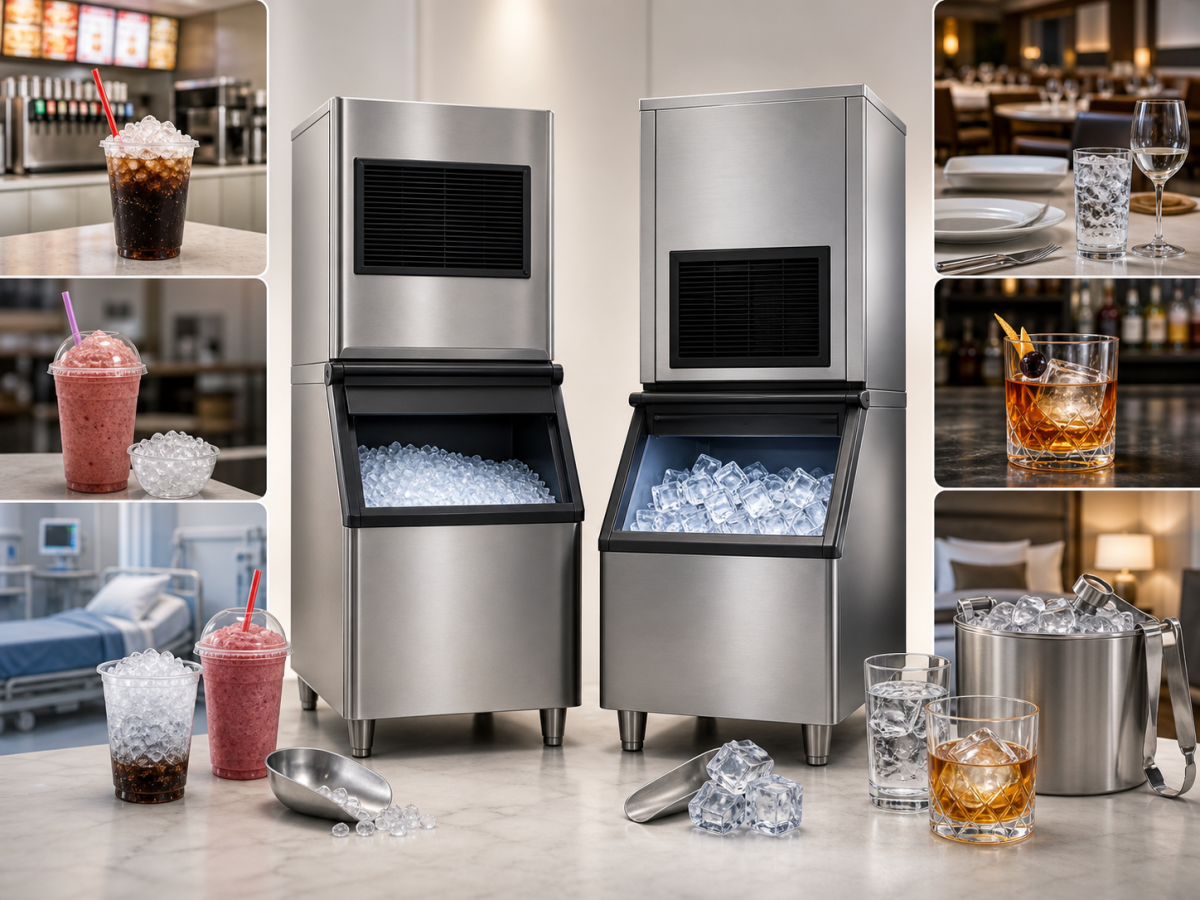
Once the ice type is settled, size the machine to peak demand, not the daily average. The bar ice machine sizing guide works through drinks per peak hour and bin versus production for cube-based programs.
Types of Ice Makers by Configuration and Cooling
The second way buyers classify ice makers is by packaging. Any of the ice types above can come in more than one format:
- Modular heads (ice-making heads) sit on a separate bin or dispenser and cover the higher output range.
- Self-contained and undercounter units combine the ice-making section and storage in one cabinet.
- Ice and beverage dispensers hold and portion ice for self-serve lines, usually fed by a head on top.
- Remote condenser systems move the condenser outdoors or to another room to keep heat out of the kitchen.
Our comparison of modular vs undercounter ice machine layouts covers footprint, bin planning and drain requirements in depth. Cooling is its own decision; the guide to air-cooled vs water-cooled ice machine costs runs the utility math.
Efficiency programs cover both machine methods. ENERGY STAR commercial ice maker criteria include air-cooled batch-type machines and continuous-type flake and nugget machines, in ice-making head, self-contained and remote condensing designs. Minimum efficiency is set separately under DOE energy conservation standards for automatic commercial ice makers, which have applied to cube type machines since 2010.
Where Smartool Square Ice Makers Fit
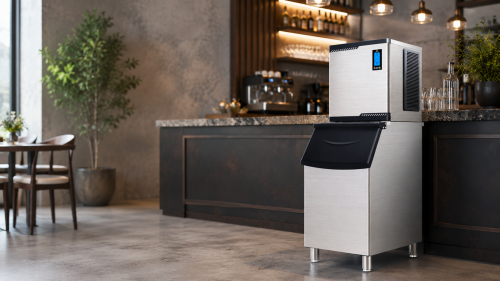
Smartool builds batch-type square cube machines. The Smartool BF500 500 lb split-type ice maker and the BF360 360 lb split-head ice maker both produce standard square cubes with 12-level ice thickness adjustment, so one head can run a thicker cube for slow-melt bar service or a thinner one for blended drinks.
| Specification | BF500 | BF360 |
|---|---|---|
| Ice type | Standard square ice cubes | Square ice cubes |
| Max daily output (70°F ambient / 50°F water) | 500 lb ±5% per 24 h | 360 lb ±5% per 24 h |
| Output at 90°F ambient / 70°F water | 375 lb ±5% per 24 h | 275 lb ±5% per 24 h |
| Ice thickness | 12-level adjustable | 12-level adjustable |
| Voltage | 110–120V / 60Hz | 110–120V / 60Hz |
| Power rating (90°F ambient / 70°F water) | 1050W | 700W |
| Operating ambient range | 41–100°F | 41–100°F |
| Cleaning and alerts | Automatic self-cleaning; water shortage and ice-full alerts; 48-hour timer | Automatic cleaning; water shortage and ice-full alerts; 48-hour timer |
| Warranty | 3-year commercial warranty | 3-year commercial warranty |
Plan around the hot-condition figure if your kitchen runs warm, since every ice machine harvests less as room and water temperatures rise; the guide to protecting ice machine output in summer heat covers placement and ventilation. Both heads are split-type units, so plan the storage bin, drain and clearance from the spec sheet.
Smartool does not make nugget or flake ice machines. If patient hydration, a chewable-ice soda program or a seafood display drives your purchase, shop for a continuous-type auger machine for that station. Many operations pair one with a square cube head for the bar and dining room. The full range of factory-direct commercial ice makers and current Smartool ice machines show what is available for cube-based service.
Common Questions About Ice Machine Types
Can one ice machine make both nugget and cube ice?
No. Cube machines freeze and harvest in cycles on an evaporator; nugget machines scrape and compress ice continuously with an auger. The refrigeration layout, water system and harvest mechanism are different, so operations that need both install two machines.
Is square ice the same as full cube ice?
Usually, yes. “Square” and “full cube” both describe the dense cube family, but dimensions differ by manufacturer and by thickness setting. Compare the cube size on the spec sheet with your glassware and any dispenser you plan to feed.
What is a crescent cube ice machine best for?
Beverage dispensers, iced coffee and tea, and bagged ice. The curved shape reduces splash and pours smoothly, while the solid core keeps melt slow. For shaken cocktails, full cube does the same job.
Does the ice type change cleaning and maintenance?
Yes. Continuous machines add an auger, bearings and an extrusion or discharge path that collect scale in hard water. Batch machines concentrate scale on the evaporator and water distribution. Either way, follow the manual’s schedule; the commercial ice machine cleaning guide separates cleaning from sanitizing, and Smartool’s ice machine maintenance guide lists operator-level condenser and water system care.
Which ice type should a new restaurant start with?
For most full-service restaurants and bars, a full or half cube machine covers water, soft drinks, tea and cocktails. Add a nugget or flake machine only when a specific station needs it. The commercial ice maker buying guide puts ice type in order with sizing, configuration, cooling and site utilities.
If square cube ice matches your menu, send us your peak drink counts, kitchen temperature and available space, and we will match you with the right BF head. Request a commercial ice machine quote to get specifications and pricing for your site.
Related posts
Are Ice Cream Vending Machines Profitable? Cost & Payback
Work out ice cream vending machine profit cup by cup: mix cost, commission, card fees, power, labor, permits and the daily sales needed to pay back the machine.
Modular Ice Machine vs Undercounter: Which Setup Fits?
Compare modular ice machines, undercounter ice makers and countertop dispensers on height, airflow, drains, bins and cost, with a site decision matrix.
2 thoughts on “Types of Ice Machines: Ice Shapes, Uses and How Each Is Made”
Comments are closed.