




Blog
500 lb Commercial Ice Machine Review: Smartool BF500 vs BF360
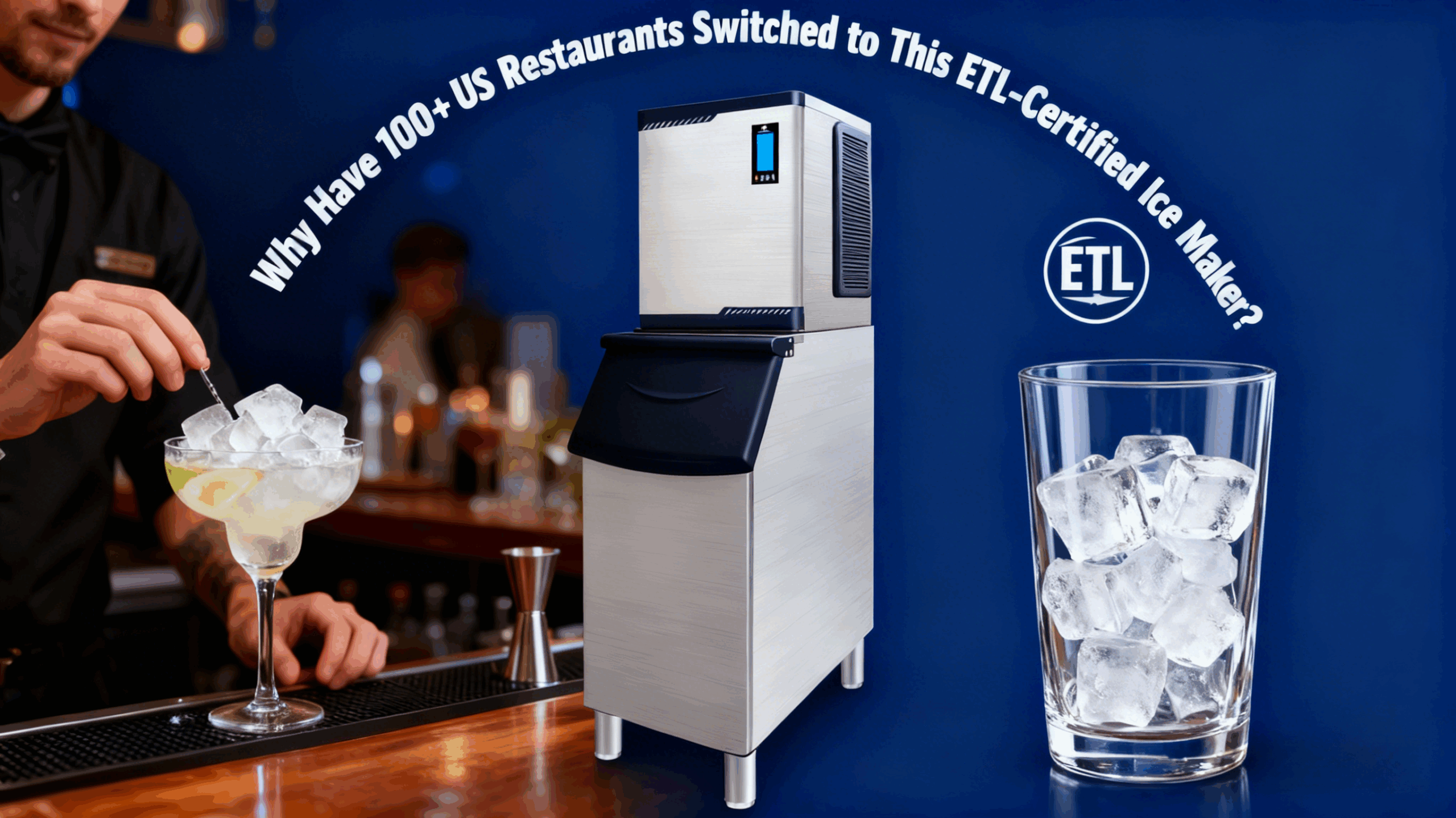
If you are shortlisting a 500 lb commercial ice machine, the Smartool BF500 is a split-type square-cube head rated at 500 lb ±5% per 24 hours in a 70°F room with 50°F water, and 375 lb ±5% at 90°F air with 70°F water. It runs on standard 110–120V/60Hz power with a 1050W rating. Its smaller sibling, the BF360, is rated 360 lb and 275 lb under the same two conditions at 700W. This review turns those numbers into servings, compares the two models spec by spec, shows who each one fits and who should buy something else, and closes with what a seafood restaurant in San Jose saw after switching.
BF500 and BF360 Verdict in One Minute
- Choose the BF500 when your worst-case day, in a warm room, needs up to roughly 375 lb of cube ice and you want to stay on a 110–120V circuit.
- Choose the BF360 when a hot-day requirement stays under about 275 lb, such as a café, dessert shop or hotel beverage station.
- Look elsewhere if your menu depends on nugget or flake ice, if you need well over 500 lb from a single head, or if the machine room regularly runs above 100°F.
- Both models share 12-level thickness control, automatic cleaning, water shortage and ice-full alerts, a 48-hour timer and a 3-year commercial warranty.
What “500 lb” Means on a 500 lb Commercial Ice Machine
A daily capacity number is only meaningful with its test conditions attached. Ice makers produce less as room air and supply water get warmer, because the condenser rejects heat less efficiently and incoming water takes longer to freeze. That is why the BF500 product page lists two figures instead of one.
- 500 lb ±5% per 24 hours at 21°C (70°F) ambient air and 10°C (50°F) water. The tolerance puts real output between about 475 and 525 lb.
- 375 lb ±5% per 24 hours at 32°C (90°F) ambient air and 21°C (70°F) water, or about 356 to 394 lb. That is 25% below the cool-condition figure.
The hot-condition figure is the one to compare across brands. AHRI Standard 810 sets the test and rating requirements for automatic commercial ice makers, and the Department of Energy’s test procedure for automatic commercial ice makers uses 90°F ambient air and 70°F supply water as rating conditions. Smartool’s 32°C/21°C figure lines up with those temperatures, so 375 lb is the like-for-like number to set against other 500 lb class quotes.
Output Per Hour at Each Condition
Hourly production decides how fast a bin recovers after a rush. At 70°F/50°F the BF500 makes about 20.8 lb an hour and the BF360 about 15.0 lb. At 90°F/70°F those rates fall to about 15.6 lb and 11.5 lb. If your machine room warms up through the afternoon, plan evening service around the lower rates. Our guide to keeping a commercial ice machine productive in summer heat covers ventilation and placement fixes.
How Many Drinks and Covers 275–500 lb of Ice Supports
The table below divides each rating by an assumed amount of ice per serving. The assumptions are round numbers, not measurements: weigh a cup, glass and shaker filled the way your staff fill them and replace them with your own figures.
- 16 oz iced drink: about 1/3 lb (5.3 oz) of cube ice.
- Water glass: about 1/4 lb (4 oz).
- Shaken cocktail served on the rocks: about 1/2 lb, counting shaker ice and the ice in the glass.
| Servings per day | BF500 at 70°F/50°F (500 lb) | BF500 at 90°F/70°F (375 lb) | BF360 at 70°F/50°F (360 lb) | BF360 at 90°F/70°F (275 lb) |
|---|---|---|---|---|
| 16 oz iced drinks (1/3 lb each) | 1,500 | 1,125 | 1,080 | 825 |
| Water glasses (1/4 lb each) | 2,000 | 1,500 | 1,440 | 1,100 |
| Shaken cocktails (1/2 lb each) | 1,000 | 750 | 720 | 550 |
Worked Example: A Full-Service Restaurant With a Seafood Station
Assume each cover gets one iced drink and one water glass, or 7/12 lb, rounded up to 2/3 lb to allow for spillage and melt in the bin. Assume a further 100 lb a day goes to holding seafood and produce. Daily covers then equal the rating minus 100 lb, multiplied by 1.5.
- BF500, hot day: (375 − 100) × 1.5 ≈ 412 covers. On a cool day, (500 − 100) × 1.5 = 600 covers.
- BF360, hot day: (275 − 100) × 1.5 ≈ 262 covers. On a cool day, (360 − 100) × 1.5 = 390 covers.
Daily totals still hide the rush. If 120 covers arrive in a three-hour dinner window, they need about 80 lb of ice. On a hot day the BF500 makes about 47 lb in those three hours, so roughly 33 lb must already be in storage when service starts. The BF360 makes about 34 lb, leaving about 46 lb to come from the bin. For drink-by-drink bar calculations, see the bar ice machine sizing guide.
BF500 vs BF360 Specifications Side by Side
Every value below comes from the “Core Specifications” and feature lists on the Smartool BF500 500 lb split-type ice maker page and the BF360 360 lb split-head ice maker page. Hourly rates and the derating percentage are calculated from those figures.
| Specification | BF500 | BF360 |
|---|---|---|
| Configuration | Split-type head | Split-type head |
| Daily output, 21°C (70°F) air / 10°C (50°F) water | 500 lb ±5% | 360 lb ±5% |
| Daily output, 32°C (90°F) air / 21°C (70°F) water | 375 lb ±5% | 275 lb ±5% |
| Output drop, cool to hot condition (calculated) | 25% | 23.6% |
| Hourly output, hot condition (calculated) | about 15.6 lb | about 11.5 lb |
| Ice type | Standard square cubes | Square cubes |
| Ice thickness | 12-level adjustable | 12-level adjustable |
| Voltage / frequency | AC 110–120V / 60Hz | AC 110–120V / 60Hz |
| Power rating (at 32°C air / 21°C water) | 1050W | 700W |
| Operating ambient range | 5–38°C (41–100°F) | 5–38°C (41–100°F) |
| Climate class | SN, N, ST | SN, N, ST |
| Cleaning | Automatic self-cleaning | Automatic cleaning |
| Alerts | Water shortage, ice full | Water shortage, ice full |
| Timer | 48-hour | 48-hour |
| Protection | Controller overheat, compressor overload, fuse overcurrent | High temperature, compressor overload, overcurrent |
| Display | LCD | LCD |
| Materials | 201 and 304 stainless steel body, nickel-plated copper ice trays | 201 and 304 stainless steel, nickel-plated copper ice trays |
| Noise | ≤65 dB at 1 m from the front, 50 dB ambient | ≤65 dB |
| Warranty | 3-year commercial warranty | 3 years |
The power rating is the figure to use for circuit planning with your electrician and as an input when you model running costs. Our breakdown of commercial ice machine cost shows how to turn wattage, local utility rates and cleaning labor into a five-year number.
Who Each Model Fits, and Who Should Look Elsewhere
| Operation | Better fit | Why | Look elsewhere if |
|---|---|---|---|
| Café, dessert or bubble tea shop | BF360 | 275 lb on a hot day covers about 825 iced drinks at 1/3 lb each on 700W | Drinks are blended with nugget or flake ice |
| Full-service restaurant with a bar | BF500 | 375 lb at 90°F/70°F leaves room for water service, cocktails and a warm kitchen | Hot-day need is well above 375 lb |
| Seafood or produce holding plus beverages | BF500 | Square cubes chill product and serve drinks from one machine | Displays require flake ice that molds around product |
| Hotel breakfast or beverage station | BF360 or BF500 | Choose by your peak-window worksheet; both run on 110–120V | Guests need a hands-free self-serve dispenser |
| Hot back room or line without ventilation | Neither, until airflow is fixed | Rated operating range tops out at 38°C (100°F) | The space stays above 100°F in summer |
| High-volume site above 500 lb a day | Two BF500 heads, or a larger machine | Splitting output across two units also keeps ice flowing if one needs service | You want one high-output head on a 208–230V circuit |
If nugget, flake or crescent ice is part of your menu, start with our overview of the types of ice machines instead. If you are still deciding how much heat and water a condenser should handle, compare air-cooled and water-cooled ice machine costs.
Trade-Offs to Weigh Before Ordering
- Split-type planning: both models are split-type heads, so ice storage, drain routing and ventilation clearance should be laid out from the spec sheet and installation manual before the unit arrives.
- One ice shape: the 12 thickness levels change cube size, but both machines make square cubes only.
- Standard power: 110–120V operation avoids a new 208–230V circuit, and it also means 500 lb per head is the ceiling in this range.
- Noise placement: ≤65 dB at 1 m suits back-of-house and bar storerooms; if the head will sit near guest seating, plan its location with that figure in mind.
- Cleaning still needs a schedule: the automatic cleaning function reduces manual work, but periodic sanitizing, condenser brushing and filter checks remain operator tasks.
Smartool’s ice machine maintenance knowledge base sets out the routine: a daily exterior wipe, condenser brushing every two weeks in dusty kitchens or monthly otherwise with power disconnected, and water system cleaning with food-grade ice machine cleaner. For step-by-step sanitizing and mold prevention, use our guide on how to clean a commercial ice machine.
Checks to Run on Any 500 lb Class Ice Machine Quote
Whichever brand makes your shortlist, these checks separate a clear quote from a vague one. Run them on every machine you compare.
| Check | Why it matters | Where to look |
|---|---|---|
| Output at 90°F air / 70°F water | The only fair basis for comparing daily capacity | Spec sheet hot-condition line or published AHRI rating |
| DOE energy standard coverage | Federal maximum energy use limits apply by equipment type and harvest rate | 10 CFR 431 Subpart H automatic commercial ice maker rules |
| ENERGY STAR listing | Only air-cooled batch and continuous machines are eligible; a logo means little without a listed model number | ENERGY STAR certified ice machine finder |
| Refrigerant and GWP | New self-contained batch machines up to 1,000 lb per 24 hours must use refrigerant with GWP of 150 or less from January 1, 2026 | Nameplate and EPA HFC restrictions for ice machines |
| NSF/ANSI 12 sanitation listing | Covers materials, design and construction of automatic ice making equipment | NSF automatic ice making equipment listings |
| Electrical safety listing | A mark from a recognized lab shows the product was tested to applicable safety standards | OSHA Nationally Recognized Testing Laboratory program and the lab’s own directory |
| Warranty and service terms | Downtime costs more than most repairs | Written policy covering machine, compressor, response and parts |
For the full decision sequence that comes before model selection, from ice type to drains and supplier questions, see our commercial ice maker buying guide.
Ownership, Warranty and Support Terms
Both product pages list a 3-year commercial warranty along with manuals and technical specifications. Smartool’s after-sales policy spells out what that covers in North America: three years on the full machine and on the compressor, one year of parts and labor, and original factory parts at cost once coverage ends.
- On-site service: available in major cities with advance reservation, with a response usually within 48 hours.
- Remote areas: video remote diagnosis and mail-in parts support.
- Remote help: free video guidance and phone consultation; email requests with the serial number get a reply within one working day.
- Extended cover: optional 1–2 year extended warranty, plus Annual Maintenance Contracts for large or customized equipment.
- Exclusions: damage from misuse or unauthorized disassembly, non-original parts or unauthorized repairs, natural disasters, abnormal voltage and transport damage.
When output drops, staff can work through the user-level checks first: water supply, inlet filter screen, room temperature and scale. The Smartool ice maker fault diagnosis system lists common symptoms and likely causes. Refrigerant, sensor, valve and electrical work belongs with a qualified technician or Smartool support.
Customer Story: A San Jose Seafood Restaurant Moves to the BF500
A seafood restaurant in San Jose, California, chilled each day’s seafood on ice every morning. Its older, smaller ice maker could not keep pace: by mid-afternoon most of the ice in the holding buckets had melted, some product had to be thrown out, and staff bought bagged ice during the afternoon rush.
After working through options with its distributor, the restaurant installed a BF500, chosen for its 375 lb rating in a 90°F room. Ice production held steady through the afternoon rush, the kitchen stopped buying bagged ice, and most seafood stayed fresh until closing. After the switch, the restaurant’s weekly seafood waste fell from about 18 lb to under 10 lb.
The lesson carries beyond seafood. The fix was not a bigger daily number on paper but enough production in a warm kitchen during the hours the ice was actually needed. A mid-size New York City restaurant running cocktails, cold drinks and seafood through summer peak season had a similar experience, with its manager describing a BF500 that ran through the busiest month without an ice shortage.
Getting a BF500 or BF360 Quote for Your Site
Start with your serving math and your warmest room temperature, then compare against the 375 lb and 275 lb hot-condition ratings. To see these models alongside the rest of the range, browse Smartool commercial ice maker machines, or visit the factory-direct commercial ice maker lineup for multi-unit and distributor orders.
If you are building a business case for several locations, the Smartool ROI solutions page has a calculator for estimating payback on an equipment investment from your own sales and customer figures. When you are ready, request a quote for the BF500 or BF360 with your daily and peak ice needs, available voltage, drain location and room temperature so the recommendation matches the conditions the machine will run in.
About Lumi Guo
View all posts by Lumi GuoLeave a Reply
Related posts
Are Ice Cream Vending Machines Profitable? Cost & Payback
Work out ice cream vending machine profit cup by cup: mix cost, commission, card fees, power, labor, permits and the daily sales needed to pay back the machine.
Modular Ice Machine vs Undercounter: Which Setup Fits?
Compare modular ice machines, undercounter ice makers and countertop dispensers on height, airflow, drains, bins and cost, with a site decision matrix.
2 thoughts on “500 lb Commercial Ice Machine Review: Smartool BF500 vs BF360”