




Blog
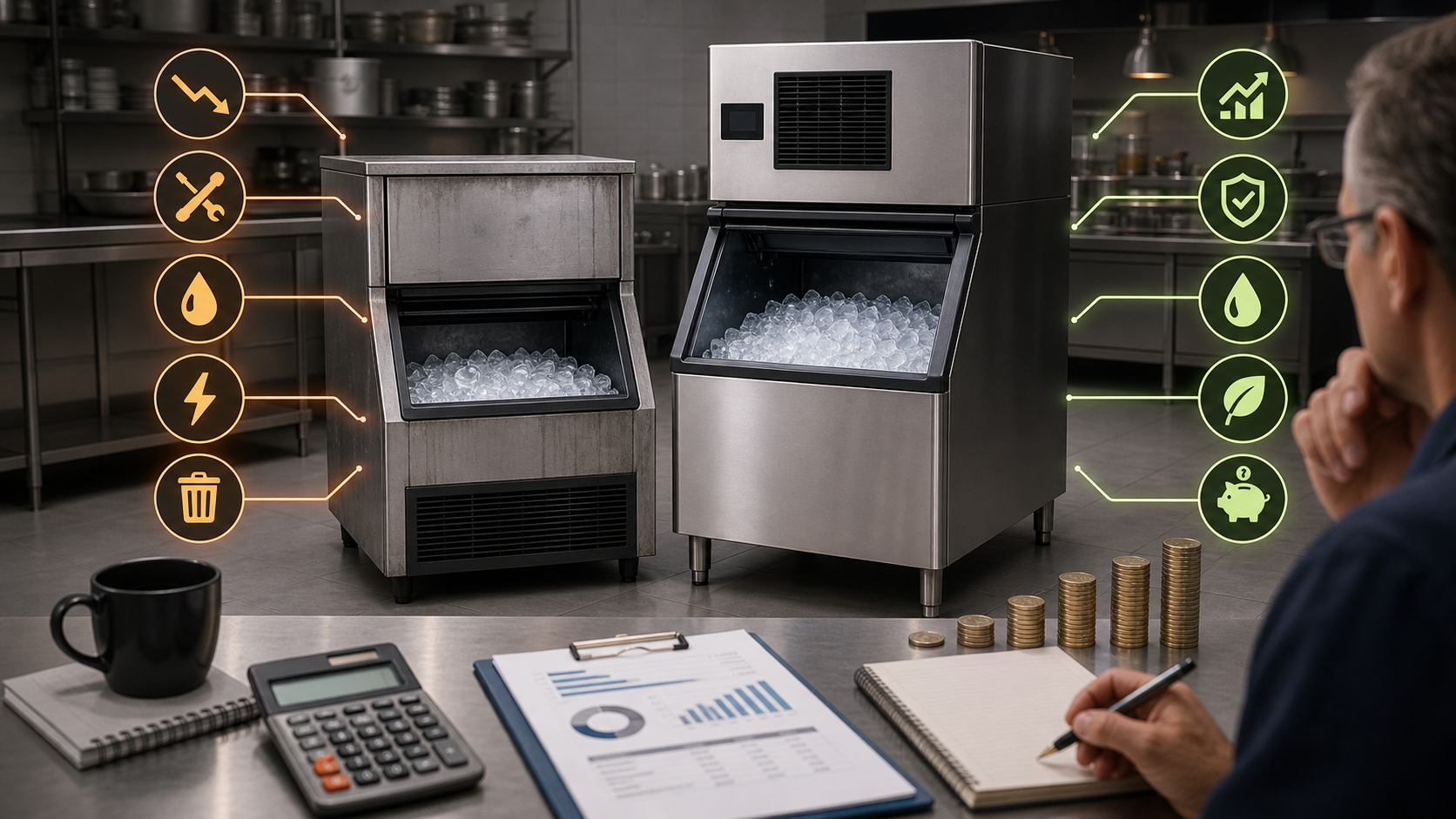
See every cost line of a commercial ice machine: price drivers, install, energy, water, cleaning and downtime, plus a 5-year TCO worksheet with real inputs.
How much does a commercial ice machine cost? There are two answers. The first is the number on the quote. The second is what you pay over the next five years to install, power, supply with water, clean, filter and back up that machine. Price lists vary widely with capacity, configuration and freight, so a list price tells you little. This guide breaks the cost into lines you can measure, works through the energy math using the rated power of two real split-type ice makers, and ends with a 5-year worksheet you fill in with your own quotes and utility rates.
The cost stack behind a commercial ice machine
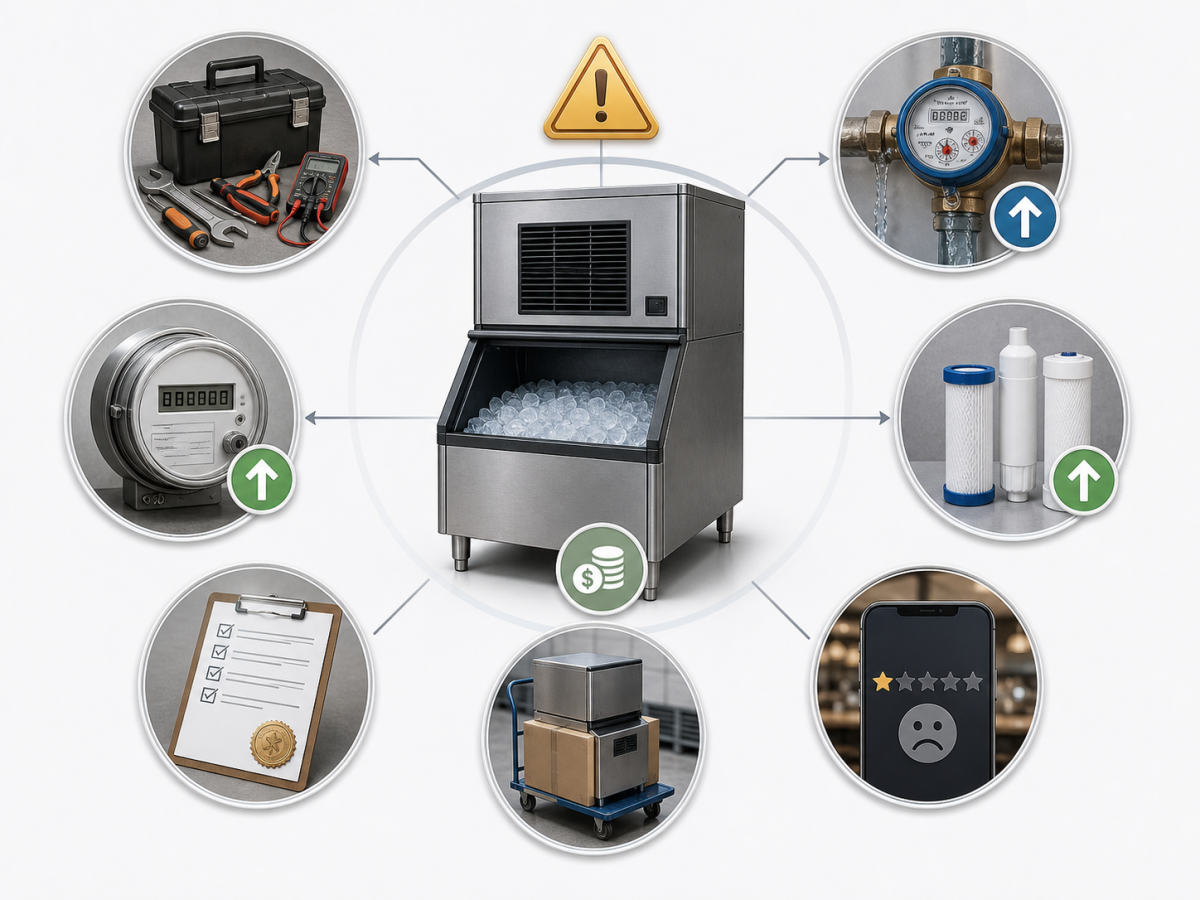
Think of the purchase as the top layer of a stack. Every layer below it is a recurring or one-time cost that a low quote does not remove:
- Equipment: the ice maker, plus the storage bin, stand, filter head and freight when they are quoted separately.
- Installation: water supply, drain, electrical circuit, placement and removal of the old unit.
- Energy: the compressor and fans run for as long as the bin calls for ice.
- Water and sewer: the water that becomes ice, plus the water flushed away during each cycle.
- Cleaning and preventive maintenance: staff time, approved cleaner and sanitizer, and technician visits.
- Filters: replacement cartridges on the filter’s service life.
- Repairs outside warranty: the years your 5-year plan runs past the warranty term.
- Downtime: bagged ice, staff runs to the store and slower service when production stops or falls short.
- End of life: removal, refrigerant recovery and disposal.
How much does a commercial ice machine cost to buy? The price drivers
Two quotes for “a 500 lb machine” can describe very different equipment. Line up these specifications before you compare prices.
Rated output and the test conditions behind it
Daily output is usually quoted at mild conditions and drops in a hot room with warm incoming water. The Smartool BF500, for example, is rated at 500 lb per 24 hours at 70°F (21°C) air and 50°F (10°C) water, and 375 lb at 90°F (32°C) air and 70°F (21°C) water. If you size on the cooler figure, a hot kitchen will be short of ice. The bar ice machine sizing guide shows how to turn peak drink counts into a daily ice requirement.
Configuration: what actually arrives
Self-contained undercounter units include their own storage. Modular heads and split-type heads make ice but rely on a separate bin or dispenser, so the head price alone is not a complete equipment cost. When you browse commercial ice maker machines, check whether a bin, legs and a water filter are part of each line item. The trade-offs between formats are covered in the modular vs undercounter ice machine guide.
Condenser type
Air-cooled machines reject heat into the room. Water-cooled machines add condenser water to your utility bill. Remote condensers need refrigerant line runs and roof or exterior work during installation. Each choice moves cost between the purchase, installation and utility lines, which is why the air-cooled vs water-cooled ice machine cost comparison is worth reading before you request quotes.
Ice type
Cube, nugget and flake ice come from different freezing mechanisms, and specialty shapes carry their own pricing. Choose the ice your menu needs first; the guide to commercial ice machine types matches ice shapes to uses.
Efficiency, controls and support terms
Efficiency changes the energy line for the life of the machine. Air-cooled models certified under ENERGY STAR’s commercial ice maker program meet energy and water limits tighter than the federal minimum, and that difference repeats on every utility bill. Controls such as automatic cleaning, low-water alerts and production timers affect labor and downtime. Warranty length and parts availability decide how much repair risk stays with you.
Ask every supplier to itemize the quote so you can compare like for like:
- Unit price, with rated output at both standard and hot conditions
- Bin or dispenser, stand or legs, and scoop holder
- Water filter head and first cartridge
- Freight, liftgate delivery and any setup
- Rated power and voltage, and water use from the spec sheet
- Warranty term, what it covers, and parts availability period
- Approved cleaner and the cleaning interval in the manual
Installation costs: water, drain, power and airflow
Installation cost depends on how far the site is from ready. A contractor quote should cover each of these items:
- Water supply: a potable water line with a shutoff valve, plus a filter head if the machine does not include one.
- Drain: a gravity drain to a floor drain or sink. The FDA Food Code 2022 (§ 5-402.11) prohibits a direct connection between the sewage system and a drain from equipment in which food is placed, and the Code defines ice as food. In practice that means an air gap.
- Electrical: BF500 and BF360 run on 110–120V/60Hz. Match the outlet and circuit to the spec sheet and local electrical code; a new circuit means an electrician.
- Clearance and heat: Smartool’s ice machine maintenance guide recommends more than 30 cm (about 12 in) of space at the back and both sides, away from heat sources. A cramped spot next to a fryer costs you in output and energy for years.
- Old unit removal: disconnecting, hauling and disposal, covered under end of life below.
Energy cost: a worked example with BF500 and BF360 rated power
Energy is the easiest recurring cost to model because the inputs are published. For the rate, the U.S. Energy Information Administration’s Electric Power Monthly, Table 5.3 puts the 2025 average commercial-sector electricity price at 13.41 cents per kWh. Replace it with the rate on your own bill, including any demand charges.
For the load, both Smartool split-type heads publish a power rating measured at 90°F (32°C) ambient air and 70°F (21°C) water. The table below turns that rating into a continuous-run ceiling: the energy the machine would use if it ran at rated power 24 hours a day, every day.
| Input or result | BF360 | BF500 |
|---|---|---|
| Rated output at 70°F air / 50°F water | 360 lb / 24 h | 500 lb / 24 h |
| Rated output at 90°F air / 70°F water | 275 lb / 24 h | 375 lb / 24 h |
| Power rating (at 90°F air / 70°F water) | 700 W | 1050 W |
| Continuous-run ceiling, kWh per day | 16.8 | 25.2 |
| Continuous-run ceiling, kWh per year | 6,132 | 9,198 |
| Ceiling cost per year at 13.41¢/kWh | $822 | $1,233 |
| Ceiling cost over 5 years | $4,112 | $6,167 |
| Ceiling kWh per 100 lb at the hot rating | 6.1 | 6.7 |
Treat these figures as an upper bound. A machine stops making ice when the bin is full, so real consumption tracks the pounds you actually use. A reasonable estimate scales the ceiling by that share: a kitchen drawing 300 lb a day from a BF500 in a 90°F room uses about 300 ÷ 375, or 80 percent, of the ceiling, which is roughly $987 a year at the EIA average rate. In a cooler room the same demand needs fewer run hours, so the estimate drops further.
Efficiency premiums can pay for themselves. The Department of Energy’s FEMP purchasing guidance for air-cooled ice machines calculates that a qualifying ENERGY STAR model saves money if it costs no more than $384 (in 2022 dollars) above a less efficient model, based on federal-facility electricity prices. The same guidance notes that sites with higher energy rates or heavy use can save more with more efficient equipment. It also warns that air-cooled units lose efficiency when airflow is blocked by a nearby wall or low ceiling.
To compare quotes on energy, ask for each model’s energy use per 100 lb of ice under the same rating conditions. The Department of Energy sets federal energy conservation standards for automatic commercial ice makers, so this figure is a normal part of a spec sheet.
Water and sewer charges
Most utilities bill water coming in and sewer going out, often per 1,000 gallons or per hundred cubic feet. An ice machine uses water in two ways: the water frozen into ice, and the water purged during each cycle to carry minerals away. Water-cooled condensers add a third, much larger stream.
The formula is simple: pounds of ice per day ÷ 100 × gallons per 100 lb (from the spec sheet) × 365 × your combined water and sewer rate per 1,000 gallons ÷ 1,000. Hard water makes this line bigger indirectly, because scale increases cleaning frequency and filter changes.
Cleaning, filters and preventive maintenance
Maintenance is the line owners cut first and pay for later. Mineral scale on the freezing surface slows heat transfer, so each batch takes longer. A dust-clogged condenser rejects heat poorly, raising power draw and stressing the compressor. Slime in the bin means discarded ice, a deep clean during service hours and a problem at inspection time. None of these shows up on the purchase quote, and all of them grow when the routine slips.
Budget four items. Staff time for the routine in the manual, costed at your loaded labor rate. Manufacturer-approved ice machine cleaner and a food-grade sanitizer. Filter cartridges, which Smartool’s maintenance guide says are usually replaced every 3 to 6 months or by processed water volume. Technician visits for the tasks staff should not do. The step-by-step routine and a fill-in cleaning log are in the commercial ice machine cleaning guide.
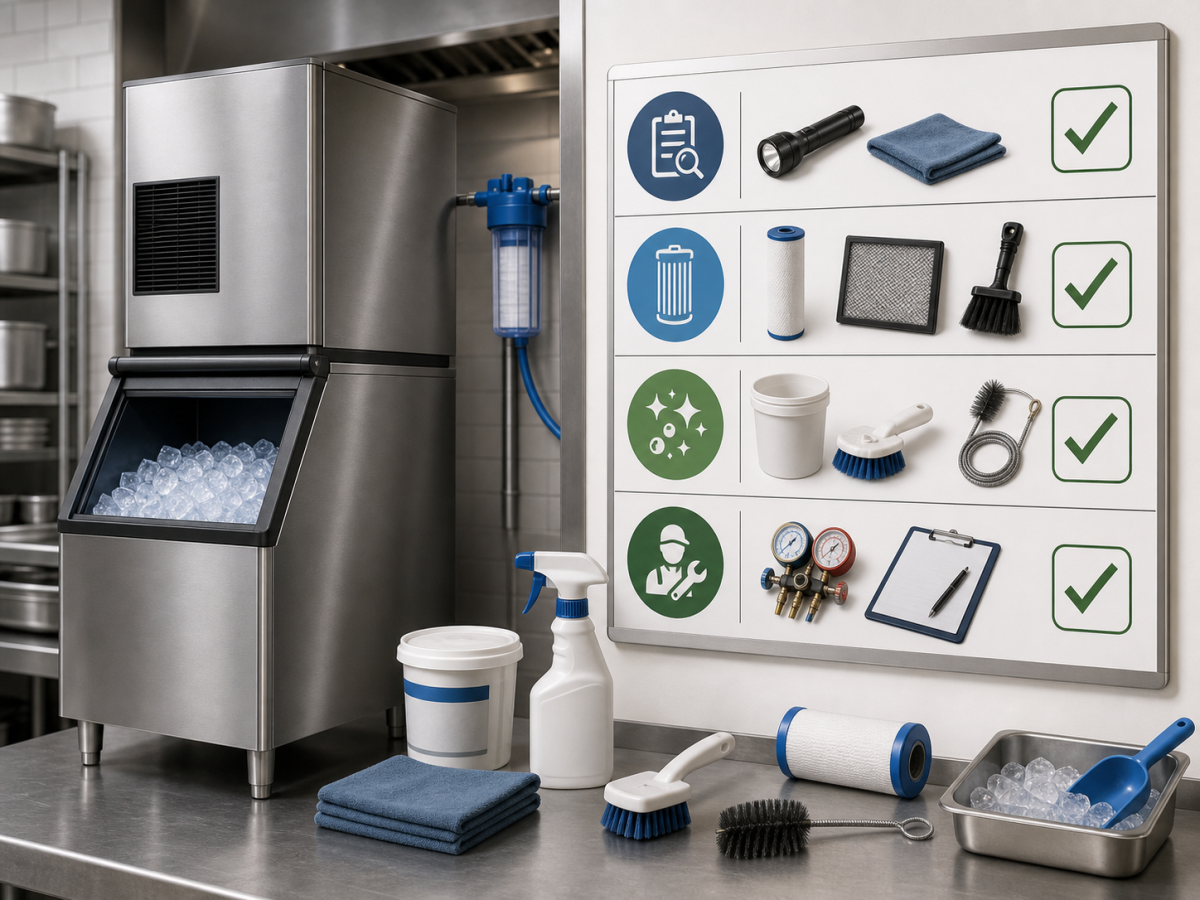
Warranty terms belong in this section too. Smartool’s after-sales policy excludes damage from misuse, non-original parts, abnormal voltage and transport, so the budget should cover correct power and the maintenance the manual calls for.
Downtime and the bagged-ice backup
Downtime cost has three parts: the bagged ice you buy, the staff hours spent fetching and hauling it, and the slower service while it lasts. Model it as outage or shortfall days × pounds short per day × your local bagged-ice price per pound, plus labor.
Undersizing creates this cost without any breakdown. Suppose a kitchen needs 300 lb a day and the room reaches 90°F in summer. A BF360 is rated at 275 lb under those conditions, so every hot day starts 25 lb short. In a room held near 70°F, the same machine is rated at 360 lb and covers the load. The warm-season effect is explained in the guide to protecting ice machine output in summer heat.
Support terms shorten outages. BF500 and BF360 have water-shortage and ice-full alerts, so a closed supply valve gets noticed before the bin runs dry. Under Smartool’s after-sales policy both have three years of machine and compressor coverage in North America, one year of parts and labor, and original parts at cost afterward. The same policy lists on-site service in major cities by appointment, usually within 48 hours, and video diagnosis with mailed parts for remote areas.
End of life: removal, refrigerant recovery and replacement
When the machine is retired, removal is not just hauling. Under the EPA’s Section 608 safe disposal requirements, refrigerant must be recovered before refrigeration equipment is scrapped, and the final disposer needs documentation of that recovery. Budget for a technician or a removal crew that handles recovery, plus the installation work for the next unit.
Timing matters as much as the disposal fee. Replacing a machine after it fails in July adds a peak-season outage to the bill. The signals that justify planned replacement are covered in when to replace a commercial ice machine.
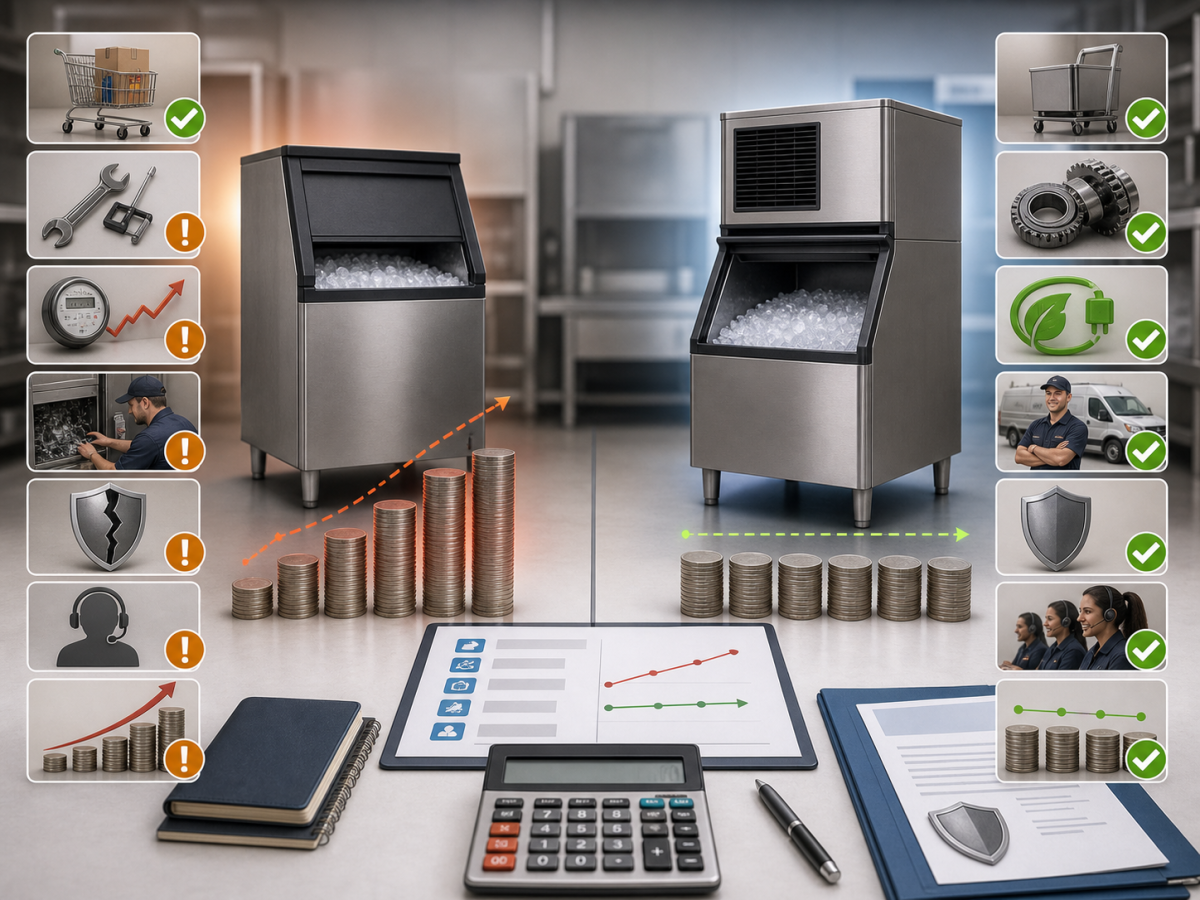
5-year commercial ice machine total cost of ownership worksheet
Fill in one column per machine you are considering. The sample column uses a BF500 serving 300 lb a day in a room that reaches 90°F. Energy uses the published power rating and the EIA 2025 commercial average. Values marked [placeholder] are round numbers to show the arithmetic; replace them with your spec sheet, utility bill and labor rate. Letters stand for amounts that only a quote can supply.
| Cost line | Formula (5 years) | Sample fill: BF500 at 300 lb/day |
|---|---|---|
| Equipment | Unit + bin or dispenser + accessories + freight | P (from quote) |
| Installation | Water line + drain with air gap + electrical + filter head + old-unit removal | I (from contractor) |
| Energy | kW × 24 × 365 × (lb needed ÷ rated lb at your conditions) × $/kWh × 5 | 1.05 × 24 × 365 × (300 ÷ 375) × $0.1341 × 5 = $4,934 |
| Water and sewer | lb/day ÷ 100 × gallons per 100 lb × 365 × $ per 1,000 gal ÷ 1,000 × 5 | 3 × 20 gal [placeholder] × 365 × $15 [placeholder] ÷ 1,000 × 5 = $1,643 |
| Cleaning labor | Cleanings per year × hours each × labor rate × 5 | 12 × 1 h × $25/h [placeholder] × 5 = $1,500 |
| Cleaner and sanitizer | Doses per year × price per dose × 5 | C |
| Filters | Cartridges per year × cartridge price × 5 | 2 to 4 cartridges a year × F |
| Preventive maintenance | Technician visits per year × visit price × 5 | M |
| Repairs after warranty | Repair reserve or extended warranty for years 4 and 5 | R (years 1 to 3 under the 3-year commercial warranty) |
| Downtime and backup ice | Outage or shortfall days × lb short × $/lb bagged ice + staff hours | D |
| End of life | Removal + refrigerant recovery + disposal | E |
| Total | Sum of all lines | P + I + $8,077 + C + F + M + R + D + E |
Run the same sheet for a smaller machine and the trade-off shows up. A BF360 at full output costs at most $822 a year in energy at the same rate ($4,112 over five years), but in a 90°F room it cannot reach 300 lb, so the downtime line fills with shortfall days. Once bagged ice is priced in, the lower energy line may cost more overall.
To test payback scenarios against revenue as well as cost, run your figures through Smartool’s ROI calculator for commercial equipment buyers.
BF500 vs BF360 as cost inputs
Both models are split-type heads on the same 110–120V supply, so the choice comes down to demand, room temperature and the energy line. The figures below come from the product pages. Because both are heads, plan the storage bin, drain and ventilation from the spec sheet when you set the installation budget.
| Cost-relevant spec | BF360 | BF500 |
|---|---|---|
| Output at 70°F air / 50°F water | 360 lb ±5% / 24 h | 500 lb ±5% / 24 h |
| Output at 90°F air / 70°F water | 275 lb ±5% / 24 h | 375 lb ±5% / 24 h |
| Power rating (90°F air / 70°F water) | 700 W | 1050 W |
| Voltage | 110–120V / 60Hz | 110–120V / 60Hz |
| Ice | Square cubes, 12-level thickness adjustment | Square cubes, 12-level thickness adjustment |
| Labor and downtime features | Automatic cleaning function, water-shortage and ice-full alerts, 48-hour timer | Automatic self-cleaning, water-shortage and ice-full alerts, 48-hour timer |
| Operating ambient range | 41–100°F (5–38°C) | 41–100°F (5–38°C) |
| Warranty (North America) | 3-year machine and compressor; 1-year parts and labor | 3-year machine and compressor; 1-year parts and labor |
Choose the BF360 360 lb split-head ice maker when your peak-season demand stays under its 275 lb hot rating, or when the room is climate-controlled. Choose the Smartool BF500 500 lb split-type ice maker when summer demand runs above that, so the extra 350 W of rated power replaces bagged ice instead of adding to it.
Ice machine cost questions buyers ask
Is leasing cheaper than buying?
It depends on what the lease includes. Add up 60 monthly payments and compare that total with the worksheet’s P, I, C, F, M and R lines, since a lease usually replaces those. Energy, water and downtime from undersizing stay with you either way.
Why do two quotes for the same capacity differ so much?
Usually because they are not the same scope. One may include a bin, filter and freight while the other quotes a bare head, or one rates output at 70°F while the other quotes 90°F. Itemized quotes using the checklist above make the gap easy to explain.
Does a bigger machine cost proportionally more to run?
No. Energy follows the pounds of ice you actually make. At 250 lb a day in a 90°F room, the estimate is about $748 a year for a BF360 and about $822 a year for a BF500. The BF500’s power rating is 50 percent higher, yet at the same demand the estimate is only about 10 percent higher, and the larger machine adds headroom for hot days.
Build your five-year numbers before you commit to a price. Start with your daily ice demand, the room temperature in July and your utility rates, then compare factory-direct commercial ice makers against that load. When you have those inputs, request a commercial ice machine quote and ask for the itemized scope listed above.
Factory-direct from Smartool
Planning a commercial equipment purchase?
Share your site conditions, daily output and budget. Our team will match a model, send the spec sheets and quote factory-direct pricing.

Written by
Senior Engineer, Smartool
Jason is a senior engineer at Smartool. He works on the commercial ice machines, soft serve and slushy machines, and refrigerated prep tables Smartool builds for restaurants, bars, hotels and dessert shops. His guides look at equipment from the engineering side: how to size a machine for a site, what it needs for power, water and airflow, and how to keep it running through busy service. He also helps buyers match the right model to their kitchen before they request a quote.
.elementor-76528 .elementor-element.elementor-element-5c7a0d0{--display:flex;--flex-direction:column;--container-widget-width:100%;--container-widget-height:initial;--container-widget-flex-grow:0;--container-widget-align-self:initial;--flex-wrap-mobile:wrap;}.elementor-76528 .elementor-element.elementor-element-5c7a0d1 .elementor-toc__header-title{text-align:start;}.elementor-76528 .elementor-element.elementor-element-5c7a0d1 .elementor-toc__header{flex-direction:row;}.elementor-76528 .elementor-element.elementor-element-5c7a0d1{--item-text-hover-decoration:underline;}
On this page
Need pricing for your project?
Get a factory-direct quote on commercial ice makers, soft serve and slushy machines, and refrigerated prep tables.
✓ Model matching and spec sheets for your site
✓ US office in City of Industry, CA
✓ Talk to an expert: +1 (872) 221-0051
Browse by topic
Ice Machine Guides
Soft Serve & Ice Cream
Slushy & Frozen Drinks
Buying & Sourcing
Compliance & Maintenance
Related posts

Ice Machine Freezing Up? Causes, Safe Checks and Fixes
Ice machine freezing up? Learn the six common causes, what staff can safely check, what needs a technician, and how to prevent repeat freeze-ups.

How to Use a Margarita Machine or Slush Machine
How to use a margarita machine or slush machine: setup, mixing and filling, freeze time, consistency, dispensing, refills and the closing routine.
7 thoughts on “How Much Does a Commercial Ice Machine Cost? 5-Year TCO”
Comments are closed.