




Blog
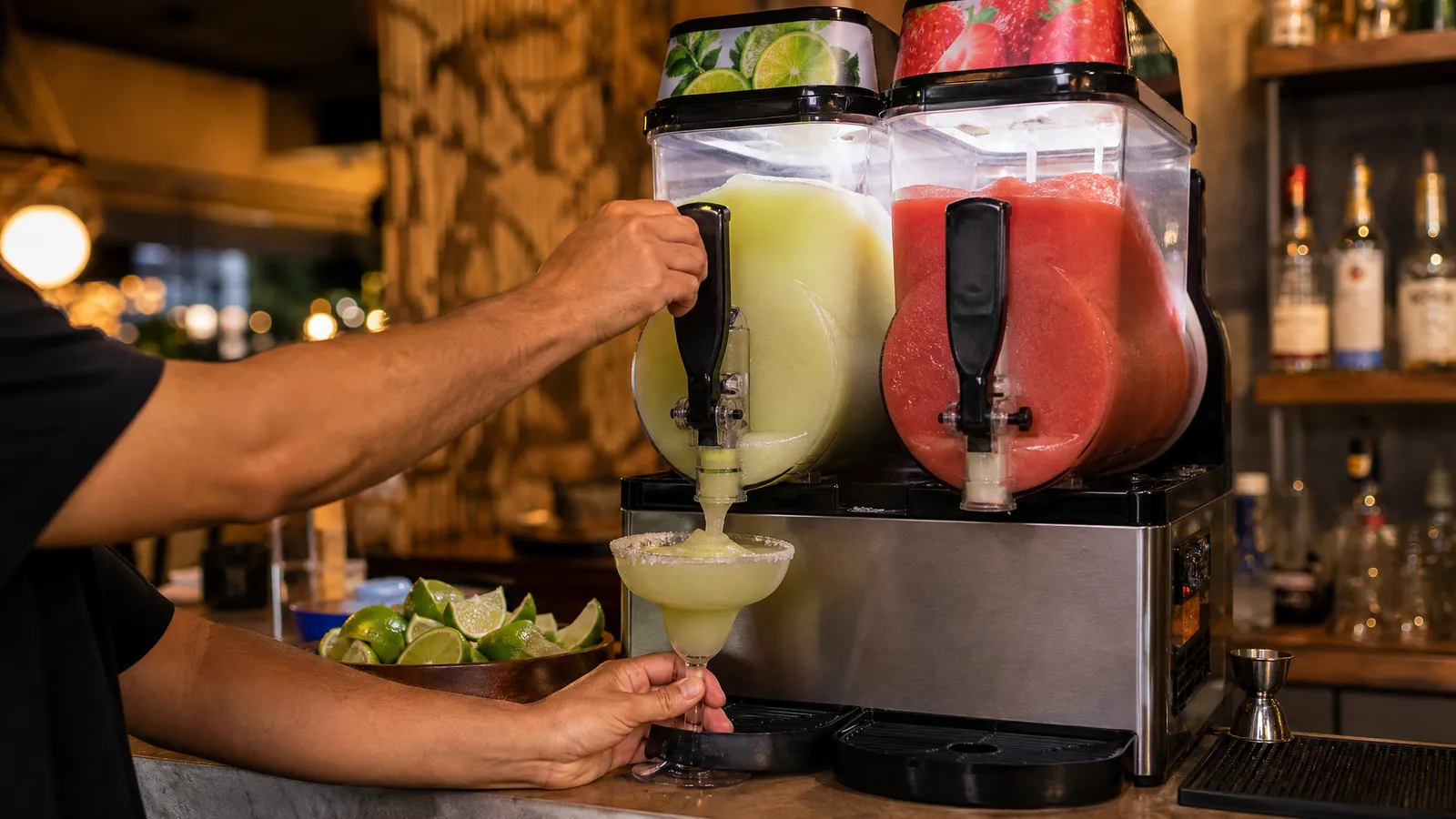
How to use a margarita machine or slush machine: setup, mixing and filling, freeze time, consistency, dispensing, refills and the closing routine.
Learning how to use a margarita machine or a commercial slush machine comes down to a short routine: set it level with room to breathe, clean and sanitize the parts, mix the product to the right sugar level, fill to the line, and give the first batch its full freeze time before you pour. After that, service is about adjusting consistency, keeping the bowls topped up with chilled mix, and draining and cleaning at close. This guide walks through each step from setup to first serve, with realistic freeze-down expectations and a short section on frozen margaritas.
Part of our commercial slush machine buying guide series.
How a slush machine works
A pour-over slush machine is a small freezer built around a clear bowl. Inside each bowl sits a refrigerated cylinder, and an auger turns around it. As the mix touches the cold cylinder, thin ice crystals form, and the auger keeps scraping and stirring them so the drink stays pourable instead of freezing into a block. Once the product reaches serving texture, the machine cycles to hold it there. A margarita machine works the same way; the difference is the mix in the bowl. So how to work a margarita machine and how to use a slush machine are the same question, answered by the steps below.
That design explains most of the rules below. The machine serves from frozen inventory, so warm mix, a hot room or a blocked condenser all show up as runny product and long waits.
Setup and placement before the first batch
Most freezing problems in the first week trace back to where the machine sits. Check these points before you plug it in:
| Check | What to look for | Why it matters |
|---|---|---|
| Level counter | Adjust the leveling feet until the machine sits flat and steady | An unlevel machine vibrates and gets noisy |
| Rear clearance | At least 20 cm (about 8 in) between the back of the machine and the wall | The condenser needs airflow to shed heat |
| Room temperature | Within the machine’s rated range; Smartool’s RLC18-1 and RL18-3 are rated for 10–32 °C (50–90 °F) | Hot rooms slow freezing and can trigger overheat protection |
| Heat sources | Away from fryers, ovens, dish machines and direct sun | Warm air at the condenser intake cuts cooling |
| Circuit | Rated current on the nameplate compared with the outlet’s circuit | Slush machines run for hours at a time |
| Drip tray access | Staff can slide the tray out without moving the machine | A full tray overflows onto the counter |
Rated current varies widely between models. The RLC18-1 single-tank slushie machine is rated at 5.3 A on 120 V, while the three-tank RL18-3 is rated at 14.5 A. The National Electrical Code (NFPA 70) treats loads that run three hours or more as continuous and sizes branch circuits with headroom above them, which in practice puts a 14.5 A machine on its own 20 A circuit. Have a licensed electrician confirm the outlet before the first service.
Before the first batch, wash, rinse and sanitize the bowl, auger, valve and seals. Food Code § 4-702.11 requires food-contact surfaces to be sanitized after cleaning and before use, and a new machine has been through packing and shipping. Reassemble with the seals seated flat, lubricated only where the manual says.
Mixing and filling the bowl
Sugar is what lets a slush freeze into soft crystals instead of hard ice. Smartool’s slush machine troubleshooting reference recommends a mix of 12–18 Brix. A mix that is too thin will not form slush; one that is too thick can stick to the auger and strain it. Our slushie machine recipes give starting ratios for 15 drinks. Follow the mix manufacturer’s ratio of syrup to water rather than stretching syrup, and check each new batch with a refractometer. Washington State University’s refractometer guide shows the basic method.
- Mix in a clean, sanitized container, not in the bowl, so you can check the ratio and Brix before it goes in.
- Chill the mix if you can. Mix that goes in cold from the walk-in has less heat to remove, so it generally reaches serving texture sooner.
- Fill to the marked line. Stay under the maximum mark on the bowl, and never run a bowl empty with the auger turning.
- Close the lid and label the bowl with the flavor and the time it went in.

How long does a slush machine take to freeze?
There is no single answer, because freeze time depends on the machine’s cooling capacity, how much mix is in each bowl, how cold the mix was, its sugar or alcohol content, and the temperature of the room. Manufacturers usually list a first-batch time. Smartool lists 40–60 minutes for the single-tank RLC18-1 and 50–75 minutes for the three-cylinder RL18-3. Treat those figures as a starting point and time your own first few batches under your own conditions.
| Factor | Tends to shorten freeze time | Tends to lengthen it |
|---|---|---|
| Mix temperature | Pre-chilled mix | Room-temperature or warm mix |
| Room | Cool, ventilated space inside the rated range | Hot kitchen, patio in summer, blocked rear clearance |
| Condenser | Clean fins | Dust or grease on the fins |
| Recipe | Sugar within the recommended Brix range | Too much sugar, or alcohol, which lowers the freezing point |
| Load | Bowls started together at opening | A large warm refill in the middle of a rush |
For planning, switch the machine on at least the listed first-batch time before opening, plus a margin for the day’s conditions. On a hot day or with a new recipe, start earlier.
Setting the consistency
Controls differ by model. Some machines have a consistency or firmness dial, others a temperature setting per bowl. The RL18-3 three-cylinder slushy machine has separate electronic temperature control for each of its three 16.5 L tanks, so a tart lemonade slush and a sweeter fruit blend can run at different settings side by side. The RLC18-1 and RL18-3 spec sheets list a discharge temperature of ≤ -1 °C (about 30 °F).
- Change one setting at a time, in small steps, and give the bowl time to settle before judging the result.
- Too runny: check Brix and room temperature before turning the setting colder. A setting cannot fix a mix that is too thin or too sweet.
- Too stiff or the auger strains: back the setting off, and check that the mix is not too thick for the machine.
- Write the setting that works for each recipe on a card by the machine, so every shift starts from the same point.
Dispensing during service
- Hold the cup under the valve before you open it, keep the rim clear of the nozzle, and close the valve fully after each pour.
- Keep the lids on between refills to hold temperature and keep debris out.
- Watch the drip tray. The RLC18-1 and RL18-2 have removable 0.2-gallon drip trays with a red button that pops up when the tray is full. Empty and rinse it before it overflows.
- Wipe sticky drips off the valve and handle through the shift. Dried syrup there is where sticking taps start.
Refilling without losing texture
Every refill adds heat that the machine has to remove, so the goal is small, cold top-ups rather than a big warm refill when a bowl is nearly empty.
- Top up with the same flavor, pre-chilled, while the bowl still holds a good amount of frozen product.
- On a multi-tank machine, stagger refills so at least one bowl of each best-seller is always at full texture.
- Keep a labeled container of chilled backup mix in the walk-in for each flavor on the menu.
- If a bowl keeps running out before the rush ends, the machine may be too small for your peak. The buying guide’s sizing worksheet shows how to check.
Using it for frozen margaritas
First, confirm the machine is meant for alcohol. Smartool’s product pages list frozen margaritas and cocktails among the intended drinks for the RLC18-1, RL18-2 and RL18-3. Then keep three rules in mind:
- Alcohol lowers the freezing point. A batch that is too strong stays soft or never sets, so follow a recipe written for frozen machines and expect a softer consistency setting and longer freeze time than a fruit slush.
- Start each batch in a clean bowl. Topping an old batch with a new one blurs the batch time, which some states require on the label.
- Check your state liquor rules on batching, labeling and to-go sales before the first batch goes in.
Batch strength, Brix and state examples are covered in more depth in our commercial margarita machine guide.
Closing and overnight routine
Smartool’s slushy machine maintenance guide calls for daily cleaning after each use or before closing. For the full routine, see how to clean a slush machine. The FDA Food Code 2022 ties cleaning of beverage dispensing nozzles and enclosed equipment parts to the manufacturer’s specified frequency, so the manual’s schedule is the one to follow. A typical close looks like this:
- Dispense or drain the remaining product and discard it.
- Flush each bowl with warm water and a little neutral detergent, running the auger briefly, then drain and repeat with clean water.
- Power off, unplug, and remove the bowl, valve, auger, seals and drip tray.
- Wash, rinse, sanitize and air-dry the parts, then wipe the outside with a damp cloth.
- Reassemble at close or before opening, and sanitize again right before the first fill.
Some machines offer a night or refrigeration-only mode for holding product. Use it only if your manual describes it and your health department accepts it for the product you serve. The maintenance guide also covers the weekly condenser cleaning and seasonal storage steps.
When the machine does not behave
| Symptom | First checks |
|---|---|
| Product stays runny | Brix, room temperature, rear clearance, condenser dust, bowl and seal seated correctly |
| Noise or vibration | Machine not level, worn auger blades, debris at the fan |
| Leaking at the tap | Aged or missing O-ring on the dispensing valve |
| Machine shuts off | Poor ventilation, unstable voltage, overload protector tripped; let it cool 10–15 minutes before restarting |
For step-by-step fixes, see our slush machine troubleshooting guide. Refrigerant and electrical faults belong with a qualified technician.
Slush and margarita machine questions
How long does a slushie machine take to freeze?
It depends on the machine, the mix and the room. Smartool lists first-batch times of 40–60 minutes for its single-tank model and 50–75 minutes for its three-tank model. Pre-chilled mix and a cool room help; warm mix, alcohol and a dusty condenser slow it down.
How do you make slushies in a slushie machine?
The steps for how to use a slushie machine are the same as above. Mix syrup and water to the manufacturer’s ratio, check that it falls in the recommended Brix range, pour it into a clean bowl up to the fill line, switch on freeze and wait for the first batch to reach serving texture. Then adjust consistency and top up with chilled mix during service.
How does a margarita machine work?
Like a slush machine. A refrigerated cylinder chills the batch while an auger keeps the ice crystals small and moving, and the machine holds the product at a pourable texture. Because alcohol lowers the freezing point, the batch recipe has to suit the machine’s cooling.
Can you make ice cream in a slush machine?
Not real ice cream. A slush machine is designed to keep product pourable, and dairy bases need a machine the manufacturer approves for them. Smartool’s slush machine pages list slushies, cider slushes, margaritas and frozen cocktails, not dairy products. Soft serve and ice cream need a machine built for them.
To compare single, dual and three-tank models, browse the Smartool slushy machine range. For multi-location or distributor orders, see our factory-direct slushy machines program, or send us your busiest-hour cup count and the circuit at the install spot to request a factory-direct quote.
Factory-direct from Smartool
Planning a commercial equipment purchase?
Share your site conditions, daily output and budget. Our team will match a model, send the spec sheets and quote factory-direct pricing.

Written by
Senior Engineer, Smartool
Jason is a senior engineer at Smartool. He works on the commercial ice machines, soft serve and slushy machines, and refrigerated prep tables Smartool builds for restaurants, bars, hotels and dessert shops. His guides look at equipment from the engineering side: how to size a machine for a site, what it needs for power, water and airflow, and how to keep it running through busy service. He also helps buyers match the right model to their kitchen before they request a quote.
.elementor-76528 .elementor-element.elementor-element-5c7a0d0{--display:flex;--flex-direction:column;--container-widget-width:100%;--container-widget-height:initial;--container-widget-flex-grow:0;--container-widget-align-self:initial;--flex-wrap-mobile:wrap;}.elementor-76528 .elementor-element.elementor-element-5c7a0d1 .elementor-toc__header-title{text-align:start;}.elementor-76528 .elementor-element.elementor-element-5c7a0d1 .elementor-toc__header{flex-direction:row;}.elementor-76528 .elementor-element.elementor-element-5c7a0d1{--item-text-hover-decoration:underline;}
On this page
Need pricing for your project?
Get a factory-direct quote on commercial ice makers, soft serve and slushy machines, and refrigerated prep tables.
✓ Model matching and spec sheets for your site
✓ US office in City of Industry, CA
✓ Talk to an expert: +1 (872) 221-0051
Browse by topic
Ice Machine Guides
Soft Serve & Ice Cream
Slushy & Frozen Drinks
Buying & Sourcing
Compliance & Maintenance
Related posts

Ice Machine Freezing Up? Causes, Safe Checks and Fixes
Ice machine freezing up? Learn the six common causes, what staff can safely check, what needs a technician, and how to prevent repeat freeze-ups.

How to Use a Margarita Machine or Slush Machine
How to use a margarita machine or slush machine: setup, mixing and filling, freeze time, consistency, dispensing, refills and the closing routine.