




Blog
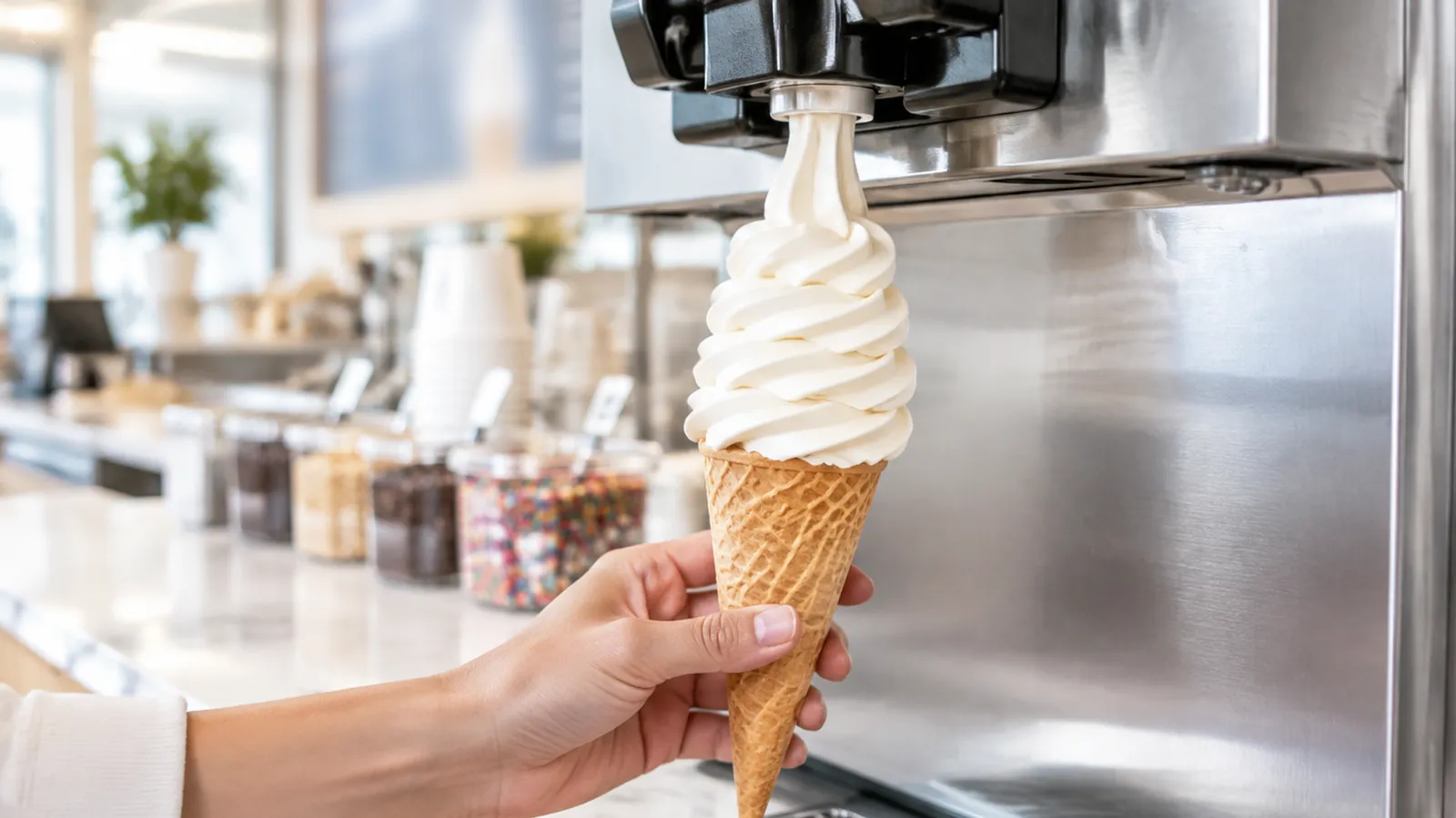
Soft serve ice cream recipe for commercial machines: sourced base ranges, a starter vanilla formula, pasteurization steps, overrun fixes and mix options.
A soft serve ice cream recipe for machine use is a balanced dairy base: milk fat for richness, milk solids for body, sugar for sweetness and a softer freeze, and a small dose of stabilizer and emulsifier to hold air and keep the texture smooth. The base has to be made from pasteurized ingredients, heat-treated, cooled fast and aged cold before it goes into the hopper. This guide gives food-science composition ranges, a starter vanilla base with three flavor variations, the food-safety steps a commercial kitchen needs, how to tune overrun and texture, and when a ready-made liquid or powder mix is the smarter call. Check your local health department’s rules before you make your own base; under some state licenses, a soft serve operation may not make mix from scratch at all.
Part of our commercial soft serve machine buying guide series.
Check the rules before you make your own base
Homemade soft serve mix is a regulated dairy product, and the rules differ by state. California is a clear example. The California Department of Food and Agriculture’s milk product plant license page states that under a soft-serve license, mixes must be obtained ready-to-use from a licensed milk products plant and may not be made from scratch. Making mix on site falls under a separate limited frozen manufacturing permit. Other states and counties set their own requirements, so ask your health department and state dairy program what applies before you buy ingredients.
Wherever you operate, the FDA Food Code 2022 sets the baseline most states adopt. Fluid and dry milk products must be obtained pasteurized (§ 3-202.14). Pasteurized eggs must replace raw eggs in foods such as ice cream unless the food is cooked to the Code’s temperatures (§ 3-302.13).
What goes into a soft serve base: composition ranges
Formulators describe a mix by its components as a percentage of total weight, not by a list of groceries. The University of Guelph’s Ice Cream Technology e-book gives these suggested compositions:
| Component | Soft-frozen mixes | Low-fat and light mixes (3–8% fat) | What it does |
|---|---|---|---|
| Milk fat | 10% | 3–8% | Richness, smooth texture, structure around air cells |
| Milk solids-not-fat (MSNF) | 12–12.5% | 11.5–13% | Body, volume and dairy flavor |
| Sucrose | 10–13% | 11–13% | Sweetness; lowers the freezing point so the product stays soft |
| Corn syrup solids | 0–4% | 4–6% | Extra solids and body with less sweetness |
| Stabilizer | 0.15–0.35% | 0.35% | Viscosity and mouthfeel |
| Emulsifier | 0.15% | 0.10–0.15% | Reduces dryness; helps fat build the air-cell structure |
| Total solids | About 36% | About 33.5–36% | The rest is water |
Guelph notes that soft serve usually runs lower in fat and higher in milk solids than hard ice cream, and that emulsifier is kept relatively high because dryness is a common soft serve concern. Stabilizer and emulsifier doses vary by product, so follow the supplier’s recommendation for the blend you buy. For how that difference plays out in equipment and serving, see soft serve vs hard ice cream machines.
Starter vanilla soft serve base (10 kg batch)
This base targets about 7% milk fat, 12% MSNF and 15% sugar, which sits in Guelph’s light-mix range with all the sweetener as sugar. The weights were calculated from the US minimum compositions for whole milk (3.25% fat) and heavy cream (36% fat), and a typical nonfat dry milk. Your dairy’s actual numbers will differ slightly, so treat it as a first test batch.
| Ingredient | Weight | Share of batch |
|---|---|---|
| Whole milk, pasteurized | 6.48 kg (14.3 lb) | 64.8% |
| Heavy cream, pasteurized (36% fat) | 1.35 kg (3.0 lb) | 13.5% |
| Nonfat dry milk | 0.61 kg (1.35 lb) | 6.1% |
| Granulated sugar | 1.50 kg (3.3 lb) | 15% |
| Stabilizer-emulsifier blend | About 30 g, or the supplier’s dose | About 0.3% |
| Vanilla extract | About 30 g, adjusted for strength | About 0.3% |
Guelph puts vanilla usage at about 0.3% of the mix, depending on the extract’s purity and concentration. Scale the batch to what you can pasteurize and cool safely in one run, not to hopper size.
Pasteurize, cool and age the base
Blending pasteurized ingredients is not the end of food safety. Once you mix them, the base is a time and temperature control for safety food, so heat-treat, cool and store it under control. Follow the steps your health department approves; this is the general sequence.
- Dry-blend first. Mix the stabilizer blend and nonfat dry milk into the sugar before they touch liquid. Tetra Pak’s Dairy Processing Handbook recommends blending stabilizers with sugar so they disperse completely.
- Heat with constant stirring. Guelph’s pasteurization chapter describes batch pasteurization of ice cream mix at 69 °C (155 °F) held for 30 minutes, with continuous systems running 80 °C (175 °F) for 25 seconds. Use a calibrated probe thermometer and log the time and temperature. Your state may set its own standard.
- Cool fast. Food Code § 3-501.14 requires cooked food to drop from 135 °F to 70 °F within 2 hours, and to 41 °F or below within 6 hours total. Use an ice bath and shallow containers, and stir.
- Add the vanilla once the base is cold.
- Age it cold. Hold the base at or below 5 °C (41 °F) for at least 4 hours, usually overnight. Both Guelph and Tetra Pak describe ageing as the step that lets fat crystallize and proteins and stabilizers hydrate, which improves whipping and texture.
- Label, date and keep it at 41 °F or below (Food Code § 3-501.16). The Food Code lets the regulatory authority approve a date-marking method for soft serve mix, so agree yours with the inspector.

Commercial plants also homogenize mix under high pressure, which a kitchen kettle cannot do. That is one reason a homemade base can be less stable than a commercial mix.
Flavor variations on the vanilla base
Chocolate soft serve
Guelph lists 3% cocoa powder as an acceptable level for chocolate ice cream. In the 10 kg batch, that is about 300 g of cocoa in place of 300 g of milk. Blend the cocoa with the sugar and add it before heating so it hydrates. Guelph also flags chocolate specking in soft serve, where cocoa fibers get trapped in churned fat, so a smooth, well-hydrated cocoa matters. Taste the aged base and raise sugar slightly if the cocoa reads bitter.
Strawberry soft serve
Guelph puts fruit at about 15–25% of the mix by weight. Use a smooth, seedless purée, and replace an equal weight of milk rather than adding purée on top, because fruit dilutes the fat and milk solids. Use a commercially pasteurized purée if it goes in after heat treatment, so you do not reintroduce contamination into a pasteurized base. Test a small batch and adjust from there.
Coffee soft serve
Dissolve instant espresso powder in the base while it is still warm, then dose to taste on a small test batch. Powder adds flavor without the water that brewed coffee would add to the batch.
Overrun and consistency adjustments
Overrun is the air the machine whips in, expressed as the percentage increase in volume over the mix. Smartool’s soft serve overrun guide puts the optimal range for soft serve at 40–70%. Below that the product is dense and costly per cup. Above about 70% it turns foamy and melts fast.
You can measure overrun with a cup and a scale. Fill a cup level with mix and weigh it, then fill the same cup with soft serve and weigh that. Overrun is the mix weight minus the soft serve weight, divided by the soft serve weight. If the mix weighs 540 g and the same cup of soft serve weighs 360 g, overrun is 50%.
Feed design affects how much control you have. Pump machines meter air into the cylinder, while gravity machines rely on natural aeration; our comparison of gravity-fed vs pump soft serve machines covers the trade-off. Test new bases in short runs. On the SW52, for example, Smartool lists a first-batch time of 10–15 minutes at 23 °C ambient and mix temperature, so a test pull gives quick feedback.
| Problem | Likely cause in the base | Adjustment to try |
|---|---|---|
| Too soft, melts fast | Low total solids, or insufficient freezing | Check the machine’s hardness setting and refrigeration first; then raise nonfat dry milk slightly |
| Too hard, dispenses slowly | Mix too concentrated or over-frozen | Lower the hardness setting; thin the formula slightly |
| Icy or coarse | Uneven mixing, temperature swings, short ageing | Age overnight, confirm the stabilizer dose, avoid topping up with warm mix |
| Dry, crumbly look | Emulsifier too low | Check the emulsifier dose against the supplier’s range |
| Weak flavor | Low fat or sugar | Raise cream or sugar slightly, or the vanilla dose |
| Sandy mouthfeel | Too much milk solids, so lactose crystallizes | Reduce nonfat dry milk |
| Foamy, airy, melts fast | Overrun too high | Reduce air intake as the manual describes |
Change one variable per test batch and write it down. If the base is right and the machine still misbehaves, work through soft serve machine troubleshooting before you reformulate.
When a commercial liquid or powder mix is the better choice
A homemade base gives you a signature flavor and full control of ingredients. It also adds a pasteurization step, a cooling log, ageing time and, in some states, a separate permit. Smartool’s soft serve mix selection and usage guide compares the three routes:
| Factor | Homemade base | Liquid mix | Powder mix |
|---|---|---|---|
| Prep | Pasteurize, cool, age in house | Ready to use | Reconstitute, about 1 part powder to 2–3 parts water or milk |
| Storage in Smartool’s guide | Refrigerated, 48 hours or less | Refrigerated at 0–4 °C, 7–14 days | Cool, dry place; shelf life per supplier label |
| Consistency across shifts | Depends on your process | High | High if staff measure accurately |
| Permits | May need a manufacturing permit | Usually simpler | Check whether reconstitution is allowed locally |
| Best fit | Signature flavors, low to moderate volume | Premium texture with little labor | High volume, limited cold storage |
Commercial mix usually wins when you run several locations, have no room for a kettle and cooling setup, or operate where scratch mix needs extra licensing. Smartool’s guide suggests starting with powder mix for market testing and moving to liquid mix later. A house base can follow once sales justify the extra work.
Soft serve recipe FAQs
What ingredients are in soft serve ice cream mix?
Milk and cream for fat, nonfat milk solids for body, sugar or other sweeteners, a stabilizer and emulsifier, and flavoring. Commercial mixes follow the same logic with tighter control of each component.
Can you make soft serve in a machine with just milk and sugar?
It will freeze, but the result tends to be icy and thin. Smartool’s overrun guidance notes that low fat or solids give an unstable foam and that missing stabilizers and emulsifiers let air escape, so milk and sugar alone struggle to hold texture.
Can you run custard mix in a soft serve machine?
Check the machine manual first. Egg-based custard bases must use pasteurized eggs unless cooked to Food Code temperatures, and thick bases may feed differently than standard mix. Run a small test batch before committing a full hopper.
How long does homemade soft serve mix last?
Smartool’s mix guide gives 48 hours or less, refrigerated, for fresh mix. Your health department’s date-marking rules take priority, and anything left in the hopper at close should be handled as your manual and inspector direct.
Once your recipe is set, match it to a machine that can keep up with your peak hour. Browse Smartool soft serve ice cream machines or our factory-direct soft serve machines, then request a factory-direct quote.
Factory-direct from Smartool
Planning a commercial equipment purchase?
Share your site conditions, daily output and budget. Our team will match a model, send the spec sheets and quote factory-direct pricing.

Written by
Senior Engineer, Smartool
Jason is a senior engineer at Smartool. He works on the commercial ice machines, soft serve and slushy machines, and refrigerated prep tables Smartool builds for restaurants, bars, hotels and dessert shops. His guides look at equipment from the engineering side: how to size a machine for a site, what it needs for power, water and airflow, and how to keep it running through busy service. He also helps buyers match the right model to their kitchen before they request a quote.
.elementor-76528 .elementor-element.elementor-element-5c7a0d0{--display:flex;--flex-direction:column;--container-widget-width:100%;--container-widget-height:initial;--container-widget-flex-grow:0;--container-widget-align-self:initial;--flex-wrap-mobile:wrap;}.elementor-76528 .elementor-element.elementor-element-5c7a0d1 .elementor-toc__header-title{text-align:start;}.elementor-76528 .elementor-element.elementor-element-5c7a0d1 .elementor-toc__header{flex-direction:row;}.elementor-76528 .elementor-element.elementor-element-5c7a0d1{--item-text-hover-decoration:underline;}
On this page
Need pricing for your project?
Get a factory-direct quote on commercial ice makers, soft serve and slushy machines, and refrigerated prep tables.
✓ Model matching and spec sheets for your site
✓ US office in City of Industry, CA
✓ Talk to an expert: +1 (872) 221-0051
Browse by topic
Ice Machine Guides
Soft Serve & Ice Cream
Slushy & Frozen Drinks
Buying & Sourcing
Compliance & Maintenance
Related posts

Ice Machine Freezing Up? Causes, Safe Checks and Fixes
Ice machine freezing up? Learn the six common causes, what staff can safely check, what needs a technician, and how to prevent repeat freeze-ups.

How to Use a Margarita Machine or Slush Machine
How to use a margarita machine or slush machine: setup, mixing and filling, freeze time, consistency, dispensing, refills and the closing routine.