




Blog
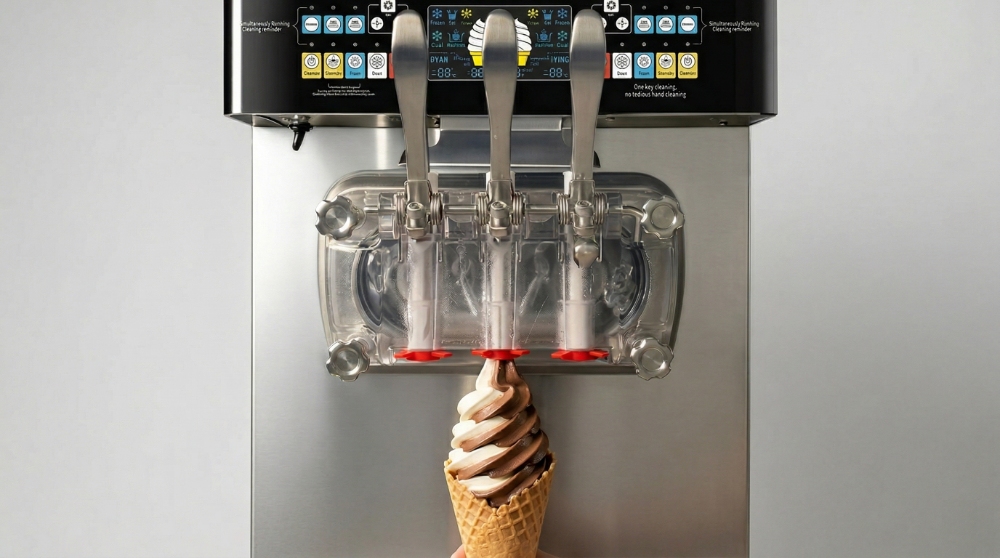
Choose a commercial soft serve machine by peak-hour output, countertop vs floor format, heads, cooling and power, with sizing formulas and a model spec table.
The right commercial soft serve machine is the smallest unit that can hold texture through your busiest hour on the power you already have. In practice that comes down to five decisions: countertop or floor-standing, how many heads, rated output against peak-hour demand, feed and cooling design, and the electrical circuit. This guide covers each one with sizing formulas and a spec-by-spec model comparison, so you can shortlist machines before you talk price.
Five Specs That Decide a Commercial Soft Serve Machine
- Rated output (L/h or qt/h): finished product per hour under the manufacturer’s stated test conditions.
- Hopper and freezing cylinder volume: how long you can serve between refills and how many servings you can pull back-to-back.
- Heads and systems: single flavor, two flavors plus twist, or two independent refrigeration systems.
- Electrical rating: voltage, nameplate current, frequency, and plug type.
- Cleaning design: the number of parts to disassemble, cleaning modes, and the routine your health authority expects.
If you are still deciding between soft serve, hard ice cream, and multifunctional equipment, start with our commercial ice cream machine buying guide and come back once soft serve is confirmed.
Countertop vs Floor-Standing Soft Serve Machines
This is usually the first fork in the road, and it is mostly a question of where the machine’s output ceiling sits relative to your peak hour. Countertop units fit existing counters and ordinary kitchen circuits more easily. Floor-standing units hold more mix and carry more refrigeration capacity, but they need a dedicated floor position and often a higher-voltage supply.
| Factor | Countertop soft serve machine | Floor-standing soft serve machine |
|---|---|---|
| Placement | Existing counter; check depth and load rating | Own floor position with side or rear clearance |
| Output ceiling | Lower; suits add-on menus and moderate peaks | Higher; suits dessert-led menus and long lines |
| Heads | Single head or compact three-head designs | Three heads, often with two refrigeration systems |
| Electrical | Many single-head units run on 110–115V | Commonly 208–240V class circuits |
| Relocation | Easier to move for seasonal layouts | Semi-permanent installation |
| Smartool examples | GT18ERLW-F, SW26REL-F, BT742SR2JL-F | BT768CRJL-TF vertical dual-system |
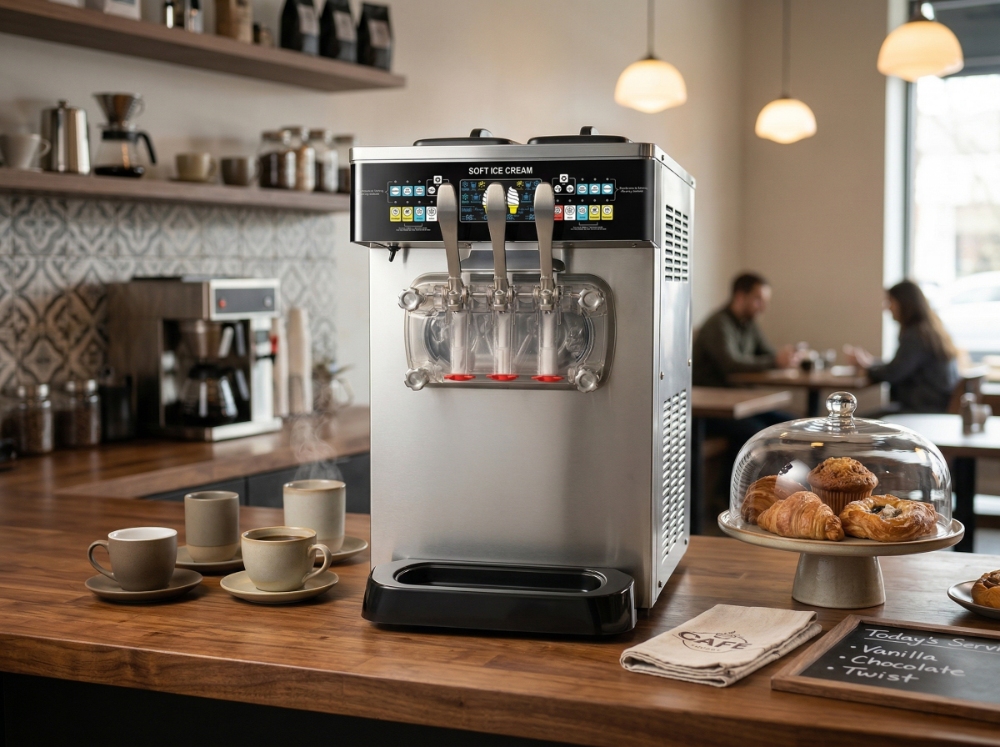
A countertop format no longer means low output. The BT742SR2JL-F countertop three-head machine is rated at 42 L/h at 974 mm tall. When demand goes beyond that, the BT768CRJL-TF vertical dual-system soft serve machine reaches 68 L/h in a 1567 mm floor-standing cabinet, with two compressors, two motors, and two evaporators that can run separately.
Single Head, Twin Twist, or Three Heads
One head means one flavor at a time and the shortest cleaning routine. It fits cafés and convenience stores where soft serve supports the main menu. Three-head machines run two flavors plus a twist, which widens the menu without adding a second machine and lets two staff members pull at once during a rush.
Dual-system designs add a practical advantage: each side has its own refrigeration, so on a slow weekday you can run one side and leave the other off. Because the two systems have independent power control, switching one side off does not stop the other.
Sizing Output for Your Peak Hour
Output ratings are measured under fixed test conditions. Smartool, for example, lists output at 23°C ambient and 23°C mix temperature. Your real peak happens in a warm room with the door opening and staff pulling back-to-back, so size with a margin.
Formula 1: Required rated output
Required L/h = peak-hour servings × serving size (mL) ÷ 1,000 ÷ planning factor
Example assumptions: 180 servings in the busiest hour, 4 fl oz (118 mL) per serving, planning factor 0.8. That gives 180 × 118 ÷ 1,000 = 21.2 L/h of finished product, or 26.6 L/h rated output after the margin. A 22–30 L/h machine covers it; an 18–24 L/h machine does not.
Heat and ventilation are the usual reasons a machine underperforms its rating. Rated output is measured at stated room and mix temperatures, so a hotter room, warmer mix or blocked airflow pulls real output down.
Formula 2: Servings per hopper fill
Servings per fill = hopper volume (L) × (1 + overrun) × 1,000 ÷ serving size (mL)
Overrun is the air whipped into the product, so a liter of mix yields more than a liter of soft serve. The table uses 40% overrun and 4 fl oz servings as example assumptions to compare refill frequency across models.
| Model | Rated output | Rated ceiling in 4 fl oz servings/hour | Hopper | Servings per hopper fill (example) |
|---|---|---|---|---|
| GT18ERLW-F | 18–24 L/h (4.8–6.3 gal/h) | 152–203 | 6 L | about 71 |
| SW26REL-F | 22–30 L/h (5.8–7.9 gal/h) | 186–254 | 10 L | about 118 |
| BT742SR2JL-F | 42 L/h (11.1 gal/h) | 356 | 8 L | about 95 |
| SW52REL-TF | 48–52 L/h (12.7–13.7 gal/h) | 407–441 | 8 L | about 95 |
| BT768CRJL-TF | 68 L/h (18.0 gal/h) | 576 | Dual hoppers | Depends on configuration |
Read the servings-per-hour column as a ceiling, not a promise. Use it to rule machines out, then apply your own planning factor.
Feed System: Gravity or Pump
Gravity-fed machines let mix flow from the hopper into the freezing cylinder through a feed tube. Pump-fed machines meter mix and air into the cylinder under pressure. The choice affects texture, how much mix each serving uses, and how many parts staff clean each night. Because it has its own trade-offs and math, we cover it separately in gravity vs pump soft serve machines.
Cooling, Airflow, and Refrigerant
Air-cooled machines reject heat into the room, so the installation spot has to supply cool air and carry the exhaust away. Check the airflow direction on the spec sheet before you pick a location:
- SW52REL-TF and SW26REL-F draw air from the bottom and exhaust from the rear top, so keep the rear clear.
- BT742SR2JL-F uses side intake and side exhaust, so side clearance matters more than rear clearance.
- BT768CRJL-TF uses side intake and exhaust, with an alternative bottom-intake, rear-exhaust option for tighter layouts.
Water-cooled machines move heat into a water loop instead of the room, which helps in hot, enclosed spaces but adds plumbing, drainage, and water cost. For most counters with reasonable ventilation, air-cooled is the simpler install.
Many newer machines, including the Smartool models listed here, use R290 (propane) refrigerant. The EPA’s refrigerant safety guidance lists flammability among the risks that equipment design and service practices must control, which is one more reason sealed-system work belongs with a qualified refrigeration technician. Ask how service is handled in your area before you buy.
Electrical Requirements Before You Order
Match the machine to your building, not the other way around. The single-head Smartool units run on 110–115V/60Hz. SW26REL-F lists 1600 W and 16 A rated current, and GT18ERLW-F lists 1580 W. The three-head BT742SR2JL-F (3800 W) and BT768CRJL-TF (4600 W) are rated 220V/60Hz, so they need a higher-voltage dedicated circuit.
- Give the nameplate voltage, current, and plug type to your electrician before delivery.
- Confirm whether your building supplies 208V or 240V and that the machine is compatible with it.
- Plan a dedicated circuit; sharing with a coffee brewer or fryer invites nuisance trips.
- Look for a listing mark from a lab in OSHA’s Nationally Recognized Testing Laboratory program on the exact model you buy.
Cleaning Routine and Food Safety
Soft serve runs on dairy mix, so daily sanitation is non-negotiable, and it is the biggest hidden labor cost in the purchase. Most state and local inspectors enforce rules based on the FDA Food Code, the model code FDA offers for adoption by local, state, and federal jurisdictions. Ask your inspector how often your jurisdiction expects full disassembly before you count on any extended cleaning interval.
For equipment design, NSF/ANSI 6 is the sanitation standard for dispensing freezers; NSF’s food equipment standards summary notes that it also covers heat treatment models. Features that reduce cleaning labor are worth comparing directly:
- GT18ERLW-F has one-touch cleaning, controlled from its 7-inch touchscreen.
- SW26-BA adds automatic sterilization and a 14-day clean-free function.
- BT742SR2JL-F and BT768CRJL-TF include night preservation and one-touch defrost.
The step-by-step daily routine is in Smartool’s ice cream machine maintenance guide, and our soft serve machine troubleshooting guide shows how skipped cleaning steps surface later as texture and leak problems.
Smartool Commercial Soft Serve Machine Comparison
| Spec | GT18ERLW-F | SW26REL-F | SW52REL-TF | BT742SR2JL-F | BT768CRJL-TF |
|---|---|---|---|---|---|
| Format | Countertop, single head | Desktop, single head | Dual refrigeration | Countertop, three heads | Vertical, three heads, dual system |
| Rated output | 18–24 L/h | 22–30 L/h | 48–52 L/h | 42 L/h | 68 L/h |
| Electrical | 110V/60Hz, 1580 W | 115V/60Hz, 1600 W, 16 A | 110V/60Hz, 3000 W rated cooling power | 220V/60Hz, 3800 W | 220V/60Hz, 4600 W |
| Hopper / cylinder | 6 L / 1.6 L | 10 L / 2.0 L | 8 L / 2.0 L | 8 L / 2.3 L | Dual |
| First batch time | 10–12 min | 13–16 min | 10–15 min | Not listed | Not listed |
| Compressor / refrigerant | Embraco 2155U | Embraco NT 2180UV, R290 | Embraco NEX2180UB ×2, R290 | Embraco, R290 | Dual Embraco, R290 |
| Noise | ≤68 dB | ≤68 dB | ≤68 dB | Not listed | Not listed |
| Net weight | 48 kg | 77 kg | 127 kg | Not listed | Not listed |
| Standout feature | 7-inch touchscreen, one-touch cleaning | Hopper pre-cooling ≤10°C | Two independent refrigeration systems | Night preservation, low-mix alarm | Sides can run separately |
For a café or convenience counter with a moderate peak, the GT18ERLW-F single-head soft serve machine keeps training simple. If the peak runs higher or you want a larger hopper, the SW26REL-F desktop soft serve machine adds output and a 10 L hopper on a 115V supply.
The SW52REL-TF high-output soft serve machine is the step up when you need close to 50 L/h without moving to a 220V circuit. Smartool supplies these as factory-direct commercial soft serve machines, backed in North America by the machine, compressor and parts-and-labor terms in its published after-sales policy.
Semi-automatic and multifunctional units sit alongside these models, so you can browse every Smartool ice cream machine model before narrowing down.
Commercial Soft Serve Machine Questions
Is a countertop soft serve machine enough for a busy shop?
It depends on the peak hour, not the shop type. Run Formula 1. A three-head countertop model rated around 40 L/h covers many dessert counters; a line that needs 60 L/h or more calls for a floor-standing, dual-system machine.
How much counter or floor space should I plan?
Plan the machine footprint plus the clearance on the sides where it takes in and exhausts air, plus standing room for staff to disassemble the front. Smartool’s maintenance guidance recommends more than 30 cm of open space at the back and sides.
What does a soft serve machine cost to run?
Mix, cones or cups, electricity, cleaning labor, and wear parts are the main recurring costs. Our soft serve machine cost and ROI worksheet shows how to total them without double counting.
Should I buy one large machine or two smaller ones?
Two smaller machines add redundancy and flavor range but double the cleaning. A dual-system machine gives part of that redundancy in one footprint and one cleaning station.
Share your peak-hour servings, serving size, flavors, and available electrical supply when you request a soft serve machine quote, and Smartool will recommend the model that fits.
Factory-direct from Smartool
Planning a commercial equipment purchase?
Share your site conditions, daily output and budget. Our team will match a model, send the spec sheets and quote factory-direct pricing.

Written by
Senior Engineer, Smartool
Jason is a senior engineer at Smartool. He works on the commercial ice machines, soft serve and slushy machines, and refrigerated prep tables Smartool builds for restaurants, bars, hotels and dessert shops. His guides look at equipment from the engineering side: how to size a machine for a site, what it needs for power, water and airflow, and how to keep it running through busy service. He also helps buyers match the right model to their kitchen before they request a quote.
.elementor-76528 .elementor-element.elementor-element-5c7a0d0{--display:flex;--flex-direction:column;--container-widget-width:100%;--container-widget-height:initial;--container-widget-flex-grow:0;--container-widget-align-self:initial;--flex-wrap-mobile:wrap;}.elementor-76528 .elementor-element.elementor-element-5c7a0d1 .elementor-toc__header-title{text-align:start;}.elementor-76528 .elementor-element.elementor-element-5c7a0d1 .elementor-toc__header{flex-direction:row;}.elementor-76528 .elementor-element.elementor-element-5c7a0d1{--item-text-hover-decoration:underline;}
On this page
Need pricing for your project?
Get a factory-direct quote on commercial ice makers, soft serve and slushy machines, and refrigerated prep tables.
✓ Model matching and spec sheets for your site
✓ US office in City of Industry, CA
✓ Talk to an expert: +1 (872) 221-0051
Browse by topic
Ice Machine Guides
Soft Serve & Ice Cream
Slushy & Frozen Drinks
Buying & Sourcing
Compliance & Maintenance
Related posts

Soft Serve Machine Maintenance Schedule: Daily to Annual
A soft serve machine maintenance schedule: daily cleaning, weekly seal checks, monthly condenser care, quarterly parts and annual service, plus a log.

Frozen Margarita Machine Recipe: Batch Ratios for Bars
A margarita machine recipe for bars: the 1:4 tequila batch ratio, a per-gallon house formula, four variations, a scaling table and fixes.
5 thoughts on “Commercial Soft Serve Machine Buying Guide: Sizing & Specs”
Comments are closed.