




Blog
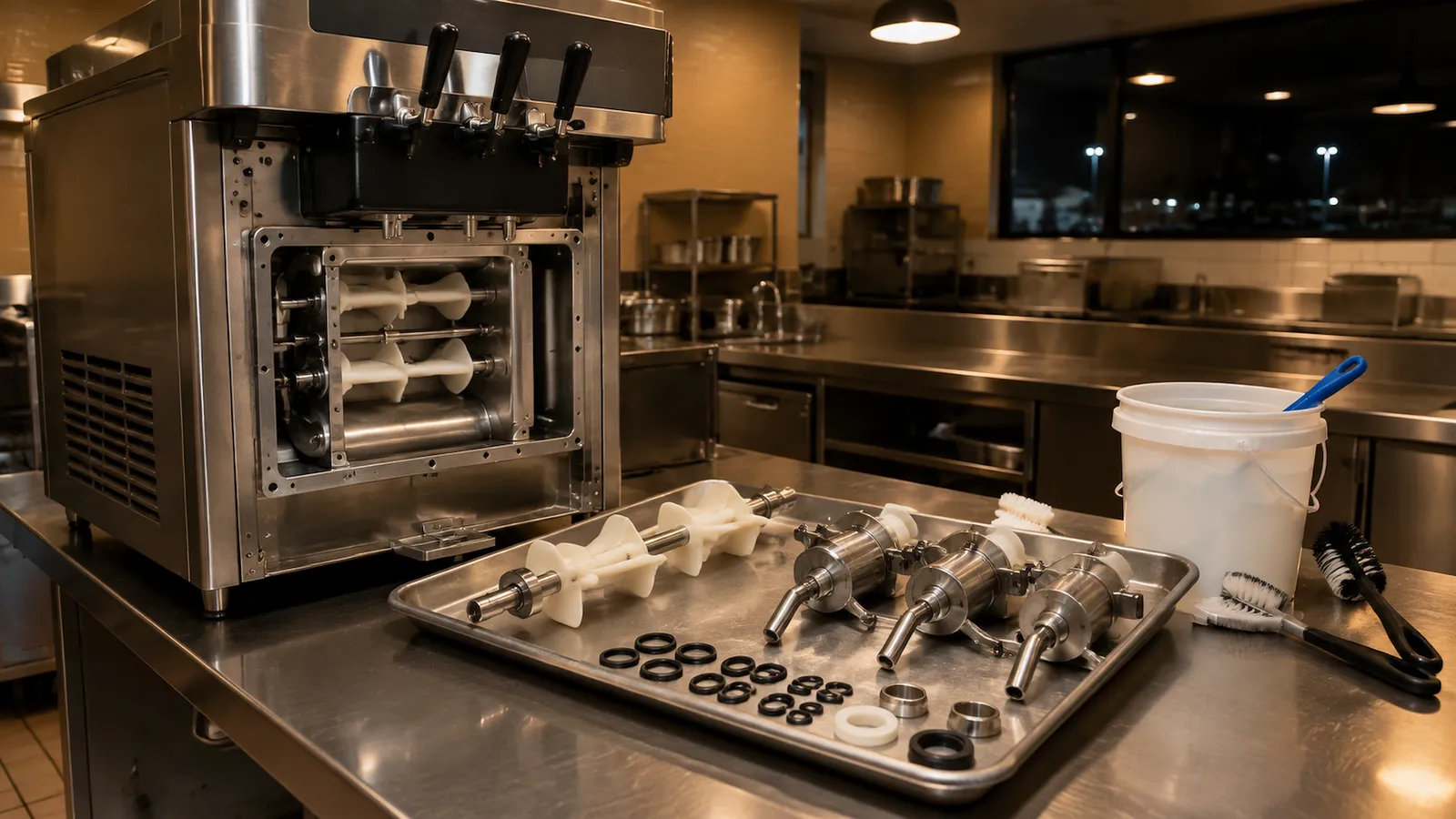
Why is McDonald's ice cream machine always broken? The reported causes, the 2024 repair exemption, and what operators should check before buying.
Why is McDonald’s ice cream machine always broken? Based on public reporting, most of the time the machine is not broken in the mechanical sense. It is running, failing or repeating a long nightly heat-treatment cycle. Or it is showing an error code that crew members cannot easily interpret, while the restaurant waits for an authorized technician. The machines are complex, the cleaning routine leaves little room for error, and repair access has been disputed for years. That dispute reached the Federal Trade Commission and the U.S. Copyright Office. This article sets out what has been reported, what changed in 2024, and what an independent operator should check before buying a soft serve machine.
Part of our commercial soft serve machine buying guide series.
The short answer: cleaning cycles, error codes and repair access
Reporting on this topic points to three overlapping causes. None of them requires the machine to be poorly built. Each one makes downtime more likely and more expensive when it happens:
- A long nightly heat-treatment cycle that has to finish before the machine will serve. If it fails, it starts over.
- Demanding cleaning and reassembly, with many small parts that all have to go back in correctly.
- Limited diagnostic access. Error messages are hard for crews to interpret, and the detailed service menus have been locked behind a code that technicians use.
The customer at the drive-through hears “the machine is broken” in every one of these cases, even when the machine is only mid-cycle.
The nightly heat-treatment cycle
Many soft serve machines have to be emptied, taken apart and cleaned every day, and any leftover mix is thrown out. The McDonald’s machines use a different approach. A 2021 WIRED investigation describes a once-a-night “heat treatment” process. It raises the contents to 151°F, holds them there to pasteurize for at least 30 minutes, and then refreezes them.
Heat treatment saves labor and mix, but the same WIRED report describes a fragile process. According to WIRED, the four-hour pasteurization cycle can fail in several ways: too much or too little mix in the hoppers, a machine switched off or unplugged at the wrong moment, or other small errors. The machine then shows a generic error message and will not serve until the full four hours of heating and freezing runs again. If that happens late in the evening or during a busy period, a restaurant can lose several hours of dessert sales.
Cleaning, teardown and a lot of small parts
Heat treatment does not remove the need for full cleaning, it only spaces it out. WIRED reported that every two weeks the machine’s components have to be disassembled and sanitized, with some parts lubricated. It also noted that the machine has at least two dozen rubber and plastic O-rings in different sizes, and that leaving a single one out can cause the pump to fail or liquid to leak.
That lesson applies to every soft serve machine, not only this one. Reassembly after cleaning is one of the most common sources of leaks, poor texture and stoppages. Our soft serve machine troubleshooting guide traces many counter-level problems back to exactly this step.
Error codes and who is allowed to read them
WIRED also reported that the Taylor C602 machine used in many McDonald’s restaurants has a hidden service menu. It opens only after a specific sequence of button presses, and that sequence did not appear in the owner’s manual. According to the report, the menu shows readings that matter for diagnosis, including mix viscosity settings, the temperature of the heating system and the meaning of error messages. Technicians on service contracts used the code, while crews saw only the error message.
A startup called Kytch built a device that read the machine’s internal data and presented it in a simpler interface for franchisees. McDonald’s and Taylor both told WIRED that the device posed dangers to employees and technicians. A Taylor spokesperson said the equipment “can be complicated” to operate and maintain, and that “the checks and balances embedded in the controls of our equipment are meant to protect the operator and service technician.” Kytch later sued Taylor, and then McDonald’s. Both companies have rejected its claims.

Right to repair: the FTC, the DOJ and the Copyright Office
Repair access for these machines has drawn federal attention several times. In 2021, FOX 8 reported, citing The Wall Street Journal, that the FTC had sent letters to McDonald’s franchisees asking about the machines. The questions reportedly covered how equipment is reviewed and whether owners could repair machines themselves.
The larger issue is legal. Section 1201 of the Digital Millennium Copyright Act generally prohibits bypassing software locks, even on equipment a business owns. Every three years the Copyright Office reviews temporary exemptions. In 2023, Public Knowledge and iFixit asked for a broad exemption for commercial and industrial equipment. In March 2024, the FTC and the Justice Department’s Antitrust Division filed a joint comment supporting it. The comment named commercial soft serve machines as one of four example categories. Its footnotes cite the petitioners’ figure that a soft serve breakdown can cost $625 per day in lost sales.
The Librarian of Congress adopted the final rule, effective October 28, 2024. It adds a new exemption for software in lawfully acquired equipment “primarily designed for use in retail-level commercial food preparation,” when bypassing a lock is necessary for diagnosis, maintenance or repair. The Register of Copyrights declined to recommend the broader class covering all commercial and industrial devices.
The exemption only removes one legal barrier to diagnosing and fixing your own equipment. It does not require a manufacturer to publish service menus, supply parts or change warranty and supplier terms. Franchise agreements and service contracts still apply as written. For an independent buyer, the practical point is to secure diagnostic access in the purchase itself rather than rely on the law to supply it later.
What independent operators can learn before buying a soft serve machine
A single shop or café has no national chain behind it and no fleet of backup machines. When the only machine is down on a hot Saturday, you lose the sales and you pay for the fix. Four areas deserve more attention than the output rating on the spec sheet.
1. Cleaning design you can actually run every night
Ask for the operator manual before you order and count the removable parts: beater, scraper blades, draw valves, seals and O-rings. Then time a practice teardown if you can. Smartool’s ice cream machine maintenance guide lays out the daily routine: run the cleaning mode, disassemble the valve, mixing shaft, scraper blades and beater bar, wash, sanitize, rinse and air-dry, then reassemble with every seal seated. If that routine does not fit your closing staff and closing time, choose a simpler machine.
Some machines add features that support the routine. The GT18ERLW-F lists a one-touch cleaning function run from its 7-inch touchscreen. Automatic cleaning cycles still do not replace hand washing of the removable parts.
2. Heat treatment vs daily teardown
Heat treatment is not a flaw. It lets high-volume operators go longer between full teardowns. But it trades daily labor for a process that depends on correct mix levels, uninterrupted power and a cycle that has to finish before opening. Compare the two honestly:
| Factor | Heat-treatment machine | Daily-teardown machine |
|---|---|---|
| Nightly labor | Lower on most nights; periodic full teardown still required | Full disassembly, wash, sanitize and reassembly every day |
| Mix handling | Mix stays in the machine through the cycle | Leftover mix is discarded at close |
| Failure mode | An interrupted or failed cycle can block service until it reruns | Reassembly mistakes (missing seal, wrong part) show up at opening |
| Dependencies | Correct fill levels, stable power, controls and sensors | Trained staff and enough closing time |
| Approval | Cleaning intervals must be accepted by your local health authority | Fits the default daily-cleaning expectation |
Treat any extended cleaning interval as something to confirm with your inspector before you buy, not after. The SW26-BA, for example, lists automatic sterilization and a 14-day clean-free function. Whether your jurisdiction accepts that interval is a question for your local health department.
3. Diagnostics you can see without a secret code
Before you buy, ask the seller for the full alarm and error-code list and check that it is in the manual you receive. Ask which checks an operator can do and which need a technician. Ask whether remote help is available when a code appears. A clear split between operator checks and technician work is a good sign. Smartool’s soft ice cream machine troubleshooting page is organized that way, with user-level and engineer-level checks for each fault. Sealed-system and electrical work should still go to a qualified technician.
4. Parts and service availability
Most soft serve downtime ends with a small part: an O-ring, a scraper blade, a drive belt or a draw valve seal. Ask which wear parts are stocked in the U.S., how fast they ship, and whether you can order them directly. Keep a spare seal kit and a set of scraper blades on site. Also ask how service works outside major metro areas. Smartool’s after-sales policy describes on-site service in major cities and video remote diagnosis with mail-in parts support elsewhere. Get the terms for your own ZIP code in writing.
Then put a number on downtime. Multiply your average daily soft serve sales by the number of days a repair could realistically take, and compare that with the price gap between machines. Our soft serve machine cost and ROI worksheet shows how to add those figures to the full cost of ownership.
Buyer checklist: questions to ask before you order
| Ask the seller | Why it matters |
|---|---|
| Can I see the operator manual and cleaning steps before I buy? | Shows the real nightly labor and parts count |
| Is every alarm and error code explained in the manual? | Staff can act on a code instead of waiting for a technician |
| Which checks can my staff do, and which need a technician? | Prevents unsafe fixes and unnecessary service calls |
| Does the machine use heat treatment or daily teardown? | Decides your closing routine and health-department approval |
| Which wear parts are stocked in the U.S., and how fast do they ship? | Sets how long a small failure keeps you closed |
| What remote support and on-site service cover my location? | Service outside major cities often works differently |
McDonald’s ice cream machine questions
Is the McDonald’s ice cream machine actually broken, or just cleaning?
Often it is not mechanically broken. Public reporting describes a four-hour nightly heat-treatment cycle that has to rerun if it fails. It also describes error messages that crews cannot easily interpret. Both leave the machine unable to serve without any part having failed. Real breakdowns do happen too, and then the wait for an authorized technician adds to the downtime.
Why are ice cream machines always broken in general?
Soft serve machines combine refrigeration, a motor-driven beater, dairy mix and many food-contact seals. Most day-to-day failures come from mix temperature or ratio, low hopper levels, blocked airflow, or parts reassembled incorrectly after cleaning. A consistent daily cleaning and pre-operation check routine prevents most of them. If you are still choosing a machine type, compare soft serve vs hard ice cream machines.
Can franchisees now repair their own ice cream machines?
Since October 28, 2024, a Copyright Office exemption has allowed bypassing software locks on retail-level commercial food preparation equipment when that is necessary for diagnosis, maintenance or repair. It removes a copyright-law barrier. It does not give owners the manufacturer’s service tools or parts, and it does not change franchise or service agreements.
Does a heat-treatment machine mean you never have to take it apart?
No. Heat treatment extends the time between full cleanings. It does not eliminate them. WIRED reported a two-week disassembly and sanitizing schedule for the McDonald’s machines. Your local health authority decides what interval applies to your shop.
If you are choosing a machine for your own shop, compare factory-direct soft serve machines by cleaning routine, diagnostics and parts support as well as output. Send us your peak-hour volume, electrical supply and location to request a factory-direct quote.
Factory-direct from Smartool
Planning a commercial equipment purchase?
Share your site conditions, daily output and budget. Our team will match a model, send the spec sheets and quote factory-direct pricing.

Written by
Senior Engineer, Smartool
Jason is a senior engineer at Smartool. He works on the commercial ice machines, soft serve and slushy machines, and refrigerated prep tables Smartool builds for restaurants, bars, hotels and dessert shops. His guides look at equipment from the engineering side: how to size a machine for a site, what it needs for power, water and airflow, and how to keep it running through busy service. He also helps buyers match the right model to their kitchen before they request a quote.
.elementor-76528 .elementor-element.elementor-element-5c7a0d0{--display:flex;--flex-direction:column;--container-widget-width:100%;--container-widget-height:initial;--container-widget-flex-grow:0;--container-widget-align-self:initial;--flex-wrap-mobile:wrap;}.elementor-76528 .elementor-element.elementor-element-5c7a0d1 .elementor-toc__header-title{text-align:start;}.elementor-76528 .elementor-element.elementor-element-5c7a0d1 .elementor-toc__header{flex-direction:row;}.elementor-76528 .elementor-element.elementor-element-5c7a0d1{--item-text-hover-decoration:underline;}
On this page
Need pricing for your project?
Get a factory-direct quote on commercial ice makers, soft serve and slushy machines, and refrigerated prep tables.
✓ Model matching and spec sheets for your site
✓ US office in City of Industry, CA
✓ Talk to an expert: +1 (872) 221-0051
Browse by topic
Ice Machine Guides
Soft Serve & Ice Cream
Slushy & Frozen Drinks
Buying & Sourcing
Compliance & Maintenance
Related posts

Ice Machine Freezing Up? Causes, Safe Checks and Fixes
Ice machine freezing up? Learn the six common causes, what staff can safely check, what needs a technician, and how to prevent repeat freeze-ups.

How to Use a Margarita Machine or Slush Machine
How to use a margarita machine or slush machine: setup, mixing and filling, freeze time, consistency, dispensing, refills and the closing routine.