




Blog
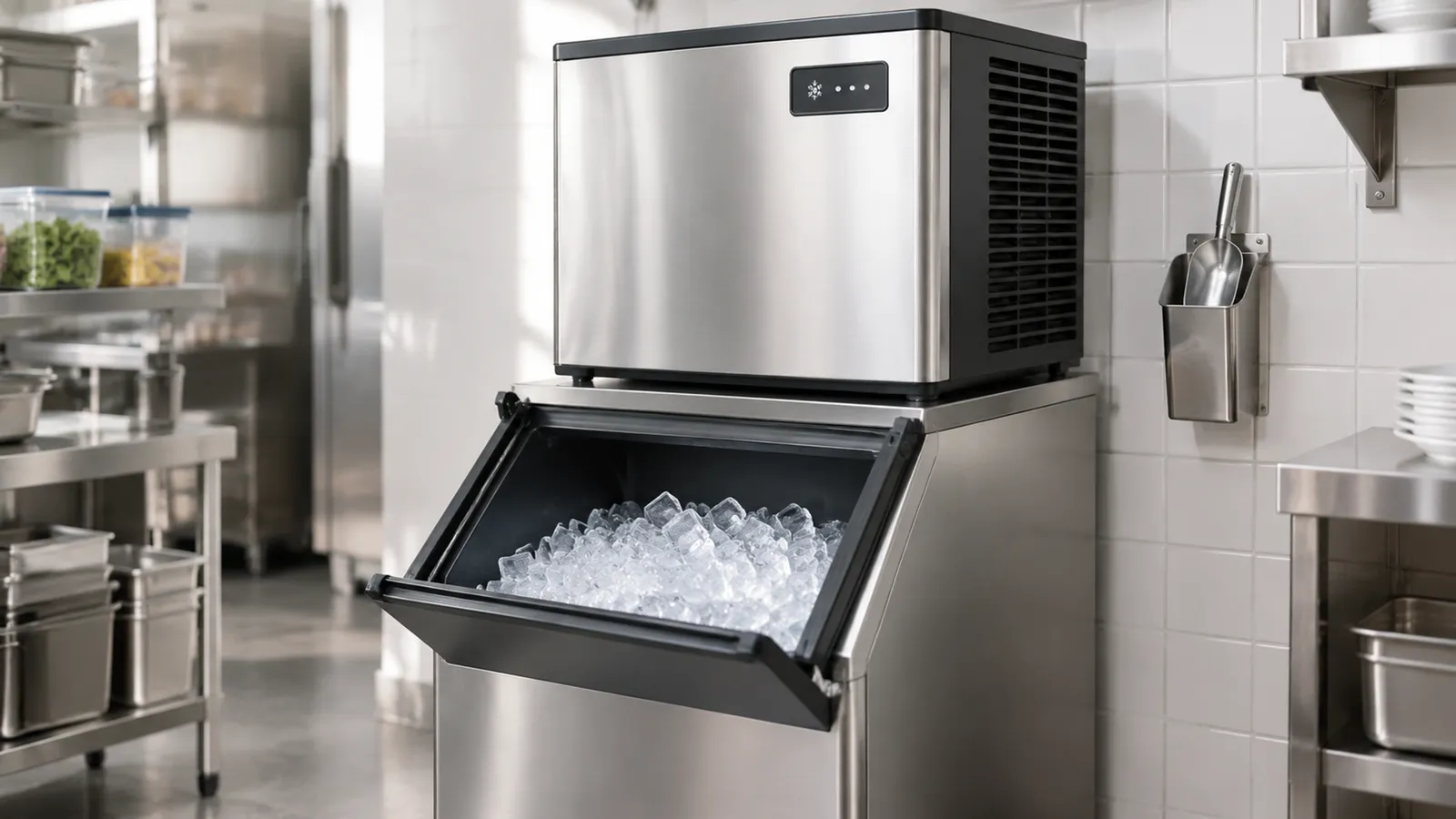
How do ice machines work? Follow the refrigeration and water circuits through freeze and harvest, and see how air, water and remote cooling differ.
How do ice machines work? A commercial cube ice machine runs two circuits side by side. A refrigeration circuit chills a metal evaporator plate well below freezing, and a water circuit pumps water across that plate so ice builds up layer by layer. When the cubes reach the set thickness, the machine switches to harvest: it warms the plate briefly, the ice lets go and drops into the bin, and the next freeze starts. The heat taken out of the water leaves through a condenser that is cooled by room air, by water, or by a remote unit outdoors. Below, each part of that loop in the order the machine runs it.
Part of our commercial ice maker buying guide series.
The short version: two circuits and a repeating cycle
Federal rules describe the same process in one line. Under the federal definitions for automatic commercial ice makers, a batch type ice maker has “alternate freezing and harvesting periods.” Cube machines are batch machines. Here is what each circuit does at each stage:
| Stage | Refrigeration circuit | Water circuit | What you notice |
|---|---|---|---|
| Fill | Idle or starting up | Inlet valve fills the water sump or trough | Water running into the machine |
| Freeze | Cold refrigerant flows through the evaporator | Pump circulates water over the evaporator; unfrozen water returns to the sump | Steady compressor and pump noise; cubes thicken |
| Harvest | Hot refrigerant gas is routed to the evaporator to warm it | Pump stops; mineral-heavy water is drained or purged in many designs | Ice drops into the bin; water runs to the drain |
| Bin full | Stops | Stops | Machine sits idle until ice is used |
The refrigeration circuit: moving heat out of the water
An ice machine does not add cold. It removes heat from water and dumps that heat somewhere else. Four components do the work, in a closed loop of refrigerant:
- Compressor: squeezes low-pressure refrigerant vapor into hot, high-pressure gas.
- Condenser: releases that heat to air or water, and the refrigerant condenses into a liquid.
- Expansion device: drops the liquid’s pressure so it becomes very cold as it enters the evaporator.
- Evaporator: the plate, grid or tray that water flows over. The refrigerant boils inside it, absorbs heat from the water and returns to the compressor as vapor.
The heat load is bigger than most people expect. Turning water that is already at 32°F into ice takes 144 BTU per pound, the latent heat figure the federal definitions use as the reference for ice hardness. Water arriving from the supply line at 70°F first needs about 38 BTU per pound removed just to reach 32°F. Every pound of ice from warm water therefore sends roughly 180 BTU through the condenser, plus the compressor’s own energy. That is why warm supply water and a hot room both slow production: the machine has more heat to move and a harder time getting rid of it.
The water circuit: sump, pump, distribution and purge
Potable water enters through an inlet valve, often after a filter, and fills a sump at the bottom of the ice-making section. A small pump lifts it to a distribution tube or spray bar that spreads it evenly across the evaporator. Water that does not freeze runs back to the sump and goes around again.
That constant flow is what makes cube ice hard and clear. The EPA’s WaterSense at Work guidance on commercial ice makers explains that cubes are washed as they freeze, so sediment and minerals are carried away instead of locking into the ice, and the rinse water is typically dumped as the machine operates. The same guidance puts perfect efficiency at about 12 gallons of water per 100 pounds of ice, and actual use at 12 to over 50 gallons per 100 pounds before any condenser water is counted. The difference is mostly rinse water.
The minerals left behind have to go somewhere, and some settle on the evaporator as scale. Scale slows heat transfer during freezing and makes ice stick during harvest. Smartool’s ice machine maintenance guide calls an inlet water filter, replaced on its service life, the most effective way to reduce scale formation, and pairs it with a regular water-system cleaning cycle.
The freeze and harvest cycle, step by step
Each design has its own sensors and timings, which the manual lists, but a cube machine follows this general sequence:
- Fill. The inlet valve opens until the sump reaches its level, controlled by a float or a level sensor.
- Freeze. The compressor runs, the evaporator drops below freezing and the pump circulates water across it. Ice forms first where the plate is coldest and grows outward in thin layers.
- End of freeze. A thickness probe, a sump water level, an evaporator temperature reading or a timer tells the controller the cubes are ready. This is the setting that changes cube size. If the plate keeps building ice and never harvests, see our guide to an ice machine freezing up.
- Harvest. A hot gas valve opens and sends hot discharge gas from the compressor straight into the evaporator. The plate warms just enough to melt the contact layer, and the cubes slide or drop off into the bin. Smartool’s ice maker troubleshooting guide lists the hot gas valve and the expansion device among the engineer checks when a machine will not harvest.
- Purge. In many machines, the remaining sump water, now carrying the minerals rinsed off the ice, drains away and fresh water refills for the next batch.
- Repeat or stop. The cycle repeats until an ice-full sensor in the bin detects ice and pauses production. When staff scoop ice out, the machine restarts.

How long does an ice machine take to make ice?
There are two answers. One batch of cubes takes one freeze and harvest cycle, which on most cube machines runs in minutes rather than hours; the manual gives the expected cycle time for your model and conditions. Refilling a bin is the number that matters in service, and it comes from the daily rating. Federal rules define harvest rate as the pounds of ice produced per 24 hours, so divide by 24 to get an hourly figure.
For example, Smartool publishes the BF500 at 500 lb ±5% per 24 hours with 70°F (21°C) room air and 50°F (10°C) water, and 375 lb ±5% at 90°F (32°C) air with 70°F (21°C) water. That works out to about 21 lb an hour in the cooler condition and about 15.6 lb an hour in the hot one. At the hot-condition rate, putting 50 lb back into the bin after a rush takes a little over three hours, and longer if the bin is also melting.
Batch versus continuous machines
Flake and nugget machines work differently. ENERGY STAR’s commercial ice maker overview describes batch-type machines as harvesting with alternating freezing and harvesting periods, mostly for beverage ice, and continuous-type machines as making flake and nugget ice through a continuous freeze and harvest process. In a continuous machine, water freezes on the inside of a refrigerated cylinder and an auger scrapes it off without stopping. Our overview of the types of commercial ice machines matches each ice shape to the process that makes it.
Where the heat goes: air-cooled, water-cooled and remote condensers
Every machine has to reject the heat it pulls out of the water, plus the heat of its own compressor. The condenser type decides where that heat ends up, and it changes the install more than any other choice:
| Condenser type | Where the heat goes | What the site needs | Watch for |
|---|---|---|---|
| Air-cooled (self-contained or head) | Into the room, pushed out by a fan | Clear air intake and discharge; EPA suggests at least 6 inches of clearance | Hot rooms, dust and grease on the coil |
| Water-cooled | Into condenser water, then to a drain or a recirculating loop | A second water supply for the condenser, plus drain capacity | Water cost and local rules on single-pass cooling |
| Remote air-cooled | Outdoors or to an unconditioned room, through refrigerant lines | A location for the outdoor condenser and licensed line work | Summer sun and debris at the outdoor unit |
The EPA guidance above calls air-cooled models suitable for most commercial settings and best where the surrounding air stays at 80°F or less. It recommends water-cooled machines only when the site requires them, such as rooms consistently above 80°F or spaces too tight for an air-cooled unit to breathe. In the most basic water-cooled setup, water passes through the condenser once and goes down the drain; recirculating it through a chiller or cooling tower cuts that use. For remote units, the Department of Energy’s FEMP guidance on air-cooled ice machines notes that the condenser usually sits outdoors or in an unconditioned equipment room, so the heat is discharged outside the conditioned space instead of loading the building’s air conditioning.
The running-cost side of this choice, including condenser water per 100 pounds of ice and the heat an air-cooled head adds to the kitchen, is worked through in our comparison of air-cooled vs water-cooled ice machines.
Split, modular and self-contained layouts
The same freeze and harvest process can be packaged in different ways. The federal definitions give the three main layouts:
- Ice-making head: a unit with no integral storage bin, designed to sit on a separately chosen bin or dispenser. The trade often calls these modular or split heads.
- Self-contained: the ice-making mechanism and the storage compartment share one cabinet, as in most undercounter machines.
- Remote condensing: the ice-making mechanism and the condenser sit in separate sections, joined by refrigerant lines.
Separating the pieces lets you size the bin to your rush and, on remote systems, move condenser heat and fan noise out of the room. The trade-off is more planning: a matching bin, drains for head and bin, and licensed refrigerant line work for a remote unit.
The bin: storage, not a freezer
Most commercial ice bins are insulated boxes rather than refrigerated freezers. Ice in the bin melts slowly, the meltwater drains away, and the machine tops the bin back up. An ice-full sensor or bin control near the top of the bin stops production when the ice reaches it and restarts the machine when the level drops. The federal definitions note that storage bins carry energy use that is not included in a head’s reported figures, which is one reason to size the bin to your rush instead of buying the largest one that fits.
How this looks on Smartool BF500 and BF360 heads
Smartool’s two ice makers are split-type heads that make square cubes on AC 110–120V / 60 Hz power. The product pages list features that map directly onto the cycle described above:
- 12-level ice thickness control: changes the end-of-freeze point, so you can set thinner or thicker cubes.
- Nickel-plated copper ice trays: the surface the ice forms on during freezing and releases from during harvest.
- Water-shortage and ice-full alerts: flag a problem on the fill side and report when the bin control has stopped production.
- Automatic cleaning function: circulates cleaner through the water circuit to deal with scale and film.
- 48-hour timer: schedules production around service.
Both models publish output at two conditions, which shows the heat load in action. The BF500 split ice maker drops from 500 lb to 375 lb per 24 hours between the cooler and hotter conditions, and the BF360 drops from 360 lb to 275 lb. Both are rated to operate in rooms from 41°F to 100°F (5–38°C). Smartool’s maintenance guide recommends more than 30 cm (about 12 inches) of space at the back and both sides, away from heat sources, so the condenser can shed heat.
Questions operators ask about how ice machines work
What is the harvest cycle on an ice machine?
It is the part of each batch where the machine releases finished ice. On most cube machines, a hot gas valve sends hot refrigerant into the evaporator, the plate warms slightly, and the cubes drop into the bin. Then the next freeze begins.
How does an ice machine know when to stop making ice?
A bin control, such as an ice-full sensor or probe, detects when ice reaches it and pauses production. A separate thickness control decides when each batch is ready to harvest. If the display shows ice-full while the bin is clearly not full, use our checklist for an ice machine not making ice.
Does a commercial ice machine need a water line and a drain?
Yes. It needs a potable water line for the ice, a drain for purge water and bin meltwater, and, if water-cooled, water for the condenser as well. Check the spec sheet for inlet pressure and drain requirements before install. Our commercial ice machine installation guide walks through each connection.
Why does my ice machine dump water every cycle?
That is the purge. It flushes away the minerals rinsed off the forming cubes so they do not end up in the ice or as scale. The EPA suggests setting the rinse, with the manufacturer, at the lowest frequency that still gives acceptable ice.
Once you know how the cycle works, spec sheets are easier to compare. Review Smartool’s factory-direct commercial ice makers, then send your peak demand, room temperature and utility details to request a factory-direct quote.
Factory-direct from Smartool
Planning a commercial equipment purchase?
Share your site conditions, daily output and budget. Our team will match a model, send the spec sheets and quote factory-direct pricing.

Written by
Senior Engineer, Smartool
Jason is a senior engineer at Smartool. He works on the commercial ice machines, soft serve and slushy machines, and refrigerated prep tables Smartool builds for restaurants, bars, hotels and dessert shops. His guides look at equipment from the engineering side: how to size a machine for a site, what it needs for power, water and airflow, and how to keep it running through busy service. He also helps buyers match the right model to their kitchen before they request a quote.
.elementor-76528 .elementor-element.elementor-element-5c7a0d0{--display:flex;--flex-direction:column;--container-widget-width:100%;--container-widget-height:initial;--container-widget-flex-grow:0;--container-widget-align-self:initial;--flex-wrap-mobile:wrap;}.elementor-76528 .elementor-element.elementor-element-5c7a0d1 .elementor-toc__header-title{text-align:start;}.elementor-76528 .elementor-element.elementor-element-5c7a0d1 .elementor-toc__header{flex-direction:row;}.elementor-76528 .elementor-element.elementor-element-5c7a0d1{--item-text-hover-decoration:underline;}
On this page
Need pricing for your project?
Get a factory-direct quote on commercial ice makers, soft serve and slushy machines, and refrigerated prep tables.
✓ Model matching and spec sheets for your site
✓ US office in City of Industry, CA
✓ Talk to an expert: +1 (872) 221-0051
Browse by topic
Ice Machine Guides
Soft Serve & Ice Cream
Slushy & Frozen Drinks
Buying & Sourcing
Compliance & Maintenance
Related posts

Ice Machine Freezing Up? Causes, Safe Checks and Fixes
Ice machine freezing up? Learn the six common causes, what staff can safely check, what needs a technician, and how to prevent repeat freeze-ups.

How to Use a Margarita Machine or Slush Machine
How to use a margarita machine or slush machine: setup, mixing and filling, freeze time, consistency, dispensing, refills and the closing routine.