




Blog
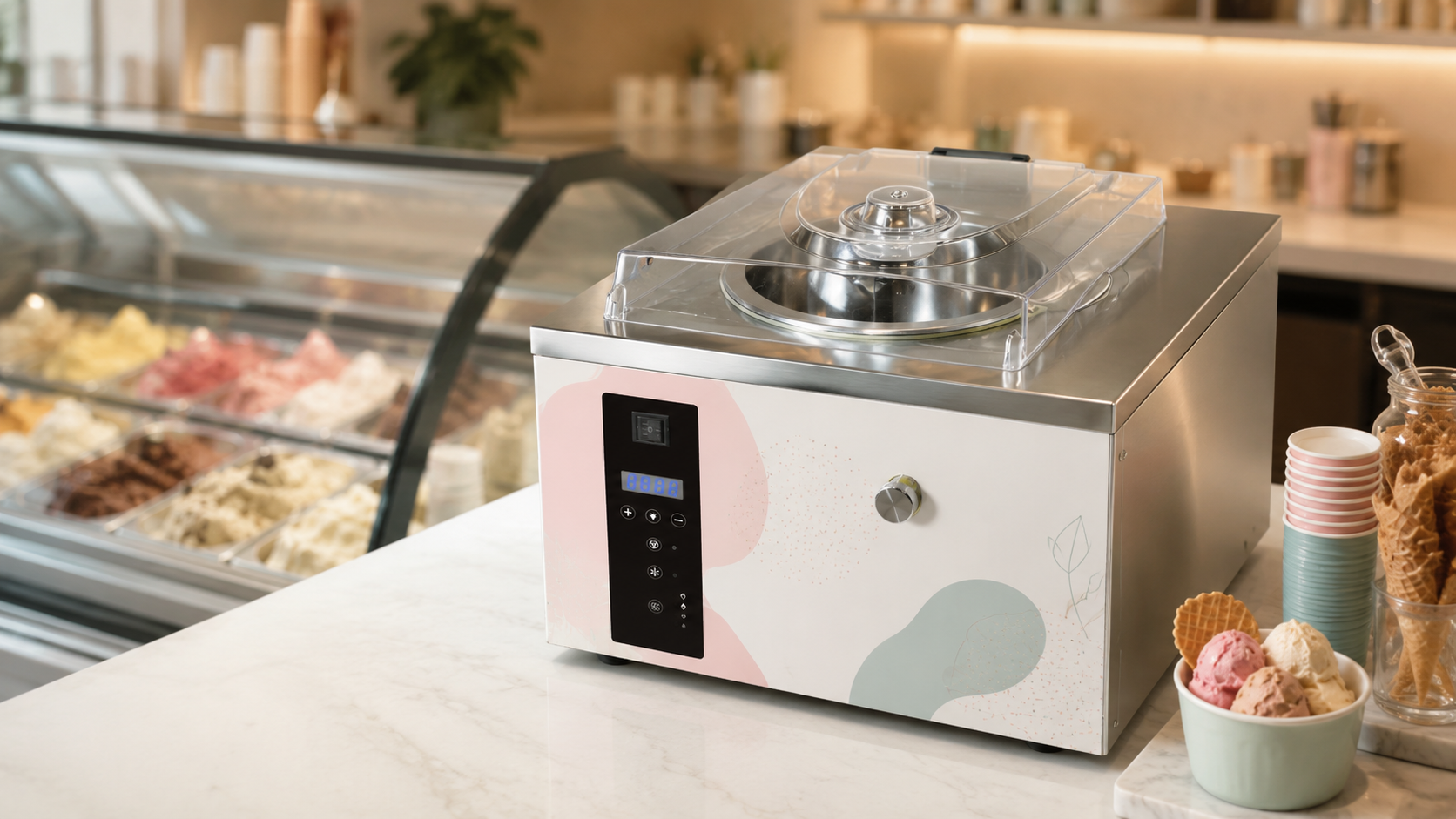
Are ice cream vending machines profitable? They can be, but profit comes from arithmetic, not from the “passive income” pitch. A machine makes money when the cups it sells each day, multiplied by what each cup contributes after ingredients, commission and card fees, cover a fixed monthly cost base and then pay off the equipment.
This guide breaks that math into variables you can fill in with your own supplier quotes and location terms. It covers the operating and compliance costs most profit estimates skip, and shows where a fully automatic unit or a mobile vending truck fits.
Are Ice Cream Vending Machines Profitable? Start With Contribution per Cup
Most online estimates jump straight to a monthly revenue figure. That number is useless without knowing how it was built. The better starting point is contribution per cup: the selling price minus everything that scales with each sale.
- Price per serving: what the customer pays at the screen.
- Ingredient and disposable cost: mix, cup, lid or spoon, and any topping.
- Location commission: the host’s percentage of gross sales, if the deal is revenue share.
- Payment processing: the card or mobile-wallet fee on each transaction.
Everything else, including electricity, connectivity, cleaning labor, insurance and a maintenance reserve, is a fixed monthly cost that does not care whether you sell 10 cups or 90. Profit is contribution per cup times cups sold, minus that fixed base. Payback is how many months of that profit it takes to recover the delivered, installed cost of the machine.
Cups per day is the variable that decides everything
Price and cost per cup are fairly predictable once you have supplier quotes. Daily cup volume is not. It depends on foot traffic past the machine, how long people linger, the season, and whether the location is open when people want dessert. It also has a hard ceiling set by the equipment: a machine rated for a certain number of cups per day cannot sell more than that, no matter how busy the corridor gets. Always check your volume assumption against the rated output of the model you are pricing.
Operating hours and dwell time
An unattended machine can sell whenever the venue is open, which is its main advantage over a staffed counter. But hours only matter if people are present and not in a hurry. A hospital waiting area or an airport gate area gives people time to stop. A commuter walkway gives them a few seconds. Two locations with similar traffic counts can produce very different cup volumes for this reason.
What Each Cup Really Costs
For a machine that freezes and dispenses soft serve to order, cost per cup is set by three things: the mix, the portion, and the disposables.
Mix cost and overrun
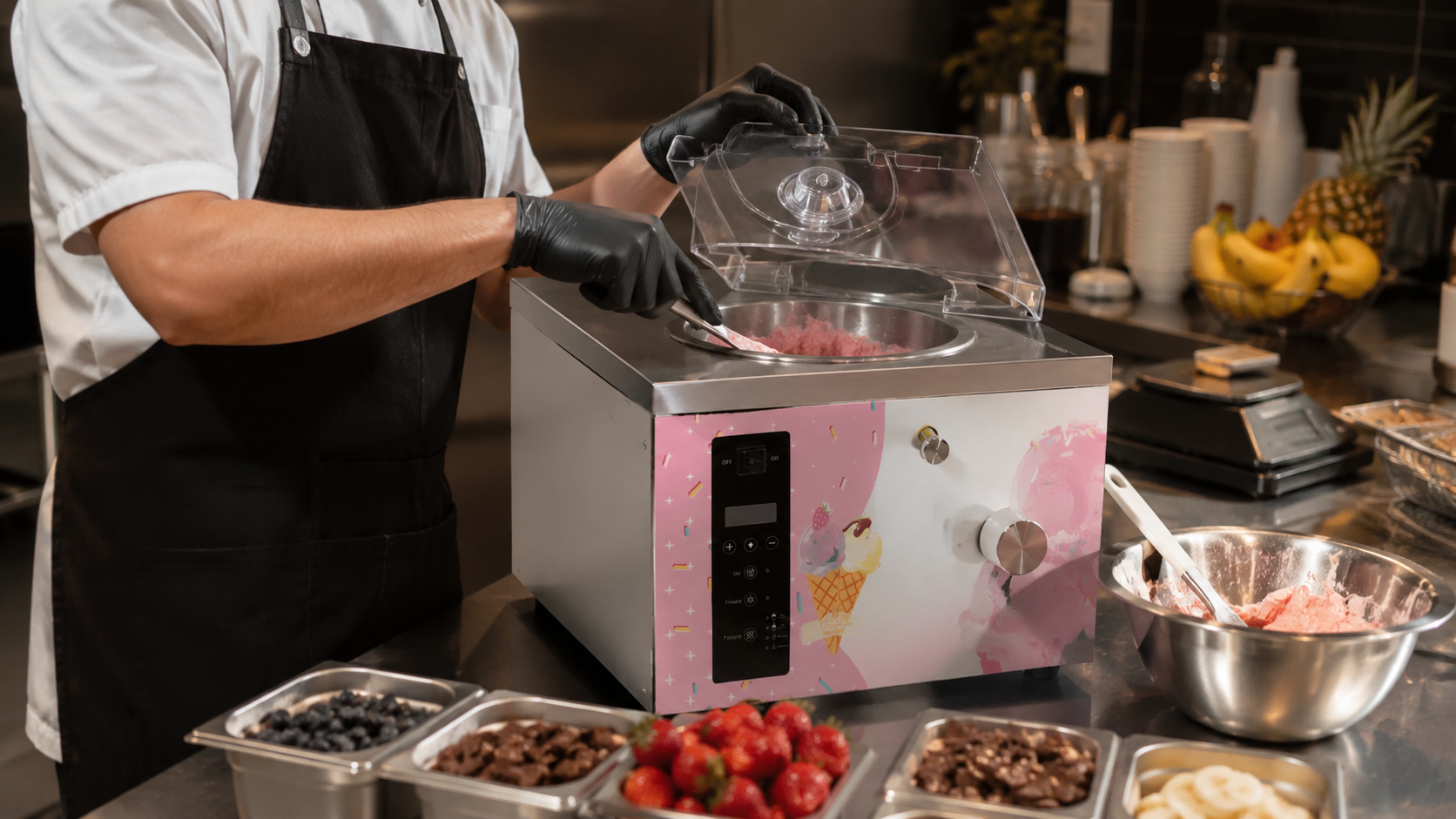
Liquid and powder mixes are priced per bag or carton, but what you sell is volume. Overrun, the air whipped into the product during freezing, determines how many servings a unit of mix produces. Higher overrun stretches the mix; too much air hurts texture and repeat purchases. Our guide to soft serve overrun explains the factors that move it, and the soft serve mix selection and storage guide compares powder, liquid and self-made mixes.
To get a real cost per cup, divide the landed price of a mix unit by the number of standard portions you actually get from it in a test run.
Cups, lids, spoons and toppings
Disposables are easy to underestimate because each piece is cheap. Add the cup, the spoon or lid, and any napkin the machine dispenses. Toppings raise the ticket but also add cost and a refill task, so price them as a separate line and check whether the margin on the upgrade is better than the base cup.
Waste and shrink
Mix that is drained during cleaning, product discarded after a temperature fault, and test cups all count against margin. Build a small waste percentage into cost per cup from the start and adjust it after the first month of sales data.
Monthly Operating Costs Behind the Profit Number
These are the costs that separate a realistic ice cream vending machine business plan from a brochure.
Location commission or flat rent
Hosts usually offer either a percentage of gross sales or a flat monthly fee. A percentage deal lowers risk while you learn the location’s real volume, because the cost falls when sales fall. A flat fee rewards you once volume is proven, since every extra cup keeps its full contribution. Many operators start on revenue share and renegotiate to a flat fee after a full season of data. Read the contract for exclusivity, power supply responsibility, restocking access hours and what happens if the host relocates the machine.
Payment processing and card security
Unattended machines sell mostly by card and mobile wallet, so the processing fee applies to nearly every cup. Get the fee schedule from your payment provider in writing, including any monthly gateway or terminal charges. Security is part of the cost too: the PCI Security Standards Council’s merchant resources explain that any business accepting payment cards must meet the PCI Data Security Standard, which is simplest when you use a certified reader and a provider that handles card data on your behalf.
Electricity
A soft serve vending machine runs a refrigeration system around the clock to keep mix cold and product ready. Estimate energy from the rated power on the spec sheet, the hours spent in each mode, and a duty-cycle assumption, since the compressor cycles rather than running flat out. Then multiply by your utility rate.
For reference, U.S. commercial customers paid an average of 14.19 cents per kWh in June 2026, according to the EIA Electric Power Monthly table of average prices by state and sector. Your state’s rate may be well above or below that average, and some hosts include power in the fee.
Cleaning and restocking labor
This is the cost most “passive income” articles leave at zero. Someone has to drive to the machine, refill mix and cups, empty waste, wipe down the dispensing area, run the cleaning cycle and log it. Count the visits per week, the time per visit including travel, and put an hourly value on it even if you do it yourself. Our ice cream machine maintenance guide outlines the daily and periodic routines that drive this time.
Remote monitoring and connectivity
Machines with remote management report sales, low-inventory status and faults over a cellular or Wi-Fi connection. Budget for the data plan and any software subscription. The payoff is fewer wasted trips: you restock when stock is low instead of on a fixed schedule, and you learn about a fault in minutes rather than on the next visit.
Maintenance reserve and downtime
Set aside a fixed amount each month for wear parts, service calls and cleaning supplies. Downtime is the larger cost: a machine that is not vending still owes its fixed costs. Operators can handle first-level checks such as confirming mix level, power and door seals; the soft ice cream machine troubleshooting guide separates those user-level checks from work that needs an engineer. Refrigerant, compressor and electrical faults belong with a qualified technician or the manufacturer’s support team.
Insurance, permits and business setup
General liability insurance, the health permit, a business license and sales tax registration are recurring costs. Spread annual fees over 12 months so they show up in the monthly worksheet.
Ice Cream Vending Machine Profit Worksheet
The worksheet below uses variables you can replace with real quotes. The example column is a set of assumptions chosen to show the math. It is not a forecast for any specific location or machine, and none of the dollar figures are equipment prices or supplier quotes.
| Variable | Symbol | How to get the real number | Example assumption |
|---|---|---|---|
| Price per cup | P | Your menu price at this location | $5.00 |
| Ingredient and disposable cost per cup, including waste | C | Mix cost per portion from a test run, plus cup, spoon and topping | $0.90 |
| Location commission | r | Host contract (use 0% if you pay flat rent and add rent to fixed costs) | 15% of gross |
| Payment processing | f | Provider fee schedule, blended across card and wallet | 3% of gross |
| Cups sold per day (monthly average) | N | Traffic observation, host sales data, then actual machine data | 40 |
| Selling days per month | D | Venue calendar | 30 |
| Electricity | Ep | Rated watts × hours × duty cycle × your rate | $47 |
| Connectivity and software | S | Carrier and platform quotes | $25 |
| Cleaning and restocking labor | L | Visits per month × hours per visit × hourly value | $520 (26 hours at $20) |
| Maintenance and supplies reserve | M | Your policy | $60 |
| Insurance, permits and licenses (monthly share) | I | Annual premiums and fees ÷ 12 | $50 |
| All-in investment | K | Delivered machine quote + installation + electrical work + opening stock | Your quote |
The formulas
- Contribution per cup = P − C − P × (r + f). Example: $5.00 − $0.90 − $5.00 × 18% = $3.20.
- Fixed monthly cost F = Ep + S + L + M + I (+ flat rent if any). Example: $47 + $25 + $520 + $60 + $50 = $702.
- Monthly operating profit = contribution × N × D − F. Example: $3.20 × 40 × 30 − $702 = $3,138.
- Break-even volume = F ÷ (contribution × D). Example: $702 ÷ $96 ≈ 7.3 cups per day just to cover operating costs.
- Payback in months = K ÷ monthly operating profit.
- Cups per day for a 12-month payback = (F + K ÷ 12) ÷ (contribution × D).
The electricity line in the example assumes a machine rated at 1,300 W while freezing and 800 W while holding, running 6 hours in freezing mode and 18 hours in holding mode at a 50% duty cycle: (1.3 × 6 + 0.8 × 18) × 0.5 ≈ 11.1 kWh per day, or about 333 kWh a month at 14.19 cents. Use your own hours, duty cycle and tariff.
How Many Cups a Day It Takes to Pay Back the Machine
Holding the example assumptions constant, this table shows how sensitive profit and payback are to daily volume. The investment levels are placeholders for comparison; put your own delivered and installed cost in the formula.
| Average cups per day | Monthly operating profit | Payback at $10,000 all-in | Payback at $20,000 all-in | Payback at $30,000 all-in |
|---|---|---|---|---|
| 10 | $258 | 38.8 months | 77.5 months | 116.3 months |
| 20 | $1,218 | 8.2 months | 16.4 months | 24.6 months |
| 40 | $3,138 | 3.2 months | 6.4 months | 9.6 months |
| 60 | $5,058 | 2.0 months | 4.0 months | 5.9 months |
| 80 | $6,978 | 1.4 months | 2.9 months | 4.3 months |
Three things stand out. First, the gap between 10 and 20 cups a day is the gap between a machine that barely covers its fixed costs and one that pays for itself. Second, the “average” must be a true annual average: a location that sells 60 cups on summer weekends and 10 on winter weekdays may average far less than its best days suggest. Third, labor is the largest fixed line in the example, so route density matters. Two machines in the same building share one trip.
Commission deserves its own check. At a 25% revenue share instead of 15%, contribution drops from $3.20 to $2.70 a cup, and the example location needs about 47 cups a day instead of 40, roughly 19% more volume, to earn the same profit. If you are also weighing a staffed counter machine, our breakdown of soft serve machine cost and ROI applies the same logic with wages in the fixed cost line. Smartool’s ROI solutions page for commercial equipment buyers also has an interactive calculator for comparing scenarios.
Choosing Placements: Malls, Campuses, Hospitals, Airports and Gyms
Location decides the N in the worksheet, but it also changes fixed costs, contract terms and approval time. Use this matrix to compare candidates before you ask for traffic data.
| Placement | Demand pattern | Deal and access considerations | Operating watch-outs | Better fit |
|---|---|---|---|---|
| Shopping malls and food courts | Steady indoor traffic, weekend and holiday peaks, families | Revenue share is common; restocking often limited to service hours | Competing dessert tenants may hold exclusivity clauses | Fixed kiosk-style machine near seating or kids’ areas |
| College campuses | High volume during terms, sharp drop in summer and breaks | Contracts often run through dining or auxiliary services, which may have exclusive food agreements | Annual average can be much lower than term-time sales | Machines in libraries, student centers or residence halls with late hours |
| Hospitals and medical centers | Visitors and staff around the clock; less seasonal | Facilities and food service departments review placement | Expect questions on cleaning logs and sanitation features | Indoor machine with visible hygiene features in waiting or cafeteria areas |
| Airports | Long hours and long dwell time near gates | Usually run through a concession program with longer approval cycles | Airside restocking may involve security screening and badge access | Operators with capital and patience for a formal bid |
| Gyms and fitness centers | Evening and weekend peaks, smaller crowds | Owner-operators may prefer flat fees or amenity arrangements | Volume is lower; menu fit matters | Secondary placement on an existing route |
| Amusement venues, parks and scenic spots | Very strong in season, weak or closed off-season | Seasonal or event-based agreements | Idle months still carry insurance and financing costs | Relocatable units that can follow traffic between venues |
| Corporate offices | Weekday lunch and afternoon only | Sometimes subsidized as an employee amenity | Low weekend and holiday volume | Large campuses with several buildings on one route |
Accessibility is part of placement. The U.S. Access Board guide to operable parts under the ADA Standards describes the 15-inch minimum and 48-inch maximum reach range for controls such as screens, buttons and card readers, along with the clear floor space needed in front of them. Check where the screen and payment reader sit on the machine you choose and leave that floor space clear when you position it.
Permits, Food Safety and Labeling Rules for Vending Ice Cream
Food safety rules are set locally, which is why the same machine can be approved quickly in one county and require a plan review in another. Build permit time into your launch schedule and talk to the health department before you sign a location contract.
What the FDA Food Code expects from vending machines
Most state and local health codes are based on the FDA Food Code 2022, a model code that jurisdictions adopt and adapt. Several provisions matter for ice cream vending:
- Automatic shutoff: a machine vending time/temperature control for safety (TCS) food must stop vending if a power or mechanical failure means it cannot hold safe food temperatures, and stay locked until it is serviced and restocked (section 4-204.111).
- Cold holding: refrigerated TCS food must be held at 41°F (5°C) or below, and stored frozen food must stay frozen (sections 3-501.16 and 3-501.11). Liquid dairy mix waiting in a hopper falls under the cold holding rule.
- Packaged vs. made-to-order: the Food Code’s vending provisions assume TCS food is dispensed in the package it was prepared in (section 3-305.13). A machine that freezes mix and dispenses soft serve into a cup does not fit that model neatly, so many health departments review fresh-dispense units individually. Bring the spec sheet, cleaning procedure and sanitation features to that conversation.
Business licenses and local permits
Beyond the health permit, expect a business license, sales tax registration and possibly a vending or location-specific permit. The SBA guide to business licenses and permits explains that requirements depend on your activity and location, and that state, county and city governments each set their own. Equipment listing and sanitation certification also come up in plan reviews; our overview of commercial kitchen equipment certifications explains how ETL, UL and NSF marks differ.
Calorie labeling once your route reaches 20 machines
Scaling changes your obligations. Under FDA’s vending machine calorie labeling requirements, operators who own or operate 20 or more vending machines must disclose calories for items when the Nutrition Facts label is not visible before purchase. A touch screen can usually carry that information, but plan the content before your 20th machine goes live.
Where the Smartool BA18-100C3 and Vending Truck Fit
Smartool’s unmanned ice cream machines cover two automated formats. Both make soft serve to order rather than vending pre-packaged bars. The specifications below are taken from each product page.
| Specification | BA18-100C3 fully automatic vending machine | Smart ice cream vending machine truck |
|---|---|---|
| Operation | Fully automatic, unmanned self-service | Fully automated, unmanned |
| Rated output | Up to 100 cups per day | — |
| Hopper | 12 L | — |
| Customer interface | 12-inch HD full touch screen | Touchscreen self-service interface |
| Payment | WeChat Pay, Alipay, coin, Visa, Mastercard | Card, mobile pay, QR code compatible |
| Power | Freezing 1,300 W / fresh-keeping 800 W; 16 A plug | AC110–120V / 60 Hz; plug and play |
| Hygiene | Alcohol disinfection and ultraviolet sterilization; transparent viewing valve window | Designed for quick daily cleaning |
| Management | Touch screen ordering and payment on the unit | Remote IoT control with real-time monitoring of sales, inventory and machine status; low-inventory and maintenance alerts |
| Refrigerant compatibility | R290 / R410a / R404a | — |
| Size and placement | Body 380 × 777 × 1,542 mm; base 520 × 800 mm | Compact footprint built for relocation; climate class SN, N, ST |
When the BA18-100C3 makes sense
The BA18-100C3 unmanned ice cream vending machine suits a fixed indoor placement such as a mall, campus building or hospital, where one spot delivers steady traffic. Its rating of up to 100 cups per day sets the top row of your worksheet: if your plan needs more than that, you need a second machine, not a better location. The 12 L hopper, together with your portion size, tells you how often someone must visit on a busy day.
The alcohol disinfection and UV sterilization features are the features a health inspector or hospital facilities manager is likely to ask about. Plan the electrical supply with an electrician against the 16 A plug before the host commits a spot.
When the vending truck makes sense
The Smartool smart ice cream vending machine truck is built for operators whose best traffic moves: scenic spots in season, event venues, or several malls that each peak at different times. Its remote management reports sales, inventory and machine status to a phone, so restocking trips can follow real demand. Standard 110–120 V power and plug-and-play setup reduce electrical work at each new site. In worksheet terms, relocation lets you chase a higher annual average N instead of accepting one location’s off-season.
If staff will still be on site, a semi-automatic counter machine such as the SW26-BA semi-automatic ice cream machine may deliver better value than a fully unmanned unit. You can compare all three formats, with placement scenarios, on the automatic ice cream vending machine solutions page.
Ice Cream Vending Machine Business Questions Operators Ask
How much does an ice cream vending machine make per month?
It depends on the annual average cups per day more than anything else. With the example assumptions above, each cup contributes $3.20, so 20 cups a day produces about $1,200 in monthly operating profit and 40 cups a day about $3,100. Replace the assumptions with your menu price, supplier costs and host terms before relying on any figure.
Is a flat rent or revenue share better for a new location?
Revenue share is usually safer until you have sales data, because your cost drops when volume is low. Once you know the location’s real annual average, calculate the flat fee at which both deals cost the same and negotiate from there.
Can one person run several machines?
Yes, if the machines are close together and report status remotely. Labor is the largest fixed cost in most worksheets, so clustering machines in one building or along one short route improves profit more than squeezing a few more cups from a single distant site.
What causes ice cream vending machines to lose money?
The common causes are a location chosen for cheap rent rather than traffic, a volume estimate based on peak days instead of the annual average, underpriced labor, and downtime. A permit delay after the machine is delivered can also consume several months of the payback period before the first cup is sold.
If your worksheet shows a location that can carry an automated machine, send us the numbers you have: expected cups per day, placement type, power available and payment needs. We will match them to the right model and prepare a quote through the Smartool product quote request page.
Related posts
Are Ice Cream Vending Machines Profitable? Cost & Payback
Work out ice cream vending machine profit cup by cup: mix cost, commission, card fees, power, labor, permits and the daily sales needed to pay back the machine.
Modular Ice Machine vs Undercounter: Which Setup Fits?
Compare modular ice machines, undercounter ice makers and countertop dispensers on height, airflow, drains, bins and cost, with a site decision matrix.
2 thoughts on “Are Ice Cream Vending Machines Profitable? Cost & Payback”
Comments are closed.