




Blog
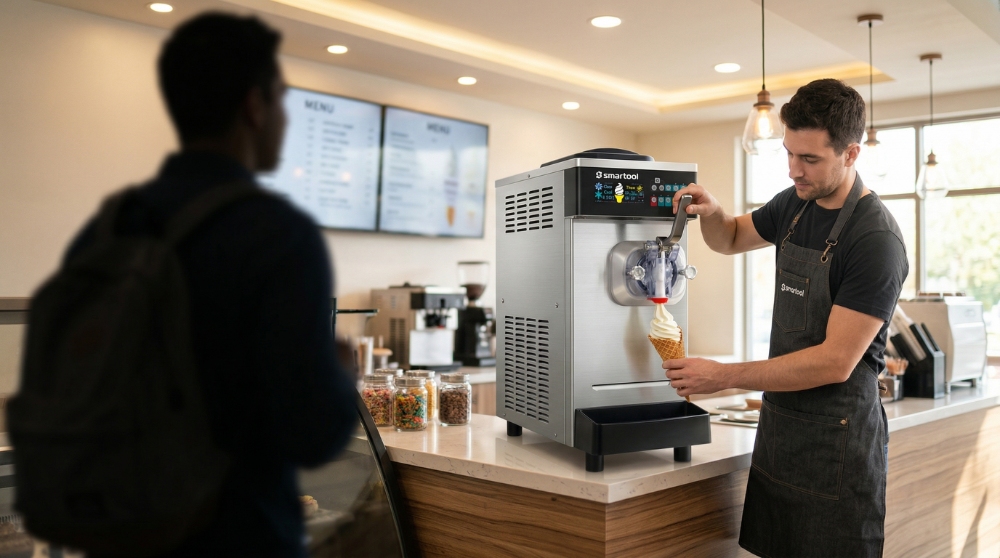
Compare soft serve, batch freezer and multifunction commercial ice cream machines, size output to your peak hour, and check power and cleaning before you buy.
A commercial ice cream machine comes in three working formats: soft serve machines that freeze and dispense on demand, batch freezers that make hard ice cream or gelato for a dipping cabinet, and compact multifunctional units that switch between hard and soft product. Pick the format from your menu first, then size it to your busiest hour, confirm the electrical supply, and check how long the cleaning routine takes your staff. This guide walks through each decision with real sizing math and a model-by-model comparison.
Commercial Ice Cream Machine Types at a Glance
The format decides your workflow more than any single spec. Food scientists at the University of Guelph describe soft serve and hard ice cream as nearly the same product at the moment of freezing: in their explanation of how ice cream is frozen and whipped, soft serve is drawn straight into the cone, while hard ice cream is packaged and hardened afterward. That one difference changes the equipment list, the labor, and the floor plan.
| Format | What it makes | How service works | Extra equipment you still need | Typical fit |
|---|---|---|---|---|
| Soft serve machine | Soft serve, frozen yogurt, twist cones, shake base | Continuous freezing; staff pull a handle per serving | Mix storage refrigeration | Cafés, QSRs, dessert counters, buffets |
| Batch freezer | Hard ice cream, gelato, sorbet | One batch at a time, then hardened and scooped | Hardening freezer, dipping cabinet, scoops | Scoop shops, gelato bars, restaurants making their own flavors |
| Multifunctional hard/soft unit | Small batches of hard or soft product, milkshakes | Batch-style, switchable by setting | Depends on menu | Menu testing, low-volume counters |
| Semi-automatic or unattended | Soft serve with controlled portions | Portion or cup-driven dispensing, self-service options | Payment and placement planning | Venues with limited staff or high foot traffic |
Soft serve machines
A soft serve machine keeps liquid mix chilled in a hopper, feeds it into a freezing cylinder, and dispenses finished product on demand. It suits operations where speed matters and the menu revolves around cones, cups, sundaes, and twists. The internal choices within this category, such as countertop or floor-standing, one or three heads, and feed system, are covered in our commercial soft serve machine buying guide.
Batch freezers for hard ice cream and gelato
A batch freezer churns a measured quantity of mix, you extract it, and the product goes into a hardening freezer before it is scooped. The Guelph text notes that a batch freezer takes roughly 10 to 15 minutes per batch, compared with about 30 seconds of residence time in a continuous freezer. That time budget is why batch production happens before service, not during the rush. Budget for the dipping cabinet and freezer space as part of the same purchase.
Multifunctional hard and soft machines
Compact multifunction units freeze small loads of either hard or soft product and can also make shake bases. They trade throughput for flexibility, so they work best where frozen desserts are a test or a side item rather than the main revenue line.
Semi-automatic and self-service formats
When staffing is the constraint, portion-controlled or unattended equipment changes the math. Operators weighing kiosks, vending units, or staff-assisted automation can compare options on our unmanned ice cream machine category page, and the economics are laid out in our guide to ice cream vending machine profit.
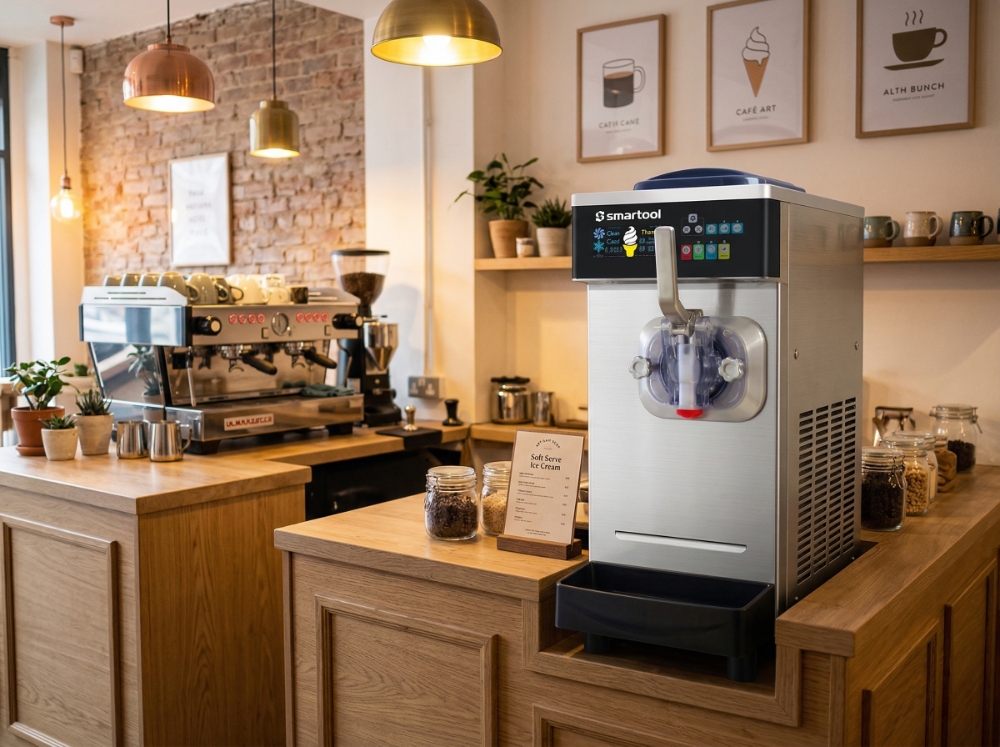
Size a Commercial Ice Cream Machine to Your Busiest Hour
Daily totals hide the real load. A shop that sells 200 servings a day may sell 90 of them between 6 p.m. and 8 p.m. The machine has to keep up with that window without the product turning soft, so size from peak-hour servings.
Soft serve output is usually rated in liters or quarts of finished product per hour. Batch and multifunction units are often rated in kilograms per hour. Convert everything to the serving size you actually sell before you compare models.
Peak-hour sizing worksheet
- Estimate servings in your busiest hour (from POS data, or cones sold in a comparable hour).
- Multiply by serving volume in milliliters. A 4 fl oz serving is about 118 mL.
- Divide by 1,000 to get liters per hour.
- Divide by a planning factor to cover warm rooms, back-to-back pulls, and mix that goes in warmer than ideal. The worksheet below uses 0.8 as an example assumption.
- Choose a machine whose rated output meets or exceeds the result.
| Peak-hour servings (4 fl oz) | Finished product needed | With 0.8 planning factor | Output class to shortlist |
|---|---|---|---|
| 80 | 9.4 L/h | 11.8 L/h | Compact single-head countertop (18–24 L/h class) |
| 150 | 17.7 L/h | 22.1 L/h | Larger single-head or semi-automatic (20–30 L/h class) |
| 250 | 29.5 L/h | 36.9 L/h | Three-head countertop or dual-system unit (40–52 L/h class) |
| 400 | 47.2 L/h | 59.0 L/h | Floor-standing, dual-system machine (60+ L/h class) |
Rated output is measured under stated test conditions, so check the ambient and mix temperatures listed next to the number. Hot, poorly ventilated rooms pull output down, so compare ratings measured at conditions close to your own.
Heads, Flavors, and Hopper Size
A single-head machine serves one flavor at a time and keeps the cleaning routine short. Three-head machines let you run two flavors plus a twist from one footprint, which helps both menu range and line speed. Dual-system machines go further: each side has its own refrigeration, so one side can keep running if you only need half the capacity on a slow day.
Hopper size sets how often staff refill during a rush. Freezing cylinder size affects how many servings you can pull back-to-back before the product needs to recover. Treat the two numbers together; a large hopper paired with a small cylinder still slows down under a long line.
Cooling, Airflow, and Installation Space
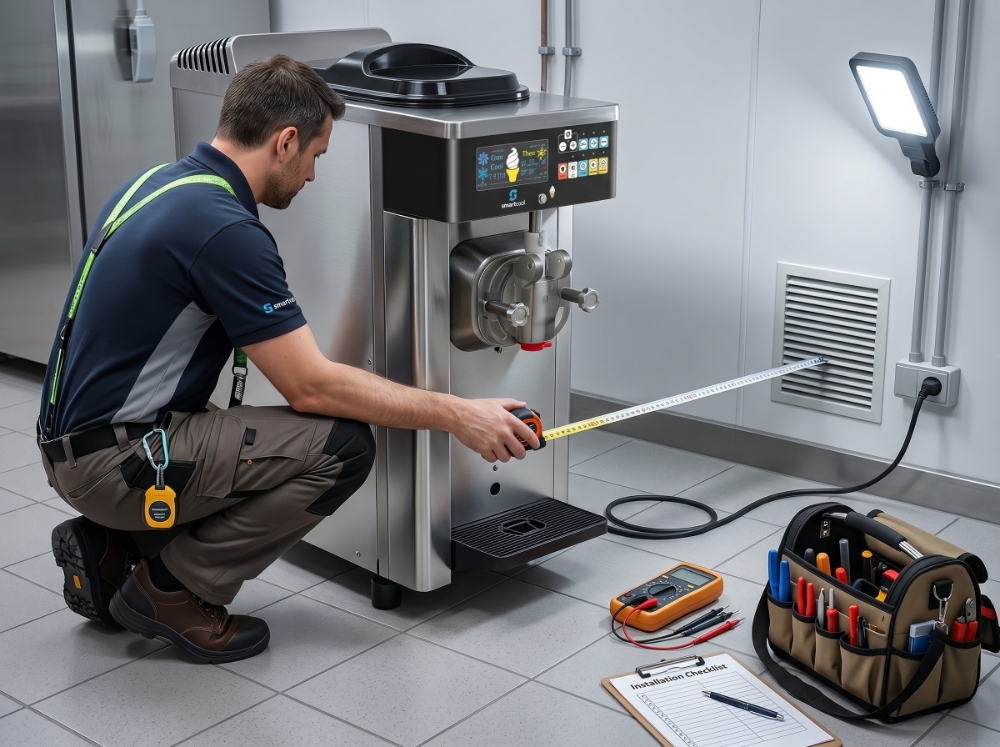
Most countertop and many floor-standing units are air-cooled: they pull room air across a condenser and push heat back into the room. That makes the air path part of the installation. Check where the machine takes in air and where it exhausts, because side-exhaust and rear-exhaust units need different clearances.
Smartool’s daily pre-operation checklist recommends more than 30 cm (about 12 in) of open space at the back and both sides, away from heat sources, in its ice cream machine maintenance guide. Measure doorways, counter depth, and counter load rating too; some high-output soft serve machines weigh well over 100 kg, and a unit that fits the counter but not the delivery path is still the wrong machine.
Power: Voltage, Current, and Frequency
Electrical mismatch is one of the most expensive surprises on delivery day. Compact soft serve units often run on a 110–115V circuit, while three-head and dual-system machines are commonly built for 220V. Before you order, confirm four things with an electrician:
- Voltage: 115V, 208V, and 240V circuits are not interchangeable, and a “220V” rating needs to be matched to what your building actually supplies.
- Current: read the nameplate amperage and plan a dedicated circuit sized for it.
- Frequency: US utility power is 60 Hz. A unit rated only for 50 Hz is not a drop-in fit.
- Plug and receptacle: the plug configuration must match the outlet, or the electrician needs to change it.
For workplace equipment, look for a safety certification mark from a lab in OSHA’s Nationally Recognized Testing Laboratory (NRTL) program, such as UL or Intertek ETL. How these marks differ from sanitation certification is covered in our guide to commercial kitchen equipment certifications.
Cleaning, Sanitation, and Food Safety Standards
Dairy mix supports bacterial growth, so the cleaning routine is part of the purchase decision. Count the parts that come out of the machine each night, how long disassembly and reassembly take, and whether the machine has a cleaning mode that flushes the cylinder. A process that takes 20 extra minutes a night adds up to real labor over a season.
For sanitation design, the relevant American National Standard is NSF/ANSI 6. According to NSF’s food equipment standards overview, it sets minimum food protection and sanitation requirements for dispensing freezers, including heat treatment models. Ask any supplier which standards a specific model has been evaluated against, and ask your health inspector how often your jurisdiction expects the machine to be fully disassembled.
Labeling matters as well. If your menu calls the product “ice cream,” the federal standard of identity for ice cream in 21 CFR 135.110 requires at least 1.6 pounds of total solids per gallon and a finished weight of at least 4.5 pounds per gallon. Your mix supplier can confirm which name your formula qualifies for.
Commercial Ice Cream Machine Buying Mistakes to Avoid
Most bad purchases trace back to a few skipped checks. Each one below has a simple countermeasure.
- Buying before the menu is fixed: a soft serve machine will not produce scoopable hard ice cream, and a batch freezer will not dispense cones on demand. Write down the product, serving size, and number of flavors first.
- Sizing on daily averages: use the peak-hour worksheet above, not total daily sales.
- Ignoring the electrical supply: confirm voltage, current, frequency, and plug type before the order, not after delivery.
- Blocking the airflow: an air-cooled machine pushed against a wall or next to a fryer loses cooling capacity and output.
- Underestimating cleaning labor: time a full teardown on a demo unit or ask for the cleaning procedure in writing.
- Comparing only the purchase price: mix yield, electricity, cleaning labor, and downtime shape the real cost. Our breakdown of soft serve machine cost and ROI shows how to put those numbers on one page.
- Skipping the certification check: confirm the safety listing and sanitation standard for the exact model number you are buying.
- Not asking about support: find out warranty length, what it covers, how remote diagnosis works, and where on-site service is available.
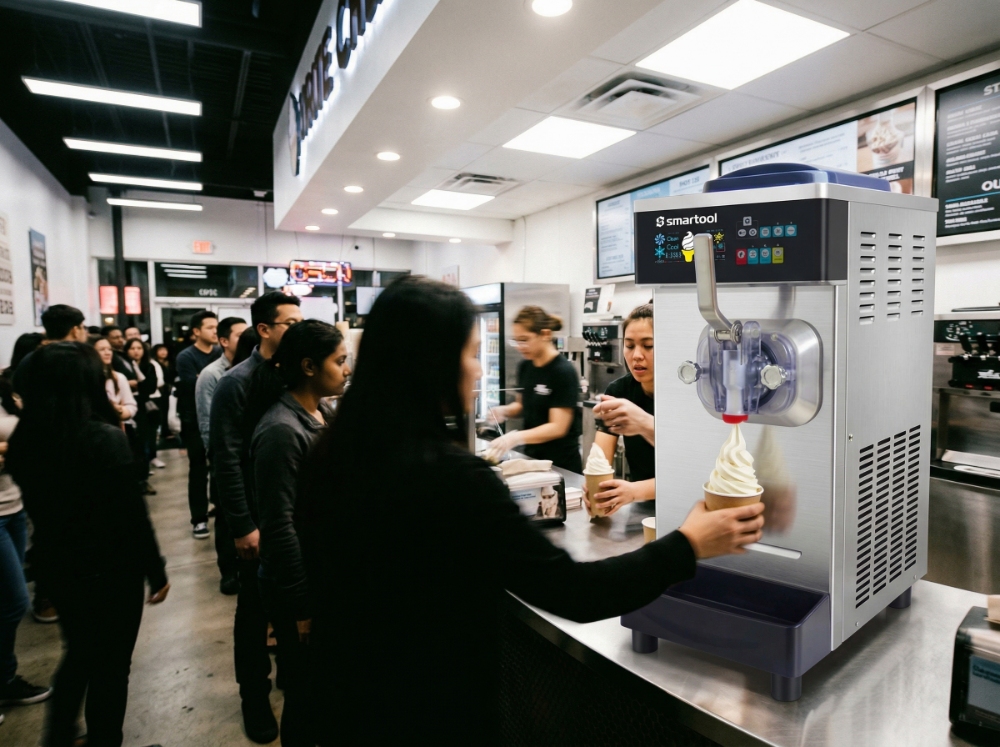
Smartool Commercial Ice Cream Machines Compared
Smartool builds soft serve, semi-automatic, and multifunctional ice cream equipment for US foodservice operators. The table uses the specifications published on each model page.
| Model | Format | Rated output | Power and electrical | Hopper / cylinder | Worth noting |
|---|---|---|---|---|---|
| GT18ERLW-F | Countertop, single head | 18–24 L/h | 1580 W, 110V/60Hz | 6 L / 1.6 L | 7-inch touchscreen, one-touch cleaning |
| SW26REL-F | Desktop, single head | 22–30 L/h | 1600 W, 115V/60Hz, 16 A | 10 L / 2.0 L | Hopper pre-cooling to ≤10°C, ≤68 dB |
| SW26-BA | Semi-automatic | 20–26 L/h | 1700 W | 10 L stainless hopper | 14-day clean-free function, cup recognition, adjustable portions |
| SW52REL-TF | Dual refrigeration | 48–52 L/h | 3000 W rated cooling power, 110V/60Hz | 8 L / 2.0 L | Independent dual refrigeration, level and voltage alarms |
| BT742SR2JL-F | Countertop, three heads, single system | 42 L/h | 3800 W, 220V/60Hz | 8 L / 2.3 L | Night preservation, one-touch defrost, low-mix alarm |
| BT768CRJL-TF | Vertical, three heads, dual system | 68 L/h | 4600 W, 220V/60Hz | Dual hoppers and cylinders | Two systems can be run separately |
| Multifunctional hard/soft (BQ3K) | Countertop | 3 kg/h | 280 W, AC220–240V/50Hz | 2.3 L hopper | Hard, soft, and milkshake modes; +10 to −10°C range |
For café counters and convenience stores adding a dessert line, the single-head units keep training and cleaning simple. High-traffic dessert shops should look at the BT742SR2JL-F three-head countertop ice cream machine, which delivers 42 L/h from a counter footprint, or the SW52REL-TF soft serve machine, which reaches 48–52 L/h on a 110V/60Hz supply with two independent refrigeration systems.
Operators who want to test hard ice cream and soft serve before committing to one direction can start with the multifunctional hard and soft ice cream maker; note its 50 Hz rating when you plan the electrical side.
For volume soft serve programs, Smartool’s commercial soft serve machines page covers factory-direct supply, and you can browse all Smartool ice cream machine models in one place.
Coverage in North America under Smartool’s published after-sales policy runs three years on the machine and compressor and one year on parts and labor, with free video and phone guidance and on-site service in major cities.
Which Machine Type Fits Your Operation
| Operation | Main constraint | Format to start with | Spec to check first |
|---|---|---|---|
| Café or bakery adding dessert | Counter space, staff time | Countertop single-head soft serve | Cleaning time, 110–115V supply |
| Dessert shop or QSR with evening rushes | Peak-hour speed | Three-head or dual-system soft serve | Rated L/h against peak worksheet, 220V circuit |
| Buffet, campus, or hotel breakfast bar | Untrained users | Single or three-head soft serve with simple controls | Portion control, alarms, drip management |
| Scoop shop or gelato bar | Flavor range, texture control | Batch freezer plus dipping cabinet | Batch size and cycle time |
| Seasonal or test menu | Uncertain demand | Multifunctional hard/soft unit | Output per hour, electrical rating |
| Mall, venue, or unstaffed location | Labor | Semi-automatic or vending format | Payment, remote monitoring, cleaning interval |
Commercial Ice Cream Machine Buying Questions
Is a soft serve machine the same as a commercial ice cream machine?
No. “Commercial ice cream machine” covers the whole category. A soft serve machine is one format within it, built to freeze and dispense continuously. Hard ice cream and gelato come from batch freezers and need hardening and a dipping cabinet.
Does a gravity-fed or pump-fed machine matter for a first purchase?
It matters if soft serve is a core product. The feed system changes texture, mix yield, and cleaning time. Our comparison of gravity vs pump soft serve machines works through the numbers.
Can one machine make both hard and soft ice cream?
Yes, at small volumes. Multifunctional units switch between modes, but their hourly output is far below a dedicated soft serve machine or batch freezer. Use them where flexibility matters more than throughput.
What should I have ready before requesting a quote?
Have four things ready: your peak-hour servings, serving size, the number of flavors, and the electrical supply available at the install location. With those four inputs, a supplier can recommend a specific model instead of a general category.
Ready to match a machine to your menu and peak hour? Request a quote from Smartool with your volume, space, and power details, and the team will recommend a model for your operation.
Factory-direct from Smartool
Planning a commercial equipment purchase?
Share your site conditions, daily output and budget. Our team will match a model, send the spec sheets and quote factory-direct pricing.

Written by
Senior Engineer, Smartool
Jason is a senior engineer at Smartool. He works on the commercial ice machines, soft serve and slushy machines, and refrigerated prep tables Smartool builds for restaurants, bars, hotels and dessert shops. His guides look at equipment from the engineering side: how to size a machine for a site, what it needs for power, water and airflow, and how to keep it running through busy service. He also helps buyers match the right model to their kitchen before they request a quote.
.elementor-76528 .elementor-element.elementor-element-5c7a0d0{--display:flex;--flex-direction:column;--container-widget-width:100%;--container-widget-height:initial;--container-widget-flex-grow:0;--container-widget-align-self:initial;--flex-wrap-mobile:wrap;}.elementor-76528 .elementor-element.elementor-element-5c7a0d1 .elementor-toc__header-title{text-align:start;}.elementor-76528 .elementor-element.elementor-element-5c7a0d1 .elementor-toc__header{flex-direction:row;}.elementor-76528 .elementor-element.elementor-element-5c7a0d1{--item-text-hover-decoration:underline;}
On this page
Need pricing for your project?
Get a factory-direct quote on commercial ice makers, soft serve and slushy machines, and refrigerated prep tables.
✓ Model matching and spec sheets for your site
✓ US office in City of Industry, CA
✓ Talk to an expert: +1 (872) 221-0051
Browse by topic
Ice Machine Guides
Soft Serve & Ice Cream
Slushy & Frozen Drinks
Buying & Sourcing
Compliance & Maintenance
Related posts

Ice Machine Freezing Up? Causes, Safe Checks and Fixes
Ice machine freezing up? Learn the six common causes, what staff can safely check, what needs a technician, and how to prevent repeat freeze-ups.

How to Use a Margarita Machine or Slush Machine
How to use a margarita machine or slush machine: setup, mixing and filling, freeze time, consistency, dispensing, refills and the closing routine.
One thought on “Commercial Ice Cream Machine Buying Guide: Types & Sizing”
Comments are closed.