




Blog
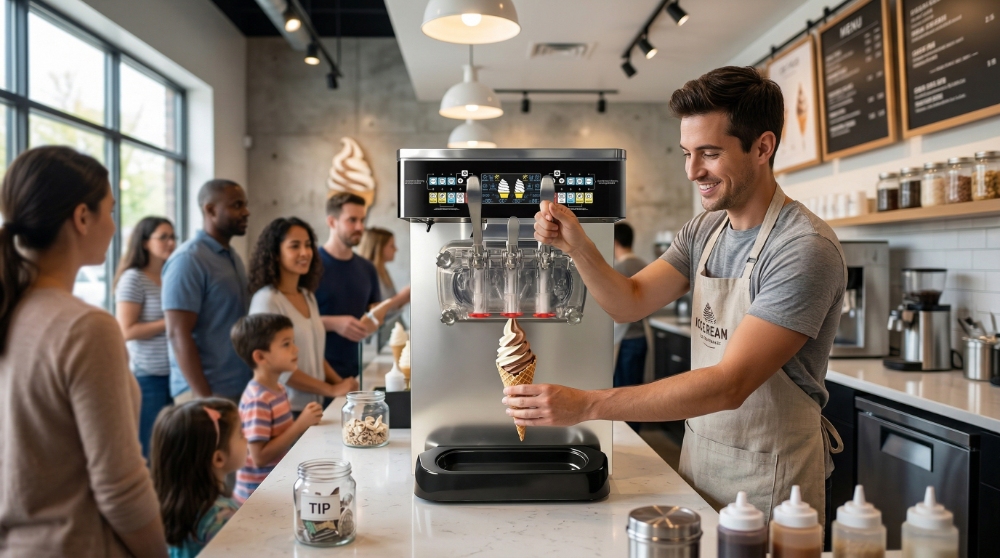
Gravity vs pump soft serve machines compared on overrun, texture, mix cost per serving, rush consistency and cleaning, plus a simple cup-and-scale overrun test.
In the gravity vs pump soft serve machine decision, the core difference is how mix and air reach the freezing cylinder. A gravity-fed machine lets mix flow down from the hopper through a feed tube, which produces a denser product with less air and fewer parts to clean.
A pump-fed machine meters mix and air into the cylinder under pressure, so you can set a higher, adjustable overrun, get more servings per gallon, and hold consistency through long rushes, at a higher equipment cost and a longer cleaning routine. Which one pays off depends on your volume, the texture your customers expect, and how much cleaning time your staff can give it.
Gravity vs Pump Soft Serve Machine: Side-by-Side
| Factor | Gravity-fed | Pump-fed (pressurized) |
|---|---|---|
| How mix enters the cylinder | Flows down from the hopper through a feed tube with a small air inlet | A pump draws mix and air in a set ratio and pushes it into the cylinder |
| Overrun control | Largely fixed by the feed tube design and mix level | Adjustable through pump settings or components |
| Texture | Denser, heavier, more intense flavor | Lighter, smoother, holds a taller swirl |
| Mix used per serving | More | Less at higher overrun settings |
| Behavior in a long rush | Refill rate limited by gravity flow; product can soften if pulled too fast | Cylinder stays filled under pressure; more stable draw after draw |
| Parts to clean | Fewer | Adds pump body, valves, seals, and tubing |
| Equipment cost | Lower | Higher |
| Usual fit | Cafés, add-on dessert programs, by-weight frozen yogurt, premium dense product | High-volume QSRs, dessert shops with sustained lines, chains standardizing yield |
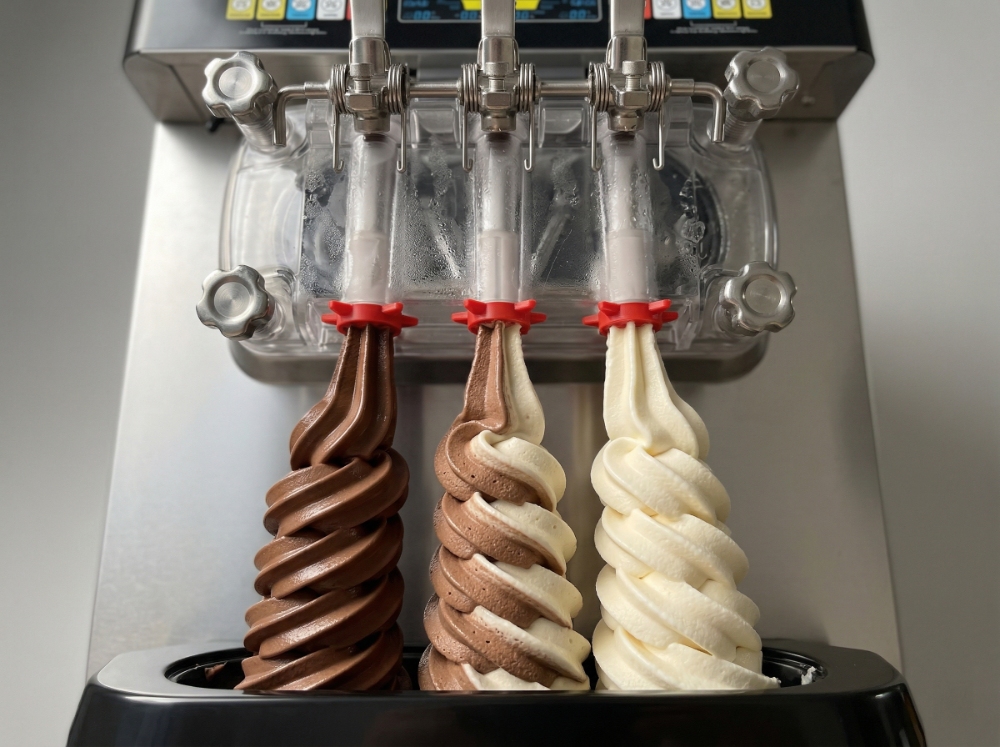
How a Gravity-Fed Soft Serve Machine Works
The hopper sits above the freezing cylinder. When product is drawn, fresh mix flows down through a feed tube into the cylinder, and a small opening in the tube lets a limited amount of air in with it. Inside the cylinder, a beater scrapes frozen product off the chilled wall and whips in that air.
Because flow depends on gravity, the air-to-mix ratio sits within a narrow band set by the feed tube and the depth of mix above it. Operators tune it mostly by choosing the right feed tube and keeping the hopper filled to the level the manual specifies. The system has few parts, so it tolerates less experienced staff and is quicker to take apart and put back together.
How a Pump-Fed Soft Serve Machine Works
A pump in or beside the hopper draws mix and air together and delivers the blend to the cylinder under slight pressure. Changing the pump setting, or on some designs a metering component, changes how much air goes in. That control lets an operator set a target overrun and repeat it across shifts, stores, and staff.
Pressure also keeps the cylinder full while product is being pulled continuously, which is why pump machines hold shape and temperature better when a line forms. The trade-off is more components: the pump body, check valves, gaskets, and feed lines all come apart for cleaning and need correct lubrication and assembly.
Overrun: The Number Behind Texture and Mix Cost
Overrun is the increase in volume from air whipped into the mix while it freezes. The University of Guelph’s ice cream technology text notes that ice cream can be up to half air by volume, and that air is what gives frozen dessert its lightness; without it, the product would behave like an ice cube.
Overrun % = (volume of product − volume of mix used) ÷ volume of mix used × 100
If one liter of mix becomes 1.5 liters of soft serve, overrun is 50%. Smartool’s knowledge base page on soft serve overrun and how it affects texture recommends controlling overrun rather than maximizing it, because product with too much air melts fast and tastes foamy.
Measure your overrun with a cup and a scale
You do not need lab equipment. Guelph’s overrun calculation methods include a weight-based formula that works with any rigid cup:
- Tare a scale with an empty cup, fill the cup level with liquid mix, and record the weight.
- Empty and dry the cup, fill it level with soft serve straight from the machine, and record the weight.
- Calculate: overrun % = (weight of mix − weight of soft serve) ÷ weight of soft serve × 100.
Example: if a cup of mix weighs 240 g and the same cup of soft serve weighs 160 g, overrun is (240 − 160) ÷ 160 × 100 = 50%. Run the test at open, mid-rush, and close. A drifting number points to mix temperature, hopper level, or a feed setup that needs attention.
Mix Cost Per Serving at Different Overrun Levels
Pump machines are often sold on mix savings. The savings are real, but they are measured in cents per serving, so volume decides whether they matter. The table uses example assumptions: prepared mix at $8.00 per gallon and a 4 fl oz serving.
| Overrun | Mix per 4 fl oz serving | Servings per gallon of mix | Mix cost per serving | Mix cost per 1,000 servings |
|---|---|---|---|---|
| 30% | 3.08 fl oz | 41.6 | $0.19 | $192 |
| 45% | 2.76 fl oz | 46.4 | $0.17 | $172 |
| 60% | 2.50 fl oz | 51.2 | $0.16 | $156 |
| 80% | 2.22 fl oz | 57.6 | $0.14 | $139 |
Formulas: servings per gallon = 128 × (1 + overrun) ÷ serving size in fl oz; mix cost per serving = mix price per gallon ÷ servings per gallon.
Moving from 30% to 60% overrun saves about $36 of mix per 1,000 servings under these assumptions. A counter selling 30 servings a day saves roughly $1 a day; a store selling 300 a day saves roughly $11 a day. Plug in your own mix price and serving size to see whether the mix savings cover a pump machine’s higher price and extra cleaning time. The full payback method is in our soft serve machine cost and ROI guide.
Where regulations limit overrun
Air cannot increase indefinitely if you sell the product as ice cream. The federal ice cream standard of identity (21 CFR 135.110) requires at least 4.5 pounds per gallon and 1.6 pounds of total solids per gallon, and every point of added overrun lowers weight per gallon. Many soft serve mixes are sold under other product names with different rules, so confirm the labeling with your mix supplier before you raise overrun.
Texture, Temperature, and What Customers Expect
Lower-overrun product from a gravity machine eats denser and colder, with a more pronounced flavor. It fits premium positioning, dipped cones, and self-serve frozen yogurt priced by weight, where a denser product means more ounces in the cup. Higher-overrun product from a pump machine feels smoother and lighter, stands taller on a cone, and looks larger for the same mix.
Mix choice matters as much as the machine. Butterfat, solids, and stabilizers determine how well the mix holds air, and mix that goes into the hopper warm freezes slowly and whips poorly. Smartool’s soft serve mix selection and usage guide recommends keeping mix at 41 °F (5 °C) or below until it goes into the hopper.
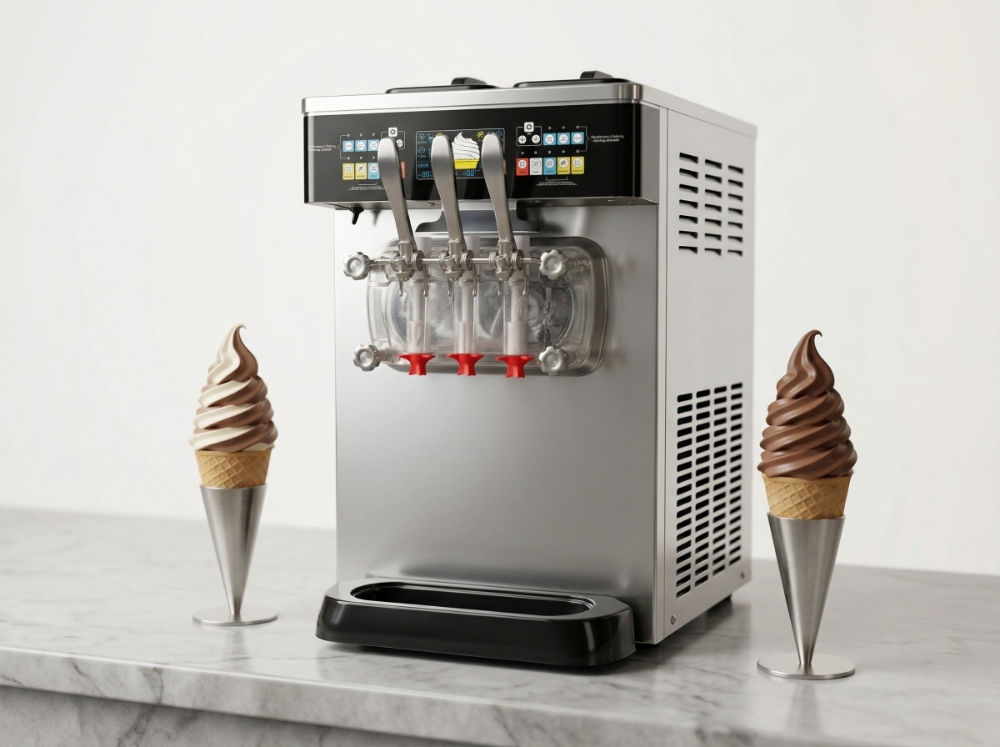
Speed and Consistency During a Rush
During a long line, each draw pulls frozen product out and lets fresh, unfrozen mix into the cylinder. On a gravity machine, refill depends on flow down the feed tube, so pulling faster than the machine recovers leaves soft, runny servings. On a pump machine, pressure keeps the cylinder full and the air ratio steady, so the 40th cone looks closer to the first.
Rated output still sets the limit for both designs. A pump will not rescue an undersized machine. Size the machine to your peak hour first, using the method in our commercial soft serve machine buying guide, then choose the feed system.
Cleaning, Parts, and Daily Labor
Both designs need daily attention to food-contact parts. A pump machine simply has more of them. Every extra gasket and valve is one more thing to inspect, lubricate with the specified food-grade lubricant, and reassemble correctly, and one more place for a missed O-ring to cause a leak or low overrun.
- Gravity: feed tube, draw valve, beater, scraper blades, seals. Faster teardown, easier training.
- Pump: all of the above plus pump body, pump parts, check valves, and mix lines. Longer teardown, more careful reassembly.
Both designs fall under NSF/ANSI 6, the sanitation standard that NSF’s food equipment standards overview describes for dispensing freezers. Whatever you buy, time a full cleaning cycle and multiply by your operating days; that labor belongs in the cost comparison. Smartool’s daily ice cream machine cleaning procedure is a useful baseline for estimating it.
Which Feed System Fits Your Operation
| Operation | Volume pattern | Better fit | Why |
|---|---|---|---|
| Café or bakery adding soft serve | Low, spread through the day | Gravity | Lower price, short cleaning, mix savings too small to matter |
| Self-serve frozen yogurt priced by weight | Moderate, customer-operated | Gravity | Denser product, simple controls, fewer parts to go wrong |
| Premium dessert concept | Moderate | Gravity | Dense texture supports the positioning |
| QSR or dessert shop with daily lines | High, concentrated peaks | Pump | Stable draw under load and meaningful mix savings |
| Multi-unit chain | High, needs repeatable yield | Pump | Overrun can be standardized across stores |
| Seasonal kiosk | Short, intense season | Either | Choose by peak hour and staff experience |
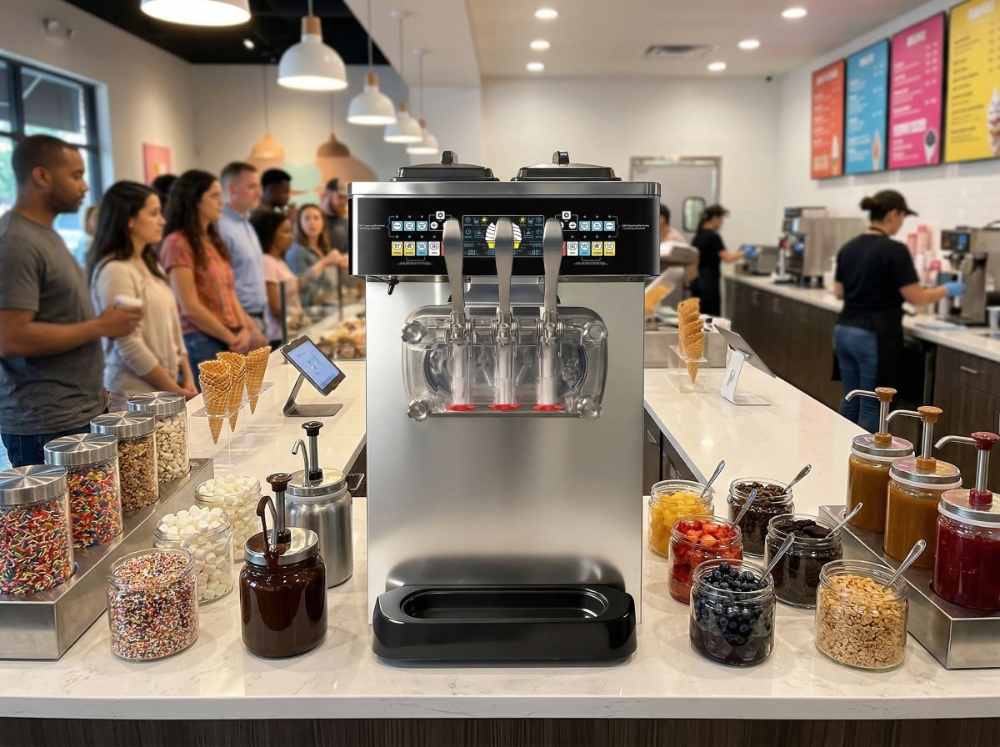
Choosing a Smartool Soft Serve Machine by Output and Texture Target
Start with the two numbers that drive this decision: the servings you need in your busiest hour and the overrun your menu calls for. Include both in your quote request so the recommendation reflects your texture and mix cost, not only capacity.
For compact counters, the GT18ERLW-F single-head soft serve machine delivers 18–24 L/h on 110V/60Hz with one-touch cleaning, which keeps the daily routine short. For sustained lines, the SW52REL-TF dual-refrigeration soft serve machine is rated at 48–52 L/h and pre-cools the hopper to 10°C or below, so mix waiting between rushes stays fresh.
Smartool’s range of commercial soft serve machines is supplied factory-direct. You can also browse all Smartool ice cream machine models, including three-head and multifunctional units.
Gravity and Pump Soft Serve Questions
Is a pump soft serve machine always more profitable?
No. Mix savings grow with volume. At low daily volume, the savings may never cover the higher equipment price and the extra cleaning labor. Run the per-serving math above with your real mix price.
Can I raise the overrun on a gravity machine?
Only within a narrow range, usually by changing to a different feed tube specified by the manufacturer. If you need a much higher or adjustable overrun, that points to a pump-fed design.
Does higher overrun make soft serve worse?
Not within a controlled range. Moderate overrun gives a smooth, stable texture. Past a certain point, the product turns foamy and melts quickly, which customers notice.
Why is my soft serve getting runny during rushes?
Usually the draw rate is outrunning the machine’s recovery, the mix went in warm, or airflow around the condenser is restricted. Our soft serve machine troubleshooting guide walks through the checks by symptom.
Tell us your peak-hour servings, target texture, and mix cost, and get a soft serve machine quote from Smartool built around those numbers.
Factory-direct from Smartool
Planning a commercial equipment purchase?
Share your site conditions, daily output and budget. Our team will match a model, send the spec sheets and quote factory-direct pricing.

Written by
Senior Engineer, Smartool
Jason is a senior engineer at Smartool. He works on the commercial ice machines, soft serve and slushy machines, and refrigerated prep tables Smartool builds for restaurants, bars, hotels and dessert shops. His guides look at equipment from the engineering side: how to size a machine for a site, what it needs for power, water and airflow, and how to keep it running through busy service. He also helps buyers match the right model to their kitchen before they request a quote.
.elementor-76528 .elementor-element.elementor-element-5c7a0d0{--display:flex;--flex-direction:column;--container-widget-width:100%;--container-widget-height:initial;--container-widget-flex-grow:0;--container-widget-align-self:initial;--flex-wrap-mobile:wrap;}.elementor-76528 .elementor-element.elementor-element-5c7a0d1 .elementor-toc__header-title{text-align:start;}.elementor-76528 .elementor-element.elementor-element-5c7a0d1 .elementor-toc__header{flex-direction:row;}.elementor-76528 .elementor-element.elementor-element-5c7a0d1{--item-text-hover-decoration:underline;}
On this page
Need pricing for your project?
Get a factory-direct quote on commercial ice makers, soft serve and slushy machines, and refrigerated prep tables.
✓ Model matching and spec sheets for your site
✓ US office in City of Industry, CA
✓ Talk to an expert: +1 (872) 221-0051
Browse by topic
Ice Machine Guides
Soft Serve & Ice Cream
Slushy & Frozen Drinks
Buying & Sourcing
Compliance & Maintenance
Related posts

Ice Machine Freezing Up? Causes, Safe Checks and Fixes
Ice machine freezing up? Learn the six common causes, what staff can safely check, what needs a technician, and how to prevent repeat freeze-ups.

How to Use a Margarita Machine or Slush Machine
How to use a margarita machine or slush machine: setup, mixing and filling, freeze time, consistency, dispensing, refills and the closing routine.
5 thoughts on “Gravity vs Pump Soft Serve Machine: Overrun, Cost & Texture”
Comments are closed.