




Blog
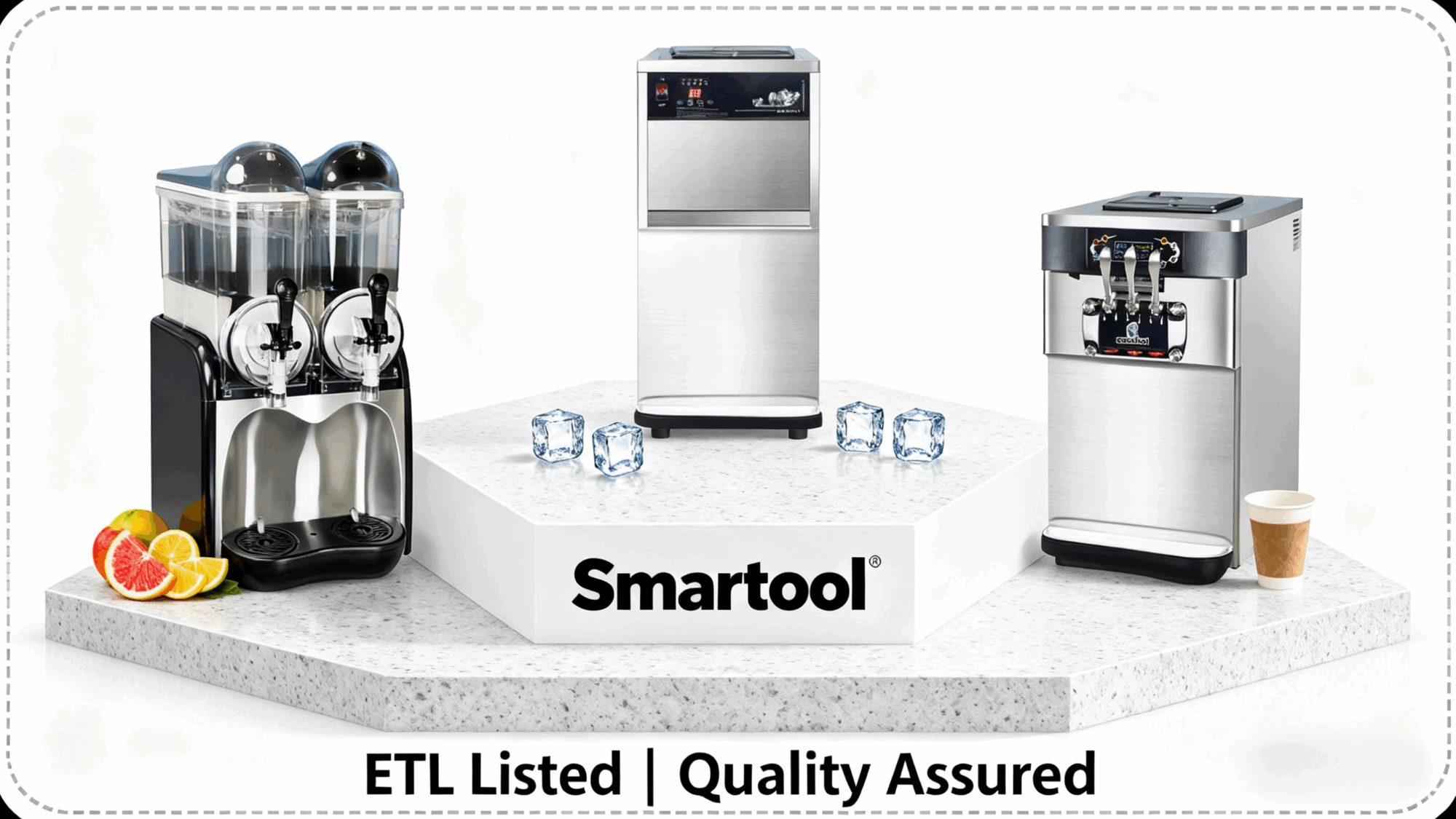
ETL, UL, NSF, FDA and DOE rules for ice machines, soft serve, slush machines and prep tables, plus what inspectors check and a pre-purchase checklist.
Commercial kitchen equipment certifications answer four separate questions: is the machine electrically safe, can it be kept sanitary, are its food-contact parts made from permitted materials, and does it meet federal energy rules where they apply. For ice machines, soft serve machines, slush machines and refrigerated prep tables, no single mark covers all four. The health inspector, the electrical inspector and the Department of Energy each look for different evidence, and a buyer who knows which document satisfies which reviewer avoids delayed openings and red-tagged equipment.
The four layers of commercial kitchen equipment certifications
Treat certification as a stack, not a single badge. Each layer has its own evidence and its own reviewer.
| Layer | Question it answers | Evidence to look for | Who usually checks |
|---|---|---|---|
| Electrical and fire safety | Can the unit shock staff or start a fire? | ETL Listed, UL Listed or CSA mark from an OSHA-recognized testing laboratory, printed on the rating plate | Electrical inspector, building official, insurer |
| Sanitation | Can the unit be cleaned and kept food-safe? | NSF, ETL Sanitation or UL Sanitation mark issued to an NSF/ANSI standard, shown on the spec sheet | Health department plan reviewer and field inspector |
| Food-contact materials | Are the parts that touch food made from permitted materials? | Materials declaration referencing FDA rules in 21 CFR; NSF/ANSI 51 for components | Health department, buyer’s quality team |
| Energy | Does the model meet the federal minimum efficiency for its class? | DOE certification for covered equipment such as automatic commercial ice makers; ENERGY STAR as an optional higher tier | DOE (a manufacturer and importer obligation), energy program administrators |
Local rules sit on top of these layers. Jurisdictions adopt their own editions of the food code and the electrical code, then add plan-review steps of their own. Ask the health department for its equipment submittal requirements before the order is placed, not after the equipment is on the loading dock.
Electrical safety: what ETL, UL and CSA listings prove
An ETL, UL or CSA listing means a Nationally Recognized Testing Laboratory (NRTL) tested a representative sample against a product safety standard and continues to inspect the factory that builds it. For electrical safety the marks are interchangeable. What matters is that the issuer appears on OSHA’s current list of Nationally Recognized Testing Laboratories and that the listing names the exact model and voltage you are buying.
For employers, the OSHA electrical standard at 29 CFR 1910.303 accepts equipment only when it is approved, and it requires listed or labeled equipment to be installed and used according to the instructions in the listing. If the installation manual calls for a dedicated circuit or a specific plug configuration, that instruction is part of what keeps the installation acceptable.
When equipment arrives without a recognized listing
An electrical inspector or building official who finds unlisted equipment in a food establishment can red-tag it, which takes the unit out of service until compliance is shown. One recovery route is an on-site evaluation such as Intertek’s field labeling service for food service equipment, which applies a serialized label to the specific unit after inspection and testing. Because the label belongs to one serial number, every additional machine needs its own evaluation. Field labeling rescues a stuck opening; it is not a purchasing plan.
The practical difference between safety listings and sanitation marks, with a mark-by-mark table, is covered in our ETL vs NSF comparison for commercial ice makers.
Sanitation certifications by equipment type
Sanitation certification is written against NSF/ANSI standards, and each standard is tied to a family of equipment. The NSF food equipment standards portfolio defines the scope of each one. The certificate you receive should cite the standard number that fits the machine.
| Equipment | Standard usually cited | Scope |
|---|---|---|
| Automatic ice machines and ice storage | NSF/ANSI 12 | Materials, design, construction and performance of equipment that makes, stores and dispenses ice intended for human consumption |
| Soft serve and frozen yogurt machines | NSF/ANSI 6 | Dispensing freezers that process previously pasteurized frozen dairy products and dispense directly into the customer’s container |
| Refrigerated prep tables, reach-ins and undercounters | NSF/ANSI 7 | Commercial refrigerators and freezers, including refrigerated food preparation units |
| Slush and frozen beverage machines | Depends on the design | Read the standard number printed on the listing; frozen beverage dispensers are certified under different standards depending on how they store and dispense product |
| Gaskets, tubing, cutting boards and other components | NSF/ANSI 51 | Materials and finishes used in commercial foodservice equipment |
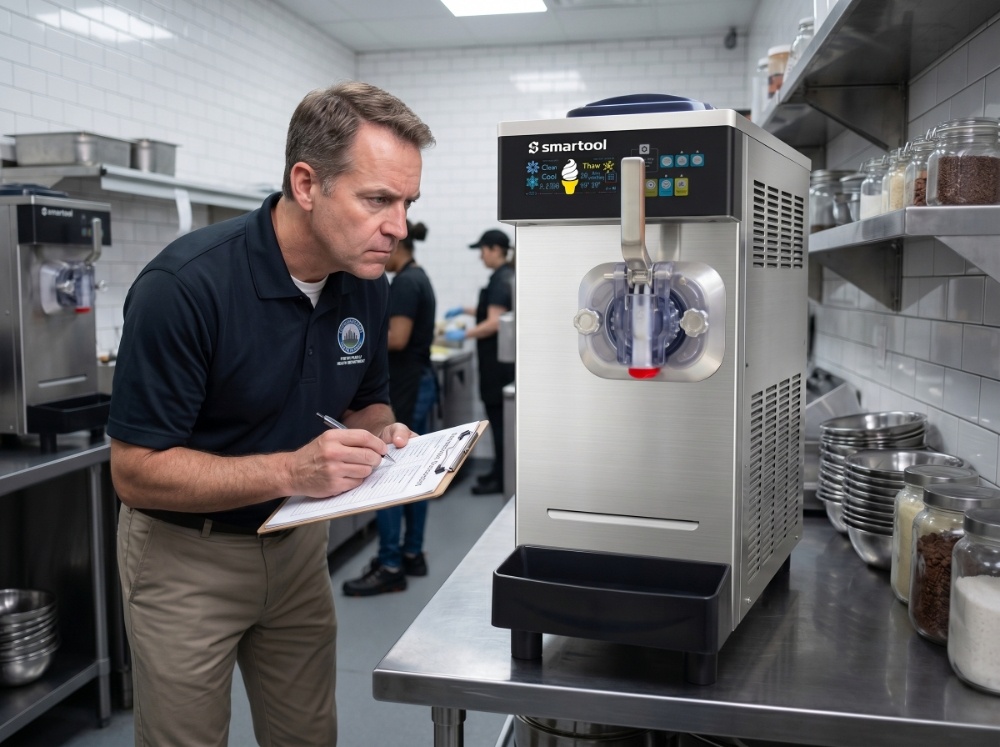
NSF is not the only organization that certifies to these standards. Intertek’s ETL Sanitation mark and UL Solutions’ foodservice equipment sanitation certification are issued against the same NSF/ANSI standards. The FDA Food Code 2022, the model code that state and local jurisdictions adopt, treats equipment certified for sanitation by an ANSI-accredited certification program as meeting its equipment design and construction requirements.
What a sanitation certificate does not cover
Certification describes how a machine was built. It does not keep the machine clean. Slime in an ice bin, mix residue in a hopper or a dirty dispensing door is a violation no matter what mark is on the rating plate. Build the cleaning routine from the manufacturer’s manual and a practical schedule such as our commercial ice machine cleaning guide, and keep the log where an inspector can see it.
Frozen dessert equipment needs the same discipline at a shorter interval, because dairy mix is a higher-risk food than ice. The ice cream machine maintenance guide lays out daily and periodic tasks operators can handle themselves.
Food-contact materials: what “FDA compliant” means
FDA does not issue a listing mark for a finished ice machine, soft serve machine or prep table. It regulates the substances that come into contact with food. When a spec sheet says “FDA compliant” or “FDA food-grade,” the statement should trace back to materials permitted under Title 21 of the Code of Federal Regulations, which can be cross-checked against the FDA inventory of food contact substances listed in 21 CFR.
In practice, ask for a materials declaration that names each food-contact part: evaporator or freezing cylinder, hopper, beater or agitator, dispensing valve, seals and tubing. Stainless steel grade matters for sanitizer compatibility, and plastic and rubber parts should be identified by compound rather than described only as “food grade.”
Energy rules: DOE standards and ENERGY STAR
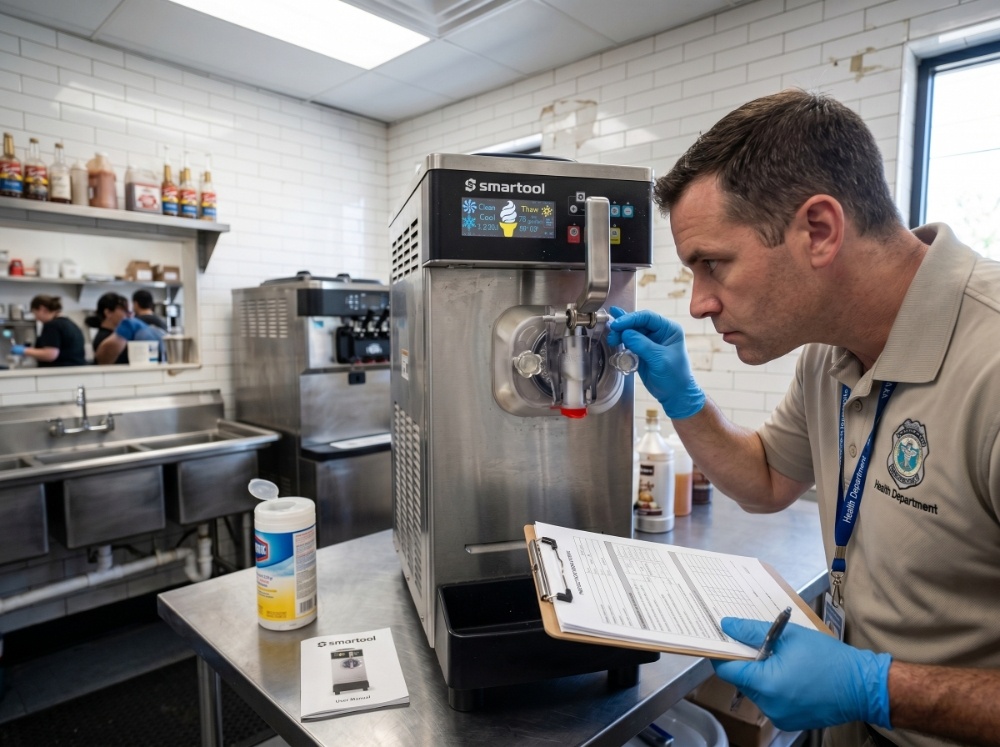
Energy compliance works differently from safety and sanitation. Federal energy conservation standards apply to covered equipment whether or not the buyer asks about them, and manufacturers and importers carry the certification duty. Automatic commercial ice makers are covered equipment: the DOE automatic commercial ice maker standards page points to the maximum energy use limits in 10 CFR 431.136 and tracks rulemaking that may change them.
ENERGY STAR is voluntary and stricter than the federal floor. Our guide to energy efficient commercial ice machines explains the kWh-per-100-lb metric, compares the DOE and ENERGY STAR limits and includes an annual electricity cost worksheet.
What inspectors check on site
When equipment holds up an inspection, the machine itself is rarely defective. Three avoidable situations account for most delays.
The certificate covers a different model
A supplier shares a certificate for a product family, but the delivered unit carries a different model suffix or voltage. Inspectors compare the rating plate with the listing, not with the brochure. Match the full model number, including suffixes such as the “REL-TF” in SW52REL-TF, before accepting delivery.
The rating plate is missing or unreadable
Certification marks belong on the permanent rating plate next to the model, serial number, voltage and current. A logo on the carton or a sell sheet does not count. If the plate is damaged in transit, contact the manufacturer before the unit goes into service.
The documents are not on file
Plan reviewers ask for spec sheets that show sanitation certification, and electrical inspectors may ask for listing information. Keep one folder, paper or digital, per machine: spec sheet, listing reference, installation manual and cleaning log. When a new unit arrives, check it against that folder the same day, so any mismatch surfaces while the supplier can still fix it.
Pre-purchase certification checklist
- Safety listing: request the laboratory name and listing reference for the exact model and voltage, then look it up in that laboratory’s public directory.
- Sanitation standard: confirm the NSF/ANSI standard number fits the equipment type, such as 12 for ice machines, 6 for soft serve and 7 for refrigerated prep tables.
- Certifier: NSF, ETL Sanitation and UL Sanitation marks issued to NSF/ANSI standards all satisfy food codes that accept ANSI-accredited certification.
- Rating plate: ask for a photo of the plate before the unit ships.
- Materials: get a declaration that names each food-contact part and its material.
- Energy: for ice makers, ask for the DOE certification data and rated kWh per 100 lb; check ENERGY STAR status if a utility incentive depends on it.
- Electrical fit: confirm voltage, amperage and plug type against the circuit at the install location.
- Local approval: send spec sheets to the health department during plan review, before the order ships.
- Foreign marks: treat CE as European documentation only; the European Commission’s CE marking guidance notes that CE does not mean an authority has approved the product as safe.
Smartool documentation by product line
Smartool builds its commercial equipment for North American 110–120V/60Hz circuits, and the Smartool technical specifications page states that its equipment has obtained FDA and ETL compliance certifications. The table below pairs each product line’s published specs with the standards to reference when requesting model-specific documents with a quote.
| Model | Category | Published specs | Documented on the product page | Standards to reference in your request |
|---|---|---|---|---|
| BF500 split-type ice maker | Ice machine | 500 lb/24 h at 21°C air and 10°C water; 375 lb/24 h at 32°C air and 21°C water; 1050 W; AC110–120V/60Hz | Stainless steel 201 and 304 body, nickel-plated copper ice trays, automatic self-cleaning | NRTL safety listing; NSF/ANSI 12; DOE ice maker certification |
| SW52REL-TF soft serve machine | Soft serve | 48–52 L/h; 8 L hopper; 2.0 L freezing cylinder; 110V/60Hz | SUS304 hopper and agitator; hopper held at or below 10°C | NRTL safety listing; NSF/ANSI 6 |
| RL18-3 three-tank slushy machine | Slush | 3 × 16.5 L tanks; 1500 W; 14.5 A; AC120V/60Hz | FCC Part 15B, IC ICES-001, CA Prop 65 compliance, FDA food-grade food-contact parts | NRTL safety listing; sanitation standard matching the dispenser design |
| TSP47FC-2 refrigerated prep table | Refrigerated prep table | 15 cu ft; 6 pans; 0–5°C; R290 refrigerant; fan cooling | NSF Standard compliance, with removable cutting board | NRTL safety listing; NSF/ANSI 7 listing reference |
Read the marks column carefully. FCC Part 15B and ICES-001 cover electromagnetic emissions, and CA Prop 65 is a California disclosure rule; none of them substitutes for a safety listing or a sanitation certificate, so keep each on its own line in the purchasing file.
Ice programs can compare both current models on the commercial ice makers factory-direct page. Kitchens adding cold prep capacity can review door, shelf and pan configurations on the Smartool salad prep table program page.
A prep table also has to hold temperature on inspection day, and a warm reading is written up regardless of certification. If a unit drifts warm, our guide to commercial refrigeration problems separates the checks an operator can make from the ones that need a technician. Buyers who want a US point of contact for documentation can learn more about Smartool’s US-based operations.
Equipment certification questions buyers ask most
Does a bar or café ice machine need NSF certification?
Usually, yes. The Food Code treats ice as food, and health departments generally expect ice machines to carry sanitation certification to NSF/ANSI 12 from NSF or another ANSI-accredited certifier. Confirm the requirement with your local plan reviewer.
Is a CE mark enough for a US kitchen?
No. CE is a manufacturer’s declaration for the European Economic Area. US inspectors look for an NRTL safety listing and a sanitation certification.
Is an ETL listing as good as a UL listing?
Yes, for electrical safety. Both are OSHA-recognized testing laboratories, and a listing from either one to the applicable product safety standard serves the same purpose.
Does ENERGY STAR replace DOE compliance?
No. DOE limits are mandatory minimums for covered equipment such as ice makers. ENERGY STAR is a voluntary tier above them.
Planning an opening or a multi-site rollout? Request a Smartool equipment quote with your model list, voltage and jurisdiction, and ask for each model’s listing and certification references to be included with pricing.
Factory-direct from Smartool
Planning a commercial equipment purchase?
Share your site conditions, daily output and budget. Our team will match a model, send the spec sheets and quote factory-direct pricing.

Written by
Senior Engineer, Smartool
Jason is a senior engineer at Smartool. He works on the commercial ice machines, soft serve and slushy machines, and refrigerated prep tables Smartool builds for restaurants, bars, hotels and dessert shops. His guides look at equipment from the engineering side: how to size a machine for a site, what it needs for power, water and airflow, and how to keep it running through busy service. He also helps buyers match the right model to their kitchen before they request a quote.
.elementor-76528 .elementor-element.elementor-element-5c7a0d0{--display:flex;--flex-direction:column;--container-widget-width:100%;--container-widget-height:initial;--container-widget-flex-grow:0;--container-widget-align-self:initial;--flex-wrap-mobile:wrap;}.elementor-76528 .elementor-element.elementor-element-5c7a0d1 .elementor-toc__header-title{text-align:start;}.elementor-76528 .elementor-element.elementor-element-5c7a0d1 .elementor-toc__header{flex-direction:row;}.elementor-76528 .elementor-element.elementor-element-5c7a0d1{--item-text-hover-decoration:underline;}
On this page
Need pricing for your project?
Get a factory-direct quote on commercial ice makers, soft serve and slushy machines, and refrigerated prep tables.
✓ Model matching and spec sheets for your site
✓ US office in City of Industry, CA
✓ Talk to an expert: +1 (872) 221-0051
Browse by topic
Ice Machine Guides
Soft Serve & Ice Cream
Slushy & Frozen Drinks
Buying & Sourcing
Compliance & Maintenance
Related posts
Chain Restaurant Case Study: 35% Reduction in Operating Costs After Implementing Standardization of Ice Makers, Ice Cream Machines, and Smoothie Machines from Smartool
Many chain eateries face the same issue when they must expand locations, and it is simple to duplica...

Smartool Commercial Equipment Lines: Ice, Soft Serve, Slush
Guide to Smartool's commercial product lines: BF ice makers, soft serve machines, RL slushy machines, vending machines and the TSP47FC-2 prep table, with specs.
7 thoughts on “Commercial Kitchen Equipment Certifications: ETL, NSF, DOE”