Seven-stage procurement guide for commercial ice, soft serve and slush equipment, with an RFQ checklist, spec checks and a TCO quote comparison template.
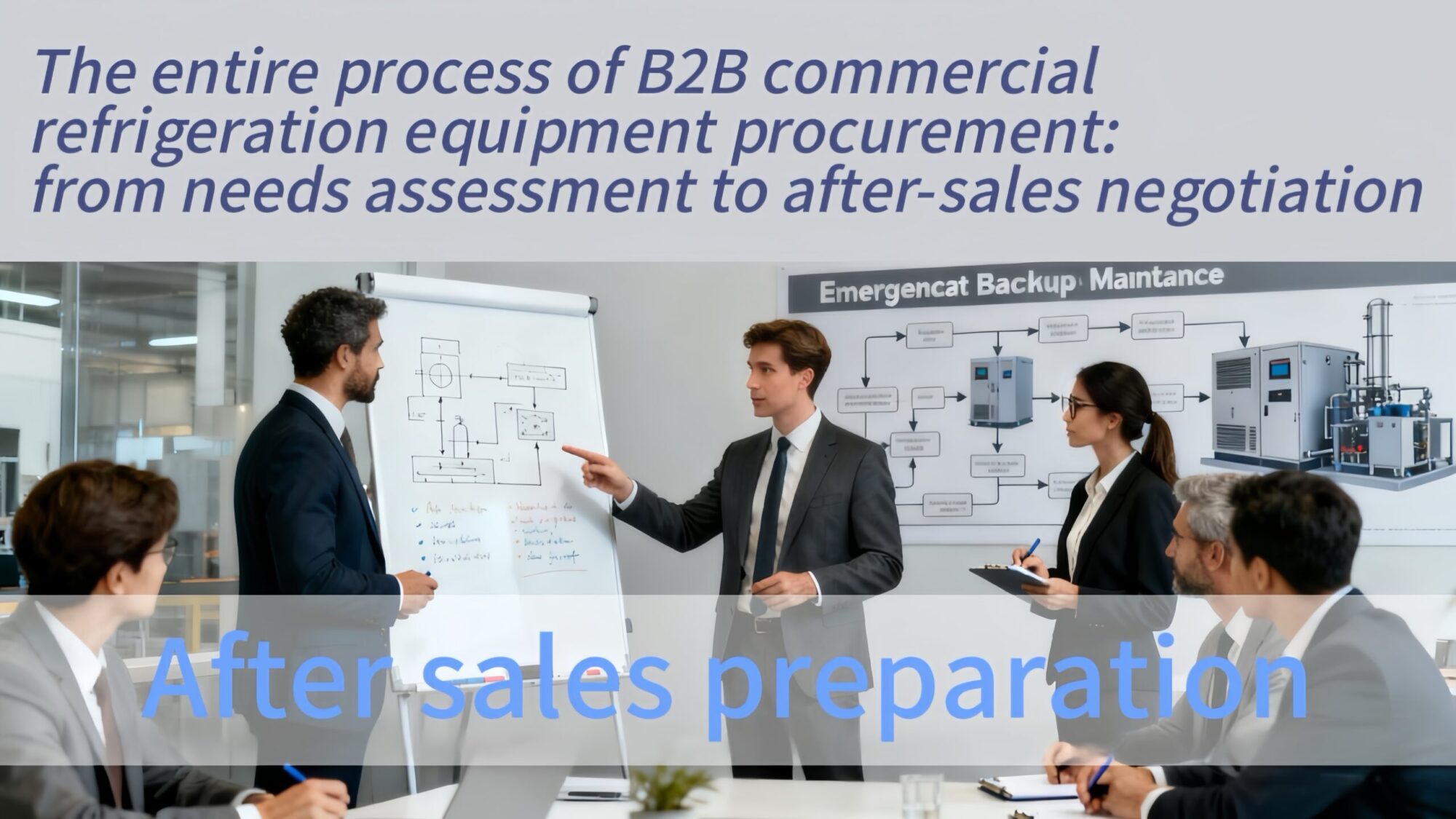
Commercial refrigeration equipment procurement works best as a seven-stage process: define peak demand and site limits, verify specifications and certifications, qualify suppliers, send a structured RFQ, compare quotes on total cost of ownership, control delivery and acceptance, and lock in after-sales terms. Skipping the first two stages is how buyers end up with an ice machine that meets its brochure number but not the July lunch rush, or a soft serve machine that needs a circuit the site does not have.
This guide is for purchasing managers at restaurant groups, hotels, franchise operators, campuses and dealers buying ice machines, soft serve and ice cream machines, slush machines and refrigerated prep tables. It includes an RFQ checklist and a quote comparison template you can reuse.
The Commercial Refrigeration Equipment Procurement Process at a Glance
Stage
Output document
Owner
1. Needs assessment
Peak-demand estimate and site audit
Operations and kitchen manager
2. Specification check
Required specs with test conditions; required listing marks
Purchasing with operations
3. Supplier qualification
Shortlist with published policies and references
Purchasing
4. RFQ
Standard request sent to every shortlisted supplier
Purchasing
5. Quote comparison
Total-cost-of-ownership comparison
Purchasing and finance
6. Delivery and acceptance
Receiving inspection and startup sign-off
Site manager
7. After-sales terms
Warranty, service and parts schedule in the order documents
Purchasing and operations
Stage 1: Needs Assessment by Business Type
Different operations stress refrigeration equipment in different ways. Start from how the business sells, not from a model list.
Business type
What drives peak demand
Specs that matter most
Quick-service and chain restaurants
Lunch and dinner rushes; drink volume per ticket
Ice output under heat, soft serve hourly output, recovery between rushes, cross-site consistency
Bars and lounges
Evening and weekend peaks; frozen cocktail programs
Ice volume and cube quality, multi-tank slush capacity, noise level
Hotels and buffets
Breakfast service, events, long operating hours
Continuous duty, low noise in guest areas, easy daily cleaning
Cafés and dessert shops
Afternoon peaks; menu variety
Countertop footprint, 110V compatibility, first-batch time, simple controls for new staff
Convenience stores and events
Seasonal impulse sales
Visible merchandising, tank count, fast freeze-down, low daily labor
Pull point-of-sale data for your busiest hours and convert it into ice pounds, soft serve liters or slush servings. Then account for heat: ice machine ratings are measured at mild room and water temperatures. The Smartool BF500 lists 500 lb per 24 hours at 21°C (70°F) air and 10°C (50°F) water, but 375 lb at 32°C (90°F) air and 21°C (70°F) water. If your kitchen runs hot, size against the second number. The commercial ice maker buying guide walks through the calculation.
Audit the site before you request quotes
Power: voltage, phase and available dedicated circuits at the installation point. Some high-output soft serve machines run on 220V; many countertop units run on 110–120V.
Water and drains: supply pressure, filtration, and floor drain location for ice machines.
Ventilation: clearance on intake and exhaust sides, and distance from fryers and ovens.
Access: door widths, stairs, elevator size and whether a liftgate delivery is needed.
Stage 2: Verify Specifications Before You Compare Prices
Price comparisons are meaningless if the specs underneath were measured differently. Three checks prevent most “it looked fine on paper” purchases.
Rated capacity vs. real capacity
Ask every supplier for output at stated test conditions and, where available, at high ambient temperature. For soft serve, look for the ambient and mix temperature behind the liters-per-hour figure; for slush, the first-batch freeze time and rated room temperature range; for prep tables, the holding range and whether the cabinet is fan-cooled. Quotes that give a capacity with no conditions go back to the supplier for clarification.
Rated power vs. energy consumption
Watts on a nameplate describe electrical load, not operating cost. Energy use depends on duty cycle, room temperature and, for ice machines, pounds produced per kilowatt-hour. Cube-type ice makers sold in the US are regulated: the Department of Energy has required manufacturers to meet federal energy conservation standards for automatic commercial ice makers with harvest capacities between 50 and 2,500 lb per 24 hours since 2010.
Efficiency programs go further. A model listed under the ENERGY STAR commercial ice maker program has been certified to energy and water limits stricter than the federal minimum, which gives you a benchmark when comparing quoted consumption figures.
Certifications you can verify
A logo in a brochure is not a certification. Request the listing number for each model and check it in the certifier’s directory. Electrical safety marks come from testing laboratories recognized under OSHA’s Nationally Recognized Testing Laboratory program, while sanitation requirements are set by NSF food equipment standards such as NSF/ANSI 12 for ice making equipment and NSF/ANSI 6 for dispensing freezers.
Processing time, carriers, freight terms, damage-claim window
Delivery promises that are not in writing
Returns
Published return reasons and cost allocation
Return terms only available after purchase
References
Operators of similar size and concept
No references in your segment
Stage 4: RFQ Checklist for Commercial Refrigeration Equipment
Send the same RFQ to every shortlisted supplier so quotes come back comparable. Missing fields are the main reason quotes cannot be lined up side by side.
RFQ field
What to include
Why the supplier needs it
Application
Business type, menu items that use the equipment, operating hours
Model selection and duty cycle
Peak demand
Ice lb, soft serve L or slush servings in the busiest hour and day
Capacity sizing with headroom
Site conditions
Summer room temperature, water temperature and pressure, ventilation clearance
Heat derating and cooling choice
Electrical
Voltage, phase, dedicated circuits available
Avoids models the site cannot power
Space
Width, depth, height, door and access limits
Footprint and delivery method
Quantity and sites
Units per site, number of sites, rollout schedule
Pricing, lead time and staging
Required certifications
Listing marks your inspectors require
Filters out non-compliant models
Delivery
Address, dock or liftgate, receiving hours, required date
Freight quote and schedule
Warranty and service
Required terms and your site cities
Confirms service coverage before pricing
Response format
Spec sheet, warranty document, lead time, freight terms, validity date
Makes quotes directly comparable
Stage 5: Compare Quotes on Total Cost of Ownership
The cheapest quote often carries the highest lifetime cost once energy, water, service and downtime are counted. Use a comparison template like this one, filling each cell from supplier documents rather than sales conversations:
Name a receiver for every delivery who checks cartons, tilt or shock indicators and serial numbers before signing. Install per the manufacturer’s electrical and clearance requirements, then run an acceptance test: ice harvest cycles and bin fill, soft serve reaching serving consistency within its first-batch time, slush freezing within the rated window, and prep tables holding their range under load. Release the final payment or holdback only after sign-off. The commercial equipment purchase contract checklist shows how to write these steps into the order.
Stage 7: Negotiate After-Sales Terms Before the PO
Your leverage is highest before the purchase order is issued. Get written answers on warranty terms by component, response and resolution expectations, on-site coverage for each site, parts supply after the warranty, and extended warranty or maintenance contract pricing. The guide to commercial equipment warranty and service includes a downtime cost worksheet for deciding how much coverage to buy.
Adding Smartool to Your Refrigeration RFQ
Smartool publishes spec sheets with test conditions for its current models, which makes them straightforward to drop into the comparison template above.
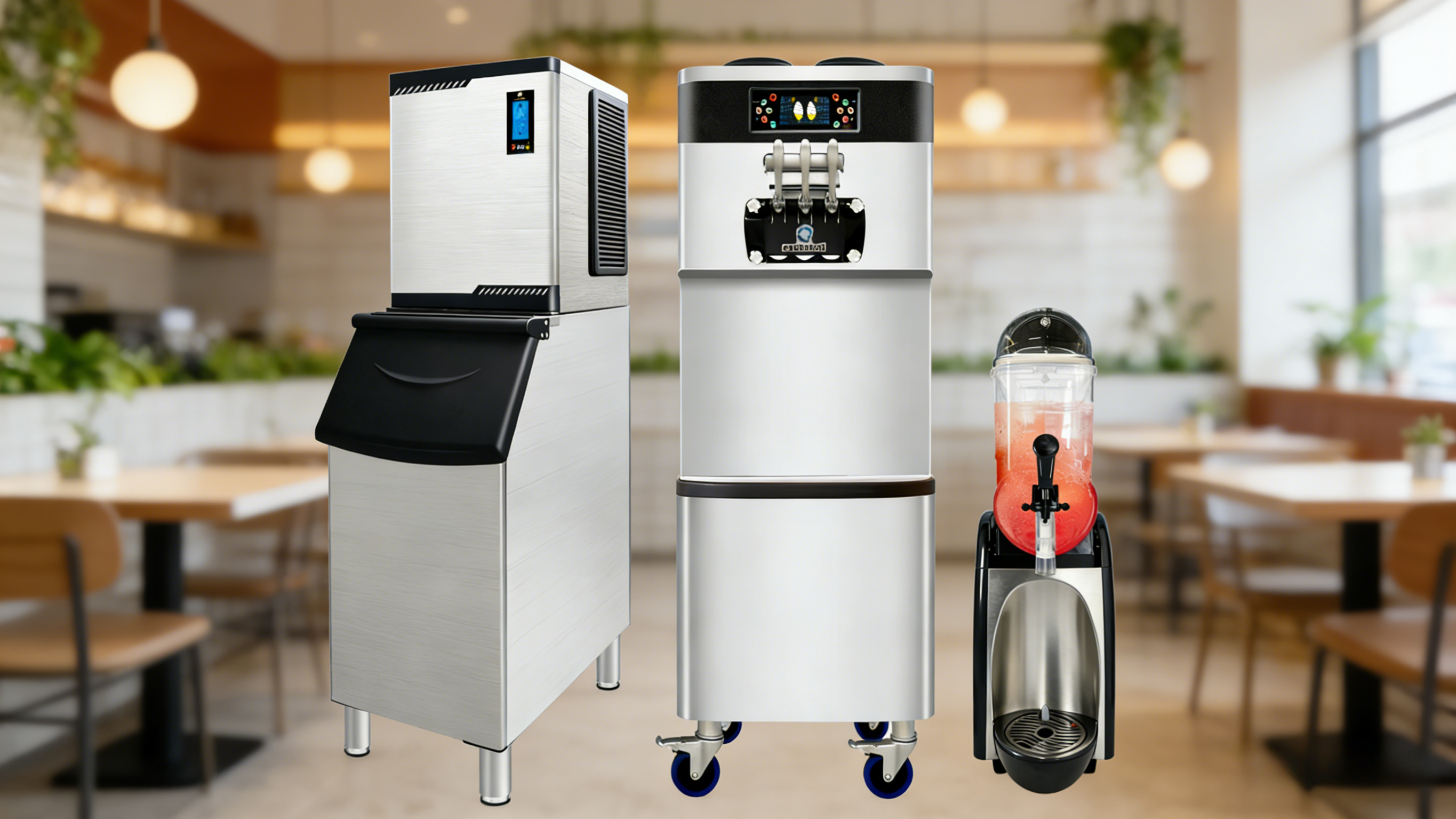
Ice: the BF500 (500 lb/24h; 375 lb at 32°C air and 21°C water) and BF360 (360 lb/24h; 275 lb in the same heat) both run on 110–120V/60Hz and make square cubes. Compare them on the Smartool commercial ice maker page.
Soft serve: the SW52REL-TF delivers 48–52 L/h on 110V/60Hz at 3000W, and the countertop GT18ERLW-F delivers 18–24 L/h at 1580W with one-touch cleaning. Both are listed on the Smartool soft serve ice cream machine page.
Slush: the RLC18-1 (one 16.5L tank, 500W), RL18-2 (two 4.7-gallon tanks, 860W) and RL18-3 (three 16.5L cylinders, 1500W, 14.5A) cover single-flavor counters through three-flavor bars. See the Smartool slushy and frozen drink machine page.
Ready to run the RFQ? Send your requirements to Smartool using the fields in the checklist above; the team replies within 24 hours with pricing and lead time.
Factory-direct from Smartool
Planning a commercial equipment purchase?
Share your site conditions, daily output and budget. Our team will match a model, send the spec sheets and quote factory-direct pricing.
Jason is a senior engineer at Smartool. He works on the commercial ice machines, soft serve and slushy machines, and refrigerated prep tables Smartool builds for restaurants, bars, hotels and dessert shops. His guides look at equipment from the engineering side: how to size a machine for a site, what it needs for power, water and airflow, and how to keep it running through busy service. He also helps buyers match the right model to their kitchen before they request a quote.
Jason is a senior engineer at Smartool. He works on the commercial ice machines, soft serve and slushy machines, and refrigerated prep tables Smartool builds for restaurants, bars, hotels and dessert shops. His guides look at equipment from the engineering side: how to size a machine for a site, what it needs for power, water and airflow, and how to keep it running through busy service. He also helps buyers match the right model to their kitchen before they request a quote.
.elementor-76528 .elementor-element.elementor-element-5c7a0d0{--display:flex;--flex-direction:column;--container-widget-width:100%;--container-widget-height:initial;--container-widget-flex-grow:0;--container-widget-align-self:initial;--flex-wrap-mobile:wrap;}.elementor-76528 .elementor-element.elementor-element-5c7a0d1 .elementor-toc__header-title{text-align:start;}.elementor-76528 .elementor-element.elementor-element-5c7a0d1 .elementor-toc__header{flex-direction:row;}.elementor-76528 .elementor-element.elementor-element-5c7a0d1{--item-text-hover-decoration:underline;}
On this page
Need pricing for your project?
Get a factory-direct quote on commercial ice makers, soft serve and slushy machines, and refrigerated prep tables.
✓ Model matching and spec sheets for your site ✓ US office in City of Industry, CA ✓ Talk to an expert: +1 (872) 221-0051






2 thoughts on “Commercial Refrigeration Equipment Procurement: RFQ Guide”