




Blog
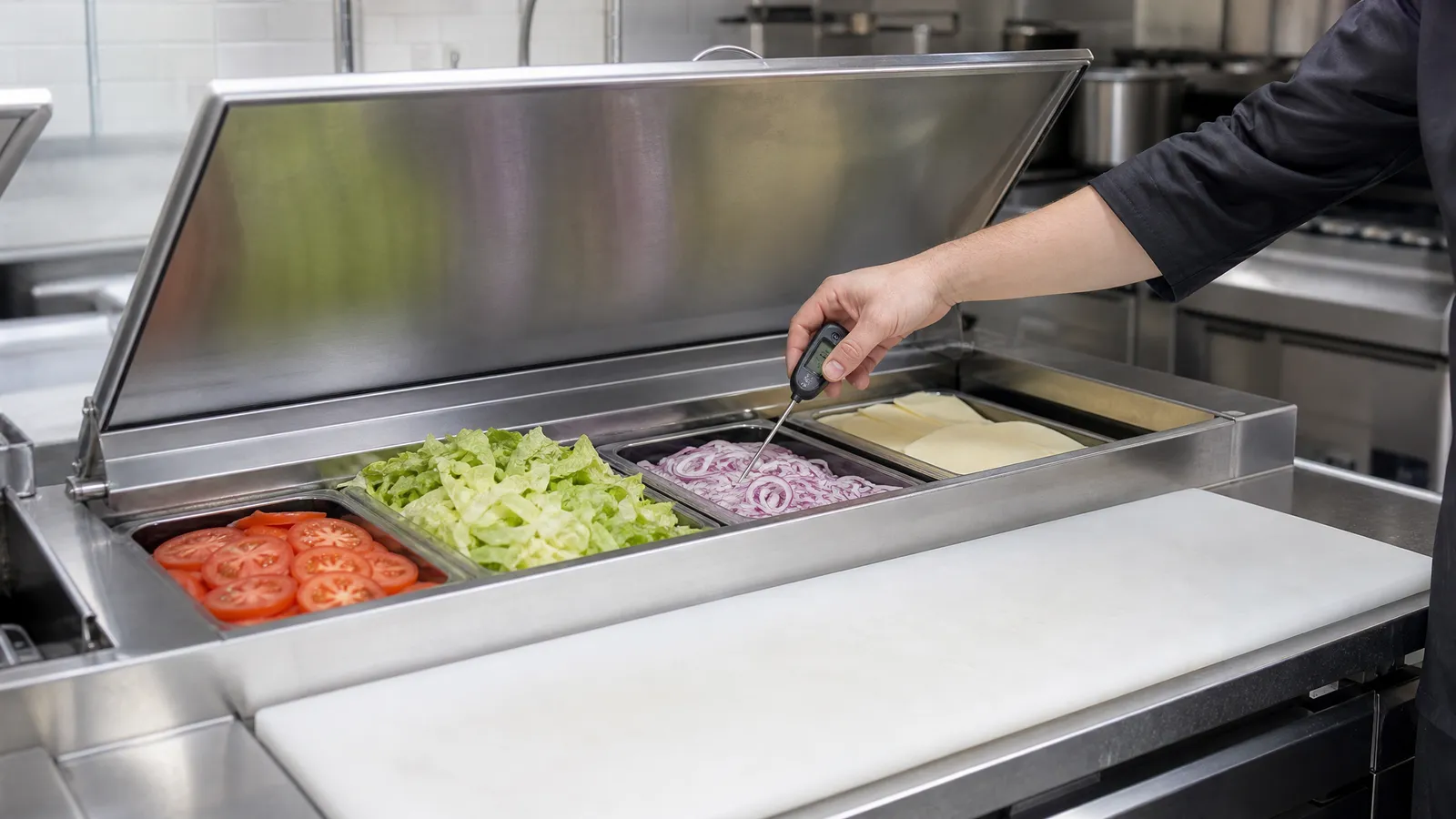
A refrigerated prep table maintenance schedule plus a symptom-to-cause guide for prep tables not cooling, frosting up or leaking water.
Refrigerated prep table maintenance comes down to a short routine on a fixed schedule: log food temperatures every shift, keep the lid and doors sealing, clean the gaskets and drain path weekly, keep the condenser clean, and book a professional service about twice a year. That routine keeps the rail at 41°F or below, cuts energy use and catches most failures while they are still cheap. When something does go wrong, the symptom usually points to the cause. This guide gives kitchen managers a maintenance schedule and a symptom-to-cause troubleshooting table, with a clear line between what staff can check and what needs a refrigeration technician.
Part of our commercial refrigeration equipment procurement guide series.
Why prep table maintenance pays off
A prep table has one job that an inspector can measure: keeping time/temperature control for safety (TCS) food cold. North Dakota’s cold holding guidelines put it plainly: cold foods must be held at an internal temperature of 41°F or less, operators should use only cold-holding equipment that can store food at 41°F or lower, and overfilled salad bar or prep table containers run warmer. Most state codes follow the same 41°F line from the FDA Food Code.
Maintenance also shows up on the power bill. ENERGY STAR’s guidance on reducing refrigeration energy costs in commercial kitchens describes a study of 10 refrigeration units where basic condenser-coil cleaning cut energy use by 17% on average, from 2% on fairly clean coils to 49% on one heavily soiled unit. Dust and grease act as insulation on the coil, so the compressor runs longer and works harder.
Refrigerated prep table maintenance schedule
| When | Task | Who |
|---|---|---|
| Every shift | Probe and log the warmest product on the rail and in the cabinet; close the lid when the line is idle | Line staff |
| Through service | Clean and sanitize the cutting board and in-use pans per your food safety plan | Line staff |
| End of day | Move rail product to covered containers, wipe pan wells and the lid, wipe door gaskets | Closing staff |
| Weekly | Empty and wipe cabinet shelves, inspect gaskets for tears, check the drain hole and the floor under the unit, clear the front grille | Kitchen manager |
| Monthly | Inspect the condenser for dust and grease; clean it as the manual directs; check door closing and casters | Trained staff or technician |
| Every six months | Professional service: condenser and evaporator coils, drain blow-out, hardware, thermostat calibration | Refrigeration technician |
The six-month line comes from refrigeration service professionals quoted in the same ENERGY STAR guidance, who recommend cleaning condenser and evaporator coils on reach-ins, undercounters and cold wells, blowing out drains and tightening hardware every six months, and calibrating thermostats. Harder use and hotter, greasier kitchens may need it more often. Daily cleaning of boards and pans is covered in our refrigerated prep table buying guide, so this guide focuses on the equipment itself.
Daily: temperature logs and rail habits
The display shows air temperature at one sensor. The food in the back row of rail pans can be several degrees warmer. Minnesota’s cold holding log asks the person in charge to use a thin probe thermometer to find the warmest internal temperature of multiple cold TCS products at least once every four hours, record it and note any corrective action. A prep table log built the same way doubles as a maintenance record: a slow upward drift over a few weeks is often the first sign of a dirty condenser or a failing gasket.
- Load the rail with food that is already cold. A prep table holds temperature; it is not built to chill warm product quickly.
- Keep product below the pan rim, where the cold air reaches it.
- Keep every pan opening filled with a pan or an adapter bar, so cold air does not escape through gaps.
- Close the lid during slow periods and overnight.
- Keep boxes, towels and stacked supplies off the front grille and away from the air intake.
Weekly: gaskets, drain path and the cabinet
Door gaskets fail slowly and cost cooling every hour they leak. The ENERGY STAR guidance treats gaskets as a housekeeping item for the operator: food debris and spills cause mold, sticking and tears, while harsh chemicals such as improperly diluted bleach shorten gasket life. Wipe them with a mild detergent solution, dry them, and look for splits, flattened sections and corners that no longer seal. Close the door on a strip of paper at several points around the frame; if it slides out with no resistance, that section is not sealing.

Then check where the water goes. Defrost and condensation water has to leave the cabinet, and a blocked drain hole is the first thing to check for water leakage (see our guide to commercial refrigeration problems). Look for standing water on the cabinet floor and under the unit, and clear food debris from the drain opening. Empty the shelves, wipe them and check that nothing is pressed against the evaporator fan or the air outlets inside the cabinet.
Monthly and twice a year: condenser, coils and calibration
The condenser is where the prep table dumps the heat it removes from the food. On a line next to fryers and griddles it collects grease and dust faster than a reach-in in a dry storeroom. Inspect it monthly with the power off. Some manuals allow trained staff to brush and vacuum the coil; others reserve it for a technician. Follow your manual, and never use a pressure washer or bend the fins.
Twice a year, a refrigeration technician should clean both coils, blow out the drain, check fans and electrical connections and calibrate the thermostat against a reference thermometer. Many current prep tables, including the TSP47FC-2, use R-290 (propane). The EPA’s SNAP list for stand-alone equipment shows R-290 as acceptable subject to use conditions, in the A3 safety class, which means higher flammability. Any sealed-system work belongs to a technician trained and equipped for hydrocarbon refrigerants. Staff should never open panels to reach the refrigeration system.
Prep table troubleshooting: symptom to cause
Match what you see to the likely cause before calling for service. The last two columns split the checks staff can make from the work that belongs to a technician; where your manual differs, follow the manual.
| Symptom | Likely causes | Staff check | Technician check |
|---|---|---|---|
| Rail warm, cabinet cold | Lid open for hours, overfilled pans, warm product loaded, gaps in the pan layout, heat from the hot line | Pre-chill, lower fill level, close gaps, close the lid when idle | Rail airflow or fan fault if habits are right |
| Whole unit warm, prep table not cooling | Worn gasket, hot food inside, blocked vents, dirty condenser | Gasket, hot food, vents | Condenser clogging, refrigerant leak, compressor |
| Frost or ice building inside | Frequent door opening, damaged gasket | Limit openings, inspect gasket | Heater element, auto-defrost system |
| Water on the cabinet floor or under the unit | Blocked drain hole | Clear the drain hole | Broken drain tube, heater malfunction |
| Food freezing in pans or on shelves | Setpoint too low, food against an air outlet | Check the setting, move product off the outlet | Thermostat or sensor calibration |
| Compressor runs almost nonstop, unit loud or hot | Dirty condenser, blocked grille, very hot room | Clear the grille, check room temperature | Coil cleaning, fan motor, refrigerant charge |
| Doors do not close on their own | Unit not level, hinge or closer worn, items blocking | Check level and brakes, clear shelves | Hinge or closer replacement |
Prep table not cooling: check in this order
- Confirm the reading. Probe the product, not the air, in several pans and on a cabinet shelf. A warm rail with a cold cabinet is a habits or airflow problem, not a refrigeration failure.
- Check power and setting. Make sure the unit is plugged in, the breaker is on and nobody changed the setpoint.
- Check the seal. Look at the door gaskets and the lid, and make sure the doors close fully.
- Check the load. Remove hot food, and clear anything blocking the vents inside.
- Check the air. Clear the grille, feel for warm air discharging, and look at the condenser for dust.
- Move food and call. If product is above 41°F, follow your food safety plan, move product to working refrigeration and book a technician.
When to book a refrigerated prep table repair
Call a technician when the staff checks do not restore temperature within a few hours, when frost keeps coming back after the gasket checks out, when the compressor clicks on and off repeatedly, or when you smell burning or hear grinding from a fan. Before the visit, gather the model and serial number, your temperature log, when the problem started and what you have already checked. Photos of the gaskets and the condenser help too. If you bought from a supplier with defined service terms, our guide to commercial equipment warranty and service explains what to ask for before the next purchase.
Notes for the Smartool TSP47FC-2
The TSP47FC-2 sandwich and salad prep table has several features that shape its routine. Its product page lists:
- A 0–5°C (32–41°F) temperature range with a fan-cooled system, so keep the setting toward the lower end to give the rail margin, and keep the cabinet’s air path clear.
- Auto defrost that works without additional condensate drain pipes, so there is no external drain line to route. Still check the cabinet floor and the drain hole weekly.
- A lift-off top cover, a removable stainless steel protective shield and a removable cutting board, which make the end-of-day clean faster.
- Auto-closing doors and two adjustable shelves rated at 150 lb each. Do not let shelf loads block the air outlets.
- Heavy-duty wheels with brakes. Roll the unit out to clean behind it and reach the grille, then set the brakes so it stays level and the doors keep closing properly.
Prep table maintenance questions
How often should a prep table condenser be cleaned?
Inspect it monthly and clean it whenever dust or grease is visible, following the manual. Service professionals quoted by ENERGY STAR recommend coil cleaning on undercounter units every six months as a baseline, more often in hot, greasy kitchens.
Why is my prep table not cold enough on top?
The rail is open to kitchen air, so habits matter most: pre-chill food, keep it below the pan rim, fill every pan opening and close the lid when the line is idle. If the cabinet is also warm, check the gaskets, vents and condenser, then call a technician.
Why is my sandwich prep table leaking water?
The most common cause is a blocked drain hole inside the cabinet. Clear it first. If water keeps collecting, a cracked drain tube or a heater fault may be the cause, and both are technician work.
Why is my prep table freezing up?
Frost inside usually comes from frequent door openings or a damaged gasket letting humid air in. If those check out, the heater or the auto-defrost system may not be working. Food freezing in the pans points instead to a setpoint that is too low or a thermostat that needs calibration.
If your current unit can no longer hold 41°F through a busy shift, compare options on our commercial refrigerated prep table page, then send your menu, pan count and line layout to request a factory-direct quote.
Factory-direct from Smartool
Planning a commercial equipment purchase?
Share your site conditions, daily output and budget. Our team will match a model, send the spec sheets and quote factory-direct pricing.

Written by
Senior Engineer, Smartool
Jason is a senior engineer at Smartool. He works on the commercial ice machines, soft serve and slushy machines, and refrigerated prep tables Smartool builds for restaurants, bars, hotels and dessert shops. His guides look at equipment from the engineering side: how to size a machine for a site, what it needs for power, water and airflow, and how to keep it running through busy service. He also helps buyers match the right model to their kitchen before they request a quote.
.elementor-76528 .elementor-element.elementor-element-5c7a0d0{--display:flex;--flex-direction:column;--container-widget-width:100%;--container-widget-height:initial;--container-widget-flex-grow:0;--container-widget-align-self:initial;--flex-wrap-mobile:wrap;}.elementor-76528 .elementor-element.elementor-element-5c7a0d1 .elementor-toc__header-title{text-align:start;}.elementor-76528 .elementor-element.elementor-element-5c7a0d1 .elementor-toc__header{flex-direction:row;}.elementor-76528 .elementor-element.elementor-element-5c7a0d1{--item-text-hover-decoration:underline;}
On this page
Need pricing for your project?
Get a factory-direct quote on commercial ice makers, soft serve and slushy machines, and refrigerated prep tables.
✓ Model matching and spec sheets for your site
✓ US office in City of Industry, CA
✓ Talk to an expert: +1 (872) 221-0051
Browse by topic
Ice Machine Guides
Soft Serve & Ice Cream
Slushy & Frozen Drinks
Buying & Sourcing
Compliance & Maintenance
Related posts

Refrigerated Prep Table Maintenance and Troubleshooting
A refrigerated prep table maintenance schedule plus a symptom-to-cause guide for prep tables not cooling, frosting up or leaking water.

Can You Make Milkshakes in a Slushie Machine?
Slushie machine milkshake recipe: why dairy stays out of the bowl, five shake-style bases with milk or soft serve added at the cup, and when to switch.