




Blog
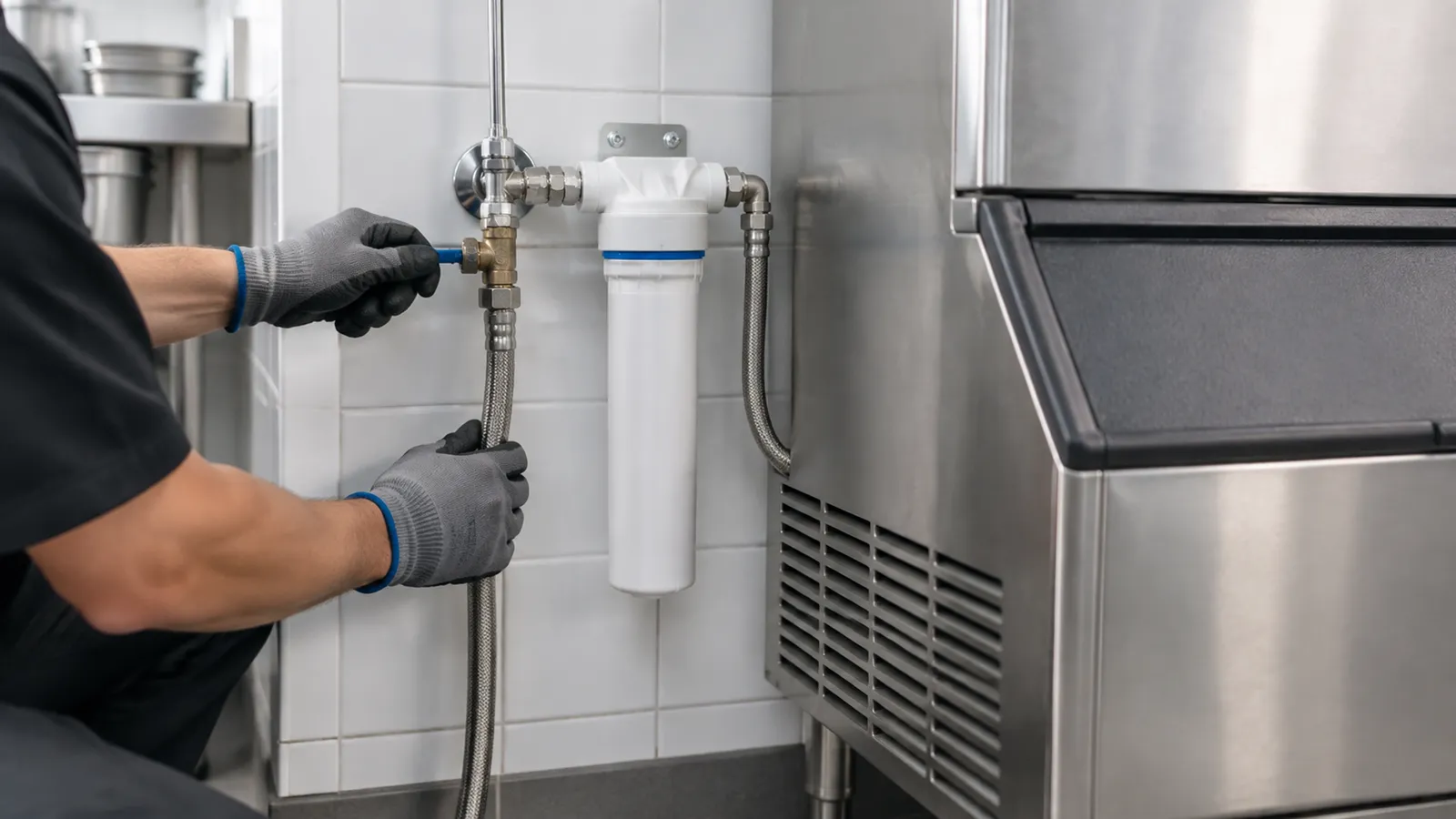
Commercial ice machine installation: water line, backflow preventer, drain air gap, electrical circuit, clearance and first start-up, with Food Code rules.
Commercial ice machine installation comes down to five connections that have to be right before the first cube drops: a potable water line with the right backflow protection, a gravity drain that ends at an air gap, a circuit that matches the nameplate, enough air around the condenser, and a level, sealed or raised footprint. The model’s installation manual sets the numbers. Your local plumbing, electrical and health codes set the rules, and licensed plumbers and electricians do the work. This guide walks through each step in the order a site survey should follow, with the FDA Food Code sections your inspector is likely to check.
Part of our commercial ice maker buying guide series.
Start with a site survey, before the machine ships
Walk the install location with the spec sheet and installation manual for the exact model, and have your plumber and electrician confirm each line below. If the manual is not in hand yet, ask the supplier for it before you sign off on the order.
| Item | What to confirm on site | Who confirms |
|---|---|---|
| Footprint and path in | Machine and bin dimensions, door widths and turns on the delivery path, floor or counter load | Manager |
| Air and clearance | Clearance the manual requires at the air intake and exhaust sides; distance from ovens, fryers and dish machines | Manager |
| Room temperature | Summer air temperature at the machine is inside the rated operating range | Manager |
| Water supply | Potable cold water within reach, a shutoff valve, inlet pressure inside the manual’s range, room for a filter | Licensed plumber |
| Backflow protection | Which device or air gap local code requires at this connection | Plumber and local inspector |
| Drain | Floor drain or floor sink below the machine’s drain outlets, with room for an air gap and enough fall | Licensed plumber |
| Electrical | Voltage, frequency and circuit that match the nameplate; receptacle or hardwire as the manual specifies | Licensed electrician |
| Remote condenser (if any) | Outdoor or roof location, line-set route and length limits from the manual | Refrigeration technician |
Clearance, ventilation and room temperature
An air-cooled ice machine rejects its heat into the room, so the space around it decides how well it runs. The Department of Energy’s FEMP guidance on air-cooled ice machines notes that placing a unit too close to a wall or a low ceiling obstructs airflow and lowers efficiency. It also points out that each manufacturer puts the air intake and exhaust in a different place, front, rear, sides or top, so read the manual before you push the machine against a wall.
- Clearance: use the manual’s figure. For Smartool machines, the Smartool ice machine maintenance guide recommends more than 30 cm (about 12 inches) at the back and both sides, in a well-ventilated spot away from heat sources.
- Heat sources: keep the machine away from fryers, ovens, dish machine vents and sunny windows.
- Operating range: every machine lists an ambient range. A storeroom that runs hot in July is the wrong location, however convenient the plumbing is.
- Service access: leave room to open panels, reach the condenser for cleaning and pull the machine forward for service.
Ice machine water line: supply, pressure and filtration
Ice is food under the FDA Food Code 2022. Section 3-202.16 says ice used as food or as a cooling medium must be made from drinking water, so the ice machine water line has to come from the potable cold water supply. A plumber should run it with these points in mind:
- A dedicated shutoff valve close to the machine, so staff can isolate it for cleaning, filter changes and service.
- Pressure inside the manufacturer’s range. Too low and the machine may flag a water shortage or make thin cubes; too high can stress the inlet valve. The manual gives the range, and a regulator is the usual fix for high pressure.
- Filtration matched to your water. Food Code § 5-202.15 requires water filters on water lines to be designed for disassembly and servicing, with a replaceable element, and § 5-204.13 requires them to be located where they can be serviced. Mount the filter where staff can see the change date.
- A flushed line. Run water through a new or disturbed line before connecting it, so sediment and debris do not go straight into the inlet valve.
- A cool route. Keep the supply away from hot water pipes and hot ceiling spaces. Warm supply water slows every freeze and harvest cycle.
Water-cooled machines also need a condenser water supply and drain on top of the potable line that becomes ice. Check the manual and local water rules before choosing that configuration.
Ice machine backflow preventer: what the code asks for
Backflow protection keeps water from the machine from being pulled back into the building supply. The Food Code handles it in four places:
- § 5-203.14 requires the plumbing system to prevent backflow at each point of use, either with an air gap or with an approved backflow prevention device.
- § 5-202.14 requires a backflow prevention device to meet American Society of Sanitary Engineering (ASSE) standards for that application and type of device.
- § 5-204.12 requires the device to be located so it can be serviced and maintained.
- § 5-205.13 requires devices such as backflow preventers to be scheduled for inspection and service, with records kept by the person in charge.
Which device goes on an ice machine, and whether the machine’s own construction already provides the protection, is a local code question. Plumbing codes and water utilities differ by state, county and city. Ask your plumber to confirm the requirement with the local inspector before the rough-in, install the device where it can be reached, and add its test dates to the equipment log.
Drains and air gaps
Three Food Code rules apply to drains:
- No direct connection. Section 5-402.11(A) says a direct connection may not exist between the sewage system and a drain from equipment in which food is placed. In practice, the machine and bin drains discharge into a floor drain or floor sink through an air gap instead of being piped into the sewer.
- Air gap size. Section 5-202.13 sets the air gap at a water supply inlet at no less than twice the inlet diameter and never less than 1 inch (25 mm). Local plumbing codes set the gap for indirect drains, often on similar terms, so confirm the figure with your inspector.
- No waste lines through the ice. Section 4-204.17 says liquid waste drain lines may not pass through an ice machine or ice storage bin.
Run drains by gravity with continuous fall and no dips where water can sit. Do not tee the bin drain into the machine drain unless the manual allows it, because a backup in one can flood the other. Where no floor drain sits below the machine, a drain pump may be an option; confirm with the manufacturer and your plumber that it suits the model and meets local code.

Electrical circuit
Read the nameplate before anyone buys a receptacle. It lists the voltage, frequency and electrical load the circuit has to carry, and the manual states whether the machine plugs in or is hardwired. A licensed electrician should size the circuit and overcurrent protection to the nameplate and the electrical code in force locally. Avoid extension cords and circuits shared with other heavy loads.
For example, the BF500 and the BF360 both run on AC 110–120V/60Hz, with power ratings of 1050W and 700W respectively at 32°C (90°F) ambient and 21°C (70°F) water. Supply voltage matters for warranty too: Smartool’s after-sales policy excludes problems caused by abnormal voltage from free warranty coverage.
Remote condensers and refrigerant line runs
On a remote-condensing machine the condenser sits apart from the ice-making section, usually outdoors or in an unconditioned equipment room. FEMP notes that this discharges the heat of ice making outside the conditioned space. The trade-off is extra installation work:
- Line-set route: the manual sets the maximum line length and vertical rise between the head and the condenser. Plan the route before cutting holes in walls or the roof.
- Certified technician: connecting, charging and testing refrigerant lines is refrigerant work. EPA Section 608 technician certification rules require technicians who maintain, service, repair or dispose of equipment that could release ozone-depleting refrigerants to be certified.
- Condenser power and mounting: the outdoor unit may need its own electrical connection, weather protection and secure mounting.
“Split” and “remote” are not always used the same way across brands, so confirm from the installation manual which parts of your model are separate and which connections they need. Our comparison of air-cooled vs water-cooled ice machines covers installation requirements for self-contained, remote and water-cooled units side by side.
Setting, leveling and sealing the machine
A machine that is out of level can make uneven cubes and hold water where it should drain. Put a spirit level on the top of the machine front to back and side to side, and adjust the legs until both read level. If the machine sits on a bin or stand, confirm the stand is rated for the combined weight of the machine and a full bin, and that the manual’s adapter or mounting kit is used.
Cleaning access around the base is a code point as well. Food Code § 4-402.12(A) says floor-mounted equipment that is not easily movable must be sealed to the floor or raised on legs with at least 6 inches (15 cm) of clearance, with a 4-inch allowance when no part of the floor underneath is more than 6 inches from the cleaning access point. Counter-mounted equipment has its own clearance rules under § 4-402.12(D) and (E).
First start: check for leaks, clean, and discard the first batches
Treat the first start as a commissioning check. The manual has the final word; a typical sequence looks like this:
- Open the water supply slowly and check every fitting, the filter housing and the backflow device for drips.
- Confirm that water leaves the drains freely and that each air gap is open.
- Clean and sanitize the bin and any food-contact areas the manual lists, since shipping and installation leave dust and handling residue.
- Power up and watch the first freeze and harvest. Note any alerts on the display.
- Discard the first batches of ice, as many as the manual specifies, before any ice goes into drinks.
- Check the ice-full function by letting the bin fill, and record the start-up date, filter install date and water pressure in the equipment log. If the first cycles produce no ice, work through our ice machine not making ice checklist before calling service.
From there, the routine takes over. Our guide on how to clean a commercial ice machine sets out the cleaning, descaling and sanitizing schedule to start on day one.
Commercial ice machine installation checklist
| Stage | Check | Done when |
|---|---|---|
| Before ordering | Installation manual and spec sheet reviewed against the site survey | Every utility on the spec sheet has a matching line on site |
| Rough-in | Water line, shutoff, filter and backflow protection | Plumber confirms local code requirement; device reachable |
| Rough-in | Drain to floor drain or floor sink | Gravity fall, air gap sized to local code, no waste lines through the bin |
| Rough-in | Electrical circuit | Electrician confirms voltage and circuit match the nameplate |
| Set in place | Clearance, leveling, sealing or legs | Manual’s clearance kept; level both ways; base sealed or raised |
| Remote systems | Line set and condenser | Certified technician installs within the manual’s length and rise limits |
| First start | Leak check, clean and sanitize, discard first batches | Dry fittings, clear drains, first batches thrown out, log started |
Ice machine installation questions
Do ice machines need a backflow preventer?
They need backflow protection. The Food Code accepts either an air gap or an approved backflow prevention device at each point of use. Whether a separate device must be added on the ice machine water line depends on the machine’s construction and your local plumbing code, so confirm it with the plumber and inspector.
Does an ice machine need a floor drain?
A plumbed commercial machine needs somewhere to send meltwater and purge water. The usual answer is a floor drain or floor sink with an air gap. If there is none nearby, ask the manufacturer whether a drain pump is approved for the model and check that local code allows it.
How do you hook up an ice machine water line?
A plumber connects the machine’s water inlet to the potable cold water supply through a shutoff valve, the filter and whatever backflow protection local code requires, using the fitting size and pressure range in the installation manual.
Can I install a commercial ice machine myself?
Owners can handle the site survey, placement and first-start checks. Plumbing, electrical and refrigerant work should go to licensed and certified trades, both for code compliance and because warranty terms often exclude damage from improper installation or supply problems.
If you are planning a new install, compare factory-direct commercial ice makers against your site survey, then send us your voltage, water and drain details to request a factory-direct quote.
Factory-direct from Smartool
Planning a commercial equipment purchase?
Share your site conditions, daily output and budget. Our team will match a model, send the spec sheets and quote factory-direct pricing.

Written by
Senior Engineer, Smartool
Jason is a senior engineer at Smartool. He works on the commercial ice machines, soft serve and slushy machines, and refrigerated prep tables Smartool builds for restaurants, bars, hotels and dessert shops. His guides look at equipment from the engineering side: how to size a machine for a site, what it needs for power, water and airflow, and how to keep it running through busy service. He also helps buyers match the right model to their kitchen before they request a quote.
.elementor-76528 .elementor-element.elementor-element-5c7a0d0{--display:flex;--flex-direction:column;--container-widget-width:100%;--container-widget-height:initial;--container-widget-flex-grow:0;--container-widget-align-self:initial;--flex-wrap-mobile:wrap;}.elementor-76528 .elementor-element.elementor-element-5c7a0d1 .elementor-toc__header-title{text-align:start;}.elementor-76528 .elementor-element.elementor-element-5c7a0d1 .elementor-toc__header{flex-direction:row;}.elementor-76528 .elementor-element.elementor-element-5c7a0d1{--item-text-hover-decoration:underline;}
On this page
Need pricing for your project?
Get a factory-direct quote on commercial ice makers, soft serve and slushy machines, and refrigerated prep tables.
✓ Model matching and spec sheets for your site
✓ US office in City of Industry, CA
✓ Talk to an expert: +1 (872) 221-0051
Browse by topic
Ice Machine Guides
Soft Serve & Ice Cream
Slushy & Frozen Drinks
Buying & Sourcing
Compliance & Maintenance
Related posts

Ice Machine Freezing Up? Causes, Safe Checks and Fixes
Ice machine freezing up? Learn the six common causes, what staff can safely check, what needs a technician, and how to prevent repeat freeze-ups.

How to Use a Margarita Machine or Slush Machine
How to use a margarita machine or slush machine: setup, mixing and filling, freeze time, consistency, dispensing, refills and the closing routine.