




Blog
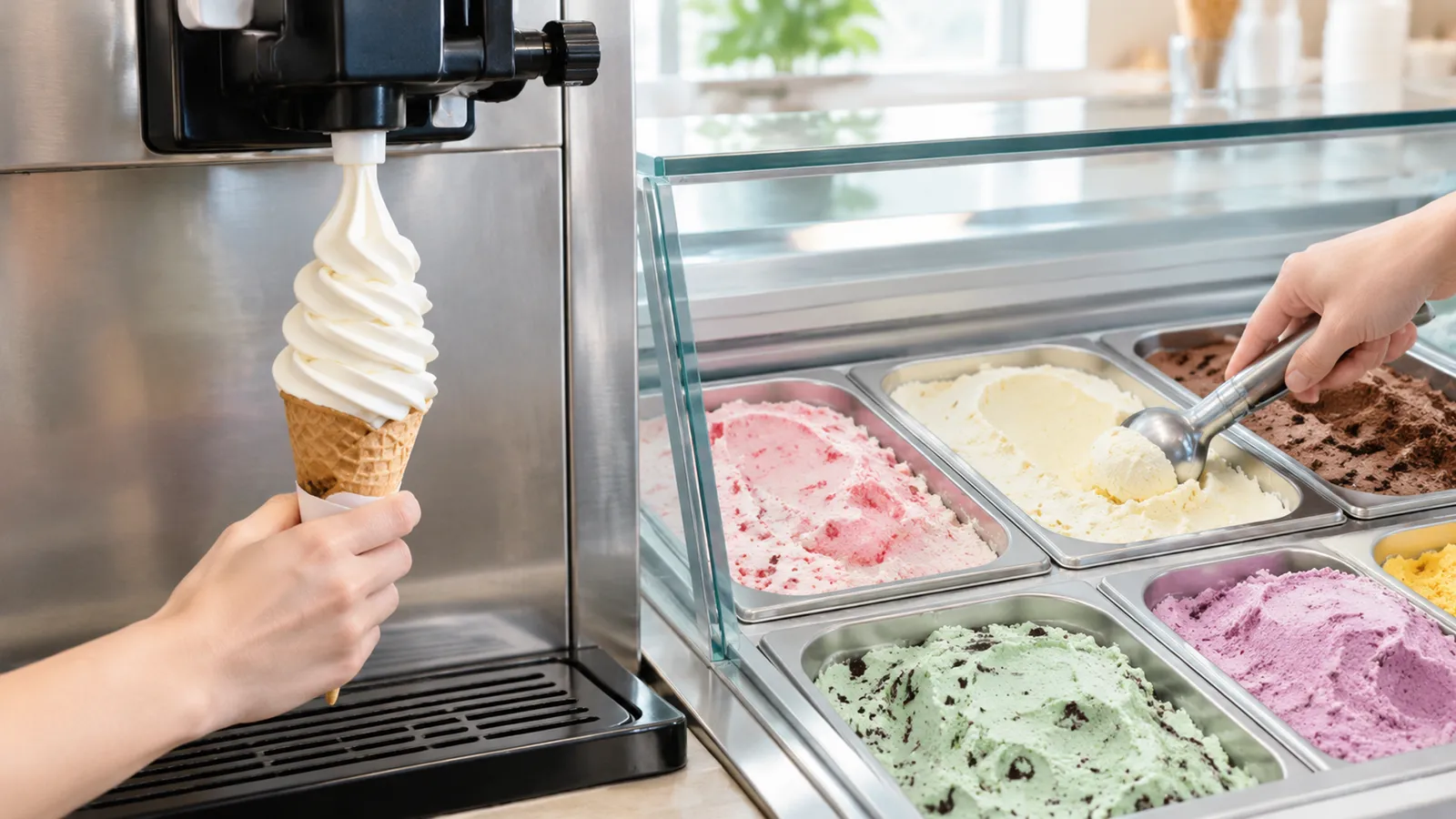
Soft serve vs hard ice cream for business: freezing process, serving temperature, overrun, equipment, and where a combined hard/soft machine fits.
Soft serve vs hard ice cream comes down to what happens after the mix is frozen. Both start as a pasteurized dairy mix that is frozen while air is whipped in. Soft serve is pulled straight from the machine into a cone or cup while it is still semi-frozen and relatively warm. Hard ice cream goes into containers, is hardened in a much colder freezer, and is later scooped from a dipping cabinet. For a business, that difference decides the equipment list, the labor, the flavor range and how fast you can serve a line. This guide compares the two on process, temperature, air content and fit, and shows where a combined hard/soft machine makes sense.
Part of our commercial soft serve machine buying guide series.
Soft serve vs hard ice cream at a glance
| Factor | Soft serve | Hard ice cream |
|---|---|---|
| When it is served | Straight from the machine, on demand | After hardening and storage, scooped to order |
| Serving temperature | About -6 to -8°C (roughly 18 to 21°F) at the spout, per Smartool’s recommended range | 6 to 10°F for dipping, per the International Dairy Foods Association |
| Freezing process | Frozen in the machine’s cylinder; no hardening step | Frozen in a batch or continuous freezer, then hardened in a colder freezer |
| Main equipment | Soft serve machine plus refrigerated mix storage | Batch freezer, hardening or storage freezer, dipping cabinet |
| Production timing | During service, one serving at a time | Before service, one batch at a time |
| Flavor range | One flavor per cylinder, often with a twist | As many flavors as your cabinet holds |
| Labor per serving | Pull a handle; fast in a rush | Scooping usually takes longer and needs training for consistent portions |
How each one is frozen
The first freezing step is almost the same for both. The University of Guelph’s Ice Cream Technology e-Book describes a scraped-surface freezer. Blades keep ice scraped off the chilled barrel wall while a dasher whips in air. The product leaves the freezer with about half of its water frozen. In the e-Book’s words, “almost the only thing which differentiates hard frozen ice cream from soft-serve” is that soft serve goes into cones at this point, while hard ice cream goes into packages to be hardened.
Continuous freezer vs batch freezer
Hard ice cream is made in one of two freezer types. Plants use continuous freezers: according to the Guelph text, mix pumped through a continuous freezer is drawn off in about 30 seconds. A batch freezer takes about 10 to 15 minutes per batch. Scoop shops and restaurants making their own flavors use batch freezers, so production happens before service rather than during it.
A soft serve machine works differently from both. It holds chilled mix in a hopper, keeps a charge of product frozen in its cylinder, and feeds in fresh mix as staff pull servings. That is why its output is rated per hour of continuous serving, not per batch.

Hardening: the step soft serve skips
After the freezer, hard ice cream is packed and hardened. The Guelph e-Book’s chapter on hardening describes blast freezers at -30 to -40°C, where most of the remaining water freezes. It notes that below about -25°C ice cream is stable without ice crystal growth, while warmer storage allows crystals to grow. Faster hardening gives a smoother product. A shop without a blast freezer hardens product in its storage freezer. That works, but it is slower, so plan freezer capacity along with the batch freezer.
Serving temperature and storage
Temperature is the difference customers notice first. The International Dairy Foods Association puts the ideal dipping range for ice cream at 6 to 10°F and recommends storage between -5 and 0°F. It also warns that above 10°F, frozen desserts are subject to changes in body, texture and flavor. That is why hard ice cream needs two cold zones: a storage freezer and a dipping cabinet held at serving temperature.
Soft serve is served warmer. Smartool’s soft serve overrun guide recommends a discharge temperature of -6 to -8°C and mix held at 41 °F (5 °C) or below before it goes into the machine. So the cold chain you need is refrigerated storage for liquid mix, not a freezer full of tubs.
Overrun: how much air is in each
Overrun is the increase in volume from air whipped in during freezing. One liter of mix that becomes 1.5 liters of product has 50% overrun. Many people assume soft serve is always the airier product, but overrun depends on the mix, the machine and the operator’s goals more than on the category.
- Hard ice cream: the federal standard of identity for ice cream, 21 CFR 135.110, requires at least 10% milkfat and a weight of at least 4.5 pounds per gallon. The weight minimum limits how much air a product sold as “ice cream” can contain.
- Soft serve: Smartool’s overrun guide gives 40 to 70% as the working range. Below that, the product is dense and harder to dispense. Above it, the product is foamy and melts fast. Our soft serve ice cream recipe for machines shows how mix formula affects overrun.
Overrun is also a cost lever. More air means more servings per gallon of mix, but too much air hurts texture. On soft serve machines, the feed system has a large effect on overrun. Our comparison of gravity-fed vs pump soft serve machines explains the difference and includes a simple cup-and-scale overrun test.
One labeling point: if your soft serve mix has less than the 10% milkfat minimum, the finished product cannot be sold under the plain name “ice cream.” Check your supplier’s spec sheet before you print a menu.
Which fits your business?
Start with how customers order and how many staff you have at peak. The menu comes second.
| Business | Better starting point | Why |
|---|---|---|
| Quick-service counter or drive-through | Soft serve | Fast, consistent servings from one handle; cones, cups, sundaes and shakes from one mix |
| Café or convenience store adding dessert | Soft serve | One machine and refrigerated mix storage; no dipping cabinet or hardening freezer |
| Scoop shop or gelato-style parlor | Hard ice cream | Flavor range and house-made recipes are the reason customers come in |
| Restaurant with plated desserts | Hard ice cream, small batches | Signature flavors made ahead and held for service |
| Food truck | Usually soft serve | Fewer cold-storage zones to power and fit in a small space |
| Low-volume counter testing frozen desserts | Combined hard/soft machine | Small loads of either product before committing to a full line |
Soft serve wins on speed and simplicity during service. Its main costs are the daily cleaning routine and a narrow flavor range per machine. Heat-treatment machines stretch the time between full teardowns but add complexity of their own, as the story of why McDonald’s ice cream machines keep breaking shows. Hard ice cream wins on variety and on the ability to make your own recipes. It costs you production time before opening, more freezer space and slower serving. For peak-hour sizing math across soft serve, batch and multifunctional formats, see our guide to the best commercial ice cream machines by format.
What a commercial hard ice cream machine setup includes
The term “commercial hard ice cream machine” usually means a batch freezer. The batch freezer is only one part of the setup:
- Batch freezer: sized in batches per hour against the tubs you need per day.
- Hardening or storage freezer: enough capacity to harden fresh batches and hold stock.
- Dipping cabinet: holds serving tubs at scooping temperature on the front counter.
- Scoops, dipper well and portion control: scooping is where hard ice cream margins are won or lost.
- Production time: someone has to make, pack and rotate stock before and between shifts.
A soft serve setup is shorter: the machine, refrigerated mix storage and a cleaning station. The GT18ERLW-F is an example of a compact single-head machine: its page lists 18 to 24 L/h output, a 6 L hopper and a 110V/60Hz supply. For multi-unit or reseller orders, Smartool also supplies wholesale soft serve machines direct from the factory.
Where a combined hard/soft machine fits
A combined machine makes small loads of either hard or soft product in one countertop unit. It gives you flexibility, but it cannot match the throughput of a dedicated machine. Smartool’s multifunctional hard and soft ice cream machine page lists:
- Functions: refrigeration, hard ice cream making, soft ice cream making, milkshake making and fresh-keeping.
- Format: countertop, 340 × 455 × 380 mm, 26 kg net weight.
- Maximum production capacity: 3 kg/h (BQ3K), 5 kg/h (BQ5K) or 7 kg/h (BQ7K).
- Hopper: 2.3 L in SUS304 stainless steel, with a maximum ingredient loading of 0.8 kg.
- Temperature range: adjustable from +10 to -10°C, with a first forming time of 12 to 20 minutes.
- Electrical: 280 W rated power, listed at AC 220 to 240V/50Hz, with R290 refrigerant.
Those numbers point to a clear role. Use it for menu testing, a dessert side item, a small café that wants both formats, or shakes alongside a few scoops. It does not replace a soft serve machine on a busy counter or a batch freezer supplying a full dipping cabinet. The listed electrical rating is 50Hz, and U.S. power is 60Hz, so confirm a U.S.-compatible configuration with sales before you order.
Soft serve vs hard ice cream questions
What is the difference between a soft serve machine and a batch ice cream machine?
A soft serve machine freezes and dispenses on demand during service, feeding fresh mix into its cylinder as servings are drawn. A batch freezer freezes one measured load at a time, typically in 10 to 15 minutes. The product is then extracted, hardened and scooped later from a dipping cabinet.
What temperature should soft serve come out of the machine?
Smartool’s guidance is -6 to -8°C (about 18 to 21°F) at discharge, with mix kept at 41 °F (5 °C) or below. Follow the range in your machine’s manual, since hardness settings and mix formulas vary.
Is soft serve real ice cream?
It is made the same way up to the point of serving. Whether it can be called “ice cream” depends on the mix. Under 21 CFR 135.110, ice cream needs at least 10% milkfat and must weigh at least 4.5 pounds per gallon. Your mix supplier’s spec sheet tells you which name applies.
Can one machine make both hard and soft ice cream?
Yes, multifunctional machines switch between the two, but they do it in small loads. They suit low-volume or test menus. A busy counter still needs a dedicated soft serve machine, and a full scoop shop still needs a batch freezer and a dipping cabinet.
Once you know which format fits, compare every commercial ice cream machine in our range by output, electrical supply and cleaning design. Share your menu, peak-hour servings and available power to request a factory-direct quote.
Factory-direct from Smartool
Planning a commercial equipment purchase?
Share your site conditions, daily output and budget. Our team will match a model, send the spec sheets and quote factory-direct pricing.

Written by
Senior Engineer, Smartool
Jason is a senior engineer at Smartool. He works on the commercial ice machines, soft serve and slushy machines, and refrigerated prep tables Smartool builds for restaurants, bars, hotels and dessert shops. His guides look at equipment from the engineering side: how to size a machine for a site, what it needs for power, water and airflow, and how to keep it running through busy service. He also helps buyers match the right model to their kitchen before they request a quote.
.elementor-76528 .elementor-element.elementor-element-5c7a0d0{--display:flex;--flex-direction:column;--container-widget-width:100%;--container-widget-height:initial;--container-widget-flex-grow:0;--container-widget-align-self:initial;--flex-wrap-mobile:wrap;}.elementor-76528 .elementor-element.elementor-element-5c7a0d1 .elementor-toc__header-title{text-align:start;}.elementor-76528 .elementor-element.elementor-element-5c7a0d1 .elementor-toc__header{flex-direction:row;}.elementor-76528 .elementor-element.elementor-element-5c7a0d1{--item-text-hover-decoration:underline;}
On this page
Need pricing for your project?
Get a factory-direct quote on commercial ice makers, soft serve and slushy machines, and refrigerated prep tables.
✓ Model matching and spec sheets for your site
✓ US office in City of Industry, CA
✓ Talk to an expert: +1 (872) 221-0051
Browse by topic
Ice Machine Guides
Soft Serve & Ice Cream
Slushy & Frozen Drinks
Buying & Sourcing
Compliance & Maintenance
Related posts

Ice Machine Freezing Up? Causes, Safe Checks and Fixes
Ice machine freezing up? Learn the six common causes, what staff can safely check, what needs a technician, and how to prevent repeat freeze-ups.

How to Use a Margarita Machine or Slush Machine
How to use a margarita machine or slush machine: setup, mixing and filling, freeze time, consistency, dispensing, refills and the closing routine.