




Blog
Ice machine freezing up? Learn the six common causes, what staff can safely check, what needs a technician, and how to prevent repeat freeze-ups.
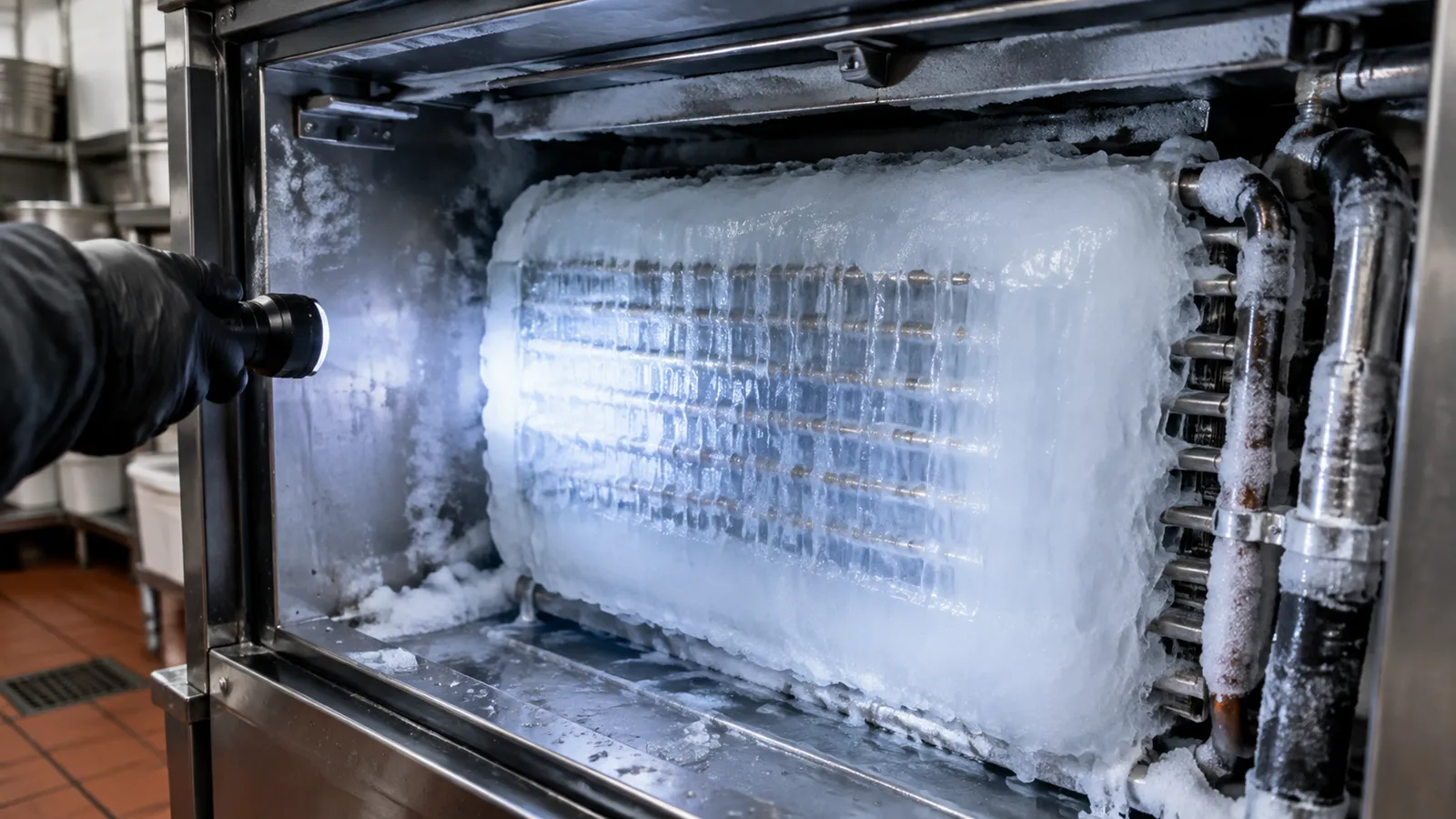
An ice machine freezing up almost always means a harvest did not finish. Ice stayed on the evaporator, the next freeze cycle added another layer on top, and the cubes fused into a sheet or a solid block. The usual causes are a harvest system that is not warming the plate, scale that makes ice stick, a water supply or water flow problem that makes ice form unevenly, a sensor that ends the freeze too late, or a room that sits outside the machine’s rated temperature range. Staff can safely thaw the machine and check water, filters, room conditions and cleanliness. Refrigerant, valves, sensors and wiring are technician work. This guide covers both, in the order that finds the cause fastest.
Part of our commercial ice maker buying guide series.
What a frozen-up ice machine looks like
A cube machine normally alternates between freezing and harvesting (how commercial ice machines work explains the cycle in detail). In harvest, the evaporator warms just enough for the cubes to drop into the bin. When that release fails, the symptoms are easy to spot once you open the front panel or look through the bin door:
| What you see | What is happening | Where to look first |
|---|---|---|
| A solid slab of ice covering the evaporator | Several freeze cycles have stacked up without a full harvest | Harvest system, scale, sensors |
| Cubes stuck to the plate and nothing in the bin | The plate is not warming enough, or ice is gripping scale | Scale first, then the harvest valve |
| Ice only on part of the plate, or lopsided cubes | Water is not reaching the whole evaporator evenly | Water supply, inlet filter, pump and distribution |
| Cubes fused into one sheet that will not break apart | Freeze ran too long, so cubes bridged together | Thickness setting and thickness sensor |
| Ice packed up into the evaporator area from the bin | The machine kept making ice after the bin was full | Ice-full sensor or bin control |
| Frost on refrigerant lines outside the ice-making area | The refrigeration side is out of balance | Technician only |
First, thaw it safely
Do not try to break the ice free while the machine is running. The evaporator is the most expensive part in the ice-making section, and it is easy to damage.
- Stop production. Switch the machine off at its control, as the manual describes, and disconnect power before you reach inside any panel.
- Empty the bin. Discard the ice. It may have been in contact with meltwater from areas you have not cleaned.
- Let the ice melt. Leave the door or panel open and let it thaw, or use the method in your manual. Never use an ice pick, knife, screwdriver or heat gun. Smartool’s ice machine maintenance guide warns against scraping the ice grid with hard objects because it can damage the tray surface.
- Look before you restart. With the plate clear, check it for white or chalky scale and check the water trough for sediment. What you find points to the cause.
- Clean, then watch the first cycles. Run the water-system cleaning cycle if scale is visible, restart, and stay nearby for the first few harvests. Discard the first batch. If the ice sheets over again, work through the causes below.
Why ice machines freeze up: six common causes
1. The harvest cycle is failing
Most cube machines harvest by opening a hot gas valve that sends hot refrigerant from the compressor into the evaporator. If that valve does not open, opens only partly, or the controller never calls for harvest, the ice stays put and the next freeze builds on top of it. Smartool’s ice maker troubleshooting guide lists three engineer checks for a machine that will not harvest: the hot gas valve, the expansion device and the ice-full probe sensor. All three sit inside the refrigeration or control system, so a repeat harvest failure after cleaning is a service call.
2. Scale on the evaporator
This is the cause staff can do the most about. Minerals in the water settle on the evaporator as scale, and ice grips a rough, scaled surface much harder than a clean one. The same harvest heat that releases cubes from a clean plate may not free them from a scaled plate, so ice hangs on and builds up. Smartool’s troubleshooting guide lists scale buildup as the user check for a machine with no ice harvest, and its maintenance guide explains that cleaning the evaporator is what keeps cubes from sticking to the grid. The EPA’s WaterSense at Work guidance on commercial ice makers also recommends periodic cleaning to remove lime and scale buildup, using the machine’s self-cleaning option where it has one. Hard water speeds the process up.
3. Water supply problems
A machine that does not get enough water cannot build even cubes. A partly closed supply valve, low building pressure, or a clogged inlet filter or screen leaves the sump short. Ice may form thin in some cells and thick in others, and a thickness or water-level control can misread what is on the plate. Smartool’s troubleshooting guide puts the inlet filter and the water source among the user checks for no water intake. Testing the inlet valve voltage and the float switch is engineer work.
4. Low water flow over the evaporator
Even with a full sump, water has to reach the whole plate. A weak circulation pump, or a distribution tube with holes partly blocked by scale, leaves dry areas on the evaporator. Those areas can frost over while other cells over-freeze, and the ice bridges across the plate instead of forming separate cubes. Cleaning the water system often clears scaled distribution holes. Testing pump operation is on Smartool’s list of engineer checks.
5. Sensors, thermistors and the thickness setting
The controller relies on sensors to decide when each freeze ends and when the bin is full. When one of them misreads, ice keeps building:
- Thickness control: a thickness probe coated in scale, or a setting pushed to the thickest level, lets the freeze run long enough for cubes to join into one sheet.
- Evaporator or harvest thermistor: on machines that time harvest from a temperature reading, a faulty thermistor can start harvest late, end it too early or skip it.
- Ice-full sensor or bin control: if it fails to see a full bin, the machine keeps harvesting until ice backs up into the ice-making area and freezes in place.
Staff can return the thickness setting to the manual’s default and keep the bin sensor area free of ice. Testing or replacing sensors belongs to a technician.
6. Room temperature and airflow
Ice machines are rated for a range of room temperatures, and both ends cause trouble. In a room that is too cold, such as an unheated storeroom in winter, condensing pressure falls and the hot gas carries less heat to the evaporator, so harvest slows or stalls. In a hot, cramped room, freeze cycles run long and the refrigeration side struggles. The EPA guidance describes air-cooled machines as best suited to rooms at 80°F or less with at least 6 inches of clearance around the air intake and discharge. The Department of Energy’s FEMP guidance on air-cooled ice machines adds that placing a unit too close to a wall or a low ceiling obstructs airflow and lowers efficiency. Check your model’s rated range on the spec sheet and compare it with the actual room temperature during the hours the machine froze up.
Low refrigerant charge or a leak can also cause uneven freezing and frost in odd places. There is no safe operator check for refrigerant; it is always a technician job.
What staff can check and what needs a technician
Keep this table near the machine so the shift lead knows where operator checks stop:
| Area | Staff can safely check | Call a technician for |
|---|---|---|
| Water supply | Shutoff valve fully open; no kinks in the supply line; inlet filter within its service date | Inlet valve coil and voltage, float switch, low building pressure |
| Scale and cleanliness | Visible scale on the plate; run the approved cleaning cycle with the manual’s cleaner | Scale on parts that need tools to reach; parts that must be removed |
| Water flow | Water spreading evenly across the plate after cleaning | Pump testing or replacement; distribution parts behind panels |
| Controls | Thickness setting back to default; bin sensor area clear of ice | Thickness probe, thermistors, ice-full sensor, control board |
| Room and airflow | Room temperature within the rated range; clearance around vents; condenser brushed with power off | Remote condenser problems, fan motors |
| Refrigeration | Nothing beyond noting frost, hissing or oily residue | Hot gas valve, expansion device, refrigerant leaks and charge |

Stop and call for service right away if you see water leaking from inside the cabinet, tripped breakers or damaged wiring, a burning smell, or if the machine freezes up again within a day of a full thaw and cleaning.
How to keep an ice machine from freezing up
Most freeze-ups trace back to scale, water or placement, and all three respond to routine. Smartool’s maintenance guide sets a practical baseline:
- Replace the inlet water filter on its service life, usually 3 to 6 months. The guide calls it the most effective way to reduce scale formation.
- Clean the water system on the interval in your manual with an official or food-grade ice machine cleaner, never a strong acidic household descaler, and rinse one or two times afterward.
- Clean the condenser every two weeks in dusty kitchens and monthly in normal conditions, with power disconnected.
- Keep more than 30 cm (about 12 inches) of space at the back and both sides, away from heat sources.
- Watch the ice every day. Thin, cloudy or odd-smelling ice is often an early warning before a bigger problem.
Add two habits of your own: log every freeze-up with the date, room temperature and what you found on the plate, and keep the thickness setting at the default unless your menu needs thicker cubes. A log makes a pattern obvious, such as freeze-ups that follow cold nights or skipped cleanings. For the full cleaning and sanitizing routine, see our guide on how to clean a commercial ice machine.
If an older machine keeps freezing up after cleaning, filtering and service, weigh the repair bills against the machine’s age and output. Our guide on when to replace a commercial ice machine walks through that decision.
Notes for Smartool BF500 and BF360 owners
The BF500 and BF360 include several features that help with the checks above:
- Water-shortage alert: flags a closed valve or restricted supply before it turns into uneven freezing.
- Ice-full alert: shows when the bin control has stopped production, which helps you tell a full bin from a stalled harvest.
- 12-level ice thickness control: if cubes are bridging, step the setting back toward the manual’s default.
- Automatic cleaning function: use it with an approved cleaner to keep scale off the ice trays.
- Rated operating range of 41°F to 100°F (5–38°C): keep the head out of unheated rooms in winter and away from hot cooking lines.
For anything past the operator checks, contact Smartool support or a qualified refrigeration technician.
Ice machine freeze-up questions
Why does my ice machine keep freezing up?
Repeat freeze-ups usually mean the cause was never removed. Scale is the most common reason ice keeps sticking, followed by a restricted water supply and a room outside the rated range. If cleaning and water checks do not stop it, the harvest valve or a sensor needs a technician.
Why is my ice machine not dropping ice?
Cubes that form but do not fall point to harvest. If the plate is clear and the bin stays empty, use our ice machine not making ice checklist instead. Check the evaporator for scale and run the cleaning cycle first. If the cubes still hang on a clean plate, have a technician test the hot gas valve and harvest controls.
Can I chip the ice off a frozen-up ice machine?
No. Turn the machine off and let the ice melt. Picks, knives and scrapers can gouge the evaporator coating, and a damaged plate makes ice stick even more.
Can hard water make an ice machine freeze up?
Yes, indirectly. Hard water leaves more scale on the evaporator and in the distribution tube. Scale makes ice stick during harvest and blocks water flow during freezing. A filter matched to your water and regular descaling are the fix.
If you are replacing a machine that freezes up often, compare factory-direct commercial ice makers with built-in cleaning and water-shortage alerts. Share your room temperature, water conditions and daily ice demand to request a factory-direct quote.
Factory-direct from Smartool
Planning a commercial equipment purchase?
Share your site conditions, daily output and budget. Our team will match a model, send the spec sheets and quote factory-direct pricing.

Written by
Senior Engineer, Smartool
Jason is a senior engineer at Smartool. He works on the commercial ice machines, soft serve and slushy machines, and refrigerated prep tables Smartool builds for restaurants, bars, hotels and dessert shops. His guides look at equipment from the engineering side: how to size a machine for a site, what it needs for power, water and airflow, and how to keep it running through busy service. He also helps buyers match the right model to their kitchen before they request a quote.
.elementor-76528 .elementor-element.elementor-element-5c7a0d0{--display:flex;--flex-direction:column;--container-widget-width:100%;--container-widget-height:initial;--container-widget-flex-grow:0;--container-widget-align-self:initial;--flex-wrap-mobile:wrap;}.elementor-76528 .elementor-element.elementor-element-5c7a0d1 .elementor-toc__header-title{text-align:start;}.elementor-76528 .elementor-element.elementor-element-5c7a0d1 .elementor-toc__header{flex-direction:row;}.elementor-76528 .elementor-element.elementor-element-5c7a0d1{--item-text-hover-decoration:underline;}
On this page
Need pricing for your project?
Get a factory-direct quote on commercial ice makers, soft serve and slushy machines, and refrigerated prep tables.
✓ Model matching and spec sheets for your site
✓ US office in City of Industry, CA
✓ Talk to an expert: +1 (872) 221-0051
Browse by topic
Ice Machine Guides
Soft Serve & Ice Cream
Slushy & Frozen Drinks
Buying & Sourcing
Compliance & Maintenance
Related posts

Ice Machine Freezing Up? Causes, Safe Checks and Fixes
Ice machine freezing up? Learn the six common causes, what staff can safely check, what needs a technician, and how to prevent repeat freeze-ups.

How to Use a Margarita Machine or Slush Machine
How to use a margarita machine or slush machine: setup, mixing and filling, freeze time, consistency, dispensing, refills and the closing routine.