




Blog
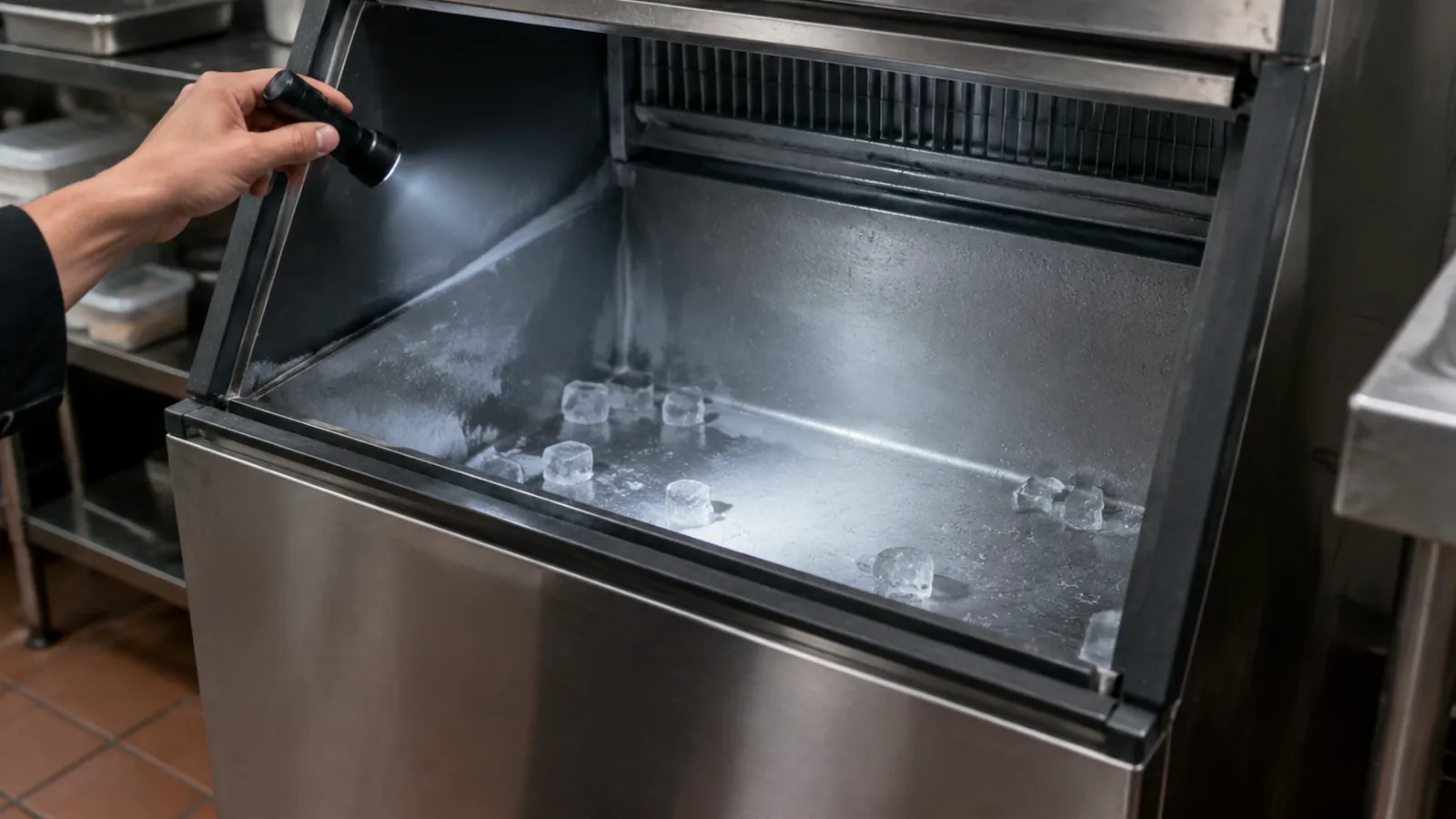
Ice machine not making ice? Check power, water supply, filter, scale, condenser airflow and harvest in order, and know when to call a technician.
When an ice machine is not making ice, the cause is almost always in one of six places: power and controls, the water supply, a clogged filter, scale, condenser airflow or room heat, or the harvest stage. Work through them in that order. The first checks need no tools and take a few minutes; the later ones tell you when to stop and call a technician. This guide gives shift leads and owners a diagnostic flow for a commercial ice machine not making ice, with a clear line between safe operator checks and repair work.
Part of our commercial ice maker buying guide series.
Ice machine not making ice: quick diagnosis table
Start with what you can see and hear. Match the symptom, run the safe check, and escalate when the last column applies.
| What you see | Likely cause | Safe check | Call a technician when |
|---|---|---|---|
| Display dark, nothing running | No power, tripped breaker, switch off | Check plug, switch and breaker | The breaker trips again, or you smell burning |
| Running, bin not full, no ice forming | Timer or cleaning mode, bin-full signal, no water | Check mode, timer settings and the ice-full alert | Settings are correct and it still will not start a freeze |
| Water shortage alert, no water in the reservoir | Closed valve, low pressure, clogged inlet screen or filter | Open the supply fully, check the screen, change an expired filter | Supply is good and the alert persists |
| Thin, cloudy or small cubes before it stopped | Low water flow or scale | Filter date, visible scale, cleaning log | Scale is on parts you cannot reach without tools |
| Hot air at the machine, output falling | Dirty condenser, blocked clearance, hot room | Power off and brush the condenser; clear the space | Overheat or overload trips repeat after cleaning |
| Ice forms but does not drop | Harvest problem: scale, valve or sensor | Clean per the manual | Ice still sticks after a full cleaning cycle |
| Hissing, oily residue, odd frost, compressor runs with no ice | Refrigeration fault | None; power down | Immediately |
Step 1: Power, switch, controls and the bin-full sensor
The fastest fixes are the ones that are not faults at all.
- Power: confirm the plug is seated, the switch is on and the breaker has not tripped. Reset a tripped breaker once. If it trips again, leave it off and call an electrician or service technician.
- Mode: if the machine was just cleaned, make sure it has been returned from the cleaning cycle to ice-making mode as the manual describes. A machine left in clean or standby mode runs without freezing.
- Timer: machines with a production timer can be set to delay or pause ice making. Check that nobody scheduled production for later in the day.
- Bin-full signal: the machine stops when it thinks the bin is full. Look for ice bridged in the drop zone, a scoop or container blocking the sensor area, or an ice-full alert on the display with a bin that is clearly not full.
A bin-full signal that stays on with an empty bin points to the sensor itself. Smartool’s ice maker troubleshooting guide lists the ice-full sensor under engineer checks, not user checks, so leave it to a technician.
Step 2: Ice machine not getting water
No water means no ice. Smartool’s troubleshooting guide lists two user checks for no water intake: the inlet filter, and whether the water source is on and delivering adequate pressure. In practice, check in this order:
- The shutoff valve at the machine is fully open. Valves get half-closed during cleaning, filter changes and nearby plumbing work.
- Other fixtures on the same line have normal flow. If they do not, the problem is the building supply, not the machine.
- The supply line is not kinked or crushed behind the machine.
- The inlet screen and the filter cartridge are clear and the cartridge is inside its service life.
If water reaches the machine with good pressure and it still does not fill, the remaining causes are inside the cabinet. The guide’s engineer checks cover the inlet valve voltage, the float switch and replacing the inlet valve. Those need a technician.
Step 3: Filter clogs and scale
A clogged filter starves the machine slowly. Cubes get thinner and cloudier for days before production stops. The Smartool ice machine maintenance guide says a pre-installed water filter must be replaced according to its service life, usually 3 to 6 months or after a set volume of water, and calls that the most effective way to reduce scale.
Scale is the other slow killer. Mineral deposits on the evaporator insulate it, stretch the freeze cycle and stop cubes from releasing. Smartool’s troubleshooting guide lists scale on the evaporator as a cause of no ice and scale buildup as the user check for no harvest. If the last cleaning is overdue in the log, run the water-system cleaning cycle with the manufacturer-approved cleaner, rinse, and discard the first batch after restart. Our guide on how to clean a commercial ice machine has the full routine and a log template.
The FDA Food Code 2022, § 4-602.11(E)(4), requires the enclosed components of ice makers to be cleaned at the frequency the manufacturer specifies, or often enough to prevent soil and mold from building up. A machine that keeps scaling up before its scheduled clean needs a shorter interval or better filtration.
Step 4: Condenser airflow
An air-cooled machine has to push heat out through the condenser. When dust and grease coat the fins, heat stays in, the freeze cycle slows and protection circuits may shut the machine down. Smartool’s maintenance guide calls condenser cleaning the most frequently overlooked but most critical step, and warns that a clogged condenser raises power use and can seriously damage the compressor.
- Clean it: disconnect power, brush the fins gently with a soft brush and vacuum the loosened dust. Smartool’s schedule is every two weeks in dusty kitchens and monthly elsewhere.
- Clear the space: boxes, cup sleeves and supplies stacked against the cabinet trap hot exhaust air. Smartool recommends more than 30 cm (about 12 inches) at the back and sides.
- Find the vents: the Department of Energy’s FEMP guidance on air-cooled ice machines notes that manufacturers put intakes and exhausts in different places, front, rear, sides or top, and that a unit placed too close to a wall or low ceiling loses efficiency.

Step 5: Room and water temperature
If the machine makes some ice but not enough, and the shortfall started with warm weather, heat is the likely cause rather than a fault. Every machine has a rated ambient range, and output falls as room and supply water temperatures rise. Our guide to ice machine performance in hot weather covers how to measure a timed harvest, compare it with the hot-condition rating and fix placement. Use it before booking a service call for a summer slowdown.
A machine that stops completely in a hot room is a different case. Above its operating range, overheat or overload protection may shut it down. Cool the space and restore airflow first. If it keeps tripping inside the rated range, call a technician.
Step 6: Harvest problems, when ice forms but will not drop
Sometimes the machine is making ice and the bin is still empty. (If the freeze and harvest stages are new to you, start with how commercial ice machines work.) Look through the door or window at the evaporator. A slab of ice stuck to the plate, cubes bridged together, or a machine that stays in the freeze stage long past normal all point to the harvest stage. If ice is building up on the plate and will not drop, see our guide to an ice machine freezing up.
The operator check is scale: a full cleaning cycle often frees a machine whose cubes were sticking to a scaled evaporator. If ice still will not release after cleaning, the causes on Smartool’s troubleshooting list are engineer work: the hot gas valve, the expansion device and the ice-full probe sensor. Do not chip ice off the evaporator with tools; you can damage the plate or its coating. For model-specific checks, use the Smartool ice maker troubleshooting page and describe the symptom to support.
Safe checks vs. technician work
Keep the line where the manufacturer draws it. Staff can check anything outside the panels; everything behind them belongs to a qualified technician.
| Operator-safe checks | Technician only |
|---|---|
| Plug, switch, breaker (one reset) | Breakers that trip again, wiring, control boards |
| Mode, timer and alert messages on the display | Ice-full sensor and probe testing |
| Supply valve, line kinks, inlet screen, filter change | Inlet valve, float switch, pump |
| Cleaning cycle with approved cleaner, per the manual | Scale removal on parts that need panels removed |
| Condenser brushing with power off, clearance, room temperature | Fan motors, compressor, overload protection faults |
| Watching a freeze and harvest through the door | Hot gas valve, expansion device, refrigerant leaks and charge |
Refrigerant work is regulated. EPA Section 608 technician certification rules require technicians who maintain, service, repair or dispose of equipment that could release ozone-depleting refrigerants to be certified. Warranty terms matter too: Smartool’s after-sales policy excludes malfunctions caused by unauthorized disassembly or non-original parts from free warranty coverage, and offers free video guidance and phone consultation.
Before you call, note the model and serial number, any alert on the display, when the machine last made normal ice, the room temperature, and your last cleaning and filter dates. A short video of a full cycle helps the technician more than a description.
What the BF500 and BF360 display tells you
Smartool’s split-type heads build several of these checks into the controls. The BF500 split ice maker and the BF360 both show water shortage and ice-full alerts on an LCD display, which separates a supply problem from a bin-full stop at a glance. Both have a 48-hour timer, so check its settings in Step 1. Both list protection against overheating, compressor overload and overcurrent, and an operating range of 5–38°C (41–100°F). A machine that stops in a room hotter than that range needs a cooler location, not a repair.
Ice machine not producing ice: common questions
Why is my ice machine running but not making ice?
Check water first: a machine can run with an empty reservoir if the valve is closed or the filter is clogged. Then check for scale on the evaporator and a dirty condenser. If water flows, the machine is clean and the compressor runs without making ice, call a technician for a refrigeration check.
Why is my ice machine not getting water?
The usual causes are a partly closed supply valve, low building pressure, a kinked line, or a clogged inlet screen or filter. Our commercial ice machine installation guide covers the supply line, filter and drain setup. If all of those check out, the inlet valve or float switch may have failed, which is technician work.
Why did my ice machine stop making ice after cleaning?
Most often it was left in cleaning or standby mode, the water supply was not fully reopened, or a part removed for cleaning was not reinstalled correctly. Follow the manual’s restart steps and discard the first batch once production resumes.
How do I reset a commercial ice machine?
Reset steps are model-specific, so use the manual. Many operators power the machine off, wait, and restart it. If a protection trip or error returns after one reset, stop resetting it and book service; repeated restarts can hide a fault that is getting worse.
If the same machine keeps failing in your busiest months, it may be time to plan a replacement. You can browse our ice machines, then share your daily ice demand and room conditions to request a factory-direct quote.
Factory-direct from Smartool
Planning a commercial equipment purchase?
Share your site conditions, daily output and budget. Our team will match a model, send the spec sheets and quote factory-direct pricing.

Written by
Senior Engineer, Smartool
Jason is a senior engineer at Smartool. He works on the commercial ice machines, soft serve and slushy machines, and refrigerated prep tables Smartool builds for restaurants, bars, hotels and dessert shops. His guides look at equipment from the engineering side: how to size a machine for a site, what it needs for power, water and airflow, and how to keep it running through busy service. He also helps buyers match the right model to their kitchen before they request a quote.
.elementor-76528 .elementor-element.elementor-element-5c7a0d0{--display:flex;--flex-direction:column;--container-widget-width:100%;--container-widget-height:initial;--container-widget-flex-grow:0;--container-widget-align-self:initial;--flex-wrap-mobile:wrap;}.elementor-76528 .elementor-element.elementor-element-5c7a0d1 .elementor-toc__header-title{text-align:start;}.elementor-76528 .elementor-element.elementor-element-5c7a0d1 .elementor-toc__header{flex-direction:row;}.elementor-76528 .elementor-element.elementor-element-5c7a0d1{--item-text-hover-decoration:underline;}
On this page
Need pricing for your project?
Get a factory-direct quote on commercial ice makers, soft serve and slushy machines, and refrigerated prep tables.
✓ Model matching and spec sheets for your site
✓ US office in City of Industry, CA
✓ Talk to an expert: +1 (872) 221-0051
Browse by topic
Ice Machine Guides
Soft Serve & Ice Cream
Slushy & Frozen Drinks
Buying & Sourcing
Compliance & Maintenance
Related posts

Ice Machine Freezing Up? Causes, Safe Checks and Fixes
Ice machine freezing up? Learn the six common causes, what staff can safely check, what needs a technician, and how to prevent repeat freeze-ups.

How to Use a Margarita Machine or Slush Machine
How to use a margarita machine or slush machine: setup, mixing and filling, freeze time, consistency, dispensing, refills and the closing routine.