




Blog
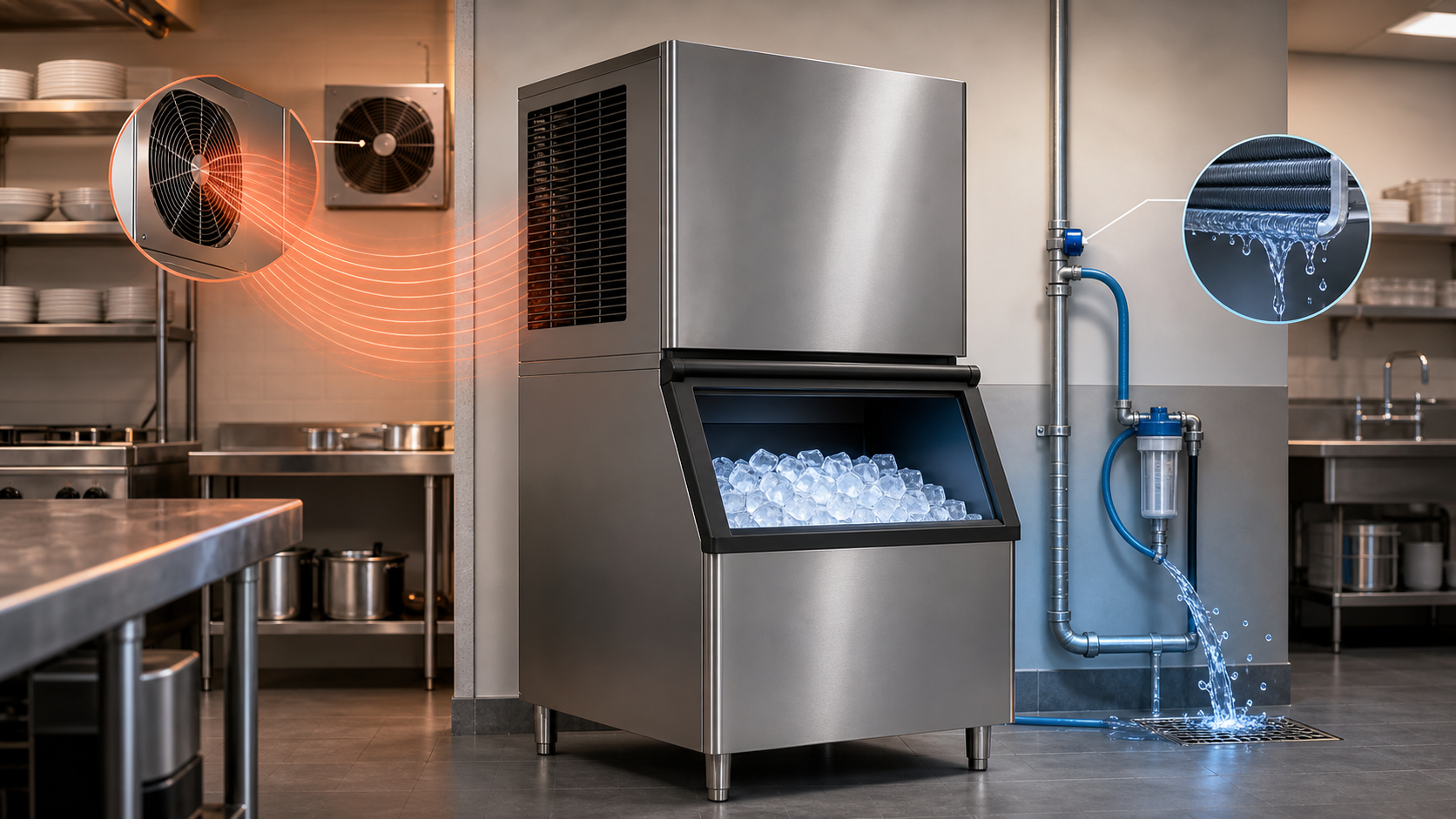
Compare air-cooled, remote and water-cooled ice machines on water use, energy, room heat, installation and codes, with a cost worksheet and decision matrix.
The air cooled vs water cooled ice machine decision comes down to where the heat goes. Every ice machine pulls heat out of water and releases it through a condenser. An air-cooled unit blows that heat into the room, or outdoors if the condenser is remote. A water-cooled unit sends it down a drain or into a building water loop. For most restaurants, bars and hotels, an air-cooled machine costs less to install and run. A water-cooled unit makes sense mainly where a year-round recirculating condenser water loop already exists and the room is too hot or too tight for a fan-cooled condenser.
Air Cooled vs Water Cooled Ice Machine: Side-by-Side Comparison
Start with the table, then read the sections below for the numbers, rules and site checks behind each row. “Remote air-cooled” is listed separately because it behaves differently from a self-contained air-cooled head in almost every row.
| Factor | Air-cooled (self-contained) | Remote air-cooled | Water-cooled |
|---|---|---|---|
| Where condenser heat goes | Into the room around the machine | Outdoors, through refrigerant lines to an outdoor condenser | Into condenser water, then to a drain or a cooling tower loop |
| Condenser water | None | None | Continuous flow while the compressor runs |
| Most sensitive to | Room air temperature and airflow | Outdoor air temperature at the condenser | Condenser water temperature |
| Heat added to the kitchen | High | Low | Low |
| Condenser fan noise in the room | Yes | No (fan is outdoors) | No condenser fan |
| Extra installation work | Clearance and ventilation | Line set, roof or wall condenser, refrigeration contractor | Condenser water supply and return or drain, loop tie-in, water treatment |
| ENERGY STAR eligible | Yes | Yes | No |
| Code exposure | Low | Low | Once-through designs restricted in some jurisdictions |
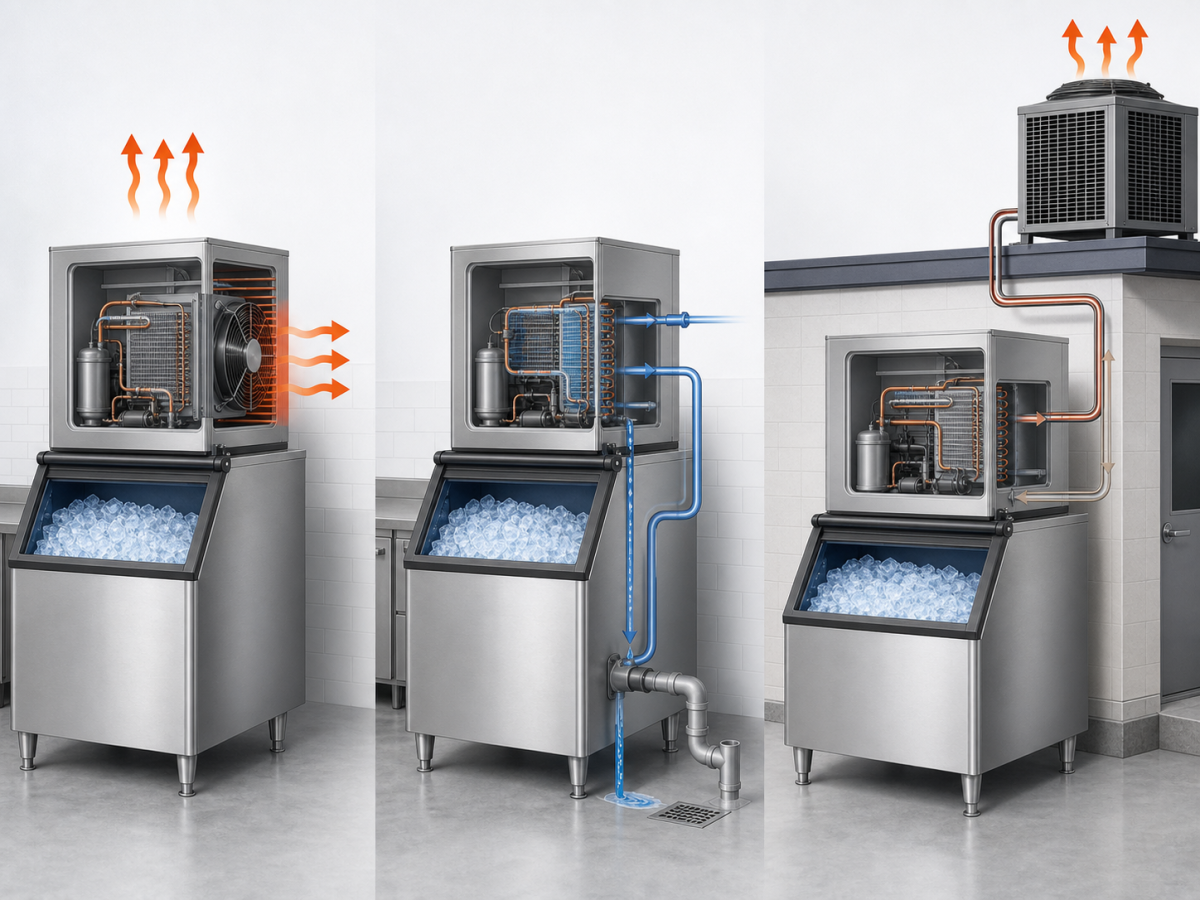
How Each Condenser Type Rejects Heat
Inside the machine, refrigerant absorbs heat from water flowing over the evaporator plate until ice forms. The compressor raises the refrigerant’s pressure and temperature, and the condenser releases that heat, plus the energy the compressor itself used. The three cooling types differ only in what carries the heat away from the condenser, but that one difference drives utilities, installation and service.
Air-cooled self-contained units
A fan pulls room air across a finned condenser coil and pushes the warmed air back out of the cabinet. The machine can only reject heat as well as the air entering the coil allows. Hot kitchens, blocked vents and warm exhaust air circulating back into the intake all lengthen freeze cycles and cut daily output. Our guide to ice output loss in hot weather covers placement and operator checks for that situation.
Remote air-cooled units
The ice-making head stays indoors while the condenser and its fan sit on the roof or an outside wall, connected by refrigerant lines. The Department of Energy’s FEMP purchasing guidance for air-cooled ice machines notes that remote-condensing units discharge the heat from ice making outside the conditioned space, which lowers the building’s cooling load. The trade-off is that the outdoor condenser now sees summer outdoor air, sun and debris, so its location matters as much as an indoor unit’s clearance.
Water-cooled units: once-through vs recirculating
A water-cooled condenser is a heat exchanger with refrigerant on one side and water on the other. A water-regulating valve varies the flow to hold condensing pressure steady. How that water is supplied is the part that matters most for cost and compliance:
- Once-through (single-pass): potable city water passes through the condenser one time and goes straight to the drain.
- Recirculating loop: condenser water returns to a cooling tower, fluid cooler or chiller and is reused. This cuts water use sharply, but the loop has its own evaporation, water treatment and maintenance.
Water Use: Condenser Water Is the Line Item That Decides Most Comparisons
Every ice machine uses potable water to make ice. Condenser water is extra, and it can be several times larger than the ice itself. In its WaterSense at Work best management practices, EPA puts total water use for water-cooled ice makers with single-pass cooling at 100 to 300 gallons per 100 pounds of ice, compared with less than 50 gallons per 100 pounds for air-cooled machines. Both figures include the water that becomes ice.
That gap is why federal, program and local rules treat water-cooled machines differently:
- Federal efficiency standards: the energy conservation standards in 10 CFR 431.136 set a maximum energy use for batch-type ice makers made on or after January 28, 2018, plus a maximum condenser water use in gallons per 100 pounds of ice for water-cooled models.
- ENERGY STAR: the program certifies air-cooled ice makers only. Water-cooled units are listed as ineligible.
- Federal facilities: the FEMP purchasing requirements for water-cooled ice machines say these machines must connect to a cooling tower, that single-pass cooling with city water is not allowed, and that an ENERGY STAR air-cooled machine must be used if no tower runs year-round.
- Local plumbing codes: Section 428.1.1 of the 2022 New York City Plumbing Code prohibits potable water for once-through cooling and requires ice machines to use air-cooled condensers or recirculating condenser water. It exempts once-through ice machines making less than 500 pounds per day at AHRI 810 standard rating conditions, plus some systems installed before 2011.
Other cities and water utilities have their own conservation rules and surcharges. Ask your plumbing official and water utility before you specify a once-through machine, and treat a recirculating loop as a real system with its own makeup water, chemical treatment and winter operation plan.
Energy Use and the Heat That Ends Up in Your Kitchen
Spec sheets are only comparable when they use the same conditions. DOE’s 2019 test procedure notice for automatic commercial ice makers explains that AHRI 810 specifies a 90°F ambient and 70°F supply water rating point. It also notes that many machines sit in conditioned spaces closer to 70°F air and 50°F water. A capacity or kWh figure quoted at 70°F/50°F will look better than the same machine at 90°F/70°F.
The ENERGY STAR commercial ice maker program certifies air-cooled batch and continuous models only, so water-cooled units have no ENERGY STAR benchmark. Compare them on kWh per 100 pounds and condenser gallons per 100 pounds at the same rating conditions.
Output behaves differently in summer by type. A self-contained air-cooled unit loses capacity as the room heats up. A remote unit tracks outdoor air at the condenser. A water-cooled unit tracks condenser water temperature, and tower water also warms in summer.
Estimate the heat an air-cooled head adds to the room
You can size the HVAC penalty with basic physics. Cooling one pound of water from 70°F to 32°F removes about 38 BTU, and freezing it removes another 144 BTU, so roughly 182 BTU per pound leaves through the condenser. The compressor’s electrical input adds 3,412 BTU per kWh.
- Ice heat: daily ice (lb) × 182 BTU. Example: 400 lb × 182 = 72,800 BTU per day.
- Electrical heat: daily kWh × 3,412 BTU. Example: an assumed 19.2 kWh per day adds about 65,500 BTU.
- Total: about 138,300 BTU per day, or roughly 5,800 BTU per hour on average.
- HVAC electricity to remove it: BTU per day ÷ your system’s EER ÷ 1,000. With an EER of 10, that is about 13.8 kWh per day.
A self-contained air-cooled head releases most of that heat into the space. Remote and water-cooled machines move most of it out of the room. Replace the example inputs with your own output, the spec-sheet power figure and your HVAC contractor’s efficiency rating.
Installation Requirements by Cooling Type
| Requirement | Air-cooled (self-contained) | Remote air-cooled | Water-cooled |
|---|---|---|---|
| Utilities at the head | Power, potable water inlet, drain | Power, potable water inlet, drain | Power, potable water inlet, drain, plus condenser water supply and return or drain |
| Airflow | Clear intake and discharge, no hot-air recirculation | Outdoor condenser with open airflow, shade where possible | No condenser airflow needed at the head |
| Additional trades | Usually none beyond plumber and electrician | Refrigeration contractor, roof or wall penetration, condenser power | Plumber or mechanical contractor for loop tie-in and water treatment |
| Main site limit | Room temperature and space around the unit | Line-set length and routing per the manufacturer | Access to a year-round loop, local water rules |
| Permits and code checks | Standard plumbing and electrical | Mechanical and roof work may need permits | Plumbing code limits on once-through cooling |
Refrigerant lines for remote condensers are installed and charged by a qualified refrigeration technician. That work is not an operator task, and it should appear as a separate line in any installation quote.
Noise and Maintenance Differences
Noise. A self-contained air-cooled head puts its condenser fan in the same room as your staff or guests. A remote condenser moves that fan outdoors, and a water-cooled unit has no condenser fan, although water valves and flow still make some sound. When you compare decibel figures, check the distance and background level used. A rating taken 1 meter from the front in a 50 dB room is not comparable with a figure that has no test conditions.
Maintenance. Each type moves the main service task to a different place:
- Air-cooled: keep the condenser coil free of dust and grease. Smartool’s ice machine maintenance guide calls for brushing the condenser with the power disconnected every two weeks in dusty kitchens and monthly elsewhere. It also recommends more than 30 cm (about 12 in) of clearance at the back and sides, away from heat sources.
- Remote air-cooled: keep the outdoor coil clear of leaves, cottonwood and roof debris. Line and refrigerant checks belong to a technician.
- Water-cooled: scale builds up inside the condenser if water quality is poor, and the water-regulating valve and loop treatment need professional attention on a schedule set by the manufacturer and your water treatment contractor.
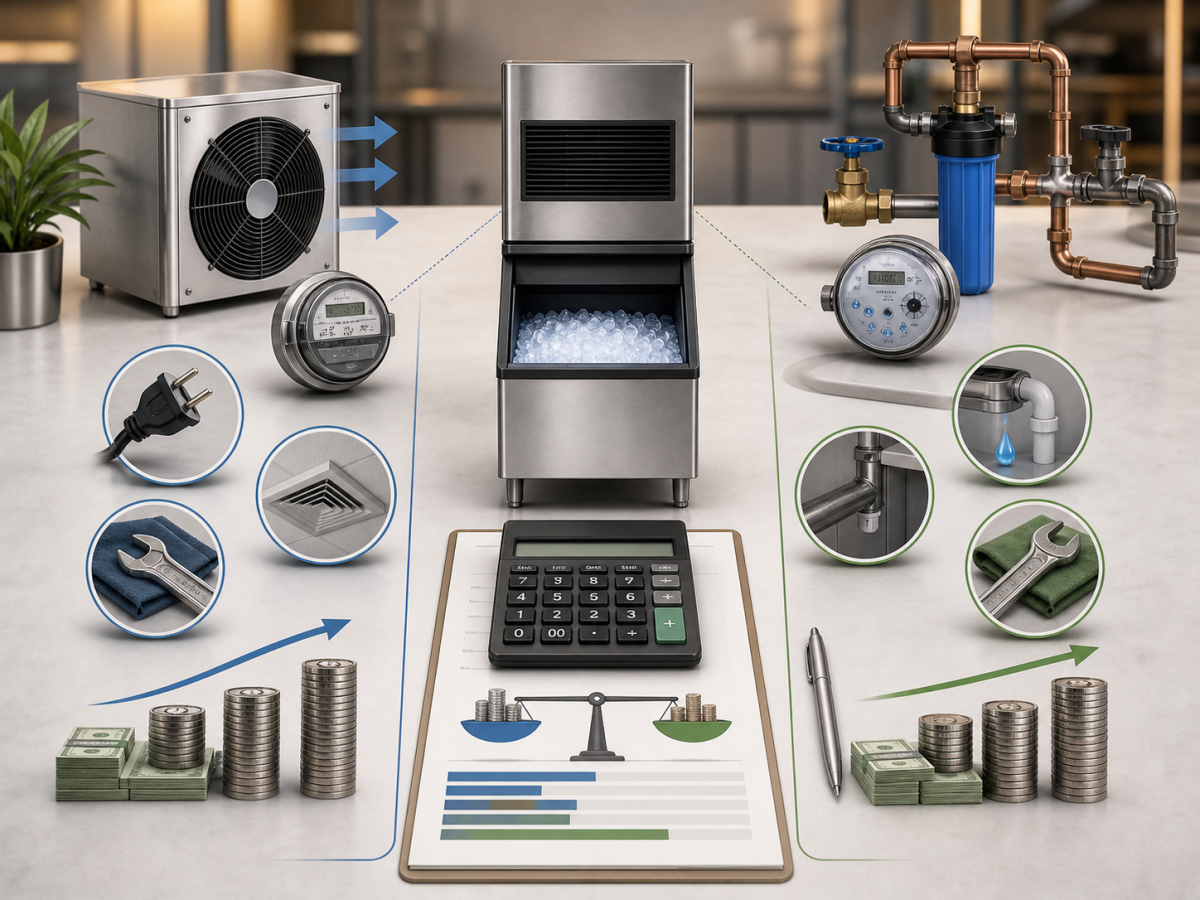
Cost Worksheet: Compare Cooling Types With Your Own Rates
Published cost comparisons rarely match your site because utility rates, water and sewer tariffs, and HVAC efficiency vary widely. Fill in the worksheet below with your local numbers instead. Use the same machine output for every column so you are comparing cooling types, not capacities.
| Line | Formula | Where the input comes from | Applies to |
|---|---|---|---|
| A. Machine electricity per year | kWh per 100 lb × (lb per day ÷ 100) × operating days × $ per kWh | Spec sheet at 90°F/70°F; your bill or state average | All types |
| B. Condenser water per year | Condenser gal per 100 lb × (lb per day ÷ 100) × days × (water + sewer $ per gal) | Spec sheet; local water and sewer tariff | Water-cooled, once-through |
| C. Loop operating share | Makeup water + treatment + tower power attributed to the ice machine | Mechanical engineer or facilities team | Water-cooled on a loop |
| D. HVAC penalty per year | Heat released indoors (BTU per day) ÷ EER ÷ 1,000 × days × $ per kWh | Heat estimate above; HVAC contractor | Mainly self-contained air-cooled |
| E. Installation (one time) | Electrical + plumbing + drain + line set or loop tie-in + permits | Written contractor quotes | All types |
| F. Maintenance per year | Coil cleaning labor + water treatment + technician visits | Service contract or in-house labor rates | All types |
| 5-year comparison | E + 5 × (A + B + C + D + F) | Sum of the lines above | All types |
Two unit conversions trip people up. For electricity, the U.S. Energy Information Administration’s EIA Table 5.6.A of average electricity prices by state lists commercial rates in cents per kWh, so divide by 100 before using line A. For water, many utilities bill per CCF, which is 748 gallons, and add sewer charges based on metered water in. Add both before you divide down to a per-gallon rate.
This worksheet isolates the cooling decision. Purchase price, downtime and replacement timing belong in the full commercial ice machine cost breakdown.
Decision Matrix for Air-Cooled, Remote and Water-Cooled Machines
Find the row that describes your site. If two rows apply, the stricter one usually wins, especially when a water rule is involved.
| Site condition | Air-cooled (self-contained) | Remote air-cooled | Water-cooled on a loop | Water-cooled once-through |
|---|---|---|---|---|
| Ventilated back-of-house, room stays inside the machine’s rated operating range | Best fit | Works, but extra install cost | Only if a loop already exists | Avoid |
| Small enclosed room or next to fryers and ovens, roof access available | Poor, heat recirculates | Best fit | Good if a loop exists | Avoid |
| Building already runs a year-round condenser water loop | Good | Good | Best fit | Avoid |
| Noise-sensitive bar, lobby or front-of-house | Fair | Best fit | Good | Avoid |
| High water and sewer rates or drought restrictions | Best fit | Best fit | Fair, loop still uses makeup water | Avoid, may be prohibited |
| Federal facility or ENERGY STAR purchasing policy | ENERGY STAR model | ENERGY STAR model | Must meet FEMP levels on a tower | Not allowed |
Where Smartool BF500 and BF360 Fit This Decision
The Smartool commercial ice maker lineup features two split-type heads that make square cubes on standard 110–120V power. The product pages publish output at two conditions, which is exactly the data you need to judge performance in a warm kitchen:
| Published spec | BF500 | BF360 |
|---|---|---|
| Output at 21°C (70°F) ambient / 10°C (50°F) water | 500 lb ±5% per 24 h | 360 lb ±5% per 24 h |
| Output at 32°C (90°F) ambient / 21°C (70°F) water | 375 lb ±5% per 24 h | 275 lb ±5% per 24 h |
| Change between the two conditions | −25% | −23.6% |
| Power rating (at 32°C / 21°C) | 1,050 W | 700 W |
| Voltage | AC 110–120V / 60 Hz | AC 110–120V / 60 Hz |
| Operating ambient range | 5–38°C (41–100°F) | 5–38°C (41–100°F) |
| Climate class | SN, N, ST | SN, N, ST |
| Noise | ≤65 dB at 1 m, 50 dB ambient | ≤65 dB |
The hot-condition figures line up with the 90°F/70°F rating point, so you can put them straight into the heat and energy math above. As a budgeting ceiling, the Smartool BF500 500 lb split-type ice maker drawing its full 1,050 W around the clock would use 25.2 kWh per day, or 6.7 kWh per 100 lb at 375 lb. The BF360 360 lb split-head ice maker works out to 16.8 kWh per day and 6.1 kWh per 100 lb on the same basis. The compressor cycles, so treat these as upper limits, not metered consumption.
To get a configuration matched to your site, include these details when you request a quote:
- Peak-season room temperature where the head will sit, measured during a busy service.
- Incoming water temperature at the supply in summer.
- Space around the unit, distance to fryers, ovens or dish machines, and how the room is ventilated.
- Whether the building has roof access, a condenser water loop, or local limits on water-cooled equipment.
- Available electrical supply and drain location, plus the bin or dispenser you plan to pair with the head.
If you are still choosing capacity and ice type, browse all commercial ice maker machines or work through the commercial ice maker buying guide first.
Air-Cooled and Water-Cooled Ice Maker Questions Buyers Ask
Is a water-cooled ice machine more energy efficient?
It depends on the room and the water. A water-cooled condenser does not depend on kitchen air, so it can hold output in a hot room with less compressor effort. Once you add condenser water, sewer charges and loop costs, the machine-level energy advantage often disappears. Compare kWh and condenser gallons per 100 pounds at the same rating conditions, then run the worksheet.
Are water-cooled ice machines banned?
No, not nationally. Federal standards cap their energy and condenser water use, ENERGY STAR does not certify them, and federal facilities must connect them to a cooling tower. Some local plumbing codes, including New York City’s, prohibit once-through potable water cooling with limited exceptions. Water-cooled machines on a recirculating loop remain a legitimate option.
Does an air-cooled ice maker work in a hot kitchen?
Yes, within its rated operating range, but expect lower output as the room heats up. Plan capacity on the hot-condition rating rather than the 70°F figure, keep the condenser clear and clean, and move the unit away from cooking equipment. If the room regularly runs near the top of the operating range, look at a remote condenser or a different location before choosing a larger machine.
Get a Cooling Configuration Matched to Your Site
The cheapest cooling type on paper is the one that fits your room, your water rules and your utility rates. Gather the site conditions listed above, run the worksheet, and request a commercial ice machine quote from Smartool with those details so the recommended head, bin and installation plan match how your kitchen actually runs.
Factory-direct from Smartool
Planning a commercial equipment purchase?
Share your site conditions, daily output and budget. Our team will match a model, send the spec sheets and quote factory-direct pricing.

Written by
Senior Engineer, Smartool
Jason is a senior engineer at Smartool. He works on the commercial ice machines, soft serve and slushy machines, and refrigerated prep tables Smartool builds for restaurants, bars, hotels and dessert shops. His guides look at equipment from the engineering side: how to size a machine for a site, what it needs for power, water and airflow, and how to keep it running through busy service. He also helps buyers match the right model to their kitchen before they request a quote.
.elementor-76528 .elementor-element.elementor-element-5c7a0d0{--display:flex;--flex-direction:column;--container-widget-width:100%;--container-widget-height:initial;--container-widget-flex-grow:0;--container-widget-align-self:initial;--flex-wrap-mobile:wrap;}.elementor-76528 .elementor-element.elementor-element-5c7a0d1 .elementor-toc__header-title{text-align:start;}.elementor-76528 .elementor-element.elementor-element-5c7a0d1 .elementor-toc__header{flex-direction:row;}.elementor-76528 .elementor-element.elementor-element-5c7a0d1{--item-text-hover-decoration:underline;}
On this page
Need pricing for your project?
Get a factory-direct quote on commercial ice makers, soft serve and slushy machines, and refrigerated prep tables.
✓ Model matching and spec sheets for your site
✓ US office in City of Industry, CA
✓ Talk to an expert: +1 (872) 221-0051
Browse by topic
Ice Machine Guides
Soft Serve & Ice Cream
Slushy & Frozen Drinks
Buying & Sourcing
Compliance & Maintenance
Related posts

Ice Machine Freezing Up? Causes, Safe Checks and Fixes
Ice machine freezing up? Learn the six common causes, what staff can safely check, what needs a technician, and how to prevent repeat freeze-ups.

How to Use a Margarita Machine or Slush Machine
How to use a margarita machine or slush machine: setup, mixing and filling, freeze time, consistency, dispensing, refills and the closing routine.
7 thoughts on “Air Cooled vs Water Cooled Ice Machine: Costs & Site Fit”
Comments are closed.