




Blog
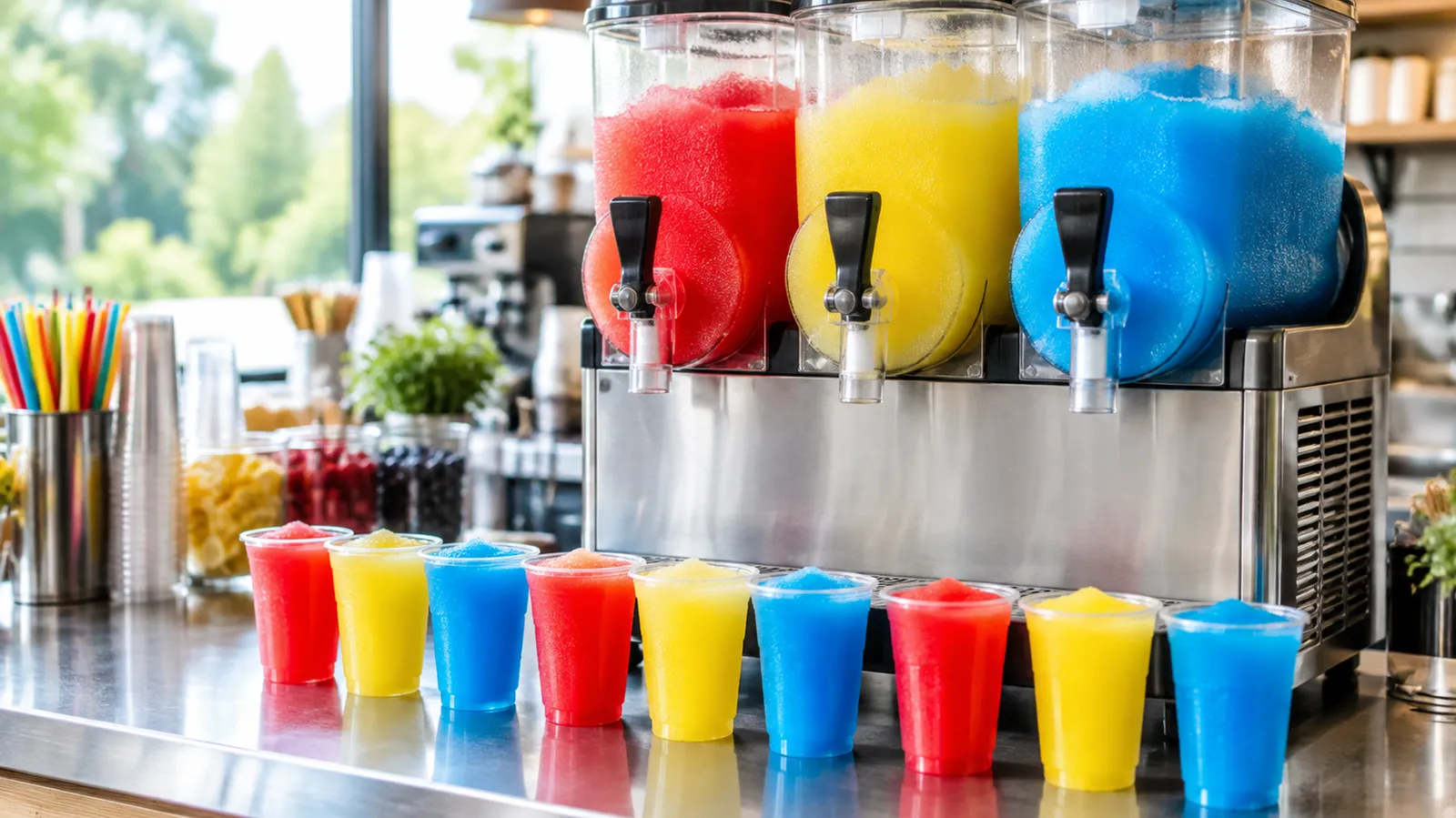
Slushie machine recipes for cafés and bars: a Brix-based method, syrup-to-water starting ratios, fixes for icy or runny slush, and 15 menu drinks.
Good slushie machine recipes are built on one number: the sugar content of the mix, measured in degrees Brix. Sugar decides whether a batch freezes into soft, pourable slush, turns into a hard block, or never sets at all. Get that right and almost any flavor works in a commercial slush machine. This guide gives you a working method for cafés, bars and convenience stores, including a starting syrup-to-water ratio, how to measure and correct a batch, and 15 menu recipes grouped into classic fruit, coffee and tea, lemonade, and alcohol-free mocktails. Treat every ratio here as a starting point, and follow your syrup maker’s label and your machine manual where they differ.
Part of our commercial slush machine buying guide series.
Why sugar content decides whether slush freezes
A pour-over slush machine chills the mix against a refrigerated cylinder while an auger keeps scraping and stirring, so the ice forms as small crystals instead of a solid block. Dissolved sugar lowers the temperature at which water freezes. That is what leaves some liquid between the crystals and keeps the drink soft enough to pour.
- Too little sugar: the mix freezes hard and icy, the auger strains, and the tap can clog.
- Too much sugar: the freezing point drops so far that the batch stays thin and runny, even after hours in the bowl.
- In the window: fine, even crystals that hold their texture through service.
Smartool’s slush machine troubleshooting knowledge base sets the target at 12–18 Brix. One degree Brix is roughly 1% dissolved sugar by weight, so a 15 Brix mix is about 15% sugar. If your syrup maker or machine manual gives a different range, use theirs.
The base method: syrup-to-water ratio as a starting point
Bottled slush concentrate
Commercial slush concentrates print a dilution ratio on the label, and that ratio is your starting point. Mix one test batch exactly as printed, measure it, and only then adjust. Do not stretch concentrate with extra water to save money: the batch drops below the Brix window and freezes hard.
House syrup made from sugar and water
For your own recipes, make a house syrup from equal weights of sugar and water. Because Brix is a percentage of sugar by weight, that syrup sits at about 50 Brix. From there, the base ratio is simple arithmetic:
- 3 parts house syrup to 7 parts unsweetened liquid, by weight (water, brewed tea, cold brew) lands at about 15 Brix, in the middle of the 12–18 window.
- Fruit juice already carries sugar, so it needs far less syrup. The recipes below account for that.
Weigh ingredients on a kitchen scale rather than measuring by volume. Syrup is denser than water, so a cup of syrup carries more sugar than a cup-for-cup ratio suggests. Scale each recipe up to the fill line marked on your bowl, and never fill past it.
Measure every new batch
A handheld refractometer reads Brix from a few drops of mix in seconds. Washington State University’s guide to measuring Brix with a refractometer shows the basic technique. Take the reading on the mixed, unfrozen batch, write it on the batch label, and keep a log so the next shift can repeat it.

How to adjust a batch that freezes too hard or stays liquid
Check the Brix reading first, then the machine. The two quick corrections below are also arithmetic, based on a batch sitting near 15 Brix and a 50 Brix house syrup:
- To raise the batch by about 1 Brix, add house syrup equal to roughly 3% of the batch weight.
- To lower it by about 1 Brix, add water equal to roughly 7% of the batch weight.
| What you see | Likely cause | What to try |
|---|---|---|
| Slush freezes hard, icy or crunchy; auger labors | Brix too low, or consistency set too firm | Add syrup in small steps and re-measure; turn the consistency setting down |
| Batch stays thin and runny | Brix too high, or alcohol in the mix | Add water in small steps and re-measure |
| Correct Brix but still runny | Warm refill, hot room or dusty condenser | Pre-chill mix, clear airflow around the machine, clean the condenser |
| Texture fine at open, watery by mid-rush | Tank drawn down and refilled warm | Top up earlier with pre-chilled mix; consider a second tank for the top seller |
| Correct mix, clean condenser, normal room, still no freeze | Possible refrigeration fault | Stop and call a qualified technician |
Pre-chilling matters because refreezing is slow. Smartool lists first-batch formation times of 40–60 minutes for the single-tank RLC18-1 and 50–75 minutes for the three-cylinder RL18-3, so a warm refill mid-rush cannot catch up. For symptoms beyond the mix, our slush machine troubleshooting guide works through them one by one.
15 slushie machine recipes for a commercial menu
All ratios are parts by weight, using the 50 Brix house syrup above, and aim for about 15 Brix. Juice sugar varies by brand and season. The juice Brix figures below are the minimums the FDA uses for 100% single-strength juice in 21 CFR 101.30, so real juice often reads higher. Measure before you pour it into the bowl.
Classic fruit slush recipes
| Recipe | Base and its minimum Brix | Starting ratio (by weight) | Notes |
|---|---|---|---|
| 1. Strawberry | Strawberry juice or smooth purée, 8.0 | 1 syrup : 5 strawberry | Strain out seeds for a smoother pour |
| 2. Watermelon-lime | Watermelon juice, 7.8 | 1 syrup : 5 watermelon, lime juice to taste | Strain out pulp and seeds before mixing |
| 3. Mango | 100% mango juice, 13.0 | 1 syrup : 15 mango | Thick nectars vary widely; measure before adding syrup |
| 4. Orange | Orange juice, 11.8 | 1 syrup : 11 orange | Pulp-free juice pours more evenly |
| 5. Spiced apple cider | Apple juice or cider, 11.5 | 1 syrup : 10 cider | Steep cinnamon in the syrup, then strain |
| 6. Grape | Grape juice, 16.0 | No syrup; cut with up to 1 water : 10 juice | Already inside the window; check the reading |
Coffee and tea slush recipes
| Recipe | Starting ratio (by weight) | Notes |
|---|---|---|
| 7. Cold brew coffee slush | 3 syrup : 7 cold brew at drinking strength | Add milk or cream at the cup, not in the bowl, unless your manual approves dairy |
| 8. Peach black tea | 2 syrup : 3 peach juice : 5 brewed black tea | Chill the tea fully before it goes in the bowl |
| 9. Hibiscus-ginger | 3 ginger-steeped syrup : 7 hibiscus tea | Gives a deep red color in a clear bowl |
Frappe-style coffee drinks are popular, but milk-based bases are perishable and harder to clean out of a slush machine. Before you put any dairy mix in the bowl, confirm with the manufacturer that the machine is intended for it. Whatever the base, follow our routine for how to clean a slush machine at close.
Lemonade slush recipes
| Recipe | Starting ratio (by weight) | Notes |
|---|---|---|
| 10. Classic lemonade | 3 syrup : 1 fresh lemon juice : 6 water | Reads slightly above 15 Brix because lemon juice carries some solids |
| 11. Strawberry lemonade | 3 syrup : 1 lemon juice : 2 strawberry purée : 4 water | Works out to about 16–17 Brix; add water if it runs soft |
| 12. Mint limeade | 3 mint-steeped syrup : 1 lime juice : 6 water | Strain the mint out completely |
Tart lemonades and sweeter fruit blends often want slightly different consistency settings. On a multi-tank machine with separate controls, such as the RL18-3 with independent electronic temperature control on each of its three 16.5 L tanks, you can set each flavor on its own.
Alcohol-free mocktail slush recipes
| Recipe | Starting ratio (by weight) | Notes |
|---|---|---|
| 13. Virgin strawberry daiquiri-style | 1 syrup : 4 strawberry purée : 1 lime juice | Lands near 14 Brix; garnish with a lime wheel |
| 14. Pineapple-coconut cooler | 1 syrup : 8 pineapple juice (12.8) : 3 coconut water | A virgin piña colada-style drink without the fat of coconut cream |
| 15. Sunrise cooler | Orange slush (recipe 4) over a spoonful of grenadine in the cup | Keeping the grenadine out of the bowl leaves the batch unchanged |
Alcohol lowers the freezing point too, so frozen cocktails need their own batch math; our commercial margarita machine guide covers it.
Running a recipe program on a slush machine
- Write a recipe card per flavor: ingredient weights, target Brix, consistency setting and the date it was last tested.
- Batch and chill ahead: keep the next refill mixed and in the walk-in so it goes into the bowl cold.
- Change flavors at close: drain, wash and sanitize the bowl, auger and tap before a new flavor, so colors and allergens do not carry over. The slushy machine maintenance steps in Smartool’s knowledge base cover the daily routine.
- Put your best seller in two tanks if a single tank empties during the rush.
If you are planning how many flavors to run, you can compare tank counts and capacities across Smartool’s commercial slushy machines.
Slushie machine recipe FAQs
What is the ratio of syrup to water for a slushie machine?
For bottled concentrate, start with the ratio on the label. For a house syrup made from equal weights of sugar and water, start at 3 parts syrup to 7 parts water by weight, which comes out near 15 Brix. Then measure and adjust.
How much sugar does a slushie need to freeze properly?
Aim for about 12–18 Brix, the range in Smartool’s troubleshooting guidance, unless your syrup maker or machine manual specifies another. Below it, slush freezes hard; above it, the batch stays runny.
Can you put soda in a slushie machine?
A pour-over slush machine is not pressurized, so carbonation escapes and you end up with flat, frozen soda. Regular soda can freeze if its Brix falls in the window. Fizzy frozen drinks come from frozen carbonated beverage machines, which are a separate, pressurized equipment category.
Can I use sugar-free syrup in a slush machine?
Only a sugar-free mix formulated for frozen beverage machines. High-intensity sweeteners give sweetness with very little of the dissolved solids that sugar provides, so a homemade sugar-free batch tends to freeze into ice and strain the auger.
How long does a slushie machine take to freeze a new recipe?
It depends on the machine, the room and how cold the mix is going in. Smartool lists 40–60 minutes for a first batch on its single-tank model and 50–75 minutes on its three-cylinder model. Pre-chilled mix shortens the wait. Our step-by-step guide on how to use a slush machine covers setup, freeze time and refills.
Ready to build a frozen drink menu around the right machine? Browse our factory-direct slushy machines, then request a factory-direct quote with your flavor count and peak-hour volume.
Factory-direct from Smartool
Planning a commercial equipment purchase?
Share your site conditions, daily output and budget. Our team will match a model, send the spec sheets and quote factory-direct pricing.

Written by
Senior Engineer, Smartool
Jason is a senior engineer at Smartool. He works on the commercial ice machines, soft serve and slushy machines, and refrigerated prep tables Smartool builds for restaurants, bars, hotels and dessert shops. His guides look at equipment from the engineering side: how to size a machine for a site, what it needs for power, water and airflow, and how to keep it running through busy service. He also helps buyers match the right model to their kitchen before they request a quote.
.elementor-76528 .elementor-element.elementor-element-5c7a0d0{--display:flex;--flex-direction:column;--container-widget-width:100%;--container-widget-height:initial;--container-widget-flex-grow:0;--container-widget-align-self:initial;--flex-wrap-mobile:wrap;}.elementor-76528 .elementor-element.elementor-element-5c7a0d1 .elementor-toc__header-title{text-align:start;}.elementor-76528 .elementor-element.elementor-element-5c7a0d1 .elementor-toc__header{flex-direction:row;}.elementor-76528 .elementor-element.elementor-element-5c7a0d1{--item-text-hover-decoration:underline;}
On this page
Need pricing for your project?
Get a factory-direct quote on commercial ice makers, soft serve and slushy machines, and refrigerated prep tables.
✓ Model matching and spec sheets for your site
✓ US office in City of Industry, CA
✓ Talk to an expert: +1 (872) 221-0051
Browse by topic
Ice Machine Guides
Soft Serve & Ice Cream
Slushy & Frozen Drinks
Buying & Sourcing
Compliance & Maintenance
Related posts

Ice Machine Freezing Up? Causes, Safe Checks and Fixes
Ice machine freezing up? Learn the six common causes, what staff can safely check, what needs a technician, and how to prevent repeat freeze-ups.

How to Use a Margarita Machine or Slush Machine
How to use a margarita machine or slush machine: setup, mixing and filling, freeze time, consistency, dispensing, refills and the closing routine.