




Blog
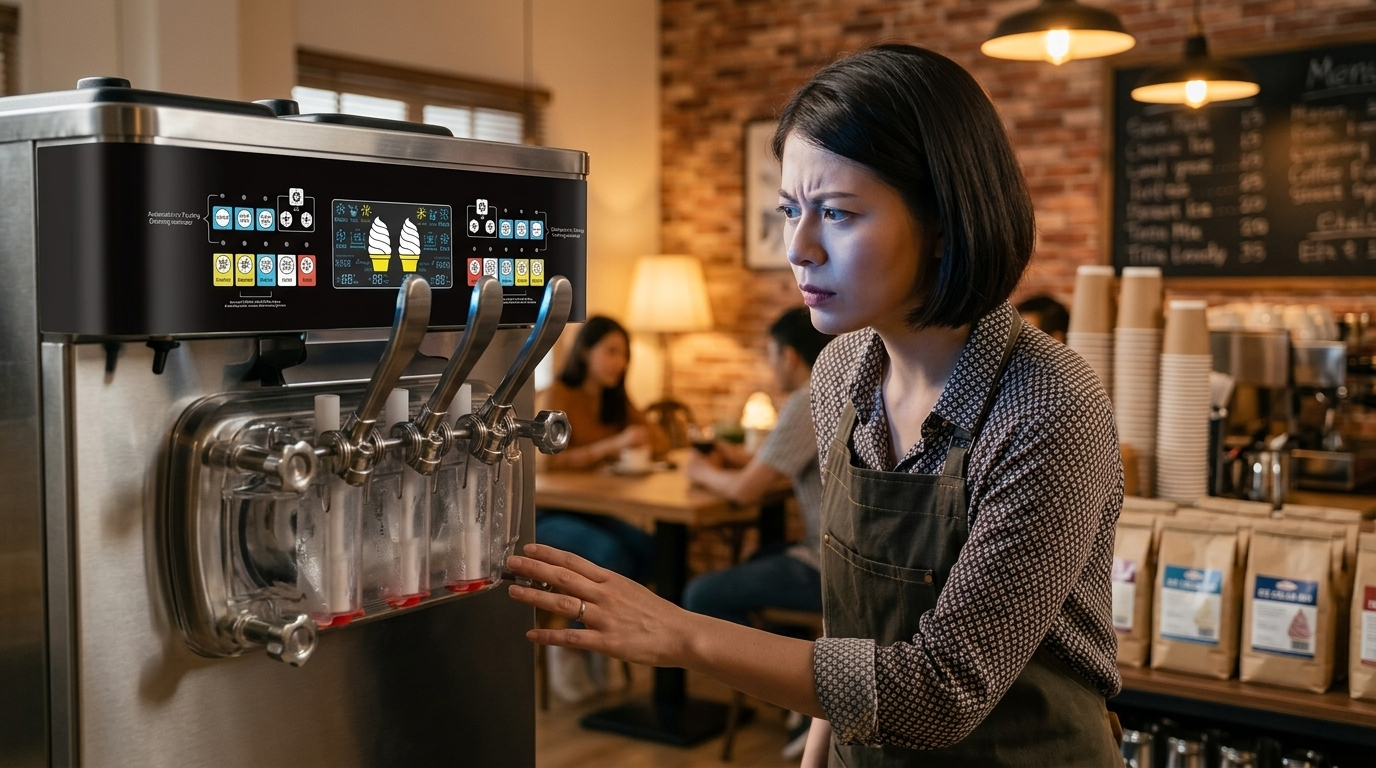
Soft serve machine troubleshooting by symptom: runny or frozen product, not freezing, leaks, noise and alarms, with operator-safe checks and when to call.
Soft serve machine troubleshooting works best by symptom. Most problems at the counter trace back to a small set of operator-level causes: mix temperature or ratio, hopper level, assembly after cleaning, blocked airflow, or the wrong mode. This guide gives the checks staff can safely run for each symptom, from runny product and freeze-ups to leaks, noise, alarms, and a machine that will not freeze at all. It also shows where to stop and call a qualified technician.
Ground Rules Before You Troubleshoot
- Power down before hands go in. Switch the machine off and disconnect power before removing the door, draw valves, or beater. OSHA’s guidance on control of hazardous energy explains why an unexpected startup during servicing can cause serious injury.
- Stay out of the sealed system and wiring. Side panels, electrical components, compressors, and refrigerant lines are technician work. Many current machines use flammable R290 refrigerant, and the EPA’s refrigerant safety overview lists flammability among the hazards that service practices must control.
- Protect the product. If mix has warmed, smells sour, or sat in the machine past your cleaning interval, discard it, then clean and sanitize before restarting.
- Follow the manual for your model. Settings, cleaning modes, and alarm names vary by manufacturer.
Quick Triage by Symptom
| Symptom | Check first (operator-safe) | Stop and call service if |
|---|---|---|
| Too soft or runny | Draw rate, mix temperature, hopper level, airflow clearance, hardness setting | Product stays soft after the machine has recovered and all checks pass |
| Too hard, icy, or frozen up | Hopper ran low, mix too thick, hardness setting, defrost or thaw per manual | Beater will not restart after thawing, or overload repeats |
| Not freezing at all | Mode selected, pre-cooling on, intake grille, room temperature | Compressor runs but the cylinder never gets cold |
| Not dispensing | Empty hopper, freeze-up at the inlet, draw valve assembly | Motor hums without turning, or stops with a burning smell |
| Leaking | O-rings present, undamaged, lubricated; parts seated correctly | Mix or liquid inside the cabinet or near electrical parts |
| Noise or vibration | Machine level, parts seated, food-contact seals lubricated | Grinding, knocking, or new compressor noise |
| Alarm or error code | Alarm meaning in the manual, the condition it reports | The same alarm returns after the cause is corrected |
| Will not start or trips breaker | Power switch, outlet, dedicated circuit, door or panel sensors | Breaker trips more than once |
Soft Serve Too Soft or Runny
Soft product means the cylinder is not removing heat as fast as mix comes in, or the mix itself resists freezing.
- Draw rate: in a rush, pulling faster than the machine recovers produces soft servings. Pause for a minute or two and check whether the next serving firms up.
- Mix temperature: mix poured in warm freezes slowly. Smartool’s soft serve mix selection and usage guide recommends keeping mix at 41 °F (5 °C) or below until it goes into the hopper.
- Mix ratio: powder mixed too thin, or a low-solids formula, will not firm up. Re-check the supplier’s ratio and let prepared mix rest before use.
- Hardness or viscosity setting: confirm nobody changed it during cleaning or a shift change.
- Airflow: an air-cooled machine pushed against a wall, boxed in, or next to a fryer loses capacity. Clear the intake and exhaust sides.
- Air or feed parts: with power off, confirm the feed tube or air tube is installed the right way and is not blocked.
- Scraper blades: during cleaning, look for chipped or rounded blade edges and report worn parts for replacement.
Too much air also makes product soft and fast-melting. If texture drifts during the day, measuring overrun helps; our comparison of gravity vs pump soft serve machines includes a cup-and-scale overrun test.
Soft Serve Too Hard, Icy, or Freezing Up
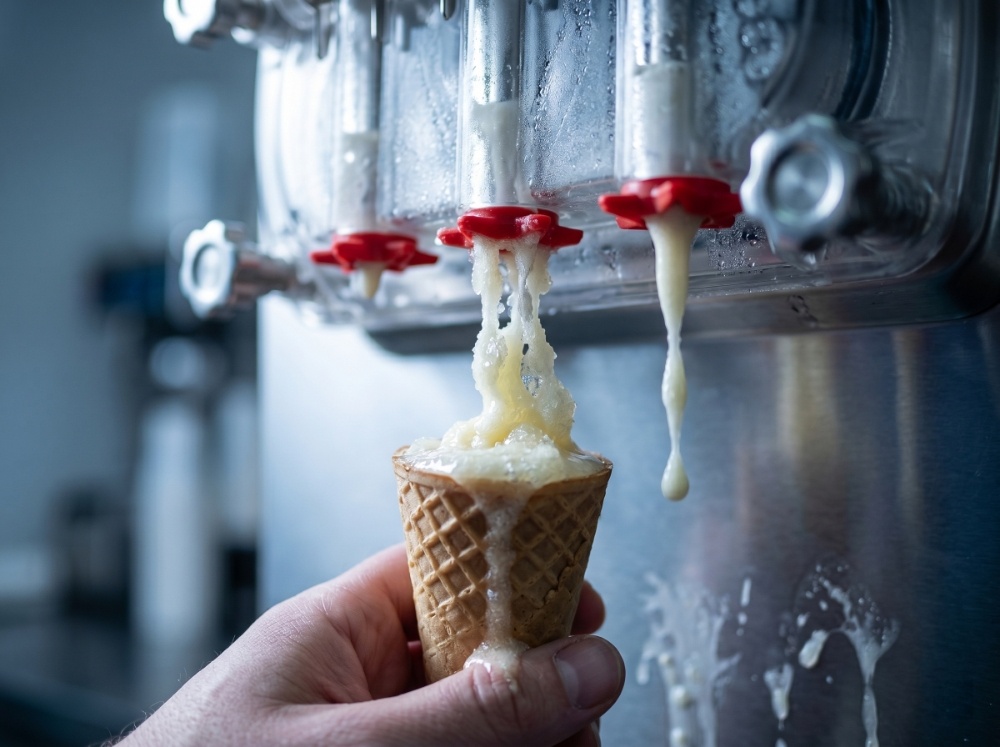
A freeze-up happens when product in the cylinder gets so stiff that the beater struggles or stops. The most common trigger is letting the hopper run low: with too little mix entering, the product that stays in the cylinder keeps freezing.
- Refill the hopper before it runs out; do not wait for the machine to shut down on low mix.
- Check that mix was not partially frozen in storage or icing in the hopper.
- Confirm the mix ratio; an over-concentrated powder mix makes stiff, slow-dispensing product.
- Lower the hardness setting if it was raised.
- If the beater has stopped, switch off and let the cylinder thaw, or use the defrost function if your model has one. Do not force the handle. Smartool’s troubleshooting page advises letting the motor cool for about 10 minutes before restarting.
Icy, grainy product without a full freeze-up often points to temperature swings or a mix that lacks stabilizer. If the machine has been in holding mode overnight, draw off and discard the first servings before judging texture.
Ice Cream Machine Not Freezing at All
When the machine runs but the product stays liquid, work through the simple causes before assuming a refrigeration fault.
- Mode: a machine left in wash, clean, standby, or off mode will not freeze. Select the freezing or auto mode.
- Pre-cooling: confirm the pre-cooling function is switched on where the model has one.
- First batch time: allow the full first-batch time before judging. Smartool lists 10–12 minutes for the GT18ERLW-F and 13–16 minutes for the SW26REL-F at 23°C ambient and mix temperature.
- Airflow and room heat: clear the intake grille, restore clearance, and move heat sources away. Smartool’s maintenance guidance recommends more than 30 cm of open space at the back and sides.
- Listen for the compressor: if the fan and beater run but the compressor never starts, stop there and call service.
If the machine still will not freeze, the remaining causes are technician work: refrigerant loss, a failed sensor or valve, or a compressor issue. Smartool’s soft ice cream machine troubleshooting reference separates the user-level checks from the engineer-level checks for this symptom.
Machine Not Dispensing or Beater Not Turning
- Hopper empty or feed blocked: refill, and check for frozen mix at the cylinder inlet.
- Freeze-up: follow the thaw steps above before pulling harder on the handle.
- Assembly: with power off, confirm the beater is fully seated on the drive and the draw valve and door parts are in the right order.
- Foreign object: check the cylinder and valve for a dropped part, spoon, or packaging fragment.
- Motor protection: many machines cut the motor when it overheats. Let it cool before restarting.
Call a technician if the motor hums without turning, stops repeatedly, or gives off a burning smell. Those symptoms point to the motor, capacitor, or control board.
Leaking Mix or Lubricant
Leaks almost always follow a cleaning or assembly problem. Find where the liquid is coming from before you do anything else.
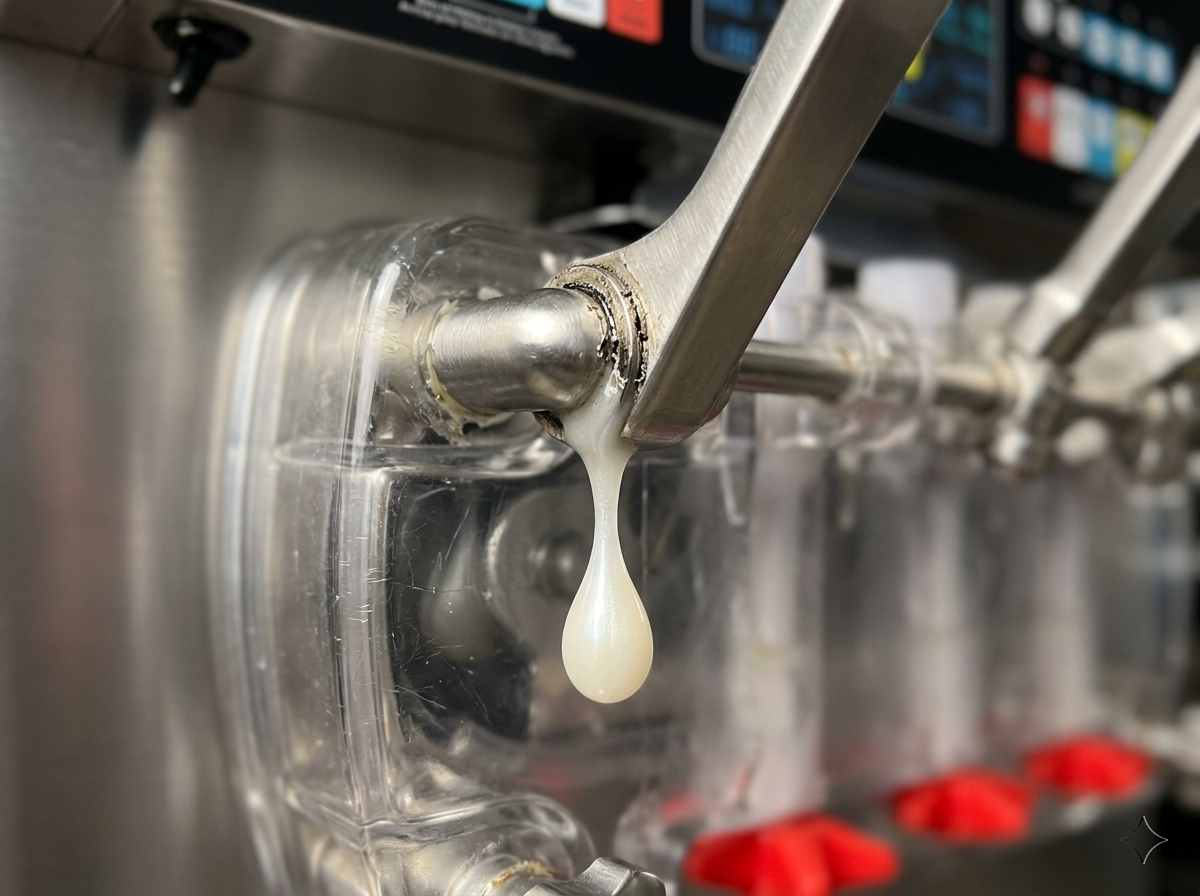
- From the front door or draw valve: an O-ring is missing, torn, flattened, or dry. With power off, inspect each one, confirm it matches the manual, and apply only the food-grade lubricant specified.
- Into the drip tray behind the door: the seal on the beater drive shaft may be worn or incorrectly installed. Stop using the machine until it is corrected, because mix can reach the drive area.
- Inside the cabinet or under the machine: switch off and disconnect power. Liquid near electrical parts is a service call, not an operator fix.
Worn seals are also a sanitation issue, because residue trapped in damaged rubber is hard to clean. Listeria is a particular concern with dairy; the CDC notes in its overview of Listeria infection that it is the fourth leading cause of death from foodborne illness in the United States.
Unusual Noise or Vibration
- Rattling or walking: level the feet and check that the counter is solid.
- Squealing from the front: seals may be dry or seated wrong after cleaning. Power off and check assembly and lubrication.
- Clicking after cleaning: a part is loose or reinstalled in the wrong orientation.
- Louder compressor or fan than usual: check airflow and room temperature first; a machine fighting heat runs harder.
- Grinding or knocking: stop the machine. Metal-on-metal sounds from the drive or compressor need a technician.
Soft Serve Machine Error Codes and Alarms
Error codes differ by manufacturer and model, so the manual is the only reliable source for what a code means. The alarms usually fall into a few groups, and each group points to a different first response.
| Alarm group | What it usually reports | Operator response |
|---|---|---|
| Low mix or mix out | Hopper level below the sensor | Add chilled mix promptly; restart freezing per manual |
| Low temperature or freeze protection | Product in the cylinder too cold or too stiff | Check hardness setting and hopper level; thaw if stalled |
| Motor overload or speed protection | Beater under excessive load | Switch off, let cool, check for freeze-up or thick mix |
| Voltage alarm | Supply voltage outside the allowed range | Confirm dedicated circuit; report to an electrician if it repeats |
| Temperature or sensor fault | A sensor reading is missing or implausible | Record the code and call service |
| Door, panel, or cleaning lockout | Safety interlock open or cleaning cycle due | Close panels, complete the cleaning cycle |
Resetting the same alarm repeatedly without correcting the cause is how a small problem becomes a motor or compressor failure. On Smartool machines, the SW52REL-TF soft serve machine includes speed protection, a material level alarm, a voltage alarm, and freezing cylinder low-temperature protection. For symptom-by-symptom guidance on Smartool equipment, use the Smartool fault diagnosis system, which covers 22 ice cream machine problems.
Machine Will Not Start or Trips the Breaker
- Check the main switch, the outlet, and that the plug is fully seated.
- Confirm the machine is on its own dedicated circuit and not sharing with high-draw equipment.
- Close any open doors or panels; safety sensors block startup.
- Make sure the machine is not still in a cleaning or standby mode.
If the breaker trips a second time, leave it off. Repeated trips point to an electrical fault or a motor or compressor drawing too much current, and both need a qualified technician or electrician.
When to Stop and Call a Technician
- Compressor runs but the cylinder never gets cold, or you hear hissing near refrigeration lines.
- Grinding, knocking, or a burning smell.
- Liquid inside the cabinet or near electrical components.
- Breaker trips repeatedly or the voltage alarm keeps returning.
- The same fault returns after the operator checks are done.
Opening the machine yourself can also cost you coverage. Smartool’s after-sales policy excludes malfunctions caused by unauthorized disassembly, unauthorized repairs, or non-original parts, which is typical of commercial equipment warranties. Our guide to commercial equipment warranty and service covers what to check in any warranty before a problem occurs.
What to Record Before You Call Service
A clear record shortens diagnosis, especially when support starts with a phone call or video session. Keep a copy of this log next to the machine.
| Field | What to write down |
|---|---|
| Model and serial number | From the nameplate |
| Symptom and when it started | First noticed, during rush or at startup, constant or intermittent |
| Alarm or code | Exact text or number, and how often it appears |
| Room temperature and clearance | Approximate temperature; anything placed near the vents |
| Mix details | Brand, powder or liquid, ratio, temperature going into the hopper |
| Last full cleaning | Date, who assembled the machine, any parts replaced |
| Checks already done | Each check from this guide and its result |
| Photos or video | The leak point, the product texture, the display, and any noise |
Preventing Repeat Soft Serve Machine Problems
Most of the symptoms above are prevented by the daily routine. Clean and sanitize food-contact parts on schedule, inspect O-rings at every reassembly, keep the hopper topped up during service, and keep vents clear. Smartool’s ice cream machine maintenance guide lays out the shutdown cleaning and pre-operation checks step by step.
Cleaning frequency for food-contact equipment is set by your local health authority, most of which base their rules on the FDA Food Code. Confirm the interval your inspector expects and train every closing shift to it.
Support for Smartool Soft Serve Machines
Check coverage before paying for a service call: in North America, Smartool’s published after-sales policy covers the machine and compressor for three years and parts and labor for one year. The policy also includes free video guidance and phone consultation, email replies from engineers within one working day, and on-site service in major cities by reservation.
Design features also reduce the problems described here. The GT18ERLW-F single-head soft serve machine has one-touch cleaning and a 7-inch touchscreen, which cuts down on assembly and settings mistakes.
Operators replacing an unreliable unit can compare Smartool’s factory-direct commercial soft serve machines or browse all Smartool ice cream machine models.
Soft Serve Machine Troubleshooting Questions
Why does my soft serve machine keep freezing up?
Usually the hopper is running low during service, the mix is too concentrated, or the hardness setting is too high. Keep the hopper filled, confirm the mix ratio, and check the setting before looking for a mechanical cause.
Can I keep serving if the product is only slightly soft?
Yes, if food safety is not in question. Slow the draw rate, check mix temperature and airflow, and investigate at the end of the shift. If the machine is leaking into the cabinet, grinding, or tripping the breaker, stop immediately.
Where do I find what an error code means?
Start with the operator’s manual for your exact model, since code meanings vary by manufacturer. Smartool customers can also use the fault diagnosis system and contact support with the code and serial number.
How often should seals and O-rings be checked?
Inspect them every time the machine is taken apart for cleaning. Replace any that are cracked, flattened, or stretched, using the part specified for your model.
If an aging machine keeps failing during your busiest hours, request a quote for a replacement soft serve machine sized to your current volume.
Factory-direct from Smartool
Planning a commercial equipment purchase?
Share your site conditions, daily output and budget. Our team will match a model, send the spec sheets and quote factory-direct pricing.

Written by
Senior Engineer, Smartool
Jason is a senior engineer at Smartool. He works on the commercial ice machines, soft serve and slushy machines, and refrigerated prep tables Smartool builds for restaurants, bars, hotels and dessert shops. His guides look at equipment from the engineering side: how to size a machine for a site, what it needs for power, water and airflow, and how to keep it running through busy service. He also helps buyers match the right model to their kitchen before they request a quote.
.elementor-76528 .elementor-element.elementor-element-5c7a0d0{--display:flex;--flex-direction:column;--container-widget-width:100%;--container-widget-height:initial;--container-widget-flex-grow:0;--container-widget-align-self:initial;--flex-wrap-mobile:wrap;}.elementor-76528 .elementor-element.elementor-element-5c7a0d1 .elementor-toc__header-title{text-align:start;}.elementor-76528 .elementor-element.elementor-element-5c7a0d1 .elementor-toc__header{flex-direction:row;}.elementor-76528 .elementor-element.elementor-element-5c7a0d1{--item-text-hover-decoration:underline;}
On this page
Need pricing for your project?
Get a factory-direct quote on commercial ice makers, soft serve and slushy machines, and refrigerated prep tables.
✓ Model matching and spec sheets for your site
✓ US office in City of Industry, CA
✓ Talk to an expert: +1 (872) 221-0051
Browse by topic
Ice Machine Guides
Soft Serve & Ice Cream
Slushy & Frozen Drinks
Buying & Sourcing
Compliance & Maintenance
Related posts

Ice Machine Freezing Up? Causes, Safe Checks and Fixes
Ice machine freezing up? Learn the six common causes, what staff can safely check, what needs a technician, and how to prevent repeat freeze-ups.

How to Use a Margarita Machine or Slush Machine
How to use a margarita machine or slush machine: setup, mixing and filling, freeze time, consistency, dispensing, refills and the closing routine.
2 thoughts on “Soft Serve Machine Troubleshooting: Symptoms & Safe Checks”
Comments are closed.