




Blog
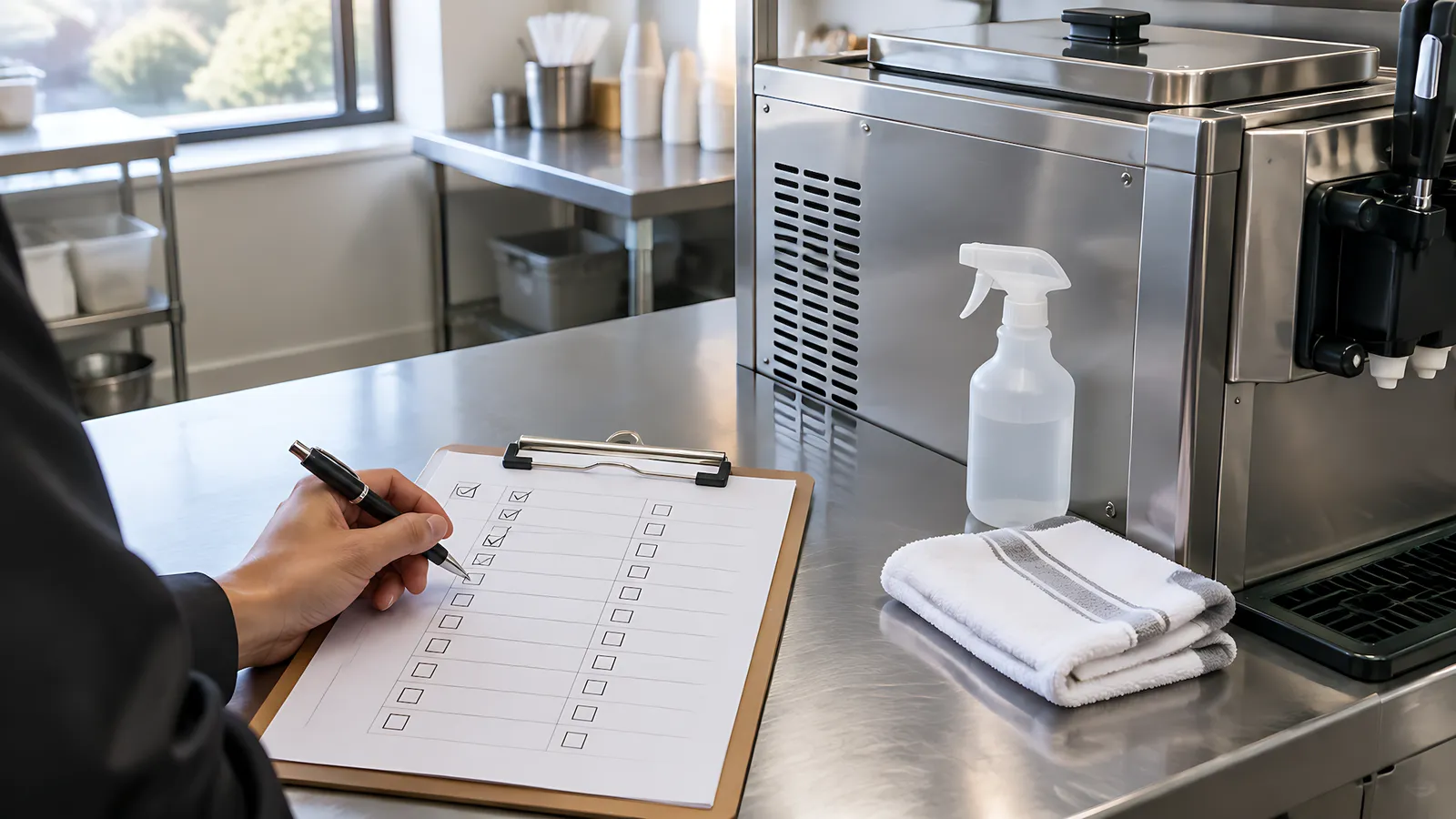
A soft serve machine maintenance schedule: daily cleaning, weekly seal checks, monthly condenser care, quarterly parts and annual service, plus a log.
Soft serve machine maintenance works best as a schedule, not a list of chores you remember when something goes wrong. Clean and sanitize every day, or on the interval your health department approves for a heat-treatment machine. Lubricate and inspect seals every week. Clean the condenser every month. Replace rubber parts every quarter, and book a technician for a tune-up once or twice a year. This guide lays out that calendar, explains why each task sits where it does, and shows how to turn it into a log your staff will actually keep. For the step-by-step teardown on a Smartool machine, follow our knowledge-base procedure linked below.
Part of our commercial soft serve machine buying guide series.
Why soft serve machines need a written schedule
A soft serve machine combines three things that wear out at different speeds: food-contact parts that touch dairy mix every hour, rubber seals and moving parts that wear with every pull of the handle, and a refrigeration system that slowly loses efficiency as dust builds up. A daily cleaning routine handles the first group. It does nothing for the other two. Without a calendar, the weekly and monthly jobs are the ones that get skipped, and they are usually the ones behind a machine that stops freezing on a hot Saturday.
There is also a paperwork reason. Warranty terms usually exclude damage from improper operation. Smartool’s after-sales policy, for example, lists “improper operation” among the situations the free warranty does not cover. A dated maintenance log is the simplest way to show the machine was looked after.
Soft serve machine maintenance schedule at a glance
The intervals below combine published guidance from local health departments and foodservice equipment trade publications. Your machine’s manual and your local health authority take priority wherever they differ.
| Frequency | Main tasks | Who |
|---|---|---|
| Before opening | Reassemble dry parts, check seals are seated, confirm the compressor starts and the machine pre-cools, check mix is fresh | Opening staff |
| During service | Keep mix above the low level, wipe drips at the spout, watch texture and recovery | Whoever is serving |
| Daily at close | Drain, flush, disassemble, wash, sanitize and air-dry all food-contact parts (non-heat-treatment machines) | Closing staff |
| Weekly | Milkstone remover in place of detergent, wipe inside side covers, inspect O-rings, lubricate per the manual, review the log | Shift lead |
| Every 2 weeks (heat treatment only) | Full disassembly and cleaning, if your health authority accepts that interval | Trained staff |
| Monthly | Clean condenser coil and filter, check side and rear clearance, check panel temperature against a thermometer | Manager |
| Quarterly | Replace rubber parts (O-rings, seals, gaskets), inspect scraper blades and drive shaft | Manager or technician |
| Every 6 months | Tune-up on seals and gaskets; consider a technician visit | Technician |
| Annually and before peak season | Replace blades, springs, belts and bushings as needed; refrigeration and electrical check; full pre-season inspection | Qualified technician |
Daily: opening checks, service habits and the closing clean
Daily work has three parts, and only one of them is cleaning.
- Before opening: reassemble parts only when they are completely dry, confirm every seal is seated, power up and check that the compressor starts and the machine enters pre-cooling. Smartool’s knowledge base also recommends more than 30 cm (12 in) of clearance at the back and both sides.
- During service: never let the cylinder run dry. Add mix or shut the machine down before the hopper empties.
- At close: drain the product, flush with water until it runs clear, then take apart, wash, sanitize, rinse and air-dry every removable food-contact part.
How often the full teardown must happen is a regulatory question, not a preference. The City of Racine, Wisconsin, Public Health Department’s soft serve cleaning procedure says counter and dispensing freezers “shall be cleaned at the end of each day’s operation,” or at intervals of no more than 24 hours if the operation runs continuously. That is the baseline most operators should plan around.
The exact teardown order differs from model to model. Smartool’s ice cream machine maintenance procedure covers it in full: which parts to remove, why the pre-rinse uses warm water around 40°C (104°F) rather than hot water, and how to sanitize and air-dry. This article stays at the level of the calendar.
Heat-treatment and “clean-free” machines
Heat-treatment machines change the daily row of the table. Foodservice Equipment Reports describes heat treatment as “the cycling of a daily heating-and-cooling process to safely control bacterial growth.” It notes that food-safety standards require a heat-treatment cycle every 24 hours, and that one manufacturer’s option stretches full disassembly to 14-day intervals, or 28 days in some states. The same FER maintenance article adds that heat treatment “doesn’t replace the need to properly wipe down the machine every day.”
Some machines market a similar benefit. The SW26-BA page lists a 14-day clean-free function and automatic sterilization. Treat any interval longer than one day as something to confirm with your inspector before you build your schedule around it. The cost of getting this wrong is visible in the story of why McDonald’s ice cream machines keep breaking: a failed nightly cycle can keep a machine out of service until it reruns.
Weekly: milkstone, lubrication and seal checks
Weekly tasks protect the parts that daily cleaning moves around but never really inspects.
- Milkstone removal: dairy minerals leave a film that ordinary detergent does not fully remove. The Racine procedure says to use an acid milkstone remover in place of detergent “once a week or as needed,” following the machine manufacturer’s instructions.
- Side covers: Foodservice Equipment & Supplies recommends removing the side covers weekly and cleaning spills with a damp, soapy towel. Mix that leaks inside the cabinet is easy to miss from the front.
- O-rings and seals: look for cuts, flattening, stiffness or swelling. A worn seal is the usual cause of drips at the door and of mix leaking into the back of the machine.
- Lubrication: FER notes that this usually covers moving parts inside the machine plus the handles and pins that hold them, using a food-grade, sanitary lubricant. Too much or too little both cause problems, so follow the amounts in your manual.
- Log review: a manager reads the week’s entries. Repeated notes about soft product, slow recovery or a recurring error code are the early signs worth acting on.
Monthly: condenser, airflow and temperature checks
The refrigeration system is where neglect turns into a service call. FES magazine’s frozen dessert equipment guide says to clean the condenser coil monthly, either by blowing it out with compressed air or with a vacuum. A coil packed with dust and grease forces the compressor to run longer, and the first symptom is usually soft product during a rush.

- Condenser coil and filter: clean the coil, and clean or replace any condenser filter. In summer, Smartool’s knowledge base suggests checking the coil every two weeks.
- Clearance: boxes, cup sleeves and new equipment creep into the space around a machine. Re-check the gaps at the back and sides.
- Temperature accuracy: compare the control panel reading with a calibrated handheld thermometer in the hopper mix. If the two disagree, the sensor needs calibration or replacement.
- Recovery test: pull several servings in a row. If the third or fourth is noticeably softer than the first, write it down and watch the trend.
Quarterly and twice a year: rubber parts and tune-ups
Rubber parts age even when they look fine. FES magazine recommends replacing rubber parts on a quarterly basis and giving soft serve units routine tune-ups on seals and gaskets every six months. A practical approach is to buy the tune-up kit for your model and swap the O-rings, seals and gaskets on a fixed date, rather than waiting for a leak to show which one failed.
At the same visit, check the scraper blades. They should be straight and sharp; dull or nicked blades leave a grainy texture and make the drive work harder. Check the drive shaft for wear where it meets the motor coupling. Grinding noises or vibration point to a bearing or drive problem, which is a technician job.
Annually and before peak season
Once a year, plan on replacing common wear parts. FES magazine lists blades, springs, belts and bushings. Have a qualified technician check refrigerant performance, compressor current and electrical connections. Sealed-system and electrical work should not be done by kitchen staff.
Time the annual visit for spring. Higher room temperatures and longer running hours put the most load on the refrigeration system, and small faults such as a dusty coil or a worn seal tend to become breakdowns in a heatwave. Smartool’s maintenance procedure includes a ten-point pre-summer inspection, from refrigeration recovery to a trial run with real mix. Booking service before technicians get busy is easier than arranging an emergency repair in July.
Keep a maintenance log your staff will fill in
A schedule only works if someone can see it was followed. Keep a one-page log next to the machine and replace it every month. Each line needs:
- Date, task and the initials of the person who did it
- Hopper mix temperature at opening and the panel reading
- Any error code shown, and what cleared it
- Parts replaced, with the date, so you can see how long seals and blades actually last
- Notes on texture, noise or leaks, even when they seem minor
The log pays off when something does go wrong. A technician who can read three weeks of symptoms finds the fault faster. If problems only appear after one particular person closes, you have a training issue, not a mechanical one. Our soft serve machine troubleshooting guide explains which symptoms to escalate. For fault-by-fault checks split between operators and engineers, see the soft ice cream machine troubleshooting table in our knowledge base.
Fit the schedule to your machine
The calendar above is a starting point. Adjust it to the features your machine actually has:
- Automatic cleaning cycles: the GT18ERLW-F lists a one-touch cleaning function. A cleaning cycle shortens the flush, but removable parts still need hand washing and sanitizing on your required interval.
- Night or standby modes: machines such as the BT742SR2JL-F list a night preservation function. Test it as part of the monthly check. If it fails, mix can spoil overnight.
- Low-mix alarms: several Smartool models list material level alarms. Make sure staff know what the alarm means, since running a cylinder dry is one of the habits that shortens part life.
- Service contracts: if you would rather hand the quarterly and annual work to someone else, Smartool’s after-sales policy says annual maintenance contracts with periodic inspections are available for large commercial equipment or customized models. Ask what applies to yours.
Soft serve maintenance questions
How often should a soft serve machine be cleaned?
Plan on a full clean and sanitize at the end of every day. Local health guidance such as Racine’s sets the limit at no more than 24 hours for continuous operation. Heat-treatment machines can run longer between full teardowns, for example 14 days on one manufacturer’s option, but only on the interval your health authority accepts and the manufacturer specifies.
Are ice cream machines cleaned weekly?
Weekly tasks exist, such as milkstone removal, lubrication and seal checks, but they add to the daily clean rather than replace it. A machine cleaned only once a week would not meet daily-cleaning requirements unless it is an approved heat-treatment design running its nightly cycle.
What lubricant should I use on a soft serve machine?
Use a food-grade, sanitary lubricant of the type your manufacturer specifies, applied to the parts and in the amounts the manual shows. Household or general-purpose grease is not suitable for parts that touch the product.
How often should O-rings and scraper blades be replaced?
Trade guidance suggests replacing rubber parts quarterly and common wear parts such as blades, springs, belts and bushings once a year. Replace any part sooner if it is cracked, stiff, nicked or bent. Your parts log will show whether your machine needs a shorter cycle.
If you are planning a new machine around a maintenance routine your team can keep, compare factory-direct soft serve machines by cleaning design, alarms and parts support as well as output. Tell us your opening hours, peak-hour volume and staffing to request a factory-direct quote.
Factory-direct from Smartool
Planning a commercial equipment purchase?
Share your site conditions, daily output and budget. Our team will match a model, send the spec sheets and quote factory-direct pricing.

Written by
Senior Engineer, Smartool
Jason is a senior engineer at Smartool. He works on the commercial ice machines, soft serve and slushy machines, and refrigerated prep tables Smartool builds for restaurants, bars, hotels and dessert shops. His guides look at equipment from the engineering side: how to size a machine for a site, what it needs for power, water and airflow, and how to keep it running through busy service. He also helps buyers match the right model to their kitchen before they request a quote.
.elementor-76528 .elementor-element.elementor-element-5c7a0d0{--display:flex;--flex-direction:column;--container-widget-width:100%;--container-widget-height:initial;--container-widget-flex-grow:0;--container-widget-align-self:initial;--flex-wrap-mobile:wrap;}.elementor-76528 .elementor-element.elementor-element-5c7a0d1 .elementor-toc__header-title{text-align:start;}.elementor-76528 .elementor-element.elementor-element-5c7a0d1 .elementor-toc__header{flex-direction:row;}.elementor-76528 .elementor-element.elementor-element-5c7a0d1{--item-text-hover-decoration:underline;}
On this page
Need pricing for your project?
Get a factory-direct quote on commercial ice makers, soft serve and slushy machines, and refrigerated prep tables.
✓ Model matching and spec sheets for your site
✓ US office in City of Industry, CA
✓ Talk to an expert: +1 (872) 221-0051
Browse by topic
Ice Machine Guides
Soft Serve & Ice Cream
Slushy & Frozen Drinks
Buying & Sourcing
Compliance & Maintenance
Related posts

Soft Serve Machine Maintenance Schedule: Daily to Annual
A soft serve machine maintenance schedule: daily cleaning, weekly seal checks, monthly condenser care, quarterly parts and annual service, plus a log.

Frozen Margarita Machine Recipe: Batch Ratios for Bars
A margarita machine recipe for bars: the 1:4 tequila batch ratio, a per-gallon house formula, four variations, a scaling table and fixes.