




Blog
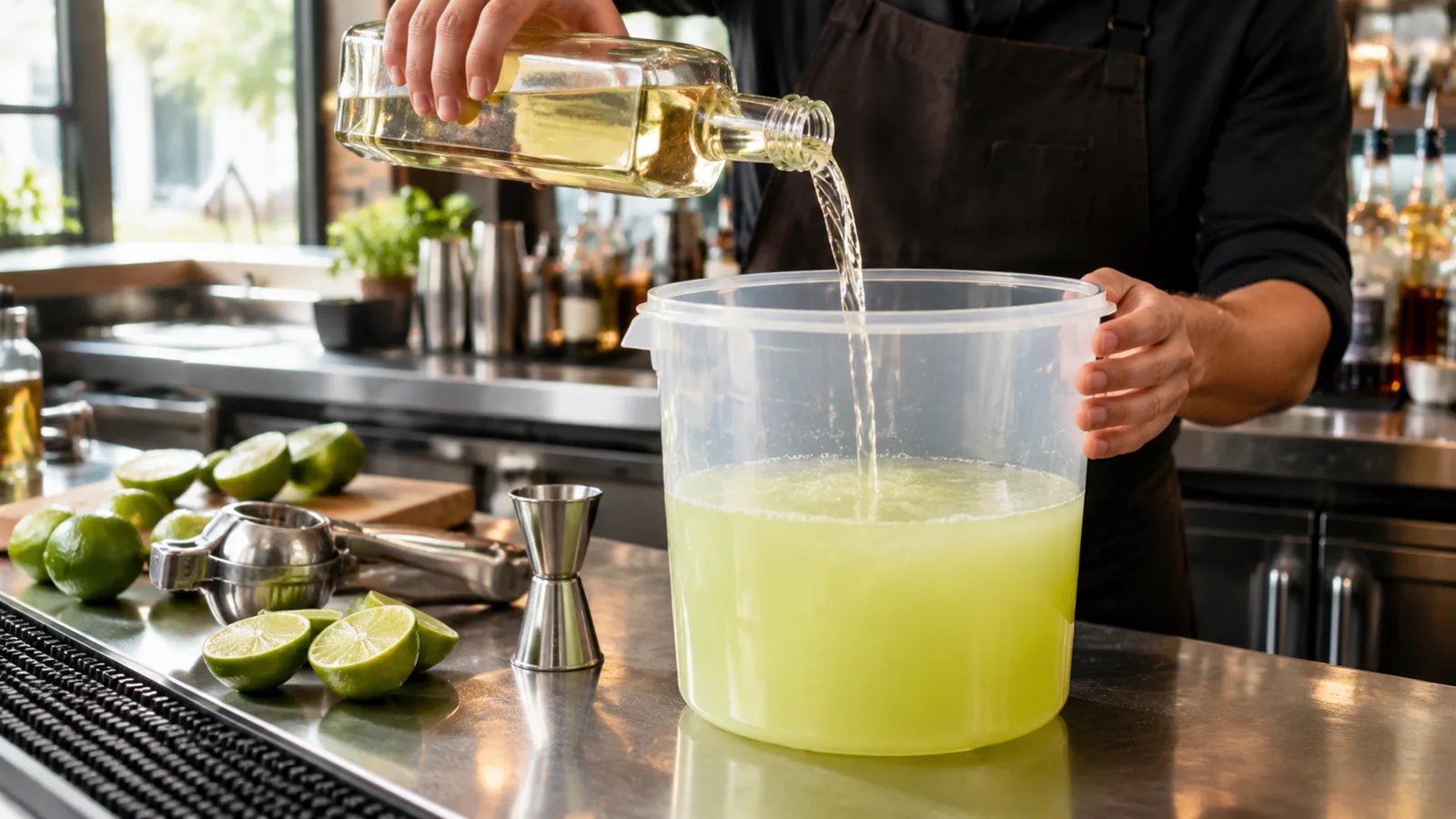
A margarita machine recipe for bars: the 1:4 tequila batch ratio, a per-gallon house formula, four variations, a scaling table and fixes.
A reliable margarita machine recipe for a bar is a batch ratio, not a single-glass recipe: about 1 part 80-proof tequila to 4 parts everything else, with the non-alcoholic base mixed to a measured sugar level before the spirits go in. That combination lands a batch near 8% alcohol by volume, which freezes to a soft, pourable texture in a frozen drink machine and pours about one and a half standard drinks per 12 oz glass. This guide gives a per-gallon house formula, four variations, a scaling table you can order bottles from, and the checks to run before a batch goes in the tank.
Part of our commercial slush machine buying guide series.
Why a frozen margarita machine recipe is different from a shaken one
A classic shaken margarita is built on something like 2 oz tequila, 1 oz orange liqueur and 1 oz lime juice, shaken over ice. Pour that straight into a slush machine and it will never set. The ice in a shaker dilutes the drink as you serve it; in a machine, the water has to be in the batch from the start.
Two things control whether the batch freezes:
- Alcohol. Ethanol lowers the freezing point of water. Engineering ToolBox’s freezing point table for ethanol-water mixtures puts a 10% mix at about -4 °C (25 °F) and a 20% mix at about -9 °C (15 °F), before any sugar is counted. The stronger the batch, the colder the machine has to run, and past a point it stays liquid.
- Sugar. Dissolved sugar also lowers the freezing point and keeps the crystals small. Smartool’s slush machine troubleshooting guide sets 12–18 Brix as the target range for slush mixes. Because alcohol is already doing part of that work, the recipes below keep the base in the lower half of that range.
Our commercial margarita machine guide covers machine choice, sizing and state liquor rules. This article stays on the recipe side: what goes in the batch container and in what ratio.
The bar batch ratio: 1 part spirit to 4 parts base
The math behind any frozen margarita machine recipe is one line: batch ABV = (spirit volume × spirit ABV) ÷ total batch volume. With 40% ABV tequila:
- 1 part tequila : 4 parts base gives 8% ABV. This is our recommended starting point.
- 1 part tequila : 3 parts base gives 10% ABV. Treat this as the upper end, and only after the 8% batch sets well on your machine.
Orange liqueur counts as spirit. Add its alcohol to the tequila’s using the ABV on its own label, because orange liqueurs vary widely in strength. Keep the total in the 7–10% band, start at the low end on a new machine, and move up only if the texture stays good through a full shift.
The cup size matters as much as the batch strength. The NIAAA defines a US standard drink as 0.6 fl oz of pure alcohol. At about 7.7% ABV, a 12 oz frozen margarita holds roughly 0.9 fl oz of alcohol, or about 1.5 standard drinks; a 16 oz cup holds about 2. Put that number on your recipe card so managers know what each pour serves.
House frozen margarita: per-gallon recipe
This is a fresh-lime version for bars that squeeze juice in prep. The syrup is a house simple syrup made from equal weights of sugar and water (about 50 Brix). All amounts are US fluid ounces and make one 128 fl oz gallon.
| Ingredient | Per gallon | Notes |
|---|---|---|
| Blanco tequila, 40% ABV | 20 fl oz | Unaged blanco is the usual choice for frozen batches |
| Orange liqueur | 6 fl oz | Assumed 30% ABV here; recalculate with your label |
| Fresh lime juice, strained | 16 fl oz | Strain out pulp so it does not collect at the tap |
| 1:1 simple syrup | 24 fl oz | Adjust after the Brix check below |
| Cold water | 62 fl oz | Filtered water keeps the flavor clean |
| Batch result | 128 fl oz | About 7.7% ABV; non-alcoholic base reads about 14 Brix |
Those figures are arithmetic from the amounts above, not lab results. Lime juice and orange liqueur both vary, so measure your own batch.
Using a bottled margarita mix instead
Many bars use a bottled sweet-and-sour or margarita concentrate for consistency. Prepare the mix with water exactly as its label directs for frozen machines, then add tequila at 1 part to 4 parts prepared mix: about 26 fl oz tequila and 102 fl oz prepared mix per gallon, or roughly 8% ABV. If the mix label already assumes a spirit amount, follow the label instead and run the ABV formula to check where you land.
Four margarita slush machine recipe variations
Each variation keeps the same 20 fl oz of tequila per gallon and trades some syrup and water for fruit, which brings its own sugar. Fruit sugar figures are the minimum Brix values the FDA sets for 100% juice, so real purée often reads higher. That is why each batch gets measured.
| Variation | Per gallon (fl oz) | Approx. ABV | Base Brix (before spirits) |
|---|---|---|---|
| Strawberry margarita | Tequila 20, orange liqueur 4, strained strawberry purée 32, lime 10, syrup 20, water 42 | 7.2% | About 14 |
| Mango margarita | Tequila 20, orange liqueur 4, mango juice or nectar 48, lime 12, syrup 12, water 32 | 7.2% | About 13 |
| Jalapeño margarita | House formula, with sliced jalapeño steeped in the warm syrup to taste, then strained | 7.7% | About 14 |
| Margarita swirl | House formula in one tank, strawberry in the other, layered in the glass at the tap | 7.2–7.7% | About 14 |
- Strawberry: strain seeds out of the purée. Fruit fiber thickens the batch, so check that it still pours freely from the tap after the first freeze.
- Mango: nectars vary more than any other base here. Some are already sweetened, which pushes Brix up fast, so measure the base before you add the 12 fl oz of syrup.
- Jalapeño: taste the syrup before it goes in. Heat builds as the syrup sits, and cold dulls it, so a slightly hot syrup reads mild in the glass.
- Swirl: pour the house margarita halfway, top with strawberry, and drag a straw through once. It needs a two-tank machine but no extra recipe.
For alcohol-free batches to run in a neighboring tank, such as a virgin strawberry daiquiri-style slush, use our slushie machine recipes.

Scaling the batch to your tank
Scale by whole gallons and fill only to the maximum line marked on the bowl. For reference, Smartool lists 16.5 L (about 4.4 gallons) per tank for the RLC18-1 single-tank slushie machine and for each of the three tanks on the RL18-3. The bottle column helps with ordering: one 750 mL bottle is about 25.4 fl oz.
| Batch size | Tequila | 750 mL bottles | Orange liqueur | Lime juice | 1:1 syrup | Water |
|---|---|---|---|---|---|---|
| 1 gallon | 20 fl oz | 0.8 | 6 fl oz | 16 fl oz | 24 fl oz | 62 fl oz |
| 2 gallons | 40 fl oz | 1.6 | 12 fl oz | 32 fl oz | 48 fl oz | 124 fl oz |
| 3 gallons | 60 fl oz | 2.4 | 18 fl oz | 48 fl oz | 72 fl oz | 186 fl oz |
| 4 gallons | 80 fl oz | 3.2 | 24 fl oz | 64 fl oz | 96 fl oz | 248 fl oz |
A 4-gallon batch yields about 42 frozen margaritas in 12 oz glasses or 32 in 16 oz glasses, before any loss in the tank and at the tap. Count your busiest two hours against that number. If one batch will not cover them, the answer is a second tank of the same recipe, not a stronger batch.
Mixing and testing each batch
- Mix the base first in a clean, sanitized container: lime, syrup, fruit and water, no spirits.
- Read the Brix of the base with a refractometer. Alcohol changes the reading, so measure before the tequila goes in. Aim for roughly 13–15; add syrup to raise it or water to lower it.
- Add the spirits by measure, using a graduated pitcher, not a free pour. A heavy hand on a 4-gallon batch adds up quickly.
- Chill the finished batch in the walk-in if you can. Cold batches reach serving texture sooner.
- Label the container with the recipe, the time it was mixed, the base Brix and the calculated ABV. Some states require a mix date and time on machine batches, so check your state rules.
Expect a margarita batch to need a softer consistency setting and more time than a fruit slush. Smartool lists first-batch formation times of 40–60 minutes for the RLC18-1 and 50–75 minutes for the RL18-3, and an alcohol batch can take longer than that. Switch the machine on well before happy hour.
Fixing a batch that will not behave
| Problem | Most likely cause in a margarita batch | Fix for the next batch |
|---|---|---|
| Stays thin or soupy | Batch above 10% ABV, or base Brix too high | Recalculate ABV; cut spirits back toward 1:4 and add water |
| Sets hard and icy, auger strains | Base Brix too low, often from extra water or a tart lime crop | Add syrup to the base until it reads in range |
| Good at open, watery by the rush | Warm refill poured into a half-empty tank | Keep a chilled backup batch; top up earlier |
| Flavor tastes flat once frozen | Cold mutes sweetness and aroma | Add more lime rather than more syrup, then re-check Brix |
| Pulp or seeds at the tap | Unstrained juice or purée | Strain through a fine sieve before the tank |
Citrus acid and sugar leave residue in the valve and seals faster than most fruit slush. Drain and clean the tank between recipes and at close; Smartool’s slushy machine maintenance steps cover the daily routine.
Choosing a machine for a margarita program
Only run alcohol in a machine whose maker lists it as an intended use. The RL18-3 three-cylinder slushy machine page describes it as “safe for making frozen margaritas, cocktails, and other alcohol-based drinks,” and its three 16.5 L tanks have separate electronic temperature control, so a margarita tank and an alcohol-free tank can run at different settings. The RLC18-1 page lists “slushies, frozen margaritas, cocktails, and alcohol-based drinks,” and the RL18-2 page lists “slushies, cider slushes, margaritas, frozen cocktails.” Confirm the alcohol ratio you plan to run with your sales rep before the first batch. You can compare tank counts across Smartool’s slushy machine range.
Frozen margarita machine recipe FAQs
How much tequila goes in a margarita machine?
Start with 1 part 80-proof tequila to 4 parts base, which is about 20–26 fl oz per gallon depending on whether orange liqueur is also in the batch. That keeps the batch near 8% ABV, a strength most frozen drink machines can set. Check the strength against your machine maker’s guidance.
What is the best margarita mix for a slush machine?
One labeled for frozen drink machines, with dilution directions on the bottle. Mixes built for shaken cocktails are usually too concentrated to freeze without extra water. Whichever you choose, prepare it per the label and confirm the Brix before adding tequila.
Why won’t my frozen margarita freeze?
Usually the batch is too strong, too sweet, or went in warm. Run the ABV formula, read the base Brix, and pre-chill the next batch. If a correctly mixed batch still will not set in a normal room, check airflow around the machine and call for service.
Can you make frozen margaritas without alcohol in the same machine?
Yes, in a separate tank. Drop the spirits from the house formula and replace them with an equal volume of water plus a little extra syrup, since the base no longer gets any help from alcohol. Label the tank clearly so staff never pour from the wrong one.
Planning a frozen margarita program across several bars? Our factory-direct frozen drink machine program covers multi-unit orders. Send us your busiest-hour drink count and glass size to request a factory-direct quote.
Factory-direct from Smartool
Planning a commercial equipment purchase?
Share your site conditions, daily output and budget. Our team will match a model, send the spec sheets and quote factory-direct pricing.

Written by
Senior Engineer, Smartool
Jason is a senior engineer at Smartool. He works on the commercial ice machines, soft serve and slushy machines, and refrigerated prep tables Smartool builds for restaurants, bars, hotels and dessert shops. His guides look at equipment from the engineering side: how to size a machine for a site, what it needs for power, water and airflow, and how to keep it running through busy service. He also helps buyers match the right model to their kitchen before they request a quote.
.elementor-76528 .elementor-element.elementor-element-5c7a0d0{--display:flex;--flex-direction:column;--container-widget-width:100%;--container-widget-height:initial;--container-widget-flex-grow:0;--container-widget-align-self:initial;--flex-wrap-mobile:wrap;}.elementor-76528 .elementor-element.elementor-element-5c7a0d1 .elementor-toc__header-title{text-align:start;}.elementor-76528 .elementor-element.elementor-element-5c7a0d1 .elementor-toc__header{flex-direction:row;}.elementor-76528 .elementor-element.elementor-element-5c7a0d1{--item-text-hover-decoration:underline;}
On this page
Need pricing for your project?
Get a factory-direct quote on commercial ice makers, soft serve and slushy machines, and refrigerated prep tables.
✓ Model matching and spec sheets for your site
✓ US office in City of Industry, CA
✓ Talk to an expert: +1 (872) 221-0051
Browse by topic
Ice Machine Guides
Soft Serve & Ice Cream
Slushy & Frozen Drinks
Buying & Sourcing
Compliance & Maintenance
Related posts

Frozen Margarita Machine Recipe: Batch Ratios for Bars
A margarita machine recipe for bars: the 1:4 tequila batch ratio, a per-gallon house formula, four variations, a scaling table and fixes.

Ice Machine Freezing Up? Causes, Safe Checks and Fixes
Ice machine freezing up? Learn the six common causes, what staff can safely check, what needs a technician, and how to prevent repeat freeze-ups.