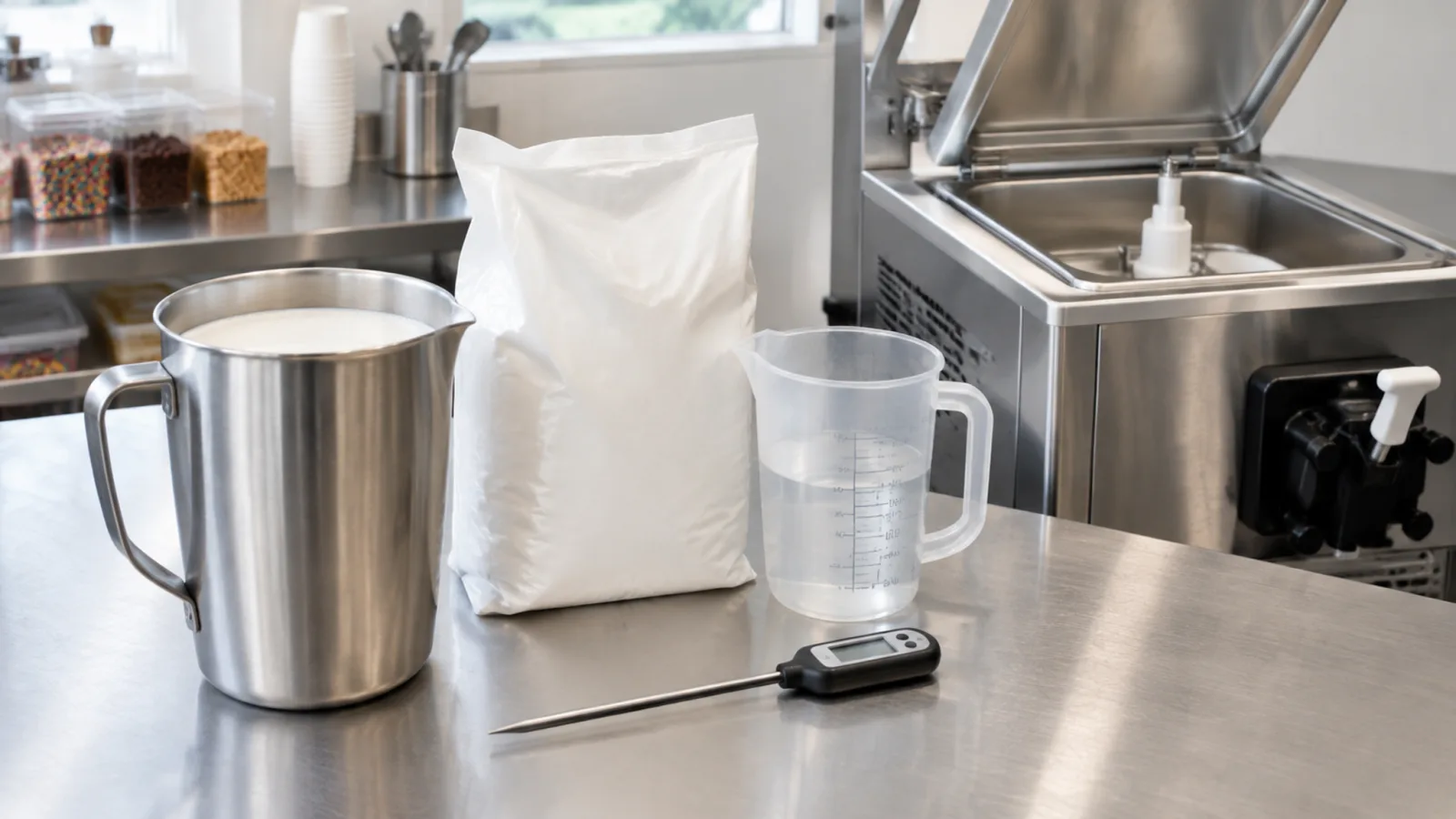
Powder, liquid or self-made soft serve mix: how they compare, what each ingredient does, how to prepare and store mix at 41 °F (5 °C) or below, and how to fix texture problems that start in the mix.
The right soft serve mix for a commercial machine is the one your staff can prepare the same way every shift and keep cold until it goes into the hopper. Powder mix costs the least and stores the longest. Liquid mix is ready to pour and gives a creamier, more consistent result. Self-made mix offers full flavor control, but it adds pasteurizing, cooling and, in some states, a separate permit. Whichever you choose, prepare it at the ratio on the supplier’s label, hold it at 41 °F (5 °C) or below, and follow your mix supplier’s label and your machine’s manual wherever they differ from general advice. This guide compares the three types, explains what each ingredient does, and covers preparation, storage, cleaning and the texture problems that usually trace back to the mix.
Signature flavors where local rules allow scratch mix
Powder mix
Powder is the cost-control option. It is light to ship, keeps a long time unopened, and lets you adjust flavors. Use the mixing ratio on the supplier’s label. Many powders are mixed at about 1 part powder to 2–3 parts water or milk, but check yours, because the ratio changes how firm the product sets. Accurate measuring is what keeps powder mix consistent from shift to shift.
Liquid mix
Liquid mix goes straight into the hopper with no dilution, which makes operation simple and the taste premium and stable. The trade-off is cold storage. It needs cold-chain transport and refrigerated storage at 0–4 °C (32–39 °F), and its shelf life is short. Follow the date and the opened-pack instructions on the supplier’s label.
Self-made mix
A house base typically uses whole milk, cream, sugar, stabilizers and emulsifiers, and flavorings such as vanilla, chocolate or fruit purée. It gives you full control of flavor, but it takes time, is harder to keep consistent, and the base must be pasteurized, cooled and held cold under your health department’s rules. Some states require a separate permit to make your own mix. Our soft serve ice cream recipe for machines covers composition ranges, a starter vanilla base and the pasteurizing and cooling steps.
What each ingredient in soft serve mix does
Whether you buy mix or make it, the same components decide how it freezes and how well it holds air. Read the supplier’s specification sheet with this table in mind.
Ingredient
Function
Butterfat
Provides richness and smooth texture
Sugar
Adds sweetness and lowers the freezing point
Stabilizer
Limits ice crystal growth and keeps the product creamy
Emulsifier
Keeps fat and water evenly blended
Milk solids
Add body and help the product hold air
Flavoring
Provides taste and aroma
Balance matters more than any single number. Low fat or solids give an unstable foam, too little stabilizer or emulsifier lets air escape, and too much sugar weakens the foam structure. That is why an unbalanced mix often shows up first as poor overrun, the air the machine whips into the product. Soft serve typically runs at 40–70% overrun. Our comparison of gravity vs pump soft serve machines explains how overrun drives texture and mix cost per serving.
How to prepare soft serve mix for the hopper
Measure at the label ratio. For powder, use exactly the powder-to-liquid ratio on the supplier’s label. Do not add extra water to stretch a batch; the ratio changes how firm the product sets.
Mix thoroughly. Uneven mixing is a common cause of rough or icy texture.
Let it rest, chilled. Give prepared mix 15–30 minutes in the refrigerator before use. This lets bubbles dissipate and the temperature even out.
Keep it at 41 °F (5 °C) or below. Mix is a time/temperature control for safety (TCS) food. Hold it at or below 41 °F (5 °C), the cold-holding limit in the FDA Food Code 2022 (§ 3-501.16), from storage until it goes into the hopper.
Pour it in cold. Warm mix freezes slowly, and mix that is partly frozen can ice up in the hopper.
Storing soft serve mix
The date on the supplier’s label always governs. The ranges below are common, not guaranteed, and an opened pack follows the supplier’s opened-pack instructions.
Type
Storage condition
Shelf life
Powder
Cool, dry place
Per supplier label (commonly 12–24 months unopened)
Liquid
Refrigerated, 0–4 °C (32–39 °F)
Per supplier label (commonly 7–14 days)
Fresh (self-made) mix
Refrigerated at 41 °F (5 °C) or below
48 hours or less, unless your health department’s date-marking rules are stricter
Ask your mix supplier for the ingredient specification and allergen statement for every product you use, and keep them where staff can find them when a customer asks.
Cleaning schedules for machines running mix
How often to take the machine apart and sanitize it depends on your machine’s operation manual and your local health department. As a minimum reference, FDA Food Code § 4-602.11(C) requires food-contact surfaces of equipment used with TCS food to be cleaned at least every 4 hours, with exceptions in paragraph (D), for example when the food is held cold or your health department has approved a different schedule. Many local procedures call for a full clean at the end of each day’s operation. Heat-treatment machines follow the interval in their manual that your health department accepts.
Use food-grade cleaning and sanitizing products only. Our soft serve machine maintenance schedule lays out the daily closing clean and the weekly and monthly tasks, and Smartool support can share model-specific cleaning instructions on request.
Mix-related texture problems and fixes
Many problems that look like machine faults start in the mix. Check these before you call service.
Problem
Likely cause
What to do
Ice cream too soft
Mix too thin, warm mix, hardness setting too low, or not enough freezing time
Check the mix ratio against the supplier’s label, pour mix in at 41 °F (5 °C) or below, raise the hardness setting a step, and check the refrigeration
Too hard or slow dispensing
Hardness (viscosity) setting too high, or mix ratio off
Lower the hardness or viscosity setting, check the mix temperature, and prepare the mix at the ratio your supplier specifies. Do not add extra water beyond the supplier’s ratio.
Weak flavor
Low butterfat or sugar in the mix
Choose a richer mix, or adjust a self-made recipe with your supplier
Rough or icy texture
Uneven mixing, temperature swings, or product left in the cylinder too long
Mix thoroughly, keep the mix cold and steady, and dispense regularly
Testing a new market: start with powder mix, then move to liquid mix later if volume and refrigerated storage allow.
Premium or branded concept: liquid mix gives a stable, premium taste with the least preparation, provided you have cold-chain delivery and refrigerator space.
Signature flavors: consider a self-made base only after you confirm with your health department that you can make mix on site.
Neither is better for every operation. Powder wins on cost and storage and suits high-volume stores and market testing. Liquid wins on convenience and a creamier, more natural flavor, but it needs refrigerated storage and has a short shelf life.
Can I add extra water to make powder mix go further?
No. Prepare powder at the ratio on the supplier’s label. The ratio changes how firm the product sets, so extra water changes the product your customers get. If the soft serve is too hard, lower the hardness or viscosity setting instead.
What temperature should soft serve mix be kept at?
At 41 °F (5 °C) or below, from storage until it goes into the hopper. That is the cold-holding limit for TCS food in FDA Food Code § 3-501.16. Liquid mix is commonly stored at 0–4 °C (32–39 °F).
How long does soft serve mix last?
Follow the date on the supplier’s label. Unopened powder commonly lasts 12–24 months and liquid mix commonly 7–14 days refrigerated. Fresh self-made mix should be used within 48 hours or less, unless your health department’s date-marking rules are stricter.
Jason is a senior engineer at Smartool. He works on the commercial ice machines, soft serve and slushy machines, and refrigerated prep tables Smartool builds for restaurants, bars, hotels and dessert shops. His guides look at equipment from the engineering side: how to size a machine for a site, what it needs for power, water and airflow, and how to keep it running through busy service. He also helps buyers match the right model to their kitchen before they request a quote.
Jason is a senior engineer at Smartool. He works on the commercial ice machines, soft serve and slushy machines, and refrigerated prep tables Smartool builds for restaurants, bars, hotels and dessert shops. His guides look at equipment from the engineering side: how to size a machine for a site, what it needs for power, water and airflow, and how to keep it running through busy service. He also helps buyers match the right model to their kitchen before they request a quote.
.elementor-76528 .elementor-element.elementor-element-5c7a0d0{--display:flex;--flex-direction:column;--container-widget-width:100%;--container-widget-height:initial;--container-widget-flex-grow:0;--container-widget-align-self:initial;--flex-wrap-mobile:wrap;}.elementor-76528 .elementor-element.elementor-element-5c7a0d1 .elementor-toc__header-title{text-align:start;}.elementor-76528 .elementor-element.elementor-element-5c7a0d1 .elementor-toc__header{flex-direction:row;}.elementor-76528 .elementor-element.elementor-element-5c7a0d1{--item-text-hover-decoration:underline;}
On this page
Need pricing for your project?
Get a factory-direct quote on commercial ice makers, soft serve and slushy machines, and refrigerated prep tables.
✓ Model matching and spec sheets for your site ✓ US office in City of Industry, CA ✓ Talk to an expert: +1 (872) 221-0051
Powder, liquid or self-made soft serve mix: how they compare, what each ingredient does, how to prepare and store mix at 41 °F (5 °C) or below, and how to fix texture problems that start in the mix.