




Blog
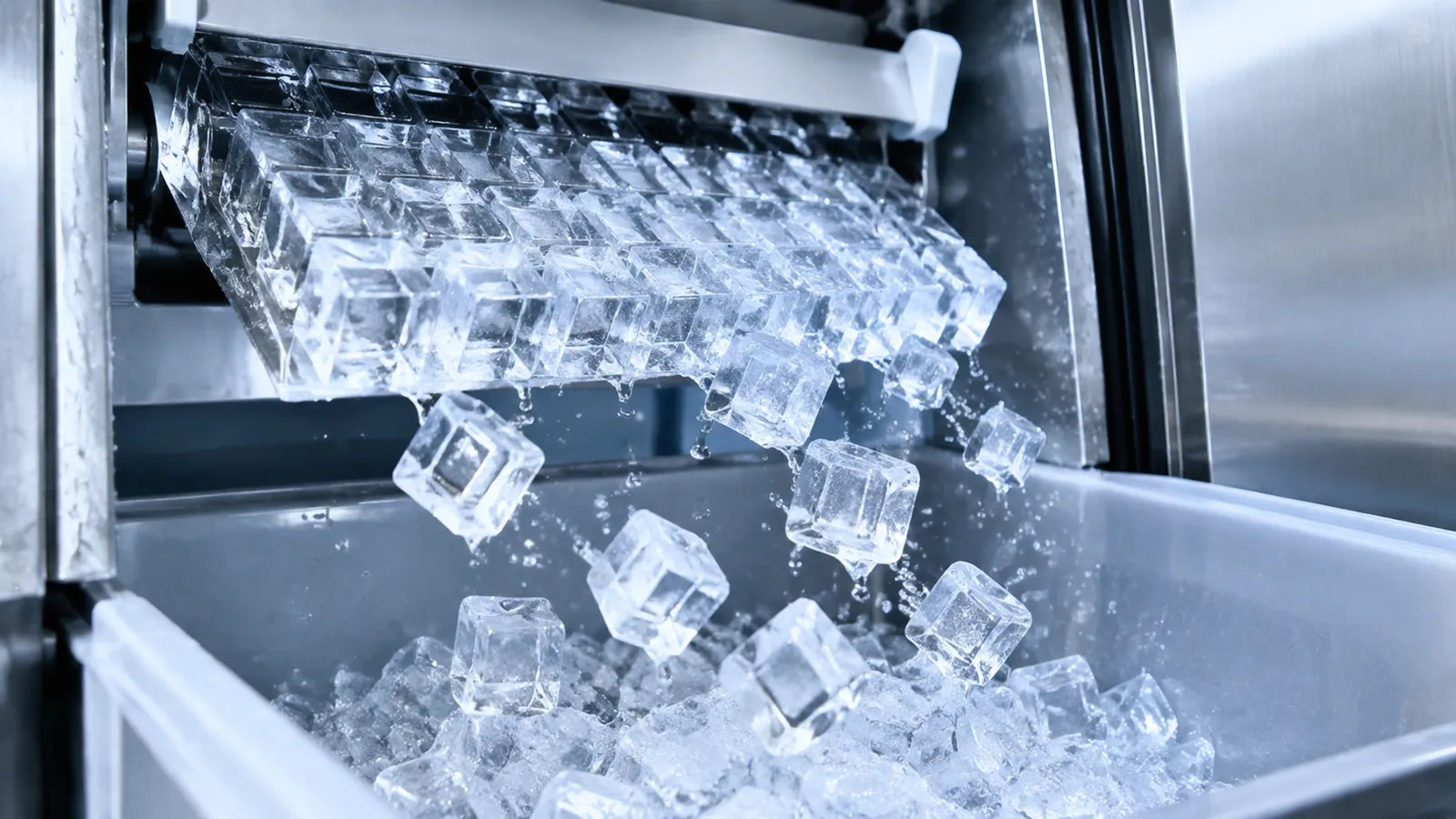
A cube ice machine makes a batch in about 10 to 25 minutes, but filling a bin takes hours. See cycle times, refill math and how to time your machine.
How long does an ice machine take to make ice? A commercial cube machine makes one batch in about 10 to 25 minutes, depending on the room and water temperature, but filling an empty bin takes hours. In one manufacturer’s published data for a small undercounter cube machine, a full freeze and harvest takes roughly 11 to 14 minutes with 70°F air and 50°F water, and 15 to 19 minutes with 90°F air and 70°F water. The same machine needs most of a day to fill its own bin from empty. This guide separates the three timings that matter in a kitchen (one batch, the first usable ice after startup, and a full bin) and shows how to measure them on your own machine.
Part of our commercial ice maker buying guide series.
Three different “how long” questions
Operators usually mean one of three things when they ask how long an ice machine takes. Each has a different answer and a different place to look it up.
| Question | Typical scale | Where the number comes from |
|---|---|---|
| How long is one batch of cubes? | Minutes | Freeze time plus harvest time in the manual or service data |
| How long until a new or cleaned machine gives usable ice? | The first few cycles, then discard | The manual’s start-up and cleaning instructions |
| How long to fill the bin or recover after a rush? | Hours | The 24-hour rating at your conditions, divided by 24 |
If you are not sure what happens inside a cycle, our explainer on how commercial ice machines work covers the freeze and harvest stages. Below, we stay with the timings.
One batch: freeze time plus harvest time
Service data for cube machines states cycle time as a simple sum: freeze time plus harvest time equals total cycle time. Freeze time is the long part and changes with conditions. Harvest is short and fairly steady. As a worked example, here are the published figures from a manufacturer’s technical specifications for a small air-cooled undercounter cube machine, rated at about 130 lb per day:
| Room air / supply water | Freeze time | Harvest time | Total cycle | 24-hour production |
|---|---|---|---|---|
| 70°F / 50°F | 10.2–11.7 min | 1.0–2.5 min | About 11–14 min | 130 lb |
| 90°F / 70°F | 14.5–16.5 min | 1.0–2.5 min | About 15–19 min | 95 lb |
| 100°F / 90°F | 17.5–21.5 min | 1.0–2.5 min | About 18.5–24 min | 80 lb |
The same document puts the weight of one harvested slab at 1.1 to 1.4 lb, and notes that half-size cubes can cycle 2 to 3 minutes faster. Those two facts explain the daily rating. At about 13 minutes per cycle, the machine runs a little over 100 cycles a day; at roughly 1.25 lb per slab that lands close to the 130 lb rating. Larger machines make heavier slabs per cycle, so they produce more per day at similar cycle times. Treat these figures as one model’s data, not a rule. Your own manual gives the expected range for your machine.
How long until a new or cleaned machine makes usable ice
A machine that has just been installed, cleaned or restarted after storage does not go straight into normal service. It has to fill the sump, pull the evaporator down to freezing temperature and run its first cycles, and the first batches are thrown away. Plan for three steps:
- Start-up checks. Water on, no leaks, drains flowing, display free of alerts. Our commercial ice machine installation guide lists the first-start sequence.
- Discard the first batches. Throw away as many batches as the manual specifies after installation or cleaning, so no dust, handling residue or cleaner reaches a drink.
- Build the bin. Only then does useful stock start to accumulate, at the hourly rate in the next section.
Cleaning adds its own time before this. Smartool’s ice machine maintenance guide describes circulating the cleaning solution for about 30 minutes if the machine has no built-in cycle, then rinsing with clean water for 10 to 15 minutes and repeating the rinse one to two times. Schedule cleaning right after a service period, not right before one, so the bin has time to recover.
How long it takes to fill the bin
For bin planning, ignore cycle time and use the daily rating. Divide the 24-hour production at your conditions by 24 to get pounds per hour, then divide the ice you need by that rate:
Hours to make the ice = pounds needed ÷ (24-hour rating ÷ 24)
The undercounter machine above has a 90 lb storage bin. At 130 lb a day it makes about 5.4 lb an hour, so filling the empty bin takes roughly 17 hours. At the 90°F room rating of 95 lb a day, it makes about 4 lb an hour and needs close to 23 hours. In other words, a small machine in a hot room may only just refill its bin overnight, and meltwater losses stretch that further.
Larger heads change the picture. Smartool publishes the BF360 at 360 lb ±5% per 24 hours with 21°C (70°F) room air and 10°C (50°F) water, and 275 lb ±5% at 32°C (90°F) room air with 21°C (70°F) water. That is about 15 lb an hour in cool conditions and about 11.5 lb an hour in the hot condition. Putting 100 lb back into a bin after a rush takes roughly 6.7 hours in the cool case and closer to 8.7 hours in the hot one. The BF500 split ice maker, published at 500 lb and 375 lb ±5% under the same two conditions, recovers the same 100 lb in about 4.8 and 6.4 hours.
What makes an ice machine take longer
If your batches are getting slower, one of these is usually the reason:
- Room air temperature. In the table above, moving from 70°F air and 50°F water to 90°F air and 70°F water adds four to five minutes to every freeze and cuts daily output by about a quarter. Heat from fryers, ovens or a closed closet has the same effect.
- Supply water temperature. Warmer water has more heat to remove before it freezes. Lines that run past a water heater or through a hot ceiling space slow every cycle.
- A dirty condenser. Smartool’s maintenance guide calls condenser cleaning the most frequently overlooked but most critical step, and links clogged condensers to reduced cooling efficiency, higher power use and compressor damage.
- Scale and low water flow. Scale insulates the evaporator and makes ice stick at harvest. A clogged inlet filter starves the machine. The same guide calls replacing the filter on its service life, usually 3 to 6 months, the most effective way to reduce scale.
- Cube thickness setting. A machine set for thicker cubes holds each freeze longer before it harvests. The BF500 and BF360 both have 12-level ice thickness control, so check the setting before assuming a fault.
- Bin door left open. Warm air speeds melting in the bin and makes recovery look slower than the machine really is.
If output has dropped only in summer, our guide to ice machine performance in hot weather covers placement and airflow fixes. If the machine has stopped producing altogether, work through the checks for an ice machine not making ice.
How to time your own machine
Refrigeration service professionals quoted in ENERGY STAR’s guidance on cutting refrigeration energy costs in commercial kitchens recommend a production test that reconciles a machine’s output against its published capacity, to confirm it is not wasting running hours, energy and water. You can run a simple version with a scale, a clean food-grade tub and a thermometer:
- Write down the room temperature near the air intake and the supply water temperature from a nearby tap.
- Time one full cycle, from the moment a harvest ends to the end of the next harvest. Repeat for two or three cycles and average them.
- Catch one harvest in the tub, or empty the bin and collect everything made over a set period, then weigh the ice and subtract the tub weight.
- Scale up to 24 hours (pounds per cycle × cycles per day, or pounds per hour × 24) and compare with the rating closest to your room and water temperatures.

A result within the rating’s tolerance at similar conditions means the machine is healthy and the issue is demand or storage. A result well below it, after cleaning the condenser and checking the filter, is worth reporting to service along with your measurements.
Plan production around the clock
Because a bin refills over hours, the best time to make ice is when you are not serving. The EPA’s WaterSense at Work guidance on commercial ice makers suggests a timer to shift ice production to nighttime or off-peak hours, which cuts peak energy demand. The BF500 and BF360 both include a 48-hour timer for this. Let the machine build stock overnight, keep the bin closed through the morning, and size the bin to cover the busiest stretch without waiting on production. If the numbers above show your current machine cannot rebuild its bin between services, the machine is undersized for your peak, and more storage or a larger head is the fix rather than a repair.
Ice machine timing questions
How long does it take a new ice machine to make ice?
The first batch arrives after the machine fills and completes its first freeze and harvest, a matter of minutes rather than hours on a typical cube machine, but it is not ready for drinks yet. Discard the batches the manual specifies, then expect the bin to build at the hourly rate from the 24-hour rating. A full bin can take most of a day on a small machine.
How long does it take an ice machine to fill up?
Divide the bin capacity by the hourly production at your room and water temperatures. A small undercounter machine making 95 to 130 lb a day needs roughly 17 to 23 hours to fill a 90 lb bin. A larger head fills the same bin in a few hours.
Why is my ice machine taking so long to make ice?
Check room heat, condenser dust, scale, the filter date and the thickness setting first. Then time a cycle and weigh a harvest. If the results fall well short of the published rating at similar conditions, book a service visit.
How long does it take to clean an ice machine?
Plan for the cleaning cycle, the rinses and the restart. Smartool’s maintenance guide describes about 30 minutes of circulating cleaner plus one to three rinses of 10 to 15 minutes each, then the first batches are discarded. Allow extra time for removing and cleaning parts by hand.
Once you know your real hourly output, compare it with your busiest day. You can browse our ice machines, then send your peak demand, bin size and room temperature to request a factory-direct quote.
Factory-direct from Smartool
Planning a commercial equipment purchase?
Share your site conditions, daily output and budget. Our team will match a model, send the spec sheets and quote factory-direct pricing.

Written by
Senior Engineer, Smartool
Jason is a senior engineer at Smartool. He works on the commercial ice machines, soft serve and slushy machines, and refrigerated prep tables Smartool builds for restaurants, bars, hotels and dessert shops. His guides look at equipment from the engineering side: how to size a machine for a site, what it needs for power, water and airflow, and how to keep it running through busy service. He also helps buyers match the right model to their kitchen before they request a quote.
.elementor-76528 .elementor-element.elementor-element-5c7a0d0{--display:flex;--flex-direction:column;--container-widget-width:100%;--container-widget-height:initial;--container-widget-flex-grow:0;--container-widget-align-self:initial;--flex-wrap-mobile:wrap;}.elementor-76528 .elementor-element.elementor-element-5c7a0d1 .elementor-toc__header-title{text-align:start;}.elementor-76528 .elementor-element.elementor-element-5c7a0d1 .elementor-toc__header{flex-direction:row;}.elementor-76528 .elementor-element.elementor-element-5c7a0d1{--item-text-hover-decoration:underline;}
On this page
Need pricing for your project?
Get a factory-direct quote on commercial ice makers, soft serve and slushy machines, and refrigerated prep tables.
✓ Model matching and spec sheets for your site
✓ US office in City of Industry, CA
✓ Talk to an expert: +1 (872) 221-0051
Browse by topic
Ice Machine Guides
Soft Serve & Ice Cream
Slushy & Frozen Drinks
Buying & Sourcing
Compliance & Maintenance
Related posts

How Long Does an Ice Machine Take to Make Ice?
A cube ice machine makes a batch in about 10 to 25 minutes, but filling a bin takes hours. See cycle times, refill math and how to time your machine.

Ice Machine Leaking Water? 7 Causes and How to Fix Them
Ice machine leaking water? Trace it to the drain, trough, inlet valve, fittings, level or condensation, and know which fixes need a technician.