




Blog
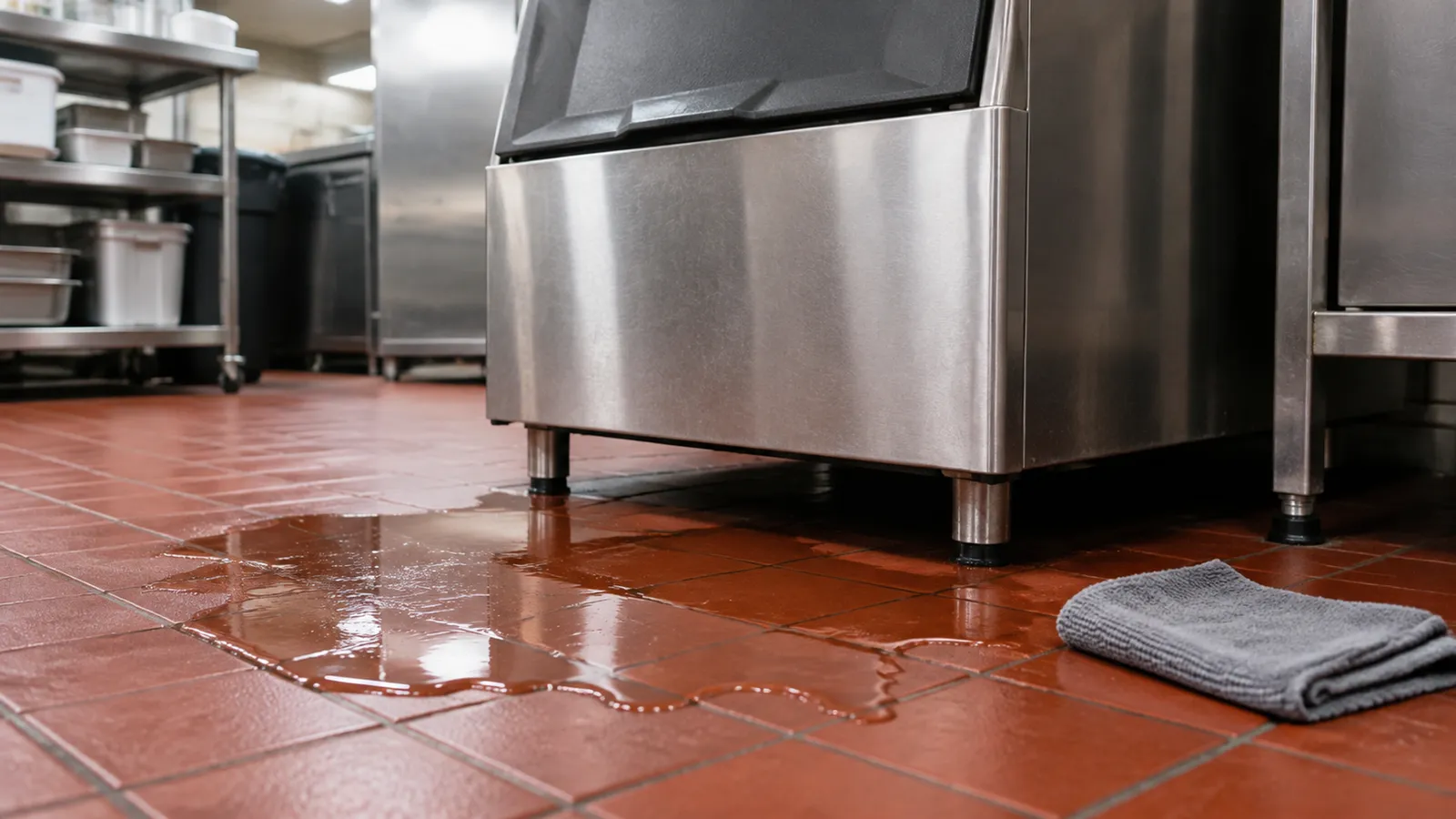
Ice machine leaking water? Trace it to the drain, trough, inlet valve, fittings, level or condensation, and know which fixes need a technician.
An ice machine leaking water usually has a plumbing cause, not a refrigeration one. In most kitchens the water comes from a blocked or badly routed drain, a water trough or distribution tube knocked out of place during cleaning, an inlet valve or float that will not shut off, a loose fitting at the filter, or a cabinet that is not level. Condensation and normal bin meltwater can look like a leak too. This guide walks a kitchen manager through each source of a commercial ice machine leaking water, in the order that finds most problems fastest.
Part of our commercial ice maker buying guide series.
First, is it actually a leak?
A cube ice machine moves a lot of water by design. The EPA’s WaterSense at Work guidance on commercial ice makers explains that cubes are washed as they freeze and the rinse water is typically dumped as the machine operates. Ice in the bin also melts slowly, and that meltwater leaves through the bin drain. So water running down the drain line, or a damp floor sink next to the machine, is normal.
It is a leak when water ends up somewhere it should not: on the floor, under the cabinet, pooling in the bin, or running to the drain nonstop while the machine makes little or no ice. Before you take anything apart, dry the floor and the outside of the cabinet completely, then watch one full freeze and harvest. Fresh water is much easier to trace than an old puddle.
Ice machine leaking water: where it shows up and what it means
| Where you find water | Likely source | Safe check | Call a technician when |
|---|---|---|---|
| Floor at the back or under the machine, worst after a harvest | Blocked, kinked or uphill drain line; backed-up floor sink | Watch the drain during a harvest; clear the floor sink; check the line for dips | The building drain itself is slow (call a plumber) |
| Floor under the bin, steady drip | Clogged bin drain, slime in the drain fitting | Empty the bin, flush the drain opening, clean per the manual | The drain fitting or bin liner is cracked |
| Water pooling in the bin, wet or slushy ice | Trough, sump or distribution tube out of place; water splashing past the curtain | Power off, check that removable parts sit where the manual shows | Parts are in place and water still misses the trough |
| Water runs to the drain constantly, little or no ice | Inlet valve not closing, float switch stuck | Close the supply valve and see if the flow stops | Every time; valve and float are engineer work |
| Drips at the back, near the supply connection | Loose fitting, filter housing, cracked supply line | Shut the supply, dry the fittings, reopen and watch | A line or valve body is cracked |
| Water dribbles out the front or the door | Machine not level, bin door or gasket problem | Check level both ways; inspect the door seal | The leg or base is damaged |
| Beads of water on lines and the cabinet in a humid room | Condensation, not a leak | Dry and watch; check room humidity and airflow | Uninsulated lines need rerouting or insulation |
1. The drain is blocked or badly routed
Drains cause more floor puddles than any other part of the system. Purge water and meltwater leave by gravity, so anything that slows that flow pushes water back toward the machine. Check these points in order:
- The floor sink or floor drain. A slow or debris-filled receptor backs water up before it reaches the drain. Clear it first.
- The drain line route. Follow the hose from the machine to the drain. It should fall the whole way, with no section lifted higher than the outlet, no kinks behind the cabinet, and no sag where water can sit.
- The bin drain opening. Slime and scale collect in the bin drain fitting. Empty the bin and run water into it. If it drains slowly, clean the opening as part of your sanitizing routine.
- Shared lines. A machine drain and a bin drain joined into one line can overload it during a harvest. If they were teed together, ask the installer whether the manual allows it.
The drain must still discharge through an air gap into the floor drain or floor sink, not connect directly to the sewer. Our commercial ice machine installation guide covers the Food Code drain rules and air gaps in detail. If a drain ever backs up into the bin, treat that ice as contaminated: discard it, then clean and sanitize the bin before you make ice again.
2. Ice machine leaking water into the bin
Water in the bin, wet clumped ice or cubes that freeze together usually means water is missing its path inside the ice-making section. The common causes are mechanical and easy to see once the machine is powered off:
- The water trough, sump or distribution tube was not reseated after cleaning, so water sprays or overflows past it.
- A splash curtain or ice deflector is missing, cracked or hanging crooked.
- Scale has blocked some distribution holes, so water streams unevenly and splashes.
- The sump overflows because the inlet valve does not close (see the next section).
Most of these show up right after a cleaning. Compare the removable parts with the diagrams in your manual and reseat anything that looks off. If scale is the issue, run the water-system cleaning cycle with an approved cleaner. The Smartool ice machine maintenance guide warns against strong acidic household descalers, which can corrode internal piping, and calls for rinsing with clean water one to two more times until no cleaner residue remains. Our guide on how to clean a commercial ice machine has the full routine.
3. Water keeps running: inlet valve or float switch
If you hear water running into the machine almost all the time, and the drain carries a steady stream even when the machine is not harvesting, the fill side is not shutting off. The inlet valve may be stuck open or leaking through, or the float or level switch may not be telling the controller the sump is full. The extra water overflows to the drain. If the drain keeps up, you see high water use and poor ice; if it does not, you see water on the floor.
The operator check is simple: close the supply valve. If the running stops, the problem is on the fill side. Leave it closed and call service. Smartool’s ice maker troubleshooting page lists the float switch and the inlet valve as engineer checks, not user checks.
4. Supply line, filter housing and fittings
A drip at the back of the machine, often found as an ice machine leaking from the bottom, often starts at a connection. Filter changes are the usual trigger: a cartridge not fully seated, a missing O-ring, or a housing that was cross-threaded. Supply lines also get crushed when the machine is pushed back against the wall after cleaning.
- Close the supply valve and dry every fitting, the filter housing and the line with a paper towel.
- Reopen the valve slowly and watch each joint for a minute. A dry paper towel held under each fitting shows a slow drip quickly.
- Reseat a filter cartridge by the filter maker’s instructions. Do not overtighten plastic housings.
- Replace any line that is kinked, flattened or cracked. A cracked valve body or a leak inside the cabinet goes to a plumber or technician.
5. The machine is not level, or the door does not seal
Troughs, sumps and bins are designed to drain toward their outlets. When a cabinet tilts forward or to one side, water can run the wrong way, spill over the edge of the trough or collect at the front of the bin and dribble out at the door.
Set a spirit level on top of the cabinet front to back and side to side, and adjust the legs until both read level. Then check the bin door: a torn gasket or a door that does not close fully lets melt and splash water out, and lets warm air in, which adds to the meltwater.

6. Condensation in a hot, humid room
Cold surfaces sweat in humid air. Water lines, the bin and the cabinet can collect enough condensation in a summer back-of-house to drip onto the floor, especially near dish machines and steam equipment. Condensation shows up as beads across a surface rather than a stream from one point, and it gets worse on muggy days. Improve ventilation, keep the machine away from steam sources and ask a plumber to insulate exposed cold lines. A hot, damp room also slows ice production, so fixing the air in the room helps on both counts.
7. Water-cooled condenser lines
A water-cooled machine has a second water circuit for the condenser, with its own supply and drain connections. A leak there can be large: the WaterSense guidance puts total water use for water-cooled machines with single-pass cooling at 100 to 300 gallons per 100 pounds of ice, against less than 50 gallons for air-cooled machines. Check the condenser connections the same way as the ice-making supply. A leak at the condenser itself, or at a water-regulating valve, needs a technician. Our comparison of air-cooled vs water-cooled ice machines explains how the two condenser types differ.
Keep the floor safe while you find the leak
A leaking machine is a slip hazard before it is a repair job. OSHA’s walking-working surfaces rule, 29 CFR 1910.22, requires workroom floors to be kept clean and, to the extent feasible, dry, and requires drainage to be maintained where wet processes are used. Put out a wet-floor sign and a mat, and keep electrical cords and plugs out of the water. If water is near the outlet or inside the cabinet, switch the machine off at the breaker before you touch it.
The same EPA guidance recommends checking ice makers for leaks periodically and training staff to report leaking machines. Add “water on the floor or in the bin” to the opening and closing checklist.
What staff can fix and what needs service
| Staff can handle | Leave to a plumber or technician |
|---|---|
| Clearing the floor sink, straightening a kinked drain hose | Slow building drains, rerouting drain lines |
| Reseating troughs, curtains and tubes per the manual | Cracked sumps, bin liners or drain fittings |
| Closing the supply valve to test for a running fill | Inlet valve and float switch diagnosis and replacement |
| Reseating a filter cartridge, tightening a hand-tight fitting | Cracked valve bodies, leaks inside the cabinet |
| Leveling the legs, checking the door seal | Water-cooled condenser and regulating valve leaks |
Notes for Smartool BF500 and BF360 owners
The BF500 split ice maker and the BF360 both list an automatic cleaning function and water-shortage and ice-full alerts on an LCD display. After an automatic cleaning, check that every removable part is back in place before the first freeze, since misplaced parts are a common cause of water in the bin. If you plan to shut a machine down for more than a month, Smartool’s maintenance guide says to drain and dry all water from the reservoir, water lines and bin, unplug the machine and leave the door slightly open. For any leak inside the cabinet, describe where the water appears and when in the cycle to Smartool support before anyone removes panels.
Ice machine leaking: common questions
Why is my ice machine leaking water from the bottom?
Start with the drain: a slow floor sink, a kinked or uphill drain line or a clogged bin drain is the most common cause. Then check the supply fittings and filter housing at the back, and make sure the machine is level. A machine that is not level can spill water out of the trough or bin.
Why is my ice machine leaking water into the bin?
Usually a removable part, such as the water trough, distribution tube or splash curtain, is out of place after cleaning, or scale has blocked the distribution holes. An inlet valve that does not shut off can also overflow the sump. Discard wet or slushy ice and fix the cause before refilling the bin.
Why is water running down the drain but the machine makes no ice?
Constant flow to the drain with little or no ice points to an inlet valve stuck open or a float switch that is not sensing a full sump. Close the supply valve and call a technician. If the machine is simply not freezing, work through our checklist for when an ice machine is not making ice.
Can I keep using an ice machine that is leaking?
Only if the leak is outside the food zone, the floor is kept dry and nothing electrical is wet. If drain water has reached the bin, or water is near the plug or inside the cabinet, stop using the ice and switch the machine off.
If an older machine keeps leaking and the repairs are adding up, it may be time to compare replacements. Review Smartool’s factory-direct commercial ice makers, then share your daily ice demand, drain layout and room conditions to request a factory-direct quote.
Factory-direct from Smartool
Planning a commercial equipment purchase?
Share your site conditions, daily output and budget. Our team will match a model, send the spec sheets and quote factory-direct pricing.

Written by
Senior Engineer, Smartool
Jason is a senior engineer at Smartool. He works on the commercial ice machines, soft serve and slushy machines, and refrigerated prep tables Smartool builds for restaurants, bars, hotels and dessert shops. His guides look at equipment from the engineering side: how to size a machine for a site, what it needs for power, water and airflow, and how to keep it running through busy service. He also helps buyers match the right model to their kitchen before they request a quote.
.elementor-76528 .elementor-element.elementor-element-5c7a0d0{--display:flex;--flex-direction:column;--container-widget-width:100%;--container-widget-height:initial;--container-widget-flex-grow:0;--container-widget-align-self:initial;--flex-wrap-mobile:wrap;}.elementor-76528 .elementor-element.elementor-element-5c7a0d1 .elementor-toc__header-title{text-align:start;}.elementor-76528 .elementor-element.elementor-element-5c7a0d1 .elementor-toc__header{flex-direction:row;}.elementor-76528 .elementor-element.elementor-element-5c7a0d1{--item-text-hover-decoration:underline;}
On this page
Need pricing for your project?
Get a factory-direct quote on commercial ice makers, soft serve and slushy machines, and refrigerated prep tables.
✓ Model matching and spec sheets for your site
✓ US office in City of Industry, CA
✓ Talk to an expert: +1 (872) 221-0051
Browse by topic
Ice Machine Guides
Soft Serve & Ice Cream
Slushy & Frozen Drinks
Buying & Sourcing
Compliance & Maintenance
Related posts

Ice Machine Leaking Water? 7 Causes and How to Fix Them
Ice machine leaking water? Trace it to the drain, trough, inlet valve, fittings, level or condensation, and know which fixes need a technician.

Soft Serve Machine Maintenance Schedule: Daily to Annual
A soft serve machine maintenance schedule: daily cleaning, weekly seal checks, monthly condenser care, quarterly parts and annual service, plus a log.