




Blog
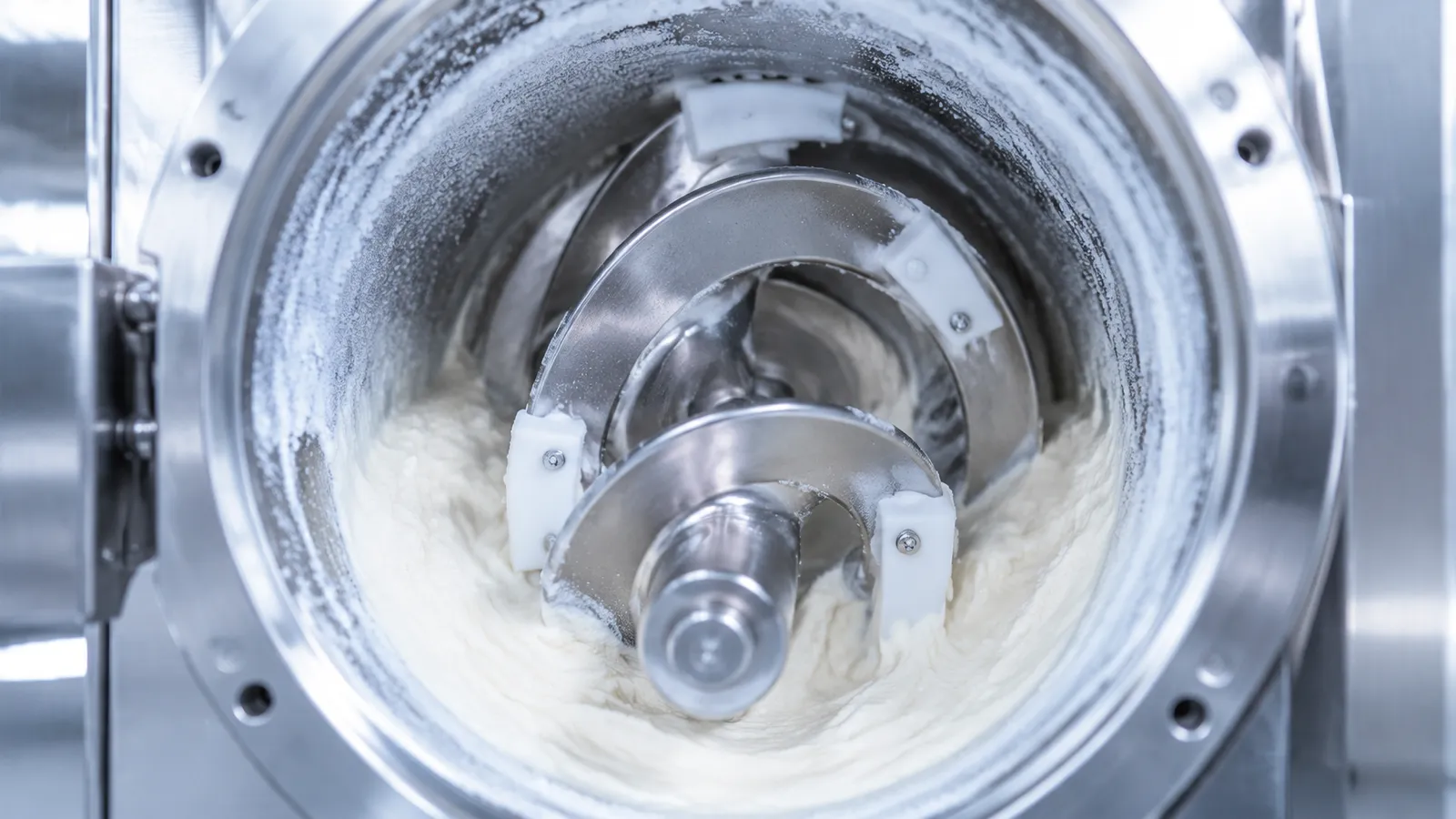
How a soft serve machine works: hopper, freezing cylinder, dasher, refrigeration and controls, plus what each part means for output, texture and cleaning.
How does an ice cream machine work when it is a commercial soft serve machine? Liquid mix waits in a refrigerated hopper, flows a little at a time into a freezing cylinder, and freezes against the cylinder’s ice-cold walls. A rotating dasher scrapes those frozen layers off before they can grow into large crystals, folds in air, and keeps everything moving toward the front. When the controller sees the product has reached serving consistency, it holds it there until someone pulls the handle. Countertop or floor model, every soft serve machine runs on that loop. Below is each part in order and what it means for output, texture and daily work.
Part of our commercial soft serve machine buying guide series.
The short version: five steps from mix to cone
- Store. Liquid mix sits in a refrigerated hopper on top of or inside the machine.
- Feed. Mix and air enter the freezing cylinder, either by gravity through a feed tube or pushed by a pump.
- Freeze. Refrigerant evaporating around the cylinder pulls heat out of the mix, and ice crystals form on the inner wall.
- Scrape and whip. The dasher turns inside the cylinder, scraping crystals off the wall, mixing them back in and working air into the product.
- Hold and serve. The controller keeps the product at serving consistency, and the draw valve dispenses it when the handle is pulled. Fresh mix flows in to replace what left.
Soft serve leaves the machine at about 25 °F (−4 °C), much warmer than hard ice cream in a dipping cabinet, and it carries a lot of air. Wikipedia’s soft serve entry puts typical milk fat at 3–6 percent and air content anywhere from 0 to 60 percent of the finished volume. Those two numbers explain most of the machine’s design: it has to freeze quickly, serve warm by ice cream standards, and control how much air goes in.
The main parts of a soft serve machine
| Part | What it does | What it means for an operator |
|---|---|---|
| Hopper | Holds liquid mix and keeps it chilled | Volume sets how often you refill during a rush |
| Feed tube or pump | Meters mix and air into the cylinder | Decides how much air the product carries and how consistent it is |
| Freezing cylinder | Stainless tube wrapped by the evaporator where the mix actually freezes | Volume and cooling power set output per hour and how fast it recovers |
| Dasher (beater, agitator) | Rotating blade assembly that scrapes, mixes and pushes product forward | Worn scraper blades and seals cause icy texture and leaks |
| Refrigeration system | Compressor, condenser and evaporator that move heat out of the cylinder | Needs clear airflow or water supply to keep up in hot weather |
| Drive motor | Turns the dasher, usually through a belt, gearbox or magnetic coupling | Motor load is a common way the controller judges thickness |
| Controller | Reads temperatures and consistency, runs serve, standby and cleaning modes | Alarms and settings live here; learn them before day one |
| Draw valve and door | Front assembly with handle, valve and nozzle | Daily disassembly point; O-rings here wear first |
Step 1: The hopper keeps mix cold
Soft serve mix is a dairy product with plenty of sugar, which makes it an easy place for bacteria to grow if it warms up. That is why the hopper is refrigerated, not just insulated. The FDA Food Code, which most state and local health departments adopt in some form, requires cold-held foods like this to stay at 41 °F (5 °C) or below. Depending on the design, the hopper is cooled by its own refrigeration circuit or by a share of the system that freezes the cylinder.
Hopper size is a convenience number, not an output number: a bigger hopper means fewer refills, not faster freezing. Fill it with mix that is already cold from the walk-in; warm mix slows the first batch. Our soft serve mix guide covers liquid and powder mixes and how to store them.
Step 2: Mix and air enter the freezing cylinder
Air is not an accident in soft serve. The industry calls it overrun: the percentage by which the volume of the frozen product exceeds the volume of mix that went in. A product with no air tastes heavy and icy; one with very high air feels foamy and melts fast. Machines get air into the cylinder in one of two ways.
- Gravity-fed. Mix drops from the hopper through a small feed tube with an air hole. The size of that hole and the level of mix in the hopper set how much air goes in. Simple, fewer parts to clean, and common on countertop machines.
- Pump-fed. A pump draws mix and air together and pushes them into the cylinder under pressure. It gives the operator more control over overrun and typically a denser, creamier product, at the cost of more parts to take apart and sanitize.
Either way, the feed only replaces what you serve. When the cylinder is full, mix stops flowing until a portion leaves through the door. For the trade-offs in texture, cost and cleaning, see gravity-fed vs pump soft serve machines.
Step 3: Refrigeration pulls heat out of the cylinder
The freezing cylinder is a stainless steel tube with the refrigeration system’s evaporator wrapped around the outside. The Dairy Processing Handbook from Tetra Pak describes the same principle in industrial ice cream freezers: refrigerant in a jacket around the cylinder absorbs heat as it evaporates, the wall gets cold, and the water in the mix freezes into ice crystals on that inner surface. A soft serve machine applies the same idea at counter or floor scale, freezing only as much as you serve.
The rest of the loop works like a reach-in cooler. A compressor pumps refrigerant vapor to a condenser, which dumps the heat into the room (air-cooled) or into water (water-cooled), and the refrigerant returns to the evaporator. That is why placement matters: an air-cooled machine pushed against a wall or next to a fryer cannot shed heat, so output drops on the hottest days, exactly when you sell the most. Keep the clearances in the manual.

Step 4: The dasher scrapes, mixes and whips
If the mix just sat against the cold wall, it would freeze solid into a layer of coarse ice. The dasher prevents that. It is a rotating assembly, usually stainless steel with plastic scraper blades, that runs the length of the cylinder. As it turns, the blades shave thin frozen layers off the wall and fold them back into the colder liquid, which keeps ice crystals small. Small crystals are what make soft serve smooth instead of grainy.
The dasher does three more jobs at the same time. It breaks the incoming air into tiny bubbles and spreads them through the product. It keeps the temperature even from back to front. And its shape pushes product toward the door, so what you draw is fully frozen. The Tetra Pak handbook also notes what happens when freezing goes too fast for the scrapers: an ice layer builds on the wall, the blades start to skate over it, and the freezer can stop and need defrosting. In a soft serve shop, that is the “freeze-up” every operator eventually meets, often caused by a mix that is too low in sugar or solids, worn blades, or a consistency setting that is too stiff.
Step 5: The controller holds consistency and the valve dispenses
A soft serve machine cycles rather than freezing once. Many machines judge thickness by the load on the dasher motor: as the product stiffens, the motor works harder, and at the set point the controller shuts the compressor off. When product is drawn and fresh mix flows in, the load drops and refrigeration starts again. Others use temperature probes, or both. The consistency setting is how operators fine-tune texture.
The front door holds the draw valve. Pulling the handle opens a port and the dasher’s forward push sends product out through a star-shaped nozzle, which gives soft serve its ridges. Twin-twist machines have two cylinders and a third valve that blends both flavors. When the shop is quiet, many controllers offer a standby or night mode that keeps product cold but not frozen, so the dasher is not churning the same product for hours.
First batch, recovery and output: reading the spec sheet
Once you know how the machine works, three numbers on a spec sheet make more sense.
- First batch time. How long the cylinder needs to turn room-temperature or chilled mix into servable product at startup. Manufacturers state it under test conditions, so ask what mix and room temperature were used.
- Output per hour. How much product the machine makes continuously. It depends on cylinder volume, cooling power and room and mix temperature, so expect less in a hot food truck than in a test lab.
- Recovery. How quickly the cylinder catches up after a run of cones. Spec sheets rarely list it, but a larger cylinder and stronger refrigeration help, and it is the number your line feels at the busiest hour.
How Smartool machines line up with these parts
Here is how three current models from our commercial soft serve machine range compare on the parts above. Figures are taken from each product page; output and first batch times are rated at 23 °C (73 °F) ambient and mix temperature where the page states it.
| Model | Output | Hopper | Freezing cylinder | First batch | Notable design point |
|---|---|---|---|---|---|
| SW52REL-TF | 48–52 L/h | 8 L | 2.0 L | 10–15 min | Independent dual refrigeration systems; 110 V / 60 Hz |
| GT18RELW | 18–24 L/h | 6 L | 1.6 L | 10–12 min | 7-inch touchscreen, one-touch cleaning; 110 V / 60 Hz |
| SW26RJL-F | 22–30 L/h | 10 L | 2.0 L | 13–16 min | Patented precooling and preservation for the hopper; magnetic coupling agitator; 115 V / 60 Hz |
The SW52REL-TF and SW26RJL-F have the same 2.0 L cylinder, but the SW52REL-TF, with two independent refrigeration systems, is rated for close to twice the hourly output. That is the point from step 3 in practice: cylinder size alone does not set output; cooling power does a lot of the work. The SW26RJL-F trades output for the largest hopper, which suits a shop that values fewer refills over peak speed. Both SW models list a patented precooling and preservation system for the hopper and a stainless agitator driven by magnetic coupling. Ask your sales rep for the hopper holding temperature, the air-feed design and the standby options of the model you shortlist, since those details are not all on the product pages.
Why soft serve machines work differently from hard ice cream machines
A batch freezer for hard ice cream freezes a fixed batch, which is extruded into pans and hardened in a freezer before serving. A soft serve machine freezes continuously and serves straight from the cylinder, which is why it needs a refrigerated hopper and a hold cycle. We compare the two side by side in soft serve vs hard ice cream machines.
What the mechanics mean for your daily routine
- Cleaning follows the parts. Everything mix touches, from hopper, feed tube or pump, cylinder and dasher to door and valve, needs regular disassembly, washing and sanitizing on the schedule in your manual and your local code. Our soft serve machine maintenance schedule lays it out by day, week and month.
- Wear parts are the moving parts. Scraper blades, O-rings and dasher seals wear with every cycle. Keeping spares on hand prevents many “machine is down” calls.
- Most problems trace to one step. Runny product points to refrigeration or airflow, icy product to worn blades or low-solids mix, freeze-ups to settings or mix, leaks to seals. Our guide to soft serve machine troubleshooting walks through the symptoms.
FAQ
How does a soft serve ice cream machine add air?
Through the feed. Gravity machines let air in through a small hole in the feed tube; pump machines draw air and mix together. The dasher then breaks the air into tiny bubbles as the mix freezes.
How long does a soft serve machine take to freeze?
Usually a matter of minutes for the first batch, not hours. The three Smartool models above list 10–16 minutes at their test conditions. Warm mix or a hot room adds time.
Why does soft serve come out runny?
The cylinder is not removing heat fast enough or the setting is too soft. Check condenser airflow, the consistency setting, whether you are drawing faster than the machine can recover, and whether the mix was warm when it went in.
Does a soft serve machine use liquid mix or powder?
It freezes liquid either way. You can pour in ready-to-use liquid mix or reconstitute a powder with water first. The machine only sees the liquid in the hopper.
If you are matching a machine to your menu, tell us your expected cones per hour, available power, counter or floor space and the mix you plan to use. We will suggest a model and answer the hopper, air-feed and standby questions above when you request a factory-direct quote.
Factory-direct from Smartool
Planning a commercial equipment purchase?
Share your site conditions, daily output and budget. Our team will match a model, send the spec sheets and quote factory-direct pricing.

Written by
Senior Engineer, Smartool
Jason is a senior engineer at Smartool. He works on the commercial ice machines, soft serve and slushy machines, and refrigerated prep tables Smartool builds for restaurants, bars, hotels and dessert shops. His guides look at equipment from the engineering side: how to size a machine for a site, what it needs for power, water and airflow, and how to keep it running through busy service. He also helps buyers match the right model to their kitchen before they request a quote.
.elementor-76528 .elementor-element.elementor-element-5c7a0d0{--display:flex;--flex-direction:column;--container-widget-width:100%;--container-widget-height:initial;--container-widget-flex-grow:0;--container-widget-align-self:initial;--flex-wrap-mobile:wrap;}.elementor-76528 .elementor-element.elementor-element-5c7a0d1 .elementor-toc__header-title{text-align:start;}.elementor-76528 .elementor-element.elementor-element-5c7a0d1 .elementor-toc__header{flex-direction:row;}.elementor-76528 .elementor-element.elementor-element-5c7a0d1{--item-text-hover-decoration:underline;}
On this page
Need pricing for your project?
Get a factory-direct quote on commercial ice makers, soft serve and slushy machines, and refrigerated prep tables.
✓ Model matching and spec sheets for your site
✓ US office in City of Industry, CA
✓ Talk to an expert: +1 (872) 221-0051
Browse by topic
Ice Machine Guides
Soft Serve & Ice Cream
Slushy & Frozen Drinks
Buying & Sourcing
Compliance & Maintenance
Related posts

How Does a Soft Serve Machine Work? Parts Explained
How a soft serve machine works: hopper, freezing cylinder, dasher, refrigeration and controls, plus what each part means for output, texture and cleaning.

Piña Colada Slush Machine Recipe (Alcoholic and Virgin)
A pina colada slush machine recipe by the gallon: rum and virgin formulas, a 1–4 gal scaling table, Brix checks and coconut cream fixes.