




Blog
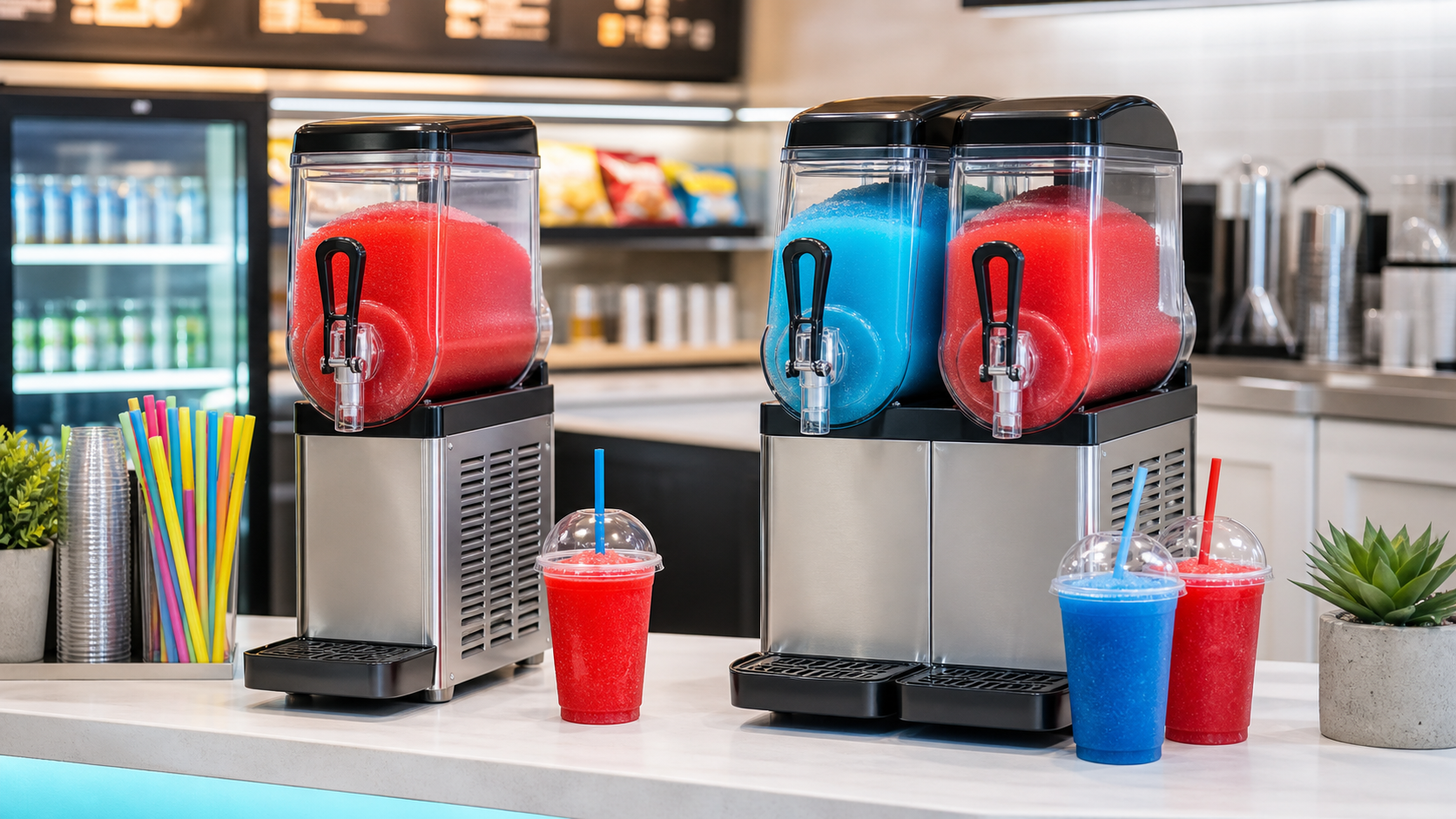
Choosing between a double vs triple slush machine comes down to two numbers: how many cups you pour in your busiest hour, and how evenly those cups split across flavors. A double (dual-tank) machine is the right call when two flavors cover your menu and the rush fits inside two tanks. A triple earns its extra width and amperage when you need a third flavor or more frozen inventory than two tanks hold. A single tank still makes sense for one signature drink. Below, each tank count is matched to a real model (Smartool’s RLC18-1, RL18-2 and RL18-3) with capacity, peak-hour math, footprint, power and menu variety.
Single, Double and Triple Tank Slush Machines at a Glance
| Single tank | Double tank | Triple tank | |
|---|---|---|---|
| Smartool model | RLC18-1 | RL18-2 | RL18-3 |
| Capacity | 16.5 L (4 gal) | 2 × 4.7 gal | 3 × 16.5 L (49.5 L) |
| Frozen inventory at full fill | 558 fl oz | 1,203 fl oz | 1,674 fl oz |
| 16 oz cups per full load | 34 | 75 | 104 |
| Flavors on display | 1 | 2 | 3 |
| Voltage | AC 120 V / 60 Hz | 110 V / 60 Hz | AC 120 V / 60 Hz |
| Rated power | 500 W | 860 W | 1,500 W |
| Rated current | 5.3 A | — | 14.5 A |
| First batch from room-temperature mix | 40–60 min | — | 50–75 min |
| Dimensions (W × D × H) | 545 × 276 × 885 mm | — | 545 × 676 × 885 mm |
| Net weight | 25 kg (55 lb) | — | 57.2 kg (126 lb) |
| Parts to wash at close | 1 hopper, valve and agitator | 2 sets | 3 sets |
| Best fit | One signature drink | Two flavors, moderate rushes | Three flavors or sharp rushes |
Cup counts use liquid volume at a full fill, rounded down, and each model’s specifications come from its Smartool product page.
How Tank Count Changes Peak-Hour Output
Tank Capacity Is Your Rush Buffer
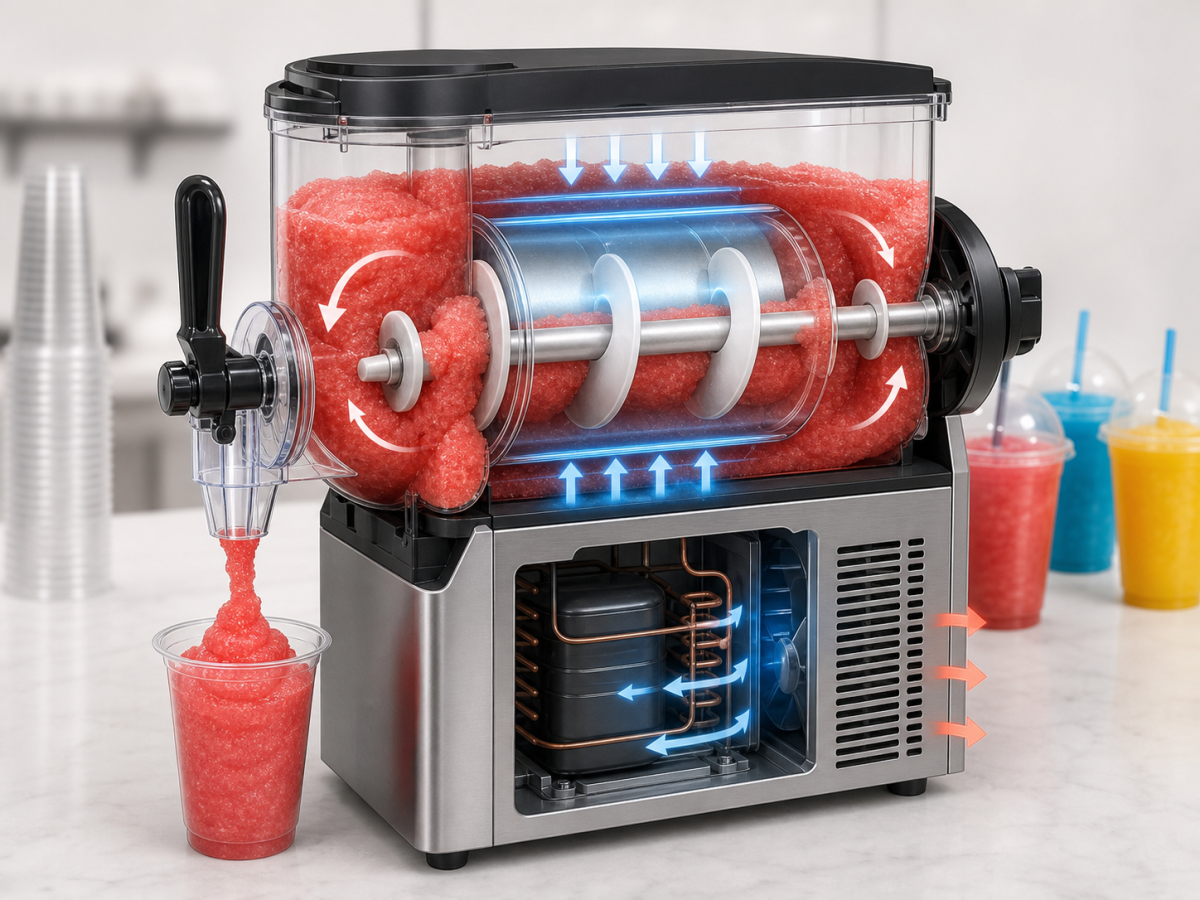
Each tank wraps a clear bowl around a refrigerated cylinder while an auger turns the mix so ice crystals stay small and pourable. What sits in the tanks at the start of a rush is already frozen and ready to sell. Once you pour it down and add fresh mix, that mix has to freeze again. Smartool lists 40–60 minutes for a first batch on its single-tank machine and 50–75 minutes on its three-tank machine, so a warm refill mid-rush does not help the customers already in line.
That is why tank count matters more for rush output than for daily output. Over a slow afternoon, any machine keeps up. During a 30-minute pre-show window, you are selling the frozen inventory you started with.
Peak-Hour Worksheet
- Pull the cup count for your busiest 60 or 120 minutes from last season’s POS data.
- Multiply by cup size to get total fluid ounces.
- Compare that total with the frozen inventory in the table above, and leave margin, since refills will not be ready to pour right away.
- Split the total by flavor. Each flavor’s share has to fit inside the tank or tanks you assign to it.
Worked example: a cinema concession pours 90 cups of 16 oz slush in its two-hour evening window, which is 1,440 fl oz. The dual-tank RL18-2 holds about 1,203 fl oz, roughly 15 cups short before any refreeze. The three-tank RL18-3 holds about 1,674 fl oz and covers the rush with margin.
Flavor Split Matters More Than Tank Count
Suppose blue raspberry makes up 60% of those 90 cups. That is 864 fl oz of one flavor, more than any single 16.5 L or 4.7 gal tank can hold. On a triple, you can run blue raspberry in two tanks and a second flavor in the third, and still cover the rush. On a double, the same fix leaves you selling one flavor from both tanks. Before you buy, check your sales mix. A lopsided favorite flavor often decides the tank count on its own.
When a Single Tank Slush Machine Is Enough
A single tank fits operations built around one drink: a café’s frozen lemonade, a food truck’s house slush, a catering station at a private event. The RLC18-1 single-tank slushie machine holds 16.5 L, draws 5.3 A at 500 W on 120 V and is rated at ≤ 65 dB. It has an LED display, one-touch cleaning and a color-changing LED light box to catch attention at the counter.
The trade-offs are simple. Changing flavors means draining and washing the tank, and once it is empty you wait out a full refreeze. If your rush regularly passes about 34 cups of 16 oz slush, or if customers keep asking for a second flavor, you have outgrown a single tank.
Double Slush Machine: Two Flavors or One Flavor With Backup
A double slush machine is the most flexible middle ground. The RL18-2 dual-tank slushy machine pairs two 4.7-gallon tanks on 110 V at 860 W. It has LED-lit tanks, tank seal rings and a drip tray alert, and Smartool builds it for mobile bars, restaurants and events.
There are two ways to run a double:
- Two flavors: the classic setup for variety, such as a fruit slush next to a lemonade, or a frozen cocktail next to a non-alcoholic option.
- One flavor in both tanks: doubles the frozen inventory of a best seller. Stagger refills so one tank is always fully frozen.
Bars often choose a double for exactly that cocktail-plus-mocktail pairing. If a frozen cocktail is part of the plan, our guide to choosing a commercial margarita machine covers how alcohol changes freezing and sizing.
Triple Slush Machine: Variety and Volume for High-Traffic Counters
A triple slush machine suits convenience stores, cinemas, concession stands and hotel pool bars, where visible variety drives impulse sales and rushes arrive all at once. The RL18-3 three-cylinder slushy machine runs three 16.5 L tanks, each with its own electronic temperature control. Its compressor has 1,111 W of cooling capacity with a microchannel condenser, and the machine is rated at ≤ 65 dB.
What you give up: it draws 14.5 A at 1,500 W, weighs 57.2 kg before any mix goes in, needs 50–75 minutes for its first batch, and adds a third set of hopper, valve and agitator parts to wash every night.
Footprint, Weight and Electrical Planning
Smartool’s single-tank and three-tank models share the 545 mm (21.5 in) and 885 mm (34.8 in) dimensions. The three-tank unit measures 676 mm (26.6 in) where the single measures 276 mm (10.9 in). Add at least 4 inches of side clearance and about 8 inches behind the unit for condenser airflow. Leave enough height above the lids for staff to refill without sliding the machine forward.
Filled weight grows quickly with tank count. Three full 16.5 L tanks add roughly 110 lb of mix to the RL18-3’s own 126 lb. Put it on a counter rated for that load, not a light cart.
Electrical service is where many triple installs stall. The National Electrical Code (NFPA 70) sizes circuits for loads that run three hours or more with headroom above rated current. A 14.5 A machine therefore belongs on a dedicated 20 A circuit, while a 5.3 A single tank fits comfortably on a standard 15 A outlet. Smartool’s installation guidance calls for a dedicated 15–20 A circuit, and a licensed electrician should confirm yours.
Cleaning Time and Operating Cost by Tank Count
Every tank adds a hopper, a dispensing valve, an agitator and seals to wash, inspect and reassemble. The FDA Food Code ties cleaning of beverage dispensing components to the frequency the manufacturer specifies, so a triple multiplies a daily task rather than a weekly one. Smartool’s daily and weekly slushy machine maintenance steps show what each tank needs.
For electricity, rated power gives a worst-case ceiling. Real use comes in lower because the compressor cycles once the product is frozen.
| Model | Tanks | Rated power | Upper-bound energy per 12-hour day |
|---|---|---|---|
| RLC18-1 | 1 | 500 W | 6.0 kWh |
| RL18-2 | 2 | 860 W | 10.3 kWh |
| RL18-3 | 3 | 1,500 W | 18.0 kWh |
Multiply by your utility rate, or by your state’s average commercial rate from the U.S. Energy Information Administration electricity price table, to compare running cost against the extra cups a larger machine sells in a rush.
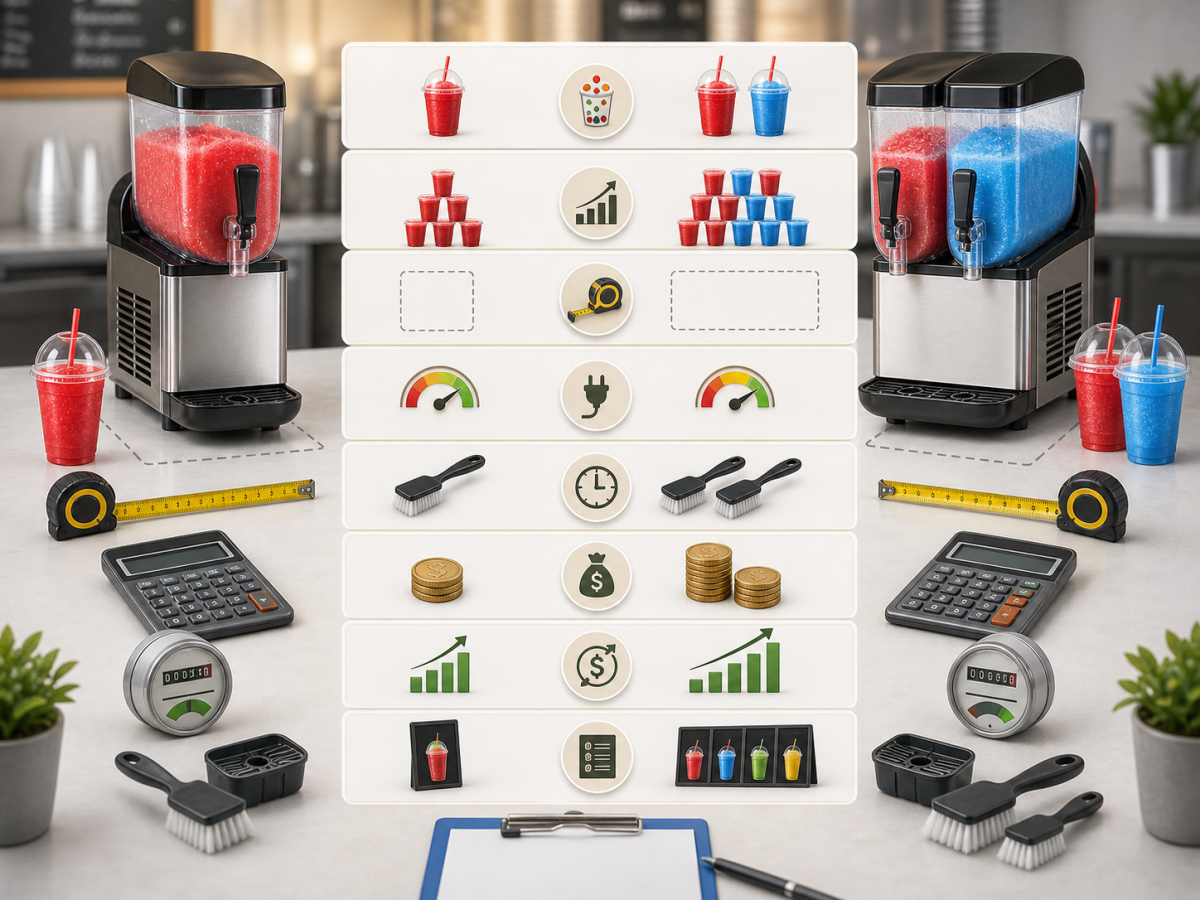
Double vs Triple Slush Machine Decision Matrix
| If your operation looks like this | Choose |
|---|---|
| One drink on the menu and a tight counter | Single tank (RLC18-1) |
| Rush stays under about 34 cups of 16 oz and the outlet is shared | Single tank (RLC18-1) |
| Two drinks cover the menu and the rush fits under about 75 cups of 16 oz | Double tank (RL18-2) |
| A frozen cocktail plus one non-alcoholic option | Double tank (RL18-2) |
| Three flavors on display, or a rush above about 75 cups of 16 oz | Triple tank (RL18-3) |
| Your best seller alone overflows one tank during the rush | Triple tank, with the best seller in two tanks |
| No dedicated 20 A circuit available | Single tank, or a double after your electrician checks the load |
If you are still weighing other factors, such as freezing specs, certifications or cost of ownership, our commercial slush machine buying guide covers them. You can also see all three models side by side in the Smartool commercial slushy machine lineup.
Tank Count Questions Operators Ask
Is a triple slush machine worth it over a double?
Yes, when your rush passes what two tanks hold, you want three flavors visible, or one flavor dominates sales. If none of those apply, a double costs less to power and takes less time to clean.
Can I run the same flavor in more than one tank?
Yes. It is the simplest way to add frozen inventory for a best seller. Refill the tanks at different times so one is always ready to pour.
Does a triple slush machine need its own circuit?
For the RL18-3, plan on it. At 14.5 A rated current, a dedicated 20 A circuit gives the continuous-load headroom that electrical codes expect. Sharing the circuit with an ice machine or blender invites nuisance trips.
Which tank count is easiest to keep running?
A single tank has the fewest seals, valves and agitators to wash and reassemble, so there are fewer places for a leak or sticky tap to start. When something does go wrong on any configuration, our slush machine troubleshooting guide walks through the checks by symptom.
Get Pricing on Single, Dual or Triple Tank Machines
Share your peak-hour cup count, flavor lineup and available circuit, and Smartool will confirm which tank count fits and quote it. Request a quote on Smartool slush machines.
Related posts
Are Ice Cream Vending Machines Profitable? Cost & Payback
Work out ice cream vending machine profit cup by cup: mix cost, commission, card fees, power, labor, permits and the daily sales needed to pay back the machine.
Modular Ice Machine vs Undercounter: Which Setup Fits?
Compare modular ice machines, undercounter ice makers and countertop dispensers on height, airflow, drains, bins and cost, with a site decision matrix.
3 thoughts on “Double vs Triple Slush Machine: How Many Tanks Do You Need?”
Comments are closed.