




Blog
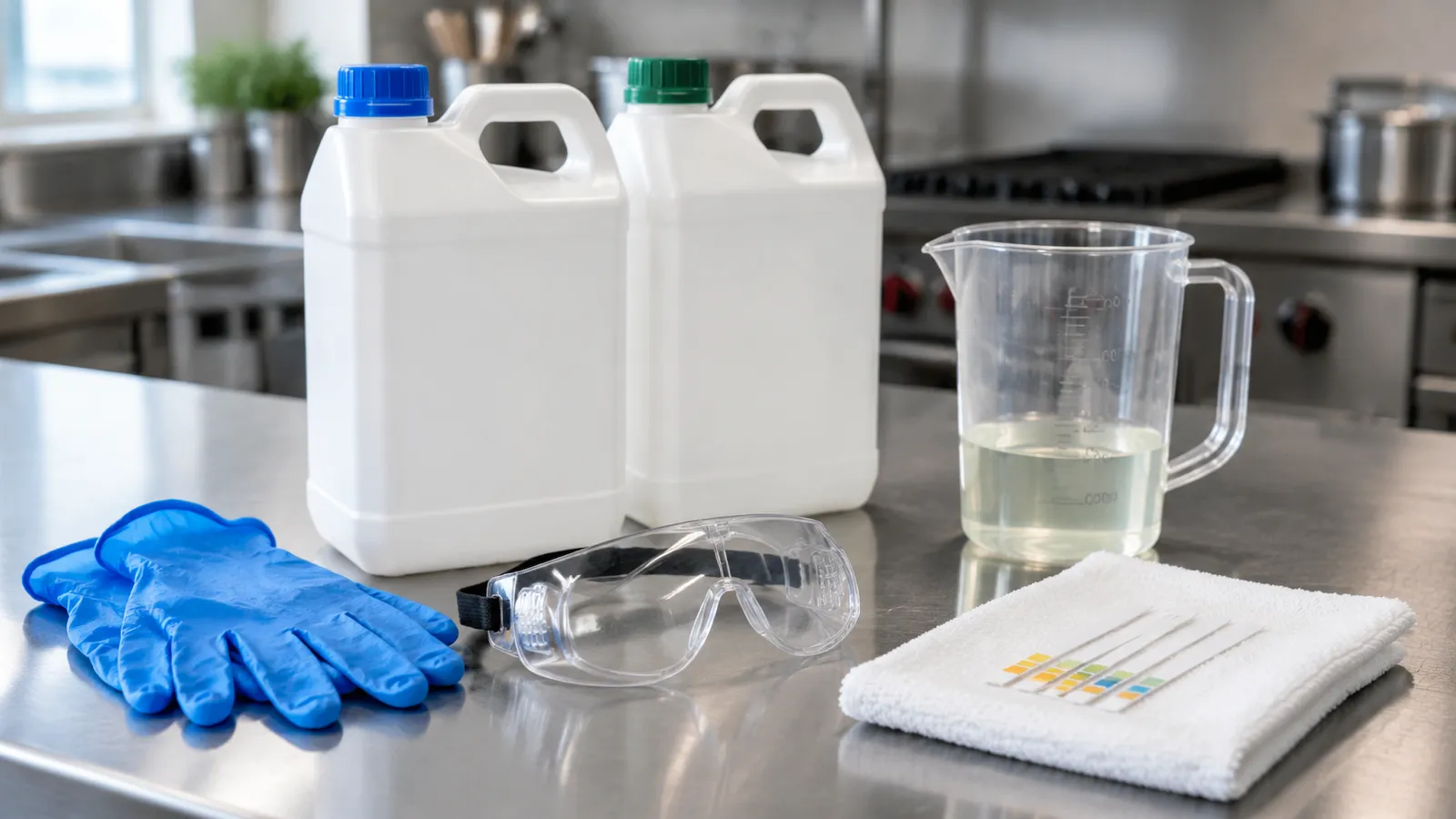
How to choose a nickel safe ice machine cleaner, descaler and sanitizer: what each does, label dilution, EPA registration, food-code rules and safety.
An ice machine cleaner and an ice machine sanitizer do two different jobs, and you need both. The cleaner, often sold as a descaler or scale remover, is an acid blend that dissolves the mineral scale hard water leaves on the evaporator and in the water system. The sanitizer is an EPA-registered antimicrobial that cuts the microorganisms on surfaces that are already clean. If the evaporator is nickel-plated, choose a nickel safe ice machine cleaner your manual approves, because the wrong acid can attack the plating that lets cubes release. Below: how to pick each product, read the label, meet food-contact rules and keep staff safe.
Part of our commercial ice maker buying guide series.
Cleaner, descaler, sanitizer: what each product does
Supplier catalogs use “ice machine cleaner,” “descaler” and “scale remover” for the same category: an acid product, often based on phosphoric or citric acid, that dissolves calcium and other minerals. A sanitizer is a separate category with a separate legal status. The EPA classes food-contact sanitizers as antimicrobial pesticides that reduce, but do not necessarily eliminate, microorganisms to levels public health codes consider safe. A third product, plain detergent, handles the scoop and other soiled parts the manual tells you to wash by hand.
| Product | What it removes | Typical chemistry | Use it for | Do not use it for |
|---|---|---|---|---|
| Ice machine cleaner (descaler, scale remover) | Mineral scale, lime, some film | Food-grade acid blend; nickel-safe versions are formulated for plated evaporators | The water-system cleaning cycle, at the dose your manual gives | Killing microorganisms; it is not a sanitizer |
| Ice machine sanitizer | Microorganisms on clean surfaces | EPA-registered chlorine, quaternary ammonium or other approved actives | The sanitizing cycle after cleaning and rinsing, plus bin, chute and door | Dissolving scale or cutting through slime; it only works on a clean surface |
| Detergent | Grease, sugar, food soil | Mild dish detergent | Scoop, holder and removable parts, as the manual allows | The water system, unless the manual says so |
The order matters. Clean first, rinse, then sanitize. A sanitizer poured over scale or slime reaches the film, not the metal or plastic underneath. Our guide on how to clean a commercial ice machine covers the full sequence, the schedule and a cleaning log.
Why “nickel-safe” matters: evaporator plating
The evaporator is the cold plate or grid where cubes form, and its surface decides how cleanly ice lets go at harvest. (See how commercial ice machines work for the freeze and harvest cycle.) Many cube machine evaporators are copper with a nickel or tin plating; others are stainless steel. A cleaner strong enough to strip scale fast can also etch the plating if it is not formulated for it, and once the plating is rough or worn, cubes grip the surface and harvest slows.
That is why chemical suppliers sell cleaners labeled “nickel-safe”: acid blends formulated for use on nickel- or tin-plated evaporators. Some buyers search for a “nickel-free” cleaner. The phrase that counts on the label is compatibility with your evaporator, not whether the formula contains nickel.

How to find out what your evaporator is made of
- Check the manual and spec sheet. Most manuals name the approved cleaner and sanitizer outright, which settles the question.
- Check the product page. Some manufacturers list the tray or evaporator material in the build specs.
- Ask the manufacturer. Give the model and serial number and ask which cleaner and sanitizer are approved. Write the answer on the cleaning log.
- Never scrape the evaporator. Hard tools damage plating too. Let the cleaner dissolve heavy scale, and repeat the cycle if the manual allows.
Which product for which problem
A stronger chemical is rarely the fix. Match the symptom first:
| What you see | Likely cause | Product to reach for | Also check |
|---|---|---|---|
| White or gray chalky crust on the evaporator, trough or water curtain | Mineral scale from hard water | Ice machine cleaner (nickel-safe if the evaporator is plated), on the manual’s cleaning cycle | Water filter cartridge date; descale interval |
| Cubes sticking, slow harvest, partial slabs | Scale on the evaporator, or a harvest fault | Cleaner first; if a clean plate still holds ice, call service | Our guide to an ice machine freezing up |
| Pink, orange or black film on bin walls, gasket or chute | Biofilm | Detergent or cleaner to remove the film, rinse, then sanitizer at label strength | Drain, air gap, scoop storage |
| Musty smell or off taste in the ice | Film in the water system or bin, or a water supply issue | Full clean and sanitize | Filter, incoming water, nearby odors |
| Thin, cloudy or small cubes | Scale, water flow or supply problems | Cleaner if scale is visible | The checks for an ice machine not making ice |
| After a boil-water notice or water main work | Possible contamination of the water system | Full clean and sanitize before use | Discard all ice; change the filter if the manual or local authority says so |
Reading the label: dilution, contact time and EPA registration
Every sanitizer sold for food-contact use carries an EPA registration number and use directions. The EPA’s guidance on pesticide labels puts it plainly: pesticide labels are legally enforceable, and each one states that using the product inconsistently with its labeling violates federal law. For an ice machine sanitizer, that means the dilution, contact time and any rinse or drain step on the label are requirements, not suggestions.
- Dilute to the label and the manual, never by eye. Cleaner doses vary by machine size, and “a little extra” acid is how plating and plastic parts get damaged.
- Look for food-contact directions. A sanitizer label lists food-contact surfaces, the use concentration and contact time. A general-purpose disinfectant without those directions does not belong in an ice machine.
- Test sanitizer strength. The FDA Food Code (§ 4-501.116) requires sanitizer concentration to be checked with a test kit or similar device. Keep strips for the active ingredient you use: chlorine strips do not read quats.
- Respect the upper limit. Stronger is not safer on a food-contact surface. Federal rules under 40 CFR 180.940 set end-use limits for sanitizer ingredients (for example, no more than 200 ppm of active quaternary compound) and require adequate draining before the surface touches food.
Can bleach be the ice machine sanitizer?
Only if your manual calls for it. Some manufacturers do specify chlorine bleach for the sanitizing step. One major ice machine maker’s cleaning and sanitizing sheet gives an exact bleach dose for that model’s water tank and says to use bleach without additives, because additives cause excessive foaming and reduce the effectiveness of the cleaning. Scented and “splash-less” bleaches are out. Bleach strength also varies between products, so a dose written for one strength is wrong for another. If the manual names a branded sanitizer instead, use that.
Food-contact rules that apply to ice machine chemicals
The FDA Food Code defines ice as food, so the inside of the machine is a food-contact surface and the chemicals used on it fall under the Code’s rules on poisonous or toxic materials. Your state or county adopts its own version; these 2022 Food Code sections are the core:
- § 7-204.11: sanitizers applied to food-contact surfaces must meet 40 CFR 180.940 (or 180.2020).
- § 7-202.12: chemicals must be used according to law and the manufacturer’s label directions, and applied so they do not harm employees or leave toxic residue on food or equipment.
- § 7-102.11: a spray bottle or bucket filled from a bulk container must be labeled with the common name of the chemical.
- § 7-201.11: store chemicals where they cannot contaminate food or equipment, separated by space or a partition and never above food. A shelf above the ice bin fails that test.
- § 4-602.11(E)(4): ice bins and the enclosed parts of ice makers are cleaned at the manufacturer’s frequency or, without one, often enough to prevent soil or mold.
Safety and PPE: the rules staff should not bend
Ice machine cleaners are acids, and many sanitizers are chlorine-based. Mixed together, they produce chlorine gas. The Mississippi Poison Control Center warns that mixing bleach with an acid can release chlorine gas, a strong irritant. A CDC report on two California state hospitals traced five episodes of chlorine gas exposure to bleach mixed with a phosphoric acid cleaner. Phosphoric acid is common in ice machine cleaners, so this is not a theoretical risk.
- Never mix cleaner and sanitizer. Run them as separate steps, with the rinse the manual specifies in between. Do not pour one into a bucket that held the other.
- No ammonia-type cleaners. Manufacturer cleaning sheets warn that they can damage the ice maker, and ammonia and bleach together also form a toxic gas.
- Wear liquid-proof gloves and goggles. Manufacturer cleaning sheets call for both, and acid cleaner labels commonly warn of serious eye damage.
- Keep the safety data sheets where staff can reach them. OSHA’s Hazard Communication Standard requires employers to keep a safety data sheet for each hazardous chemical accessible to employees and to train them on the hazards.
- Ventilate and empty the bin. Remove all ice first, and discard the ice made during and right after the cycles as the manual directs.
How often: signals that it is time to clean
The manual sets the interval. Published manufacturer instructions range from at least once a year on some models to at least twice a year on others, and hard water, heat, yeast or a busy bar station all justify cleaning sooner. Watch for these signals between scheduled cleans:
- Visible white scale on the evaporator or water trough
- Harvest taking longer, or cubes hanging on the plate
- Cloudy, thin or odd-tasting ice
- Pink or black film on the gasket, chute or bin walls
- A boil-water notice, a closure, or the machine sitting idle
If scale comes back well before the next scheduled clean, the chemical is not the problem. Look at the water filter and the incoming water. Cleaner, sanitizer, filters and staff time are recurring costs worth budgeting; our breakdown of commercial ice machine cost includes them.
Warning signs you used the wrong chemical
- The evaporator looks different after a clean: dull, rough, flaking or discolored patches on a surface that used to be smooth and bright.
- Harvest got worse, not better: cubes start sticking right after a descale, which points to damaged plating rather than leftover scale.
- Heavy foam in the reservoir or sump: can mean a bleach with additives, or another product the manual does not allow.
- Chemical smell or taste in the first ice: incomplete rinsing, or a product used above label strength.
- Corrosion on fittings or cracked plastic parts after cleaning.
If you see any of these, stop production, rinse the water system as the manual describes, discard the ice, and call the manufacturer or a qualified technician with the product name and dose you used. Damaged plating is a repair decision, not something another chemical will fix.
If you run a Smartool BF500 or BF360
The product pages for the BF500 and the BF360 list a stainless steel 201 and 304 build with nickel-plated copper ice trays, so the plating question above applies to both. The BF500 page lists automatic self-cleaning and the BF360 page an automatic cleaning function; the cycle handles the water system, while the bin, scoop and door still need hand cleaning and sanitizing. The product pages do not name a specific cleaner, sanitizer or dilution. Use the products and doses in your model’s operation manual, and if you do not have the manual or want to confirm a chemical before you buy a case of it, ask Smartool support with your model number.
Ice machine cleaner and sanitizer questions
Is ice machine cleaner the same as an ice machine descaler?
Usually, yes. Most products sold as ice machine cleaner are acid descalers that remove scale. Neither one sanitizes. You still need a separate, EPA-registered sanitizer after cleaning and rinsing.
Can I clean an ice machine with vinegar?
Not as a substitute for the manual’s cleaner. Vinegar is a weak acid with no dose or contact time written for your machine, and it is not a registered sanitizer. Use the cleaner your manual names, and avoid strong household acids such as toilet bowl cleaners, which can corrode internal piping.
Are ice machine cleaner tablets nickel-safe?
Some are, some are not. Tablets are usually formulated for particular machines. Read the label for evaporator compatibility and use them only if your manual allows tablets.
How often should you clean and sanitize an ice machine?
At the manual’s interval, and sooner when the signals show up. The Food Code requires cleaning at the manufacturer’s frequency or often enough to prevent soil and mold, and whenever contamination may have occurred.
If hard water is eating into your cleaning schedule, or you are choosing a machine and want the cleaning routine settled before it arrives, compare factory-direct commercial ice makers with built-in cleaning cycles. Tell us your daily ice demand, water conditions and site, and we will answer your model and maintenance questions when you request a factory-direct quote.
Factory-direct from Smartool
Planning a commercial equipment purchase?
Share your site conditions, daily output and budget. Our team will match a model, send the spec sheets and quote factory-direct pricing.

Written by
Senior Engineer, Smartool
Jason is a senior engineer at Smartool. He works on the commercial ice machines, soft serve and slushy machines, and refrigerated prep tables Smartool builds for restaurants, bars, hotels and dessert shops. His guides look at equipment from the engineering side: how to size a machine for a site, what it needs for power, water and airflow, and how to keep it running through busy service. He also helps buyers match the right model to their kitchen before they request a quote.
.elementor-76528 .elementor-element.elementor-element-5c7a0d0{--display:flex;--flex-direction:column;--container-widget-width:100%;--container-widget-height:initial;--container-widget-flex-grow:0;--container-widget-align-self:initial;--flex-wrap-mobile:wrap;}.elementor-76528 .elementor-element.elementor-element-5c7a0d1 .elementor-toc__header-title{text-align:start;}.elementor-76528 .elementor-element.elementor-element-5c7a0d1 .elementor-toc__header{flex-direction:row;}.elementor-76528 .elementor-element.elementor-element-5c7a0d1{--item-text-hover-decoration:underline;}
On this page
Need pricing for your project?
Get a factory-direct quote on commercial ice makers, soft serve and slushy machines, and refrigerated prep tables.
✓ Model matching and spec sheets for your site
✓ US office in City of Industry, CA
✓ Talk to an expert: +1 (872) 221-0051
Browse by topic
Ice Machine Guides
Soft Serve & Ice Cream
Slushy & Frozen Drinks
Buying & Sourcing
Compliance & Maintenance
Related posts

Nickel-Safe Ice Machine Cleaner vs Sanitizer: How to Choose
How to choose a nickel safe ice machine cleaner, descaler and sanitizer: what each does, label dilution, EPA registration, food-code rules and safety.

Soft Serve Mix Guide: Types, Prep, Storage and Texture Fixes
Powder, liquid or self-made soft serve mix: how they compare, what each ingredient does, how to prepare and store mix at 41 °F (5 °C) or below, and how to fix texture problems that start in the mix.