




Blog
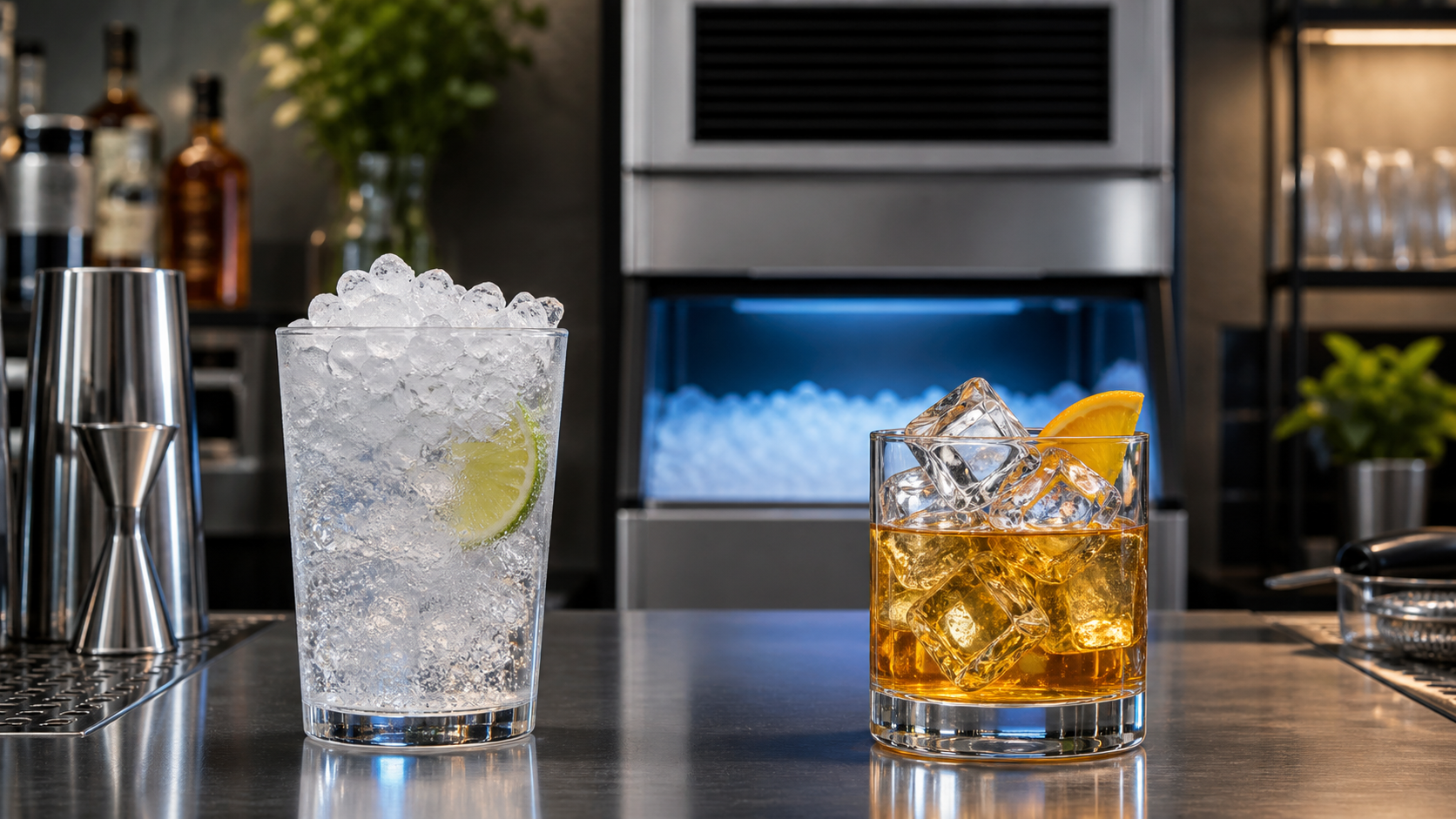
Choosing the wrong ice type costs real money — mismatched ice raises drink waste, triggers customer complaints, and inflates energy bills. A commercial ice machine is refrigeration equipment that produces ice in specific shapes for foodservice, healthcare, or hospitality use, and the shape it makes determines everything downstream. This article compares nugget and cube ice across texture, melt rate, production cost, and ideal use cases so operators can make a data-backed equipment decision.
What Sets Nugget Ice and Cube Ice Apart
Nugget and cube ice differ in physical structure, production method, and sensory properties, which directly affect drink quality and operational efficiency. Learning each type’s mechanics prevents costly equipment mismatches.
How Nugget Ice Is Made and What It Feels Like
Nugget ice, also called pellet or chewable ice, is produced by a commercial nugget ice maker that compresses flaked ice into small, cylindrical pellets roughly 1 inch long. The compressed flake structure traps air pockets, giving nugget ice a soft, chewable texture and a porous surface that absorbs beverage flavor quickly.
Production is continuous-flow, meaning a nugget ice machine outputs ice steadily rather than waiting for a batch cycle to complete. This steady output makes nugget ice equipment well-suited to high-volume beverage stations where demand is constant throughout the service period.
How Cube Ice Is Made and What It Feels Like
Cube ice is formed by flooding a refrigerated evaporator plate or grid with water, freezing it in layers, then harvesting the cubes in a batch cycle. A commercial ice maker producing full cubes yields dense, slow-melting blocks typically 1–1.25 inches per side. Clear ice makers use a directional-freeze method that pushes dissolved gases outward during freezing, producing optically transparent cubes prized in craft cocktail bars for both visual appeal and flavor neutrality. The layered freeze process creates a denser crystal structure that resists melting significantly longer than compressed-flake formats.
Key Physical Differences That Affect Drink Performance
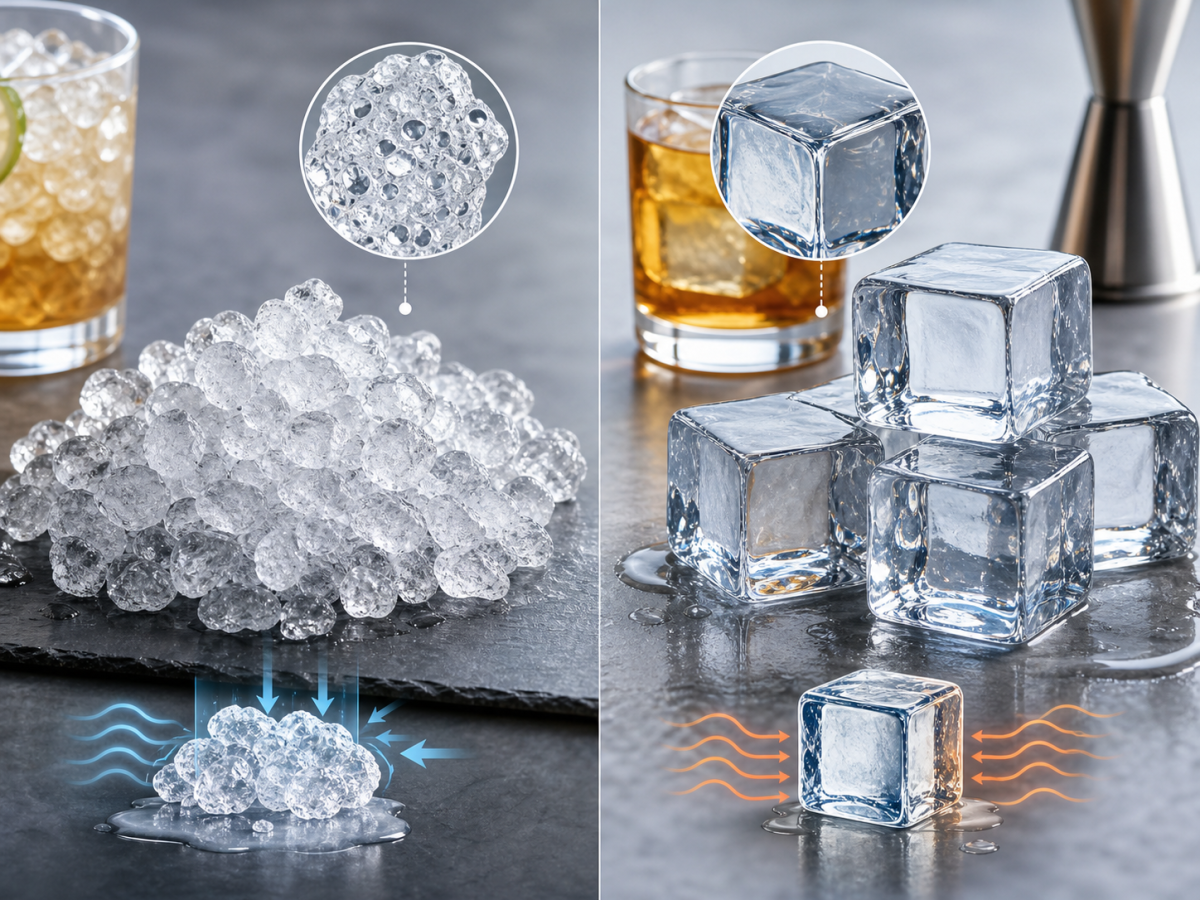
- Nugget ice carries a surface-area-to-volume ratio roughly 40% higher than a full cube of equivalent mass, which accelerates initial chilling speed but also increases melt rate proportionally.
- Cube ice displaces less liquid per ounce of ice added, preserving drink concentration longer during table service.
- Nugget ice weighs less per unit volume, so a bin rated for 100 lb of cubes typically holds only 70–75 lb of nugget ice — a difference that directly affects restocking frequency and labor cost during peak hours.
The production method determines texture, melt rate, and bin efficiency before a single drink is poured. These physical differences cascade into real operational and cost consequences covered in the next section.
Which Business Types Benefit Most From Each Ice Style
Ice type suitability varies sharply by industry segment, customer expectation, and drink menu. Matching ice style to business type reduces waste, improves guest satisfaction scores, and lowers per-drink ice cost.
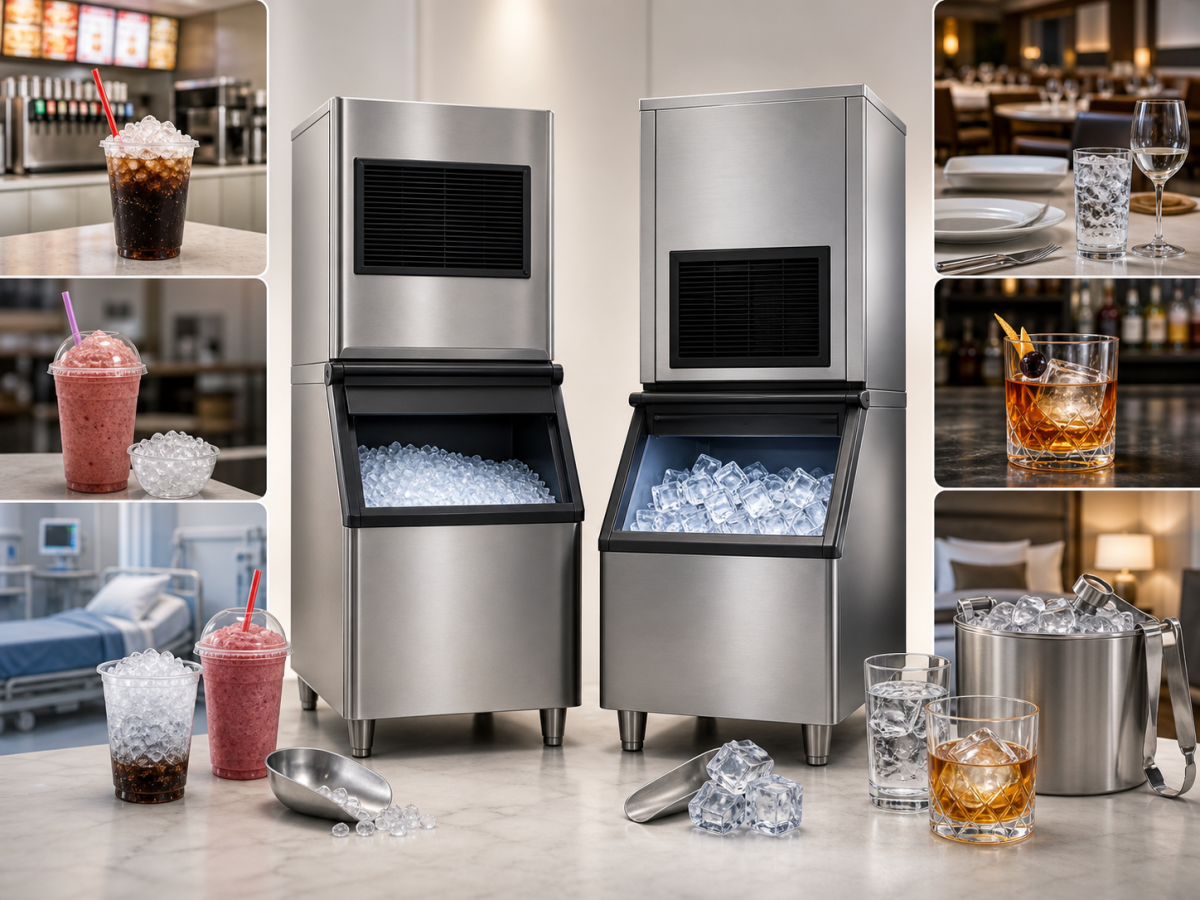
| Business Type | Recommended Ice Style | Primary Reason |
| Full-service restaurant | Cube ice | Slow melt preserves drink flavor during table service; cubes suit water, soda, and cocktails equally. |
| Fast-casual or QSR | Nugget ice | Rapid chilling fills cups faster during high-volume service; customers associate nugget ice with premium beverages. |
| Craft cocktail bar | Clear cube ice | Optical clarity and slow melt rate protect spirit flavor profiles and support visual presentation at the glass. |
| Healthcare facility | Nugget ice | Soft, chewable texture is safe for post-surgical and elderly patients; nugget ice machines are standard in clinical nutrition guidelines. |
| Hotel lobby or self-serve station | Cube ice | Dense cubes resist clumping in guest-access ice dispensers and require less frequent bin refills between housekeeping rounds. |
| Smoothie or specialty beverage café | Nugget ice | Porous texture blends more smoothly and absorbs syrups evenly, improving consistency across high-volume batches. |
No single ice style dominates every segment — the right choice depends on service speed, drink menu, and customer demographics. Operators running mixed menus should evaluate which ice type serves the highest-volume drink category first, then plan secondary equipment around remaining needs.
Operational Costs and Maintenance Differences Between Ice Types
Beyond ice quality, the commercial ice machine you choose affects daily energy draw, water consumption, cleaning frequency, and repair complexity. These operational factors often outweigh upfront equipment price over a 5–7 year equipment lifecycle.
- Nugget ice machines consume 15–25% more water per pound of ice than cube machines because the flaking and compression process requires continuous water flow to prevent auger clogging.
- Cube ice machines typically draw less electricity per 100 lb of ice produced, since batch-freeze cycles allow the compressor to rest between harvests rather than running continuously.
- Commercial nugget ice makers require auger cleaning every 30–90 days because the compression mechanism accumulates mineral scale significantly faster than flat evaporator plates used in cube production.
- Clear ice makers demand the most rigorous water filtration — sediment above 0.5 microns causes visible clouding and must be addressed with a dedicated inline filter sized to the unit’s flow rate.
- A bar ice machine producing cube ice generally has fewer moving parts than a nugget unit, translating to lower average annual maintenance costs in high-use environments over a multi-year horizon.
- Nugget ice machines used in healthcare environments are commonly selected with NSF certification and stricter sanitation protocols in mind, which require more frequent internal sanitization cycles than standard foodservice units operating under the same certification.
Operational cost differences between nugget and cube equipment compound over years of daily use, making total cost of ownership a more reliable decision metric than purchase price alone. The next section provides a step-by-step framework for calculating which type fits your specific operation.
How to Choose the Right Commercial Ice Machine for Your Operation
Selecting a commercial ice machine requires matching equipment specifications to your peak demand, space constraints, and water quality, not just ice style preference. Follow these steps in sequence to avoid undersizing or over-specifying your unit.
1. Calculate your peak daily ice demand: Multiply your busiest-day cover count by the industry benchmark for your segment — 1.5 lb per restaurant guest, 3 lb per bar guest, or 5 lb per healthcare patient — to establish your minimum daily pound requirement before evaluating any equipment specification.
2. Add a 20% capacity buffer: Equipment rated exactly at your demand peak will run continuously, accelerating compressor wear; a 20% capacity overhead extends equipment life and handles unexpected volume spikes without service disruption.
3. Assess your water quality: Request a water hardness and TDS (total dissolved solids) report from your utility provider — water above 200 ppm TDS requires a filtration system sized to the machine’s flow rate, or scale buildup will void most manufacturer warranties within 18 months.
4. Confirm ventilation and ambient temperature: Air-cooled commercial ice makers require 6–12 inches of clearance on all sides and perform best below 90°F ambient; kitchens exceeding this threshold should specify a water-cooled or remote-condenser model to maintain rated output.
5. Match bin capacity to service intervals: A bin holding less than four hours of peak production forces staff to monitor ice levels constantly, so size the bin to bridge your longest gap between restocking or natural production cycles during service.
6. Verify NSF, UL, and local health code compliance: Confirm the unit carries NSF/ANSI 12 certification and check your local health department’s specific requirements for ice machine placement, drainage connection, and sanitation logging before finalizing any purchase commitment.
Running this six-step process before purchasing eliminates the most common sizing and installation errors that lead to early equipment failure. Operators who complete steps 1–3 first reduce the risk of selecting equipment that cannot meet demand or survive local water conditions.
Match Your Ice Machine to Your Business Reality
Nugget ice wins on chewability and clinical safety; cube ice wins on melt rate and energy efficiency — neither type is universally superior. Operational costs over 5–7 years matter far more than sticker price, and water quality alongside peak demand calculations must precede any equipment decision. Audit your peak daily ice demand and water quality data now, before specifying any ice machine, to ensure the unit you install can actually perform under your real operating conditions.
Frequently Asked Questions
Q1. How Much Ice Does a Commercial Nugget Ice Machine Produce Per Day?
Most commercial nugget ice machines are rated between 300 and 1,000 lb per 24 hours, depending on compressor size and ambient conditions. Output can decline noticeably as ambient temperature rises above the manufacturer’s rated conditions, with many units losing measurable production efficiency in hotter kitchens, so always verify the machine’s published performance curve against your kitchen’s actual measured temperature before sizing.
Q2. What Is the Difference Between a Nugget Ice Maker and a Flake Ice Machine?
A nugget ice maker compresses flaked ice into dense, chewable pellets, while a flake ice machine produces loose, flat shavings that remain uncompressed. Flake ice melts faster and is used primarily for food display and seafood preservation rather than beverage service, where the compressed pellet structure and chewable texture of nugget ice are required.
Q3. Can a Restaurant Ice Machine Produce Both Nugget and Cube Ice?
No. A single ice machine is engineered for one ice type only. The evaporator design, auger or grid mechanism, and harvest cycle are each specific to a single ice shape. Operators needing both types must install two separate units or dedicate individual machines to different service stations within the same facility.
Q4. Why Does Nugget Ice Melt Faster Than Cube Ice in Drinks?
Nugget ice melts faster because its porous, compressed-flake structure produces a significantly higher surface-area-to-volume ratio than a solid cube of equal mass. Greater surface area exposed to warm liquid accelerates heat transfer and speeds melting — a direct trade-off for the faster initial chilling that nugget ice delivers at the moment of service.
Q5. How Often Does a Commercial Ice Maker Need to Be Cleaned?
Most health codes and manufacturer guidelines require a full sanitization cycle every 30–90 days. Nugget ice machines with auger mechanisms need cleaning closer to the 30-day mark due to faster mineral scale buildup in the compression chamber. High-TDS water supplies may require monthly cleaning regardless of ice type to maintain continuous NSF/ANSI 12 compliance.
Related posts

How to Clean a Commercial Ice Machine Step by Step (2026 Guide)
Get rid of slime and mold in your commercial ice maker. Follow our step-by-step instructions to ensure health compliance and clear ice quality.
The Hidden Costs of Cheap Ice Machines Every Business Owner Should Know
High repair costs and emergency bagged ice wipe out any upfront savings on budget ice makers. Discover the true 5-year total cost of ownership here.