




Blog
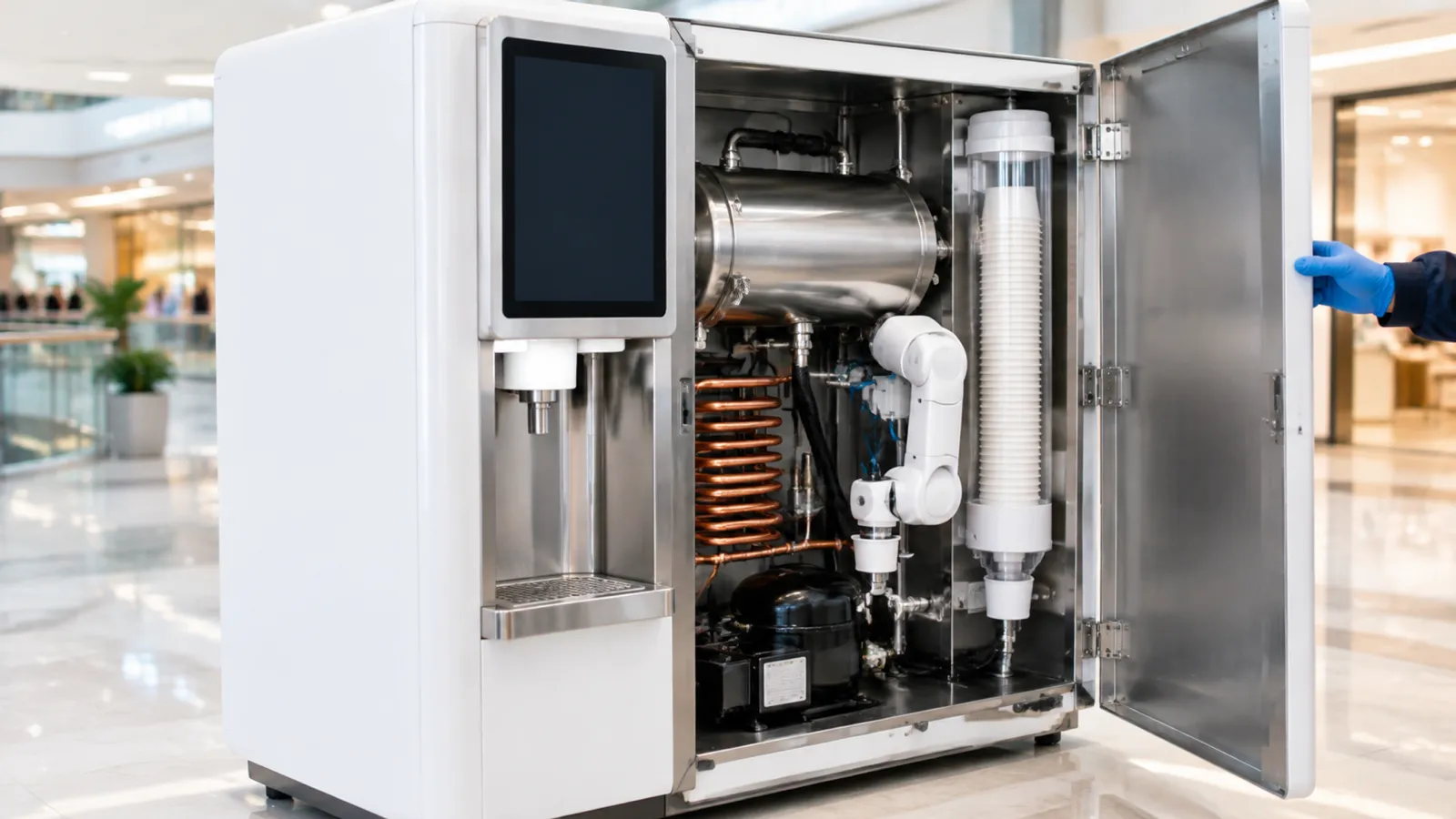
How an ice cream vending machine works, from cold mix and freezing cylinder to robot arm, payment, telemetry and cleaning, plus a buyer's spec checklist.
How does an ice cream vending machine work? Inside the cabinet is a soft serve freezer, like the one a dessert shop runs behind the counter, wrapped in automation that replaces the person at the handle. A refrigerated hopper keeps liquid mix cold, a freezing cylinder turns it into soft serve, and a robot arm or enclosed mechanism places a cup under the valve, fills it and hands it out. A touchscreen and card reader take the order, a controller watches temperatures and faults, and a connected dashboard tells the operator when to refill or clean. Below is each stage in order, then the questions to ask a supplier before you buy.
Part of our commercial soft serve machine buying guide series.
One order, start to finish
Whether the supplier calls it an ice cream robot, an automated ice cream machine or a smart ice cream vending machine, the sequence behind a single sale looks much the same:
- The customer picks a size, flavor and toppings on the screen and pays.
- The controller checks that the product is at serving consistency and that cups, mix and toppings are in stock.
- A cup drops from the stack and the arm or carriage moves it under the dispensing valve.
- The valve opens, and the cup turns or moves so the soft serve builds into a swirl.
- Toppings or sauce are added, and the cup goes to the pickup window.
- The sale, stock levels and machine status are logged and sent to the operator’s dashboard.
Stage 1: Mix storage and refrigeration
Liquid soft serve mix waits in a refrigerated hopper until the freezing cylinder calls for more. Mix is a time/temperature control for safety (TCS) food, so the FDA Food Code 2022 cold-holding rule applies: hold it at 41 °F (5 °C) or below (§ 3-501.16). In a kiosk nobody stands next to the hopper, so refrigeration and its temperature sensor are the first line of food safety.
Many machines run two modes: freezing during selling hours and a lower-power standby that keeps mix and product cold overnight. The BA18-100C3 product page, for example, lists a 12 L hopper and dual power modes, freezing at 1300 W and fresh-keeping at 800 W. Hopper size sets servings between refills; our soft serve mix guide compares powder and liquid mix on storage and consistency.
Stage 2: The freezing cylinder and overrun
From the hopper, mix flows into a horizontal freezing cylinder. The refrigeration system chills the cylinder walls while a beater scrapes the frozen layer off the wall and folds it back in, which keeps ice crystals small. As one manufacturer’s explainer of how a soft serve machine works puts it, the freezing cylinder chills the product while beaters scrape and mix it so no ice crystals form.
Air is blended in at the same time. That air, called overrun, decides texture and how many servings each unit of mix yields: more air gives a lighter product and stretches the mix, less air gives a denser one. Gravity-fed machines draw mix and air into the cylinder through a feed tube; pump machines meter them under pressure. Our comparison of gravity-fed vs pump soft serve machines shows how overrun changes mix cost per serving.
Without an employee to notice soft product during a rush, the machine judges consistency itself, usually from the beater motor’s load or product temperature, and holds an order until the product is ready. Ask how it measures consistency and what the customer sees while waiting.
Stage 3: Dispensing, cups and the robot arm
This is where an ice cream vending machine differs most from a counter unit. Instead of a draw handle, an actuator opens the dispensing valve for a set time or volume. A cup dispenser releases one cup from a stack, and a positioning mechanism holds it under the valve. On a robotic ice cream machine it is a visible arm behind glass, and watching it work is part of the sale. Other designs use an enclosed carriage or turntable. To build a swirl, the cup rotates and lowers under the stream or the arm traces a spiral.

Cups are easier to automate because they stand upright and tolerate a firm grip. Cones are fragile and pick up moisture, so they need a gentler holder and a sealed store. The serving then goes to a pickup window whose door stays closed until the order is ready.
Toppings and sauces
Dry toppings usually sit in sealed canisters with a metering screw or drum; sauces come from small pumps. Each topping adds a part to refill and clean and another point where humidity or a blocked line can stop sales, so a short menu is easier to start with. List topping ingredients on the screen so customers with allergies can decide before they pay.
Stage 4: The touchscreen and payment
The screen is the salesperson: it shows the menu, takes the order and explains what to do if something goes wrong. The BA18-100C3 page lists a 12-inch HD touchscreen. Payment hardware differs most between markets, since card readers and mobile wallets depend on the processor and region, so confirm the US payment setup with your sales rep. Processing fees and card-security duties are covered in our guide to ice cream vending machine profit margins.
Reach matters too. Under the 2010 ADA Standards, where vending machines are provided, at least one of each type must have operable parts that meet section 309, which points to the reach ranges in section 308: no higher than 48 inches and no lower than 15 inches above the floor for an unobstructed forward reach. Check where the screen, reader and pickup window sit, and ask your venue what it requires.
Stage 5: Remote monitoring and telemetry
A controller records each sale, reads the sensors and reports over cellular or Wi-Fi to a cloud dashboard: sales by item and hour, mix and cup levels, temperatures, cleaning status and fault codes. Operators can often change prices or the menu from the same screen.
Telemetry makes a route manageable: you restock when stock is low and hear about a fault before the venue calls. Smartool’s vending landing page describes the BA18-100C3 with remote performance tracking and cloud real-time monitoring. Before you buy any connected machine, ask what the dashboard shows, whether it needs a monthly subscription or data plan, and who owns the sales data.
Stage 6: Sensors, fault alerts and automatic shutoff
Sensors replace the employee who would notice problems. Common ones watch mix level, hopper and cylinder temperature, consistency, cup presence and the doors. When a reading goes out of range, the machine stops selling the affected item and sends an alert.
For food safety this is not optional. The Food Code’s vending provision, § 4-204.111, requires a machine vending TCS food to have an automatic control that stops vending if a power failure, mechanical failure or other condition means it cannot hold safe food temperatures, and to stay stopped until it is serviced and restocked. States adopt the text with their own numbering; Minnesota’s version of the automatic shutoff rule also limits a refrigerated machine to no more than 30 minutes above 41 °F immediately after it is filled, serviced or restocked. Ask the supplier how the machine handles a power cut overnight and what it does with mix that warmed up.
Operators handle first-level alerts such as low mix, a cup jam or an open door. Refrigeration, compressor and electrical faults belong with a qualified technician, so ask how fault codes are documented and who answers.
Stage 7: Automated cleaning and heat treatment
Cleaning is where an automation claim needs the most checking. Many local health procedures expect a soft serve machine to be cleaned at the end of each day’s operation, or at least every 24 hours if it runs continuously. Some machines stretch the interval between full teardowns with heat treatment. Foodservice Equipment Reports describes it as a daily heating-and-cooling cycle that controls bacterial growth, notes that one manufacturer’s option can reduce full disassembly to 14-day intervals (28 days in some states), and adds that the machine still needs a proper wipe-down every day.
Vending machines add hygiene features around the dispensing area. The BA18-100C3 page lists alcohol disinfection and ultraviolet sterilization, and Smartool’s comparison table gives it a 7-day auto-clean cycle. The interval you can actually run is the one your health department accepts, so bring the cleaning procedure to the permit conversation. Our soft serve machine maintenance schedule lays out the daily, weekly and monthly tasks that still apply.
Stage 8: The refill and service routine
Automation removes the cashier, not the visit. A typical service stop looks like this:
- Before you leave: check the dashboard for stock levels, temperatures and open alerts, and bring the mix, cups and parts you will need.
- Refill: top up mix straight from cold storage, then cups, lids, spoons and toppings.
- Clean: wipe the nozzle area, pickup window and screen, empty the drip tray and waste bin, and run or verify the cleaning cycle.
- Check: read hopper and cylinder temperatures, test a serving, and look at door seals and the cup path.
- Record: sign the cleaning and temperature log, which an inspector may ask to see.
Count the visits per week and the time per visit, including travel. That labor is a running cost the brochure rarely shows.
What to check before you buy: a stage-by-stage spec checklist
Use each stage as a line on your request for quote.
| Stage | Question to ask the supplier | Why it matters |
|---|---|---|
| Mix storage | What is the hopper volume, and how does the machine hold mix at or below 41 °F overnight? | Sets servings per refill and food safety while unattended |
| Freezing | What is the rated output per hour or day for the US configuration, and how is consistency measured? | Decides whether one machine covers your busiest hour |
| Dispensing | Cups, cones or both? How many cups does the stack hold, and how is a jam cleared? | A jam stops sales until someone clears it |
| Toppings | How many toppings and sauces, and how are they refilled and cleaned? | Each one adds refill time and a failure point |
| Payment | Which card reader and mobile wallets ship with the US version, and which processors does it support? | Payment hardware varies by market |
| Accessibility | How high are the screen, card reader and pickup window above the floor? | Venues may require the 15–48 inch reach range |
| Telemetry | What does the dashboard show, does it need a subscription or data plan, and who owns the data? | Recurring cost and how many trips you save |
| Sensors and shutoff | Does the machine stop selling automatically when temperatures go out of range, and how is it reset? | Required for TCS vending where Food Code § 4-204.111 is adopted |
| Cleaning | What is the cleaning cycle, and what documents can you give my health department? | Your inspector decides the interval you can run |
| Power and site | What voltage, plug and circuit does the US unit need, and what are the footprint and ventilation clearances? | An electrician may be needed before delivery |
| Service | Who repairs it locally, how are spare parts shipped, and what does the warranty cover? | Downtime costs sales every hour |
Several of these answers are on Smartool’s product pages. The BA18-100C3 page lists a 12 L hopper, a 12-inch touchscreen, R290, R410a and R404a refrigerant compatibility, a machine body of 380 × 777 × 1542 mm, and a warranty of 3 years on core components (compressor, motor, PCB) and 1 year on other parts. The comparison on our automatic ice cream vending machine page adds a 0.45 m² footprint, SUS304 stainless steel and an Embraco compressor. Output, voltage and payment options for the US configuration are best confirmed with your sales rep against your site. Still choosing between unattended and staff-assisted formats? The unmanned ice cream machine range puts the options side by side.
Ice cream robot questions
How does a robot ice cream machine make soft serve?
The freezer makes it; the robot serves it. The freezing cylinder freezes the mix and whips in air. The arm handles the cup, opens the valve and delivers the serving.
How long can you keep ice cream in a soft serve machine?
As long as the manual and your health department allow, and only while it stays cold. Standard machines are usually cleaned daily; heat-treatment designs can run longer where the inspector accepts it.
Does an automated ice cream machine need staff?
Not to sell, but yes to run. Someone still refills, cleans, keeps the log and answers alerts.
Is an ice cream vending machine profitable?
It depends mostly on cups sold per day. Mix, cups, commission, card fees and service time set the cost of each sale; the profit guide linked above walks through payback.
If you are planning a placement, start with the site rather than the machine. Tell us the venue, expected foot traffic, opening hours, available power and the payment methods your customers use, and we will match a configuration and answer the spec questions above when you request a factory-direct quote.
Factory-direct from Smartool
Planning a commercial equipment purchase?
Share your site conditions, daily output and budget. Our team will match a model, send the spec sheets and quote factory-direct pricing.

Written by
Senior Engineer, Smartool
Jason is a senior engineer at Smartool. He works on the commercial ice machines, soft serve and slushy machines, and refrigerated prep tables Smartool builds for restaurants, bars, hotels and dessert shops. His guides look at equipment from the engineering side: how to size a machine for a site, what it needs for power, water and airflow, and how to keep it running through busy service. He also helps buyers match the right model to their kitchen before they request a quote.
.elementor-76528 .elementor-element.elementor-element-5c7a0d0{--display:flex;--flex-direction:column;--container-widget-width:100%;--container-widget-height:initial;--container-widget-flex-grow:0;--container-widget-align-self:initial;--flex-wrap-mobile:wrap;}.elementor-76528 .elementor-element.elementor-element-5c7a0d1 .elementor-toc__header-title{text-align:start;}.elementor-76528 .elementor-element.elementor-element-5c7a0d1 .elementor-toc__header{flex-direction:row;}.elementor-76528 .elementor-element.elementor-element-5c7a0d1{--item-text-hover-decoration:underline;}
On this page
Need pricing for your project?
Get a factory-direct quote on commercial ice makers, soft serve and slushy machines, and refrigerated prep tables.
✓ Model matching and spec sheets for your site
✓ US office in City of Industry, CA
✓ Talk to an expert: +1 (872) 221-0051
Browse by topic
Ice Machine Guides
Soft Serve & Ice Cream
Slushy & Frozen Drinks
Buying & Sourcing
Compliance & Maintenance
Related posts

How Does an Ice Cream Vending Machine Work? Inside the Robot
How an ice cream vending machine works, from cold mix and freezing cylinder to robot arm, payment, telemetry and cleaning, plus a buyer's spec checklist.

Sandwich Prep Table Sizes: 27 to 72 Inch Explained
Sandwich prep table sizes from 27 to 72 inches: door counts, 1/6 pan capacity, mega-top vs standard top, board depth and a checklist to size yours.