




Blog
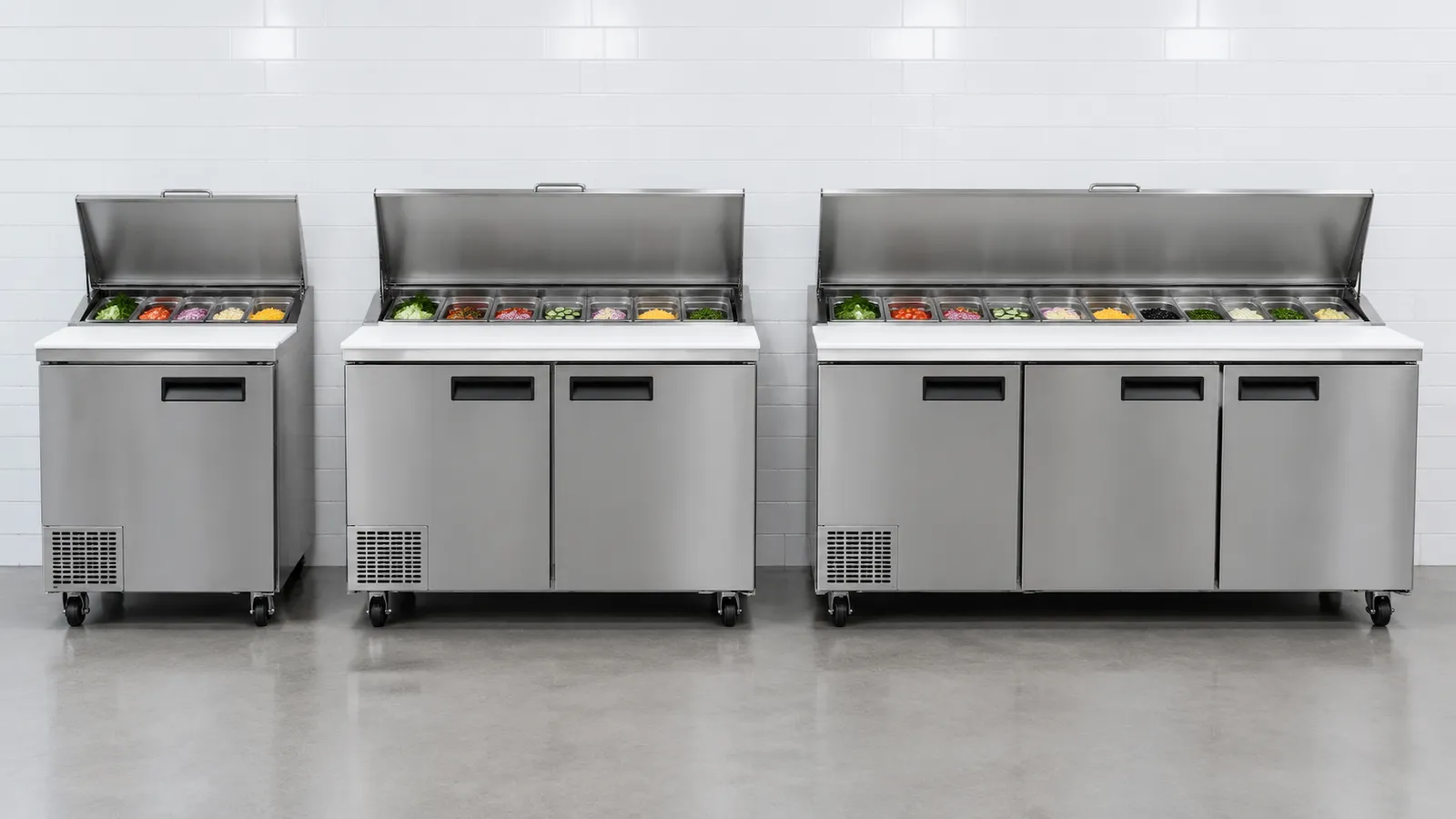
Sandwich prep table sizes from 27 to 72 inches: door counts, 1/6 pan capacity, mega-top vs standard top, board depth and a checklist to size yours.
Sandwich prep table sizes run from about 27 to 72 inches wide, and the width you pick sets the door count, the number of pans on the rail and how much backup stock fits underneath. On published spec sheets from two major US manufacturers, a 27-inch unit has one door and eight 1/6-size pans, 36- to 60-inch units have two doors and 8 to 16 pans, and a 72-inch unit has three doors and 18 pans on a standard top. Mega-top versions add a third row of pans at the same width. Standard tops are about 30 to 32 inches deep, mega-tops about 34. This guide turns those numbers into a sizing table, explains what changes between standard and mega-top, and gives you a checklist for sizing a unit to your menu before you ask for quotes.
Part of our commercial refrigeration equipment procurement guide series.
Sandwich prep table sizes at a glance
The table below collects the five common widths. Pan counts are for 1/6-size pans, the small square pans that hold most sandwich and salad toppings. Where two manufacturers list different pan counts at the same width, both are shown, because that difference is exactly what catches buyers out.
| Nominal width | Listed width | Doors | 1/6 pans, standard top | 1/6 pans, mega-top | Often a fit for |
|---|---|---|---|---|---|
| 27 in | 27 to 27-5/8 in | 1 | 8 | 12 | Cafés, kiosks, food trucks, a second station beside the main line |
| 36 in | 36-3/8 in | 2 | 8 | 12 | Small menus where a 27-inch cabinet is too tight for backup stock |
| 48 in | 48 to 48-3/8 in | 2 | 8 or 12 | 18 | A single build line in a sandwich shop or deli |
| 60 in | 60 to 60-3/8 in | 2 | 10 or 16 | 24 | Longer menus, or a line where a second cook helps at peak |
| 72 in | 72 to 72-3/8 in | 3 | 18 | 30 | High-volume lines with two builders working side by side |
These figures come from manufacturer spec sheets checked in October 2026. Other brands land close to them but not on them, so read the table as a range. The 27-inch mega-top needs a footnote: the single-sided model we checked reaches 12 positions with nine 1/6 pans plus three smaller 1/9 pans.
Width, depth and height: read the full footprint
“48-inch” is a nominal size. The units in our table measure anywhere from 48 to 48-3/8 inches wide, and that extra fraction matters when a table has to slot between a wall and a griddle stand. Measure the gap, then compare it with the listed width on the spec sheet, not with the size in the product name.
Depth is the number buyers forget. Standard-top units in our sample are 30-1/8 to 32 inches deep. Mega-tops are deeper, at 34-1/8 inches, because the extra row of pans pushes the rail back. That depth decides how much aisle is left behind the cook, and whether the unit fits through your back door and down the hallway. Measure the narrowest point on the delivery path before you order.
Height is where spec sheets disagree the most. One manufacturer lists 36-3/4 inches overall for its standard tops and 40-3/8 inches for mega-tops; another lists about 45 inches for its standard tops. The difference is mostly what each figure includes, such as the raised rail, the lid and the legs or casters. Ask which parts the stated height covers, especially if the unit has to fit under a shelf or a pass-through window.
Some lines also sell ADA-height versions with a 34-inch work surface. The 2010 ADA Standards set work surfaces at 28 to 34 inches above the floor, and the 5 percent requirement applies to work surfaces used by people other than employees. A back-of-house prep line usually falls outside that rule, but operators who plan for accessible workstations ask for this option.
Door count and cabinet storage by width
Door count follows width. On the standard models we checked, 27-inch units have one door, 36- to 60-inch units have two, and 72-inch units have three. Shelf count follows the doors: one manufacturer supplies two shelves in its 27-inch unit, four in its 36-, 48- and 60-inch units and six in its 72-inch unit. Some lines replace doors with drawers, which hold full-size pans of backup product and save bending.
Interior volume climbs with width too. Another manufacturer lists 6.9 cubic feet for its 27-inch unit, 13.01 for the 48-inch, 16.02 for the 60-inch and 20.02 for the 72-inch. Cubic feet tell you the size of the box, not how it is divided, so also ask for shelf dimensions and check that your backup containers fit.
Pan capacity: how many 1/6 and 1/3 pans fit
A 1/6-size pan in these spec sheets measures 6-7/8 by 6-1/4 inches and comes 4 inches deep as standard, and the same rails also accept 6-inch-deep pans. A 1/3-size pan is 12-3/4 by 6-1/4 inches, so it takes roughly the space of two 1/6 pans. Pan divider bars let you mix sizes, and a 1/9-size pan (about 4-1/4 by 6-15/16 inches) fits small items such as olives or jalapeños.
The key lesson from the table is that width alone does not tell you the pan count. At 48 inches, one manufacturer sells both an 8-pan and a 12-pan standard top. At 60 inches, one standard top carries 10 pans and another carries 16. When you compare quotes, write down the pan count, pan size and pan depth for every unit, and ask whether the pans are included.

Deeper pans hold more product in the same slot, but don’t pile product above the rim. North Dakota’s cold holding guidelines warn that overfilled salad bar or prep table containers run warmer, and cold food must stay at 41°F or below. If your par levels only work with heaped pans, you need more positions, not taller piles.
Standard top vs mega-top at the same width
A mega-top adds a row of pans by deepening the rail, and the cutting board pays for it. Using one manufacturer’s line as the example:
| Width | Standard top pans | Mega-top pans | Standard board depth | Mega-top board depth | Unit depth (std / mega) |
|---|---|---|---|---|---|
| 48 in | 12 | 18 | 11-3/4 in | 8-7/8 in | 30-1/8 / 34-1/8 in |
| 60 in | 16 | 24 | 11-3/4 in | 8-7/8 in | 30-1/8 / 34-1/8 in |
| 72 in | 18 | 30 | 11-3/4 in | 8-7/8 in | 30-1/8 / 34-1/8 in |
So a mega-top gives you at least half again as many pans at the same width, at the cost of about 3 inches of board depth and 4 inches of floor depth. That trade suits bowl, burrito and deli lines with long ingredient lists. It suits a sub shop less well if the cooks need room to slice and wrap. Our refrigerated prep table buying guide compares the three configurations in more detail.
Cutting board depth: the dimension your cooks feel
Standard sandwich tops in our sample have boards 10 to 11-3/4 inches deep, and mega-tops 8-7/8 inches. Some 27-inch units come with a 17-inch board, but that model fits six 1/6 pans and two 1/9 pans instead of eight, and it grows to 38-3/8 inches deep. One manufacturer also sells 19-inch boards as an option. Lay your largest tortilla, flatbread or roll on a tape measure: if it is wider than the board is deep, cooks will build over the edge all shift.
Sandwich vs salad vs pizza prep tables: how the sizes differ
Sandwich and salad prep tables are the same equipment. Manufacturers list them as “sandwich/salad units”, and every size above applies to both. Pizza prep tables are built differently. One manufacturer’s pizza line comes in 44-5/8, 60-1/4 and 67-3/8 inch widths, about 33-5/8 inches deep, with 1/3-size pans that are 6 inches deep (six on the 44-inch unit, nine on the 67-inch unit) and a 19-1/2-inch board for stretching and topping a full pie. If you build both sandwiches and pizza, that board depth is the deciding number.
How to size a sandwich prep table to your menu and throughput
- Count rail positions. List every cold item a cook reaches for at peak. Give small-portion items a 1/6 pan and high-volume items such as lettuce or cheese a 1/3 pan, which counts as two positions. Add one or two spare positions for specials.
- Match positions to a top. Up to 8 positions fits a 27-inch standard top; 12 needs a 48-inch standard top or a 27/36-inch mega-top; 16 to 18 points to a 60- or 72-inch standard top or a 48-inch mega-top.
- Count builders. If two people build at the same time, each needs their own stretch of board and reach to the pans. That usually means a 60- or 72-inch unit, or two smaller units on either side of the line.
- Size the cabinet for refills. Count the backup pans and containers you hold through a rush, then check shelf dimensions and door count, not just cubic feet.
- Check the space. Measure line length, aisle depth behind the cook and the delivery path. One manufacturer’s doors swing within the cabinet dimensions, but the cook still needs room to bend and open them.
- Check power. One manufacturer’s standard models, from 27 to 72 inches, all run on 115V with a NEMA 5-15P plug and draw 3.5 to 7.2 amps. Confirm the plug and circuit for any unit you quote.
Clearance and ventilation around the unit
Most self-contained prep tables have the compressor at the back. Both manufacturers in our sample list a rear-mounted compressor or rear condensing-unit access. A rear-breathing unit pushed flat against a wall, or placed beside a fryer, runs longer and holds the rail less well. Use the clearance stated in the installation manual for the exact model, and keep space in front of the grille and behind the unit for cleaning. Front-breathing models are built for tighter, built-in spots. Our refrigerated prep table maintenance guide covers keeping the condenser clean once the unit is in place.
NSF and electrical listings: what to check on the quote
- Sanitation listing for the whole unit. Refrigerated prep tables fall under NSF/ANSI 7, the standard for commercial refrigerators and storage freezers. Look up the exact model number in the NSF certified food equipment listings, and ask whether a claim covers the whole unit or only a part such as the pans or the cutting board.
- Electrical safety mark. Look for a UL, ETL, CSA or similar mark on the data plate. Our guide to commercial kitchen equipment certification requirements explains which mark answers which question.
- Don’t filter by ENERGY STAR. The ENERGY STAR criteria for commercial refrigerators exclude refrigerated preparation tables, so no prep table at any width will carry the label. Compare insulation, self-closing doors and the lid instead.
Where the Smartool TSP47FC-2 fits
The TSP47FC-2 is Smartool’s sandwich and salad prep table. Its product page lists a 15 cubic foot cabinet, 6 trays on the top, two adjustable shelves rated 150 lb (68 kg) each, a 0–5°C (32–41°F) range, R290 refrigerant, fan cooling, auto-closing doors, a lift-off top cover and heavy-duty wheels with brakes. The page does not publish exterior dimensions or tray size, so confirm width, depth, height and pan size with your sales rep and run them through the checklist above. If your rail-position count comes to six or fewer, it belongs on your shortlist.
Sandwich prep table size questions
How many pans fit in a 48 inch sandwich prep table?
On the standard tops we checked, 8 or 12 pans of 1/6 size, depending on the model. A 48-inch mega-top holds 18.
How deep is a sandwich prep table?
Standard tops are about 30 to 32 inches deep and mega-tops about 34 inches. Models with an extra-deep cutting board can reach 38 inches or more.
What is the smallest sandwich prep table?
Full-size refrigerated units start at about 27 inches wide with one door and eight 1/6 pans. Countertop rails are smaller, but they have no refrigerated cabinet below.
How tall is a sandwich prep table?
Listed heights range from about 36-3/4 to 45 inches, depending on the model and on whether the figure includes the rail and lid. ADA-height versions have a 34-inch work surface.
Once you know your rail positions, builder count and the space on the line, compare Smartool’s refrigerated prep table options. Then send your menu, line measurements and pan count to request a factory-direct quote, and we will confirm whether the TSP47FC-2 fits your line.
Factory-direct from Smartool
Planning a commercial equipment purchase?
Share your site conditions, daily output and budget. Our team will match a model, send the spec sheets and quote factory-direct pricing.

Written by
Senior Engineer, Smartool
Jason is a senior engineer at Smartool. He works on the commercial ice machines, soft serve and slushy machines, and refrigerated prep tables Smartool builds for restaurants, bars, hotels and dessert shops. His guides look at equipment from the engineering side: how to size a machine for a site, what it needs for power, water and airflow, and how to keep it running through busy service. He also helps buyers match the right model to their kitchen before they request a quote.
.elementor-76528 .elementor-element.elementor-element-5c7a0d0{--display:flex;--flex-direction:column;--container-widget-width:100%;--container-widget-height:initial;--container-widget-flex-grow:0;--container-widget-align-self:initial;--flex-wrap-mobile:wrap;}.elementor-76528 .elementor-element.elementor-element-5c7a0d1 .elementor-toc__header-title{text-align:start;}.elementor-76528 .elementor-element.elementor-element-5c7a0d1 .elementor-toc__header{flex-direction:row;}.elementor-76528 .elementor-element.elementor-element-5c7a0d1{--item-text-hover-decoration:underline;}
On this page
Need pricing for your project?
Get a factory-direct quote on commercial ice makers, soft serve and slushy machines, and refrigerated prep tables.
✓ Model matching and spec sheets for your site
✓ US office in City of Industry, CA
✓ Talk to an expert: +1 (872) 221-0051
Browse by topic
Ice Machine Guides
Soft Serve & Ice Cream
Slushy & Frozen Drinks
Buying & Sourcing
Compliance & Maintenance
Related posts

Sandwich Prep Table Sizes: 27 to 72 Inch Explained
Sandwich prep table sizes from 27 to 72 inches: door counts, 1/6 pan capacity, mega-top vs standard top, board depth and a checklist to size yours.

Nickel-Safe Ice Machine Cleaner vs Sanitizer: How to Choose
How to choose a nickel safe ice machine cleaner, descaler and sanitizer: what each does, label dilution, EPA registration, food-code rules and safety.