




Blog
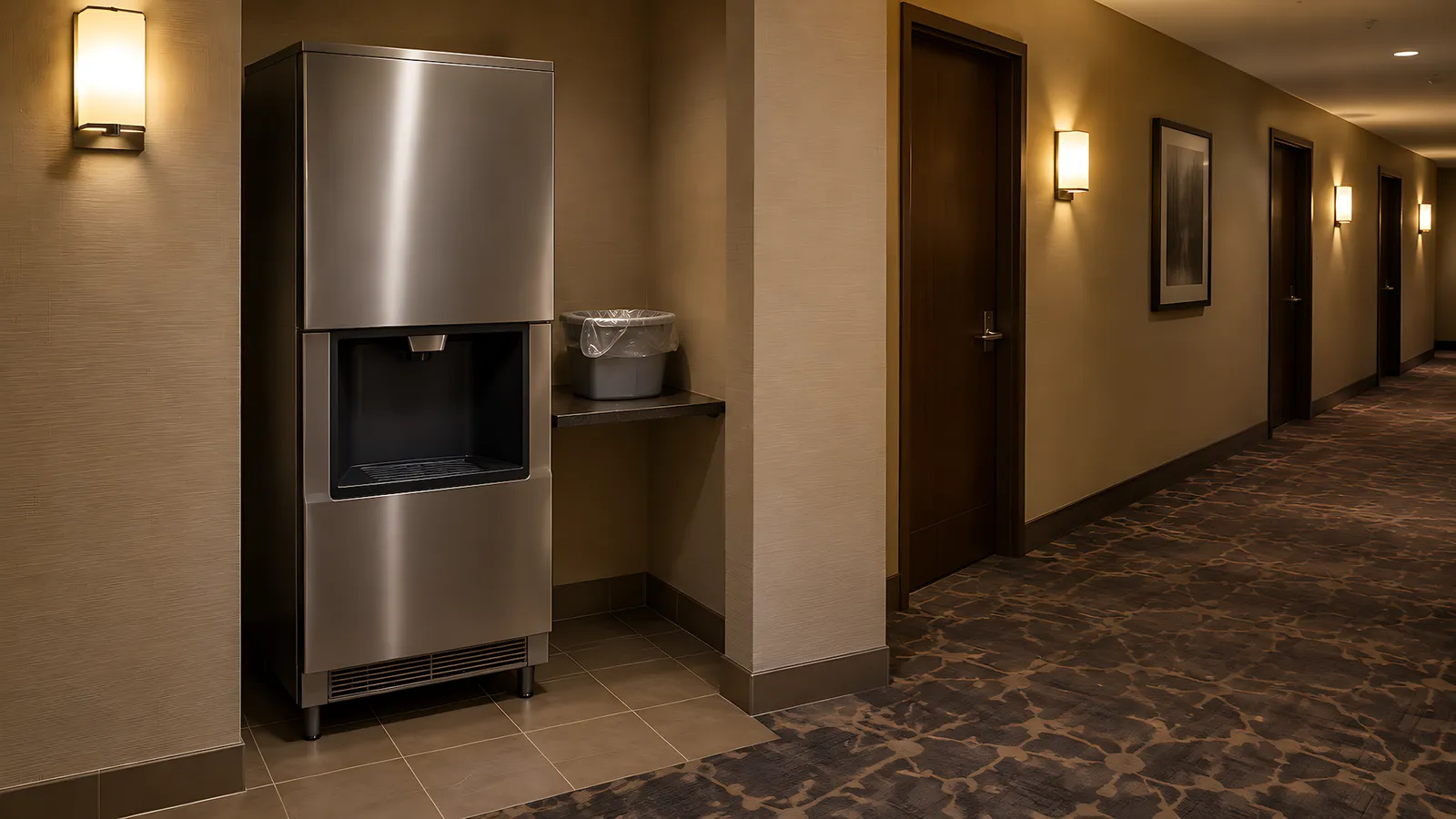
Plan hotel ice machines by room count: about 5 lb per room, station placement, dispensers vs bins, guest safety and a cleaning schedule.
A hotel ice machine plan has to cover three separate demands: guest ice on the room floors, the bar, and the kitchen and banquet side. Guest ice is the part that is unique to hotels, and one manufacturer’s usage guide puts it at about 5 lb per room per day. From there, the work is deciding how many ice stations you need, where they go, whether guests use a dispenser or a bin, and who keeps each one clean. This guide covers sizing per room, placement, guest safety and upkeep for hotel ice machines, written for owners, general managers and chief engineers planning a new build, a renovation or a replacement.
Part of our commercial ice maker buying guide series.
Why do hotels have ice machines?
Free ice on every floor is an American lodging habit with a specific origin. According to Mental Floss’s account of why hotels have ice machines, Holiday Inn founder Kemmons Wilson noticed in the 1950s that rival hotels charged extra for ice and made it free at his properties. Because the franchise used uniform standards, every new location carried the policy, competitors followed, and free ice became a standard amenity at almost all US hotels.
Today guests expect it. They fill buckets for drinks in the room, for coolers on the way to the beach or a ballgame, and for medical needs. An empty machine or a dirty bin gets noticed, and it shows up in reviews.
Map hotel ice demand by area
Size each area on its own, then add them up. A machine that serves the bar should not also be counted on for the fourth-floor ice room. A manufacturer’s ice usage guide gives these lodging starting points:
| Hotel area | Starting figure per day | Notes |
|---|---|---|
| Guest ice (room floors) | 5 lb per room | Plan at full occupancy for peak nights |
| Restaurant | 1.5 lb per person or seat | Drinks and water service |
| Cocktail bar | 3 lb per person or seat | Size the bar with its own method |
| Catering and banquets | 1 lb per person | Event days drive the peak |
The bar and restaurant are sized like any other food and beverage outlet, by seats, menu and the busiest service window. We cover that method in our guide on how to size an ice machine for a bar, so this guide stays with the guest floors. Do not forget smaller users that draw from guest-floor machines in practice: housekeeping, room service and pool or fitness areas.
Sizing guest ice per room
Guest ice is different from bar ice in two ways. Demand is spread across many stations instead of one, and it tends to come in waves rather than a single service window, typically in the evening after check-in and in the morning when guests fill coolers before heading out. Watch your own stations for a week to confirm the pattern. Work it out station by station:
- Count the rooms each station serves. One station per floor serves that floor; a station on alternate floors serves two.
- Multiply by the per-room figure. Use 5 lb per room at full occupancy as the starting point, then adjust for your guest mix. Resorts, extended-stay properties and hotels near stadiums, beaches or highways with cooler traffic tend to run higher; business hotels with a busy lobby bar may run lower on the floors.
- Use the hot-room rating. Ice alcoves and closets are often warmer than the kitchen. Compare your daily target with each machine’s output at the higher test temperature, not the headline figure.
- Size the bin for the evening wave. The machine refills overnight; the bin or dispenser storage has to carry the station through the evening rush.
Here is how that works for a 150-room hotel with 30 rooms on each of five guest floors. At 5 lb per room, the property needs about 750 lb of guest ice a day when it is full. A station on every floor needs about 150 lb a day. A station on alternate floors serving 60 rooms needs about 300 lb a day. As a check against published figures, Smartool rates the BF360 at 275 lb ±5% per 24 hours with 32°C (90°F) room air and 21°C (70°F) water, which is below that 300 lb target in a hot alcove, while the BF500 is rated at 375 lb ±5% at the same condition. Run the same comparison for any model you consider.
Where to put hotel ice machines
Many hotel brands set their own standard for how many ice stations a property needs, so check the brand standards first if you are a franchisee. After that, placement comes down to guests, neighbors and utilities.
- Guest access. Put the station on the main path, near elevators or stairs, so no guest walks the length of a long corridor with a bucket. Vending alcoves often pair ice with drinks and snacks.
- Noise. Compressors, fans and falling ice carry through walls. Keep stations away from shared walls with guest rooms where you can, and compare published noise figures. The BF500 and BF360 product pages both list operating noise at 65 dB or less.
- Drains and water. Each station needs a potable water supply and a floor drain or floor sink with an air gap. On upper floors that is the hardest part to retrofit, so confirm it early. Our commercial ice machine installation guide covers the water line, drain and electrical requirements.
- Heat and airflow. An air-cooled machine pushes its heat into the room. A small closed alcove can heat up and cut output. Keep the clearance the manual calls for; Smartool’s ice machine maintenance guide recommends more than 30 cm (about 12 inches) at the back and both sides, away from heat sources.
- Floors. Use a hard, cleanable floor with a mat, since guests drip and spill. Carpet around an ice station stays wet and grows odors.
Dispenser or bin with a scoop?
For guest self-service, a dispenser that drops ice into the bucket at the push of a button or lever keeps hands, scoops and buckets out of the stored ice. A bin with a scoop costs less and holds more, but every guest opens the door and handles the scoop, so contamination risk and cleaning workload go up. Many properties use dispensers on guest floors and keep bin-and-scoop setups in back-of-house areas where trained staff serve the ice.
If guests operate the dispenser, its controls should be reachable for guests using wheelchairs. The 2010 ADA Standards for Accessible Design set an unobstructed forward reach of 48 inches maximum and 15 inches minimum above the floor. Confirm the requirement for your project with your architect. Stock bucket liners at every station so guests do not carry ice in a bare bucket.
Is ice from a hotel ice machine safe?
It can be, when the machine is installed and maintained properly. Ice is treated as food under the FDA Food Code, which most state and local health departments adopt in some version: it has to be made from safe drinking water, and the enclosed parts of ice makers have to be cleaned at the frequency the manufacturer specifies, or often enough to prevent soil and mold from building up. Guest-floor machines are where this slips. The same Mental Floss article cites a 2012 CBC investigation that found bacteria, including E. coli, on ice machines at six major hotel chains in Canada. A machine handled by many guests needs a written cleaning schedule and someone accountable for it.
Upkeep schedule for hotel ice machines
Split the work between housekeeping, who see the stations every day, and engineering, who handle the machine itself. The intervals below come from Smartool’s maintenance guide and from refrigeration service professionals quoted by ENERGY STAR on refrigeration maintenance in commercial kitchens.
| Interval | Task | Owner |
|---|---|---|
| Daily | Wipe the outside and the dispense area, empty the drip tray, check for water on the floor, restock liners, check ice looks clear and uniform | Housekeeping |
| Every two weeks to monthly | Clean the condenser: every two weeks in dusty spaces, monthly elsewhere | Engineering |
| Every 3–6 months | Replace a pre-installed water filter according to its service life, usually 3 to 6 months | Engineering |
| At least every six months, more often if needed | Clean and sanitize machine, bin and dispenser with new filters; production test against published output | Engineering or service contractor |
| Per the manual | Water-system cleaning cycle with an approved cleaner | Engineering |
The ENERGY STAR guidance notes that machines with aggressive mold or scale, poor water quality or long running hours may need more frequent cleaning than the six-month baseline, which describes many busy guest-floor stations. For the full cleaning routine, see our guide on how to clean a commercial ice machine. Log every clean with the date and initials on a card inside the station door, so the engineer and the health inspector can both see it.

Choosing machines for a hotel
- Ice type. Standard cubes melt evenly, a good fit for guest buckets and coolers. Our guide to types of commercial ice machines compares the other shapes.
- Standardize. Using one or two models across all floors simplifies spare parts, filters and staff training.
- Production timing. A timer lets machines build stock overnight and during off-peak hours. The BF500 and BF360 both have a 48-hour timer, water-shortage and ice-full alerts on an LCD display, and 12-level ice thickness control.
- Power. Check the circuit at each station. Both Smartool heads run on AC 110–120V/60Hz.
The BF500 split ice maker is published at 500 lb ±5% per 24 hours with 21°C (70°F) air and 10°C (50°F) water, and makes standard square cubes. When you request a quote, ask Smartool to confirm the bin or dispenser pairing for each station, since guest-floor dispensing and back-of-house storage need different setups.
Hotel ice machine questions
How much ice does a hotel need per room?
A common manufacturer starting point is about 5 lb of guest ice per room per day. Plan at full occupancy, adjust for cooler-heavy guests, and size the bar, restaurant and banquets separately.
Is it safe to drink ice from a hotel ice machine?
It should be, since hotel ice is food and must be made from safe drinking water in a machine cleaned on schedule. Guests can look for a clean dispenser, liners for buckets and a recent cleaning log. Operators carry the responsibility to keep it that way.
How often should hotel ice machines be cleaned?
Follow the manufacturer’s interval for the water system. Service professionals quoted by ENERGY STAR suggest cleaning and sanitizing machines, bins and dispensers at least every six months, more often with heavy use, mold or hard water. Wipe the outside and dispense area daily.
Does every hotel floor need an ice machine?
Not always. Many properties put a station on alternate floors, sized for two floors of rooms. Check your brand standards and the walking distance from the farthest room.
Planning ice for a new property or a renovation? Review Smartool’s factory-direct commercial ice makers, then send your room count, floor layout and station locations to request a factory-direct quote.
Factory-direct from Smartool
Planning a commercial equipment purchase?
Share your site conditions, daily output and budget. Our team will match a model, send the spec sheets and quote factory-direct pricing.

Written by
Senior Engineer, Smartool
Jason is a senior engineer at Smartool. He works on the commercial ice machines, soft serve and slushy machines, and refrigerated prep tables Smartool builds for restaurants, bars, hotels and dessert shops. His guides look at equipment from the engineering side: how to size a machine for a site, what it needs for power, water and airflow, and how to keep it running through busy service. He also helps buyers match the right model to their kitchen before they request a quote.
.elementor-76528 .elementor-element.elementor-element-5c7a0d0{--display:flex;--flex-direction:column;--container-widget-width:100%;--container-widget-height:initial;--container-widget-flex-grow:0;--container-widget-align-self:initial;--flex-wrap-mobile:wrap;}.elementor-76528 .elementor-element.elementor-element-5c7a0d1 .elementor-toc__header-title{text-align:start;}.elementor-76528 .elementor-element.elementor-element-5c7a0d1 .elementor-toc__header{flex-direction:row;}.elementor-76528 .elementor-element.elementor-element-5c7a0d1{--item-text-hover-decoration:underline;}
On this page
Need pricing for your project?
Get a factory-direct quote on commercial ice makers, soft serve and slushy machines, and refrigerated prep tables.
✓ Model matching and spec sheets for your site
✓ US office in City of Industry, CA
✓ Talk to an expert: +1 (872) 221-0051
Browse by topic
Ice Machine Guides
Soft Serve & Ice Cream
Slushy & Frozen Drinks
Buying & Sourcing
Compliance & Maintenance
Related posts

Hotel Ice Machines: Sizing per Room, Placement and Upkeep
Plan hotel ice machines by room count: about 5 lb per room, station placement, dispensers vs bins, guest safety and a cleaning schedule.

Refrigerated Prep Table Maintenance and Troubleshooting
A refrigerated prep table maintenance schedule plus a symptom-to-cause guide for prep tables not cooling, frosting up or leaking water.