




Blog
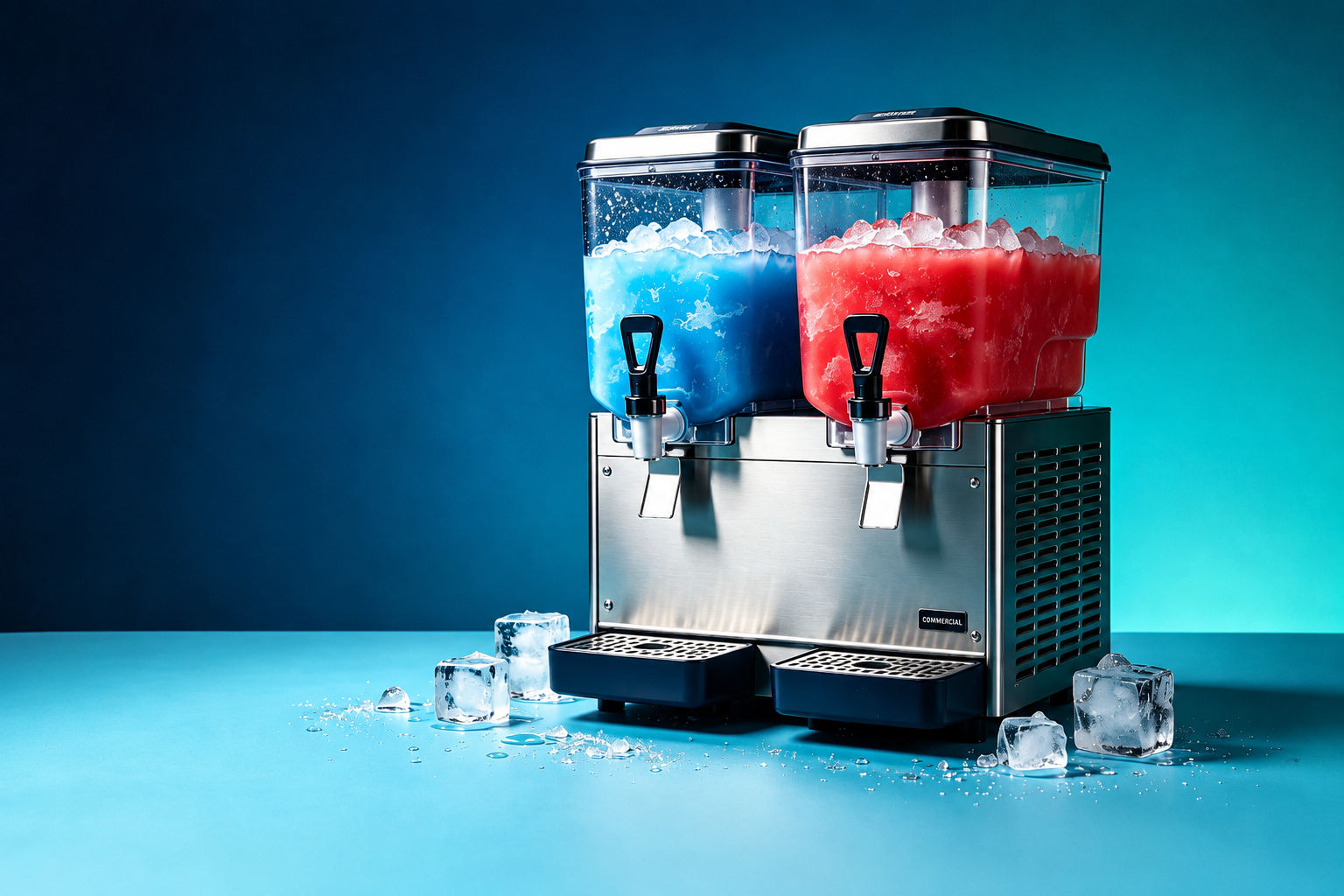
Most buyers judge a commercial slushy machine based on price and how it looks. This approach misses the internal specs that actually determine your profit, daily operating costs, and the machine’s lifespan. This guide breaks down every important feature and technical specification. You will learn what the numbers mean in practice, which specs directly affect your bottom line, and which ones are just marketing filler.
Feature 1: Freezing Systems: The Foundation of Performance
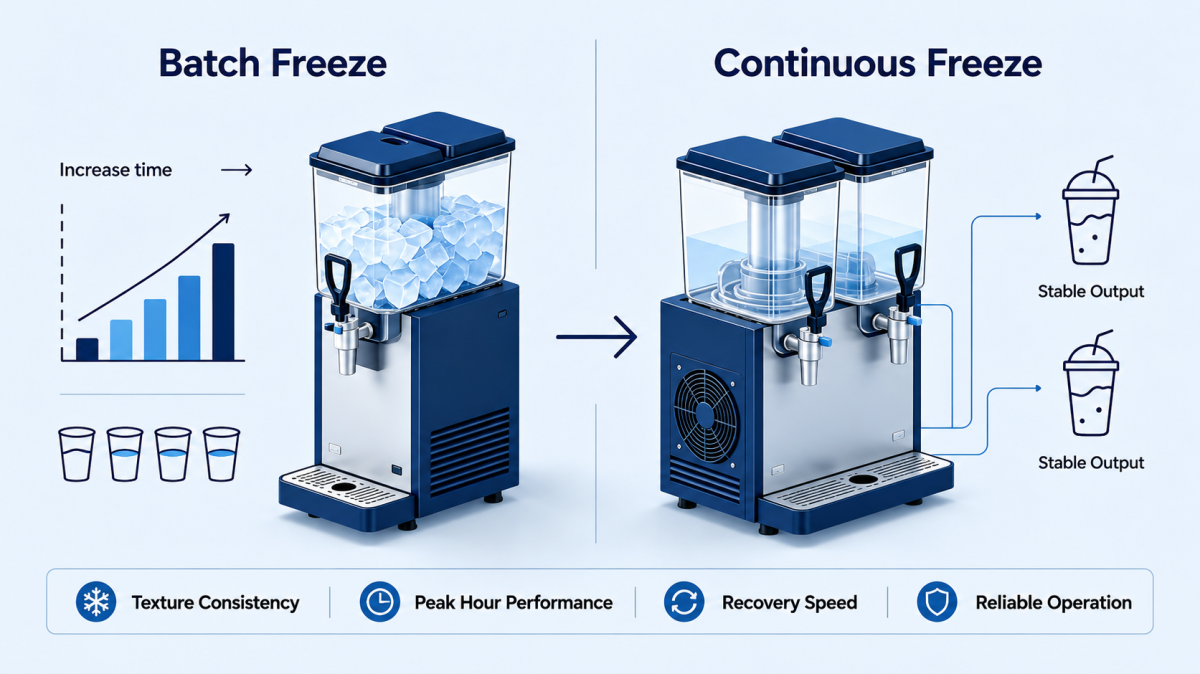
A commercial slush machine relies on its cooling system to turn liquid into ice. While home models might use cheap cooling methods, professional units must use compressor-based refrigeration to handle constant use.
Batch Freeze vs. Continuous Freeze
- Batch Freeze: These machines freeze one full tank at a time. They are cheaper and work well for small shops with low demand. The risk is that the texture becomes inconsistent if you sell drinks faster than the machine can freeze the next batch.
- Continuous Freeze: The compressor stays active to keep the mix in a semi-frozen state at all times. This creates a consistent texture throughout the day. This system is a must for high-traffic spots like cinemas or busy gas stations.
Why Cooling Power Matters
Weak systems fail during peak hours. Underpowered compressors cannot keep the target temperature when you are pouring drinks and adding room-temperature liquid at the same time. If you plan to serve more than 100 cups a day, choosing high-performance slushy machines with a continuous freeze system is the standard you should look for.
Feature 2: Capacity and Tank Configuration Options
The size and number of tanks on your frozen beverage machine dictate how many flavors you can offer and how often your staff needs to refill the unit.
Choosing the Right Hopper Size
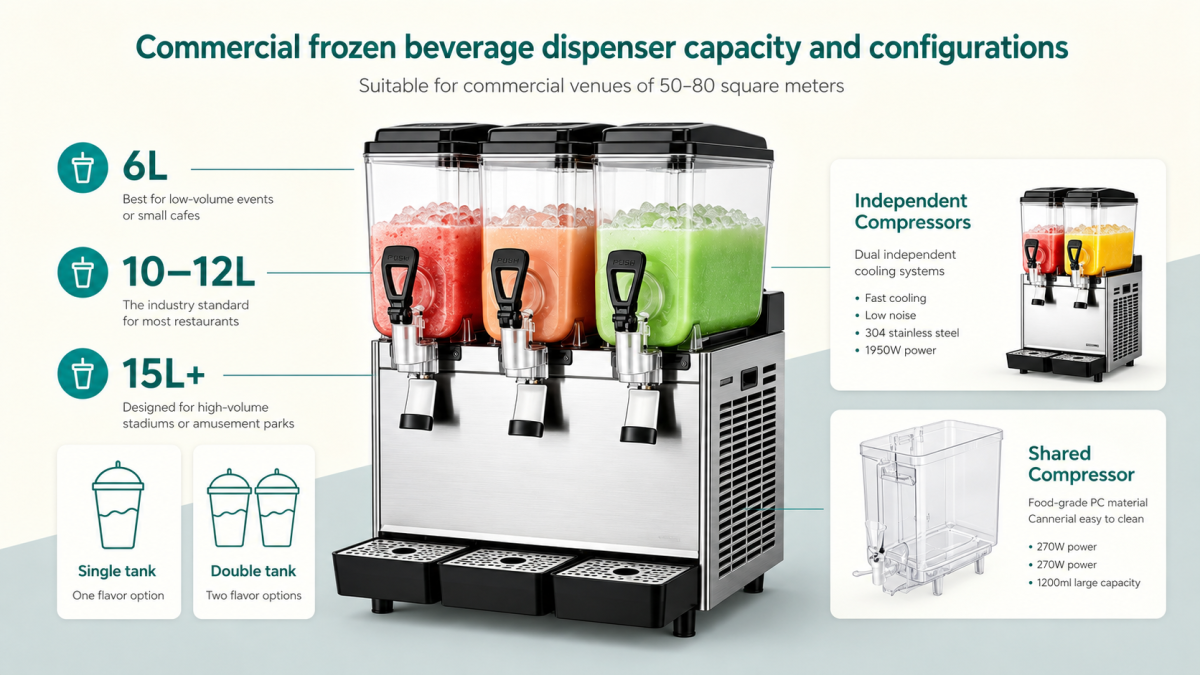
Hopper sizes generally fall into three categories:
- 6L: Best for low-volume events or small cafes.
- 10–12L: The industry standard for most restaurants.
- 15L+: Designed for high-volume stadiums or amusement parks.
A 12L hopper usually gives you about 30 to 40 cups per fill. Keep in mind that the usable capacity is only about 80% of the rated volume. If you run the tank to the very bottom, the quality of the slush drops.
Independent vs. Shared Compressors
You can choose between single, dual, or triple tanks. A critical spec to check is whether the tanks share one compressor or have independent circuits. Independent circuits allow you to set different temperatures for each tank. This is helpful if you want to serve a standard slush in one tank and a dairy-based drink in the other. If you are configuring a heavy-duty system, you might explore high-capacity models direct from a slushy frozen drink machine factory direct pipeline to match your exact configuration rules.
Feature 3: Production Speed and Recovery Time
Speed dictates your sales volume during busy shifts. A commercial slushie machine must reach serving consistency quickly in the morning and bounce back fast after you add fresh mix.
First-Batch Production Time
Most professional units require 20 to 40 minutes from a cold start to reach the right texture. High-performance models can cut this down to 15 minutes. If a machine is too slow, you lose revenue during your first hour of operation.
Recovery After Refilling
When a hopper drops below 40% and you add room-temperature liquid, the system must re-freeze the new batch. This usually takes 10 to 20 minutes. A slow recovery creates a service gap during peak demand, leaving customers with watery drinks. To avoid unexpected downtime during sudden spikes, refer to a practical guide on handling a restaurant peak season alert to secure continuous operational plans.
- Pro Tip: Start your machine 45 minutes before opening.
- Refill Strategy: Keep hoppers above 50% capacity to minimize the freeze time for new liquid.
- Seller Question: Ask for the documented recovery time after a 50% refill.
Feature 4: Temperature Control and Product Quality
Precision determines if your slush has the right semi-frozen texture or turns into a solid block of ice. Small temperature swings can ruin the product.
Ideal Settings by Drink Type
- Standard Slush: -2°C to -3°C.
- Carbonated Drinks: -3°C to -4°C (CO₂ lowers the freezing point).
- Alcoholic Drinks: These need specialized machines. Standard units cannot handle the very low freezing points of alcohol.
Digital vs. Mechanical
Digital controllers offer precision to ±0.5°C and include alerts if the temperature drifts. Mechanical dials are imprecise and vary based on the room temperature. Digital is the only standard for professional use. If the mix stays 1°C too warm, it becomes watery; 1°C too cold, and the machine might lock up and stop service. Verifying these specs keeps you from getting tricked by misleading data, a process discussed in evaluating parameters in essential learning for b2b procurement safely.
Feature 5: The Compressor: Heart of the Machine
The compressor is the most expensive part to replace. It drives both freezing speed and your monthly power bill.
Brand and Quality
Only buy machines with named compressor brands like Embraco, Danfoss, or Tecumseh. Generic, unnamed compressors are a major quality risk. If a supplier hides the brand name, treat it as a red flag.
Compressor Types and Power
- Fixed-Speed: Runs at full power. Simple and cheaper upfront.
- Inverter (Variable-Speed): Adjusts power based on demand. Saves 15–30% on energy and lasts longer.
- Condenser Tubes: Insist on copper. It transfers heat better than aluminum and resists rust.
Power Reference Guide:
- Single Tank: 300–500W
- Dual Tank: 700–950W
- Triple Tank: 1,280–1,500W
Feature 6: Cooling Systems: Air vs. Water
You must choose how the machine removes heat. This decision depends mostly on where you plan to put the machine and the temperature of your kitchen.
Air-Cooled Units
These are the most common for slush machines. They plug into a standard outlet and don’t need water lines. They are easy to install but need about 15cm of space on all sides for airflow. If the room gets hotter than 32°C, their performance might slow down.
Water-Cooled Units
These work great in hot kitchens where there isn’t much airflow. They stay stable even under heavy use. However, they require a plumbing connection and will increase your water bill significantly. For most indoor shops, air-cooled is the better default choice.
Feature 7: Energy Efficiency and Power Modes
Because these machines run all day, electricity costs add up. Looking for energy-saving features can save you hundreds of dollars over the life of the unit.
Night and Standby Modes
A “Night Mode” keeps the product just above freezing during off-hours. This uses very little power compared to keeping it frozen. It also makes the morning startup much faster—usually 15 minutes instead of 40.
Real Power Consumption
A dual-tank machine uses about 8–11 kWh per day, while a triple-tank unit uses 15–18 kWh. When checking specs, ask for the “total system wattage.” Some sellers only list the compressor power and ignore the motors and lights, which makes the machine look more efficient than it actually is. Inefficient settings can be a hidden drag on your business, much like how the hidden cost in your kitchen is inefficient refrigeration when using unoptimized hardware lines.
Feature 8: Build Quality and Materials
The materials used in the best slushie maker determine how long it stays leak-free and how easy it is to keep shiny and clean for customers.
Food-Grade Components
The hopper should be made of food-grade polycarbonate. This material is clear, won’t crack easily, and handles temperature changes well. Avoid cheap plastics that turn yellow or get cloudy over time. The body should be stainless steel to resist rust and look professional.
Seals and Gaskets
The internal shafts and drums must be stainless steel. Check the quality of the rubber seals. High-quality silicone seals prevent leaks. Since seals are the part you will replace most often, make sure you can easily buy replacements from your supplier.
Feature 9: Dispensing Design and Portion Control
How the drink comes out of the machine affects your waste levels and how fast your staff can work during a busy shift.
- Drip-free spout: prevents liquid dripping between cups; in high-volume operations, even 5ml of waste per dispense adds up to significant ingredient loss daily
- Portion control mechanism: preset dispense volume per pull; standardizes cup size; critical for franchise and chain operations to control ingredient cost and maintain brand consistency
- Drip tray with level indicator: built-in float sensor or visual indicator alerts staff when tray needs emptying — prevents overflow and hygiene issues during busy service
- Transparent hoppers: allow staff to monitor product levels without opening the machine; also function as a passive visual sales tool — customers seeing colorful, moving slush are more likely to make an impulse purchase
- Wide-mouth vs narrow-flow: wide-mouth fills cups faster for high-traffic venues; narrow-flow offers more presentation control for premium beverage concepts
Feature 10: Cleaning Design and Hygiene Features
Sugar and dairy are perfect breeding grounds for bacteria. If your machine is hard to clean, your staff will skip steps, which can lead to health code violations.
Removable Parts
You must be able to remove the tanks completely. If the tanks are fixed to the machine, you can never truly sanitize the corners. Professional machines allow you to take apart the agitator, seals, and valves without using special tools.
Cleaning Schedules
- Daily: Wipe the outside and the dispensing tap.
- Weekly: Drain the tank and run a full sanitize cycle.
- Monthly: Descale the system to remove mineral buildup from the water.
- Dairy: If you use milk-based mixes, you must perform a full deep clean every single day. Staying on top of maintenance is vital for high-volume units, similar to the strategies required for maintaining commercial refrigeration units under continuous stress.
Feature 11: Noise Levels in Customer Areas
Noise level becomes immediately critical once the machine is installed in a customer-facing environment.
- Typical commercial range: 62–75 dBA; normal conversation is approximately 60 dBA; above 70 dBA is clearly noticeable in quiet environments
- Recommended maximum for customer-facing locations: ≤ 65 dBA — suitable for cafés, boutique stores, hotel lobbies, and open dining areas
- Higher tolerance acceptable for: convenience stores with ambient music, cinema lobbies, entertainment venues, back-of-house kitchen placement
Noise is primarily generated by compressor quality and agitator motor design — quality compressor brands with vibration-dampening feet significantly reduce noise. Always request the dBA rating in the specification sheet; if the supplier cannot provide a specific figure, treat this as a caution signal.
Feature 12: Certifications and Safety Compliance
Certifications are not just stickers; they are legal requirements for operating a food business. They prove the machine is safe for your staff and your customers.
Major Certifications to Check
- NSF/ANSI 7: This is the gold standard for food safety. It proves the materials are safe to touch food and the machine is easy to clean.
- UL / ETL: These prove the electrical system won’t start a fire or shock your employees.
- CE: This is the safety standard required for machines sold in Europe.
Ask for the certificate number and look it up on the official NSF or UL websites. Using uncertified equipment can void your insurance and lead to heavy fines from the health department. To dive deeper into the distinctions between electrical and sanitary marks, check out our breakdown on etl vs nsf framework parameters to protect your storefront.
Common Mistakes When Evaluating Slush Machine Specs
Even experienced buyers make mistakes when looking at technical sheets. Avoid these common traps to ensure you get the right equipment.
- Buying Based on Price Alone: The cheapest machine usually costs the most over three years because of high energy bills and constant repairs. Understanding the full picture helps buyers avoid unraveling the total lifetime cost anomalies that deplete operational revenue.
- Trusting Laboratory Data: Manufacturers test machines in perfect, cool rooms. In a real kitchen, the output might be 20% lower. Always buy a slightly larger machine than you think you need.
- Ignoring Peak Demand: Don’t buy a machine based on your average sales. Buy it based on your busiest two hours of the week.
- Forgetting Maintenance Costs: If a machine is hard to take apart, you will spend more on labor costs every single day.
Pick the Best Commercial Slush Machine for Long-Term Profit
Don’t let a low price tag fool you. The best value comes from high-quality compressors, precise digital controls, and durable stainless steel parts. Look past the shiny exterior to check the actual recovery speeds and energy ratings. Matching your machine to your busiest hour ensures you never turn away a thirsty customer. Use these specs to buy a unit that stays cold, runs cheap, and cleans up fast.
FAQs
Q1: What is the most important feature to look for?
The combination of the freezing system and temperature control. The freezing system tells you if the machine can keep up with a crowd, while the temperature control ensures the slush isn’t too chunky or too liquid.
Q2: How do I pick the right size?
Look at your busiest hour. Calculate how many cups you sell during that rush. If that number is close to the machine’s total capacity, you need a bigger model or a second machine.
Q3: Which certifications are mandatory?
In North America, you almost always need NSF and UL/ETL listings to satisfy health inspectors and insurance companies. Operating commercial systems legally requires meeting basic rules, as shown in the review of no etl mark no market constraints for modern food businesses.
Q4: How often should I clean the machine?
Wipe it down daily, but do a deep disassembly and sanitizing wash once a week for sugar-based drinks. If you use dairy, you must deep clean it every day.
Related posts
How to Clean a Commercial Ice Machine Step by Step (2026 Guide)
Get rid of slime and mold in your commercial ice maker. Follow our step-by-step instructions to ensure health compliance and clear ice quality.
The Hidden Costs of Cheap Ice Machines Every Business Owner Should Know
High repair costs and emergency bagged ice wipe out any upfront savings on budget ice makers. Discover the true 5-year total cost of ownership here.