




Blog
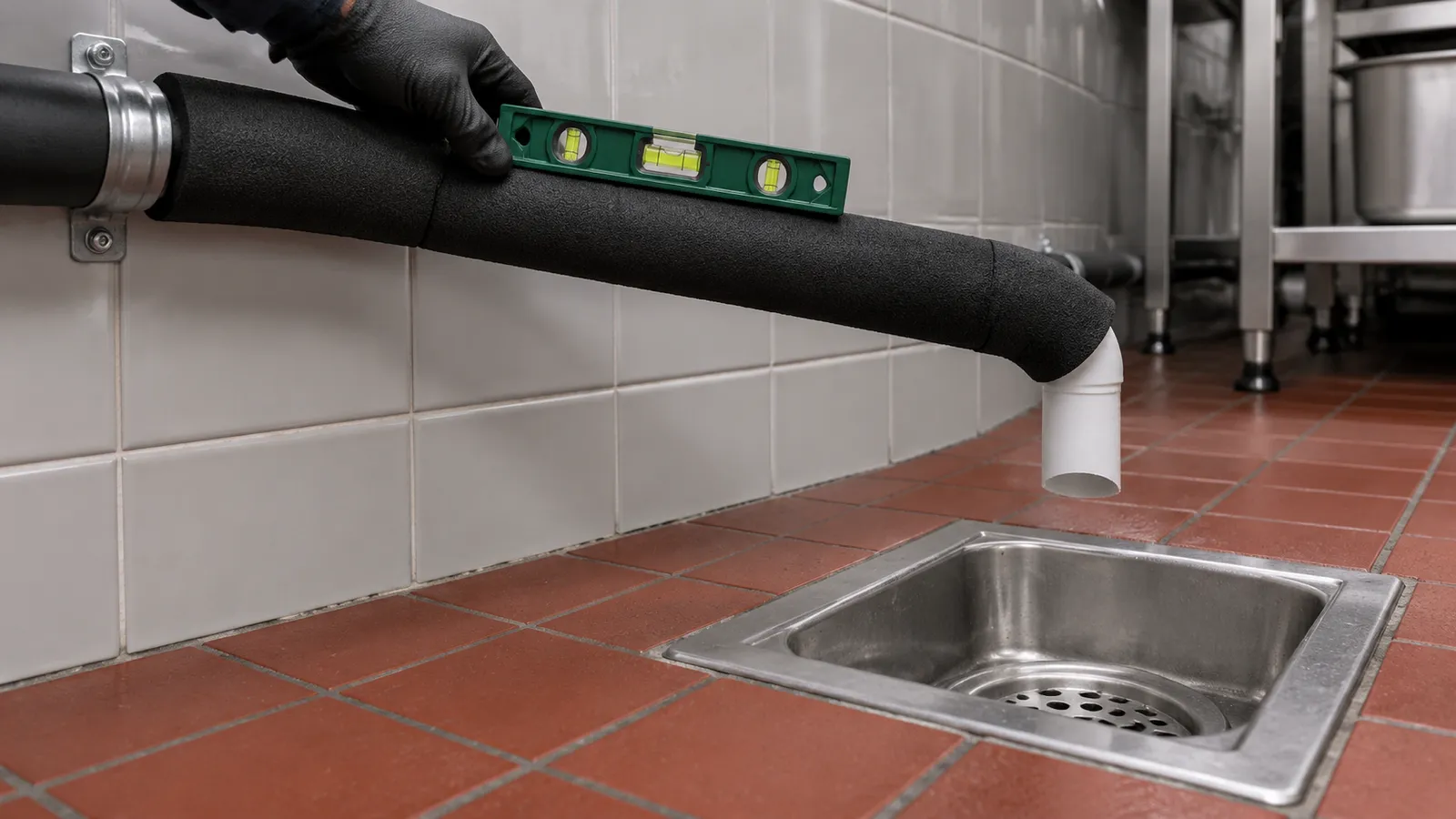
Ice machine drain requirements: air gap vs air break, floor sinks, 1/4 in per ft slope, separate bin drains, hose size, venting and drain pumps.
A commercial ice machine drain has to do one job without fail: carry purge water, meltwater and condenser water away from the machine without ever letting sewer water back toward the ice. So codes treat it as an indirect waste: the line ends in open air above a floor sink or floor drain instead of being piped into the sewer, it falls steadily to that receptor, and the bin and ice maker usually drain separately. Below are the requirements an inspector will check, where each comes from, and when a drain pump makes sense.
Part of our commercial ice maker buying guide series.
Why ice machine drains are held to a stricter rule
Ice is food under the FDA Food Code 2022, and the code protects it at the drain end as well as the supply end. Section 5-402.11(A) says a direct connection may not exist between the sewage system and a drain from equipment in which food is placed. Otherwise a sewer backup could push wastewater up the line and into the bin. Section 4-204.17 adds that liquid waste drain lines may not pass through an ice machine or ice storage bin.
The plumbing codes say the same thing in their own terms. The International Plumbing Code (IPC), Section 802.1.1, requires equipment used to store, prepare or handle food to discharge through an indirect waste pipe by means of an air gap. The Uniform Plumbing Code (UPC) lists ice-making machines by name among food and beverage equipment that needs indirect waste piping, and it requires an air gap for bins that store unpackaged ice. Which code applies depends on your state or city, and many jurisdictions amend it, so treat the sections below as model rules and confirm the local version with your inspector.
The drain also works hard: many cube machines purge mineral-laden sump water every cycle, and the bin drain takes meltwater around the clock. Our guide to how commercial ice machines work explains the purge step.
Air gap vs air break: which one an ice machine needs
Both leave the drain pipe open to the room before water enters the receptor. The difference is the protection they give if the receptor backs up.
| Air gap | Air break | |
|---|---|---|
| Where the pipe ends | Fully above the flood level rim of the floor sink or receptor | Below the rim, but not sealed into the receptor or its trap |
| Minimum size | IPC 802.2.1: at least twice the effective opening of the indirect waste pipe. The UPC sets a minimum vertical drainage air gap of 1 inch | No fixed vertical distance; the pipe must not be connected to the trap seal |
| What happens in a backup | Wastewater overflows the receptor onto the floor before it can reach the pipe | Wastewater can rise into the end of the pipe |
| Ice machines and ice bins | Required by IPC 802.1.1 for food storage and handling equipment, and by the UPC for unpackaged ice storage | Allowed for some other indirect wastes; ask your inspector before using one on any ice equipment |
Measure from the lowest point of the pipe end to the receptor’s rim, not to the grate or the water inside. Food Code 5-202.13 (twice the inlet diameter, never less than 1 inch) is written for water supply inlets, so for the drain gap follow your adopted plumbing code.
Ice machine floor drain or floor sink: what the receptor needs
The “waste receptor” is usually a floor sink: a basin set flush with the floor, with a removable strainer and a trap below. A floor drain, hub drain or standpipe can also serve, depending on local rules. Under IPC Section 802.2 and 802.3, the receptor must be:
- Trapped and vented and connected to the building drainage system.
- Covered with a removable strainer or basket over its outlet, other than hub drains for clear water and standpipes.
- Accessible. Receptors may not sit in concealed spaces, plenums, crawl spaces or above ceilings, and they need ready access for cleaning.
- Sized for the total flow of every indirect waste pipe that discharges into it, so check what else already drains there before adding an ice machine.
A floor sink beside or just behind the bin keeps the run short and lets staff see the air gap and clean the strainer without moving equipment.
Drain slope: why 1/4 inch per foot is the usual target
Ice machine drains are gravity drains in most installations, so the line must fall all the way from the outlet to the receptor. Two references point to the same figure:
- Plumbing codes. IPC Table 704.1 sets a minimum slope of 1/4 inch per foot for horizontal drainage pipe 2-1/2 inches or smaller. The UPC sets a uniform slope of not less than 1/4 inch per foot, or 2 percent, for horizontal drainage piping, with limited exceptions for larger pipe.
- Manufacturer manuals. Installation manuals we checked from two ice machine makers call for at least 1/4 inch of fall per foot on the drain line.
The slope must be continuous. A sag on the floor, a coil of spare hose behind the bin or an uphill section to a high floor sink all leave low points where water sits and slime grows. If your model’s manual gives a steeper pitch or a maximum run, follow it.
Separate bin and machine drains
A modular or split ice maker that sits on a storage bin usually has at least two drain outlets: one from the ice-making section and one from the bin. Water-cooled machines usually add a separate condenser drain. Run each one to the receptor on its own line unless the manual for that model says otherwise.
The UPC states it directly for food-handling equipment: each indirect waste pipe shall be separately piped to the indirect waste receptor and shall not combine with other indirect waste pipes. The practical reason: if a shared line slows or backs up, purge water can flow into the bin and melt or contaminate the ice. One flake ice machine manual, for example, calls for a separate gravity drain for the storage bin and a separate condenser drain on water-cooled models.
Venting and trapping the drain line
Venting happens at two points. The receptor itself must be trapped and vented under IPC Section 802.2; one flake ice machine manual calls a trapped and vented floor drain the ideal drain receptacle. On the machine side, some installation manuals require the drain tubing to be vented so it cannot siphon or air-lock, and some drain pump kits ship with a vent tube. If your model’s manual shows a vent, install it where the manual places it.
Length also matters for trapping. Under IPC Section 802.2, indirect waste piping that exceeds 30 inches in developed length measured horizontally, or 54 inches in total developed length, must be trapped. The UPC requires a trap on indirect waste pipes longer than 5 feet and less than 15 feet. Short, direct runs avoid both issues.
Ice machine drain hose and line: material and size
Size the drain line to the outlet on the machine and never smaller. The UPC sets the indirect waste pipe for ice-making machines at not less than the drain on the unit and in no case less than 3/4 inch.
For material, use pipe or tubing that your plumbing code approves for drainage and that the manual allows. Manuals differ: one flake ice machine manual says “use only rigid tubing,” while another manufacturer supplies a silicone drain line with a minimum bend radius of 8 inches. If your model allows flexible hose, keep it short, supported and free of loops so it cannot kink, sag or get crushed behind the bin. Where the line changes direction, the UPC asks for cleanouts on indirect waste pipes so the line can be flushed.
Insulation, condensation and heat
Cold meltwater and purge water make the drain line sweat in a humid kitchen, and the drips can be mistaken for a leak. Some manufacturer manuals call for insulating the bin drain; one says the storage bin drain line “should be insulated.”
Keep the line away from fryers and ovens, where heat can soften plastic tubing, and out of walkways. If water still appears around a running machine after the drain is set up correctly, work through our guide to ice machine leaking water.
When an ice machine drain pump makes sense
Gravity is the default. A drain pump is the fallback when no floor drain or floor sink near the machine is low enough, such as a bar island or a space where the slab cannot be cut for a new floor sink. Several ice machine makers sell drain pump kits matched to specific models for these sites.

- Use a pump approved for your model. Capacity, lift height and any overflow safety shutoff vary between kits, so ask the machine maker or your dealer which pump fits.
- The air gap still applies. The pump discharge line must still end at an approved receptor with the required air gap; a pump does not make a direct sewer connection acceptable.
- Plan power and access. The pump needs its own receptacle and room to remove it for cleaning.
- Add it to the cleaning schedule. Pump reservoirs collect the same slime and scale as the bin drain.
Common ice machine drain mistakes
- Hard-piping the drain into a sewer line or into the trap of a floor sink, with no air gap.
- Tucking the drain end below the rim of the floor sink or into the strainer.
- Teeing the bin drain into the machine drain, or into a hand sink or dish machine drain.
- Running the line flat, uphill or with a sag behind the equipment.
- Reducing the drain below the outlet size, or below 3/4 inch where the UPC applies.
- Skipping the drain line and floor sink strainer at cleaning time. See how to clean a commercial ice machine.
Ice machine drain inspection checklist
Use this list before the health or plumbing inspector arrives. It covers drains only; for water supply, electrical, clearance and start-up, use the full checklist in our commercial ice machine installation guide.
| Check | What passes |
|---|---|
| Connection to sewer | No direct connection; every ice machine and bin drain ends in open air |
| Air gap | Pipe end above the receptor’s flood level rim by the distance your adopted code requires |
| Receptor | Trapped, vented, accessible floor sink or approved receptor with strainer, sized for all lines draining into it |
| Slope | Continuous fall, typically at least 1/4 inch per foot, with no sags or loops |
| Separate lines | Machine, bin and any condenser drains run separately unless the manual allows otherwise |
| Size | Not smaller than each drain outlet, and not less than 3/4 inch where the UPC applies |
| Vent and trap | Vent where the manual shows it; trap on long indirect runs as the local code requires |
| Routing | No other waste line passes through the ice machine or bin |
| Insulation | Bin drain and other cold runs insulated where they could sweat |
| Drain pump, if used | Model-approved pump, discharge ending at an air gap, on its own receptacle |
Planning drains for a BF500 or BF360
Smartool’s BF500 is a split type ice maker rated at 500 lbs per 24 hours, and the BF360 is a split head model rated at 360 lbs per 24 hours. The product pages do not list the drain outlets, their sizes or whether a pump is needed, so confirm the BF drain configuration with your sales rep before the plumber roughs in the floor sink. Share your floor plan with the receptor marked, and ask for the installation manual so your plumber can check outlet positions, line size and venting against local code.
Ice machine drain questions
Can an ice machine drain be connected directly to the sewer?
No. Food Code 5-402.11(A) prohibits a direct sewer connection for drains from equipment holding food, including ice. The IPC requires an air gap for food-handling equipment, and the UPC requires indirect waste piping for ice-making machines and an air gap for bins holding unpackaged ice.
What size drain line does an ice machine need?
At least the size of the drain outlet on the unit. Where the UPC applies, the indirect waste pipe for an ice-making machine may not be smaller than 3/4 inch. The manual for your model gives the outlet size.
Can the bin and the ice maker share one drain line?
Usually not. The UPC requires separate indirect waste pipes for food-handling equipment, and a shared line can back machine water into the bin. Follow the manual if it shows otherwise.
Do I need a drain pump for an ice machine?
Only if there is no floor sink or floor drain low enough to reach by gravity with continuous slope. Use a pump kit approved for your model, and end its discharge at an air gap over an approved receptor.
Drain planning is easier when the machine is chosen with the site in mind. Compare capacities and configurations in our commercial ice maker range, then request a factory-direct quote and ask the team to confirm the drain setup for the model you choose.
Factory-direct from Smartool
Planning a commercial equipment purchase?
Share your site conditions, daily output and budget. Our team will match a model, send the spec sheets and quote factory-direct pricing.

Written by
Senior Engineer, Smartool
Jason is a senior engineer at Smartool. He works on the commercial ice machines, soft serve and slushy machines, and refrigerated prep tables Smartool builds for restaurants, bars, hotels and dessert shops. His guides look at equipment from the engineering side: how to size a machine for a site, what it needs for power, water and airflow, and how to keep it running through busy service. He also helps buyers match the right model to their kitchen before they request a quote.
.elementor-76528 .elementor-element.elementor-element-5c7a0d0{--display:flex;--flex-direction:column;--container-widget-width:100%;--container-widget-height:initial;--container-widget-flex-grow:0;--container-widget-align-self:initial;--flex-wrap-mobile:wrap;}.elementor-76528 .elementor-element.elementor-element-5c7a0d1 .elementor-toc__header-title{text-align:start;}.elementor-76528 .elementor-element.elementor-element-5c7a0d1 .elementor-toc__header{flex-direction:row;}.elementor-76528 .elementor-element.elementor-element-5c7a0d1{--item-text-hover-decoration:underline;}
On this page
Need pricing for your project?
Get a factory-direct quote on commercial ice makers, soft serve and slushy machines, and refrigerated prep tables.
✓ Model matching and spec sheets for your site
✓ US office in City of Industry, CA
✓ Talk to an expert: +1 (872) 221-0051
Browse by topic
Ice Machine Guides
Soft Serve & Ice Cream
Slushy & Frozen Drinks
Buying & Sourcing
Compliance & Maintenance
Related posts

Ice Machine Drain Requirements: Air Gap, Floor Drain, Pumps
Ice machine drain requirements: air gap vs air break, floor sinks, 1/4 in per ft slope, separate bin drains, hose size, venting and drain pumps.

Energy Efficient Soft Serve Machine: Watts, Night Mode, Cost
Compare soft serve machine energy use: rated watts vs duty cycle, night mode, refrigerant, a monthly cost formula, ENERGY STAR status and 220 V wiring.