




Blog
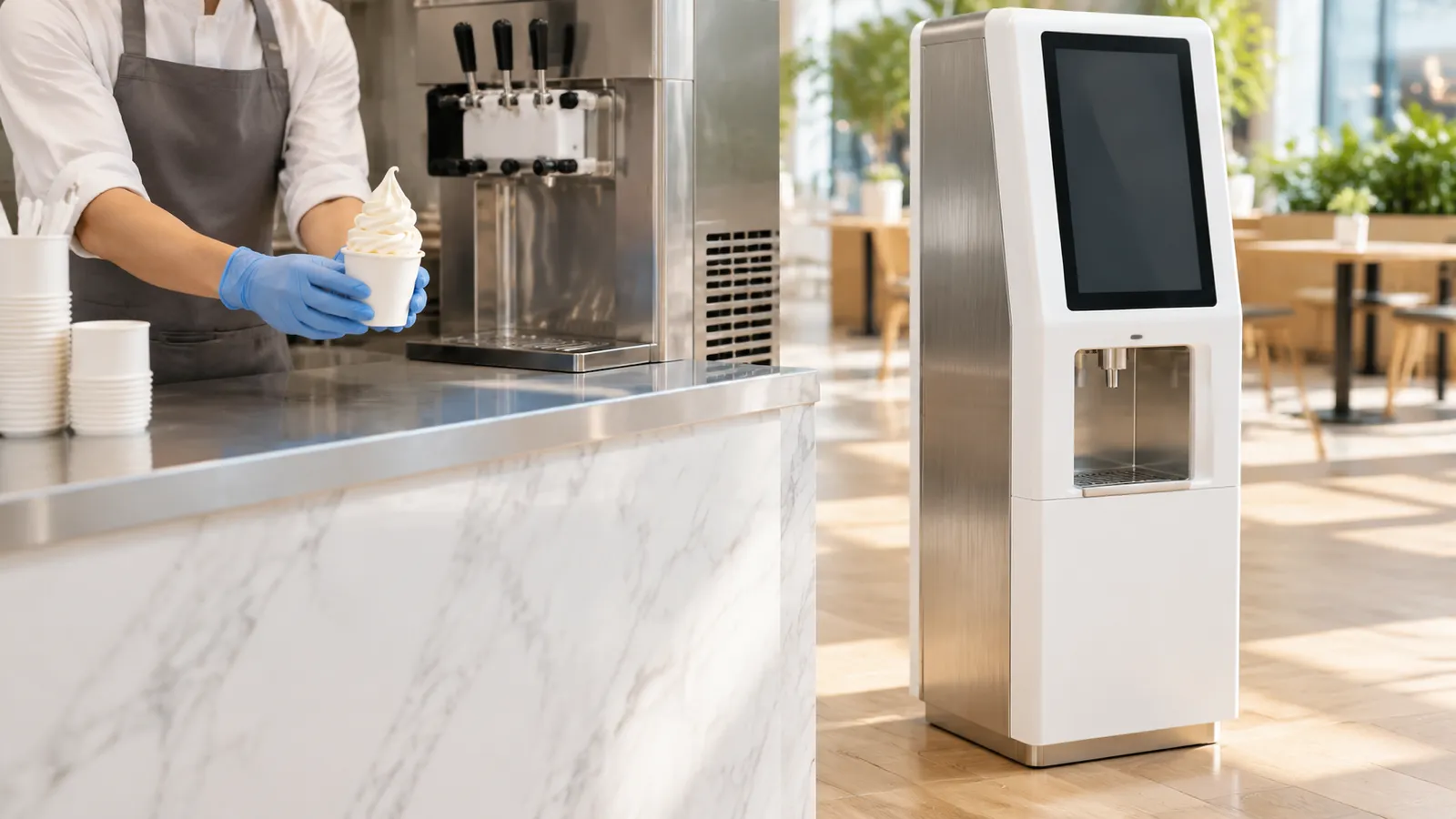
Compare a self service ice cream vending machine with semi-automatic and staffed soft serve machines: labor, space, throughput, cleaning, power and cost logic.
Ice cream vending machine vs soft serve machine is really a question about staffing. A self service ice cream vending machine freezes, dispenses and takes payment on its own, so it can sell where nobody works the counter. A staffed soft serve machine makes the same product, but an employee pulls the handle, takes the money and cleans up. In between sits the semi-automatic counter machine: staff still serve, but the machine handles portioning and much of the cleaning. Which one fits depends on your foot traffic, your hours, the space and power you have, and how much your local health department will let a machine do alone. This guide compares all three on the points that change the business case, then gives you a checklist for your site.
Part of our commercial soft serve machine buying guide series.
The three formats in plain terms
All three run the same core process: chilled liquid mix flows from a hopper into a freezing cylinder, where it is frozen and whipped into soft serve. What differs is who does everything around that cylinder.
- Fully automatic vending robot. An unmanned ice cream machine in a closed cabinet. The customer orders and pays on a touchscreen, the machine drops a cup, fills it and presents it at a pickup window. Staff only visit to refill, clean and fix faults. Smartool’s BA18-100C3 is this type.
- Semi-automatic counter machine. An employee still hands the cup over, but the machine controls the portion and recognizes the cup type, and it often has automatic sterilization. The SW26-BA in Smartool’s unmanned range is built for this middle ground.
- Staffed soft serve machine. The familiar countertop or floor unit behind a dessert counter. Staff pull the handle, build the cone, take payment and run the cleaning routine. The GT18RELW single head machine is a typical small-shop example.
Side-by-side comparison
Every row depends on the exact model, so check the spec sheet for the unit you are quoting.
| Factor | Fully automatic vending | Semi-automatic counter | Staffed soft serve |
|---|---|---|---|
| Staff at point of sale | None; scheduled service visits | One person serving | One or more people serving |
| Peak-hour speed | One order at a time, fixed cycle | Fast; staff work in parallel with the machine | Fastest with skilled staff and enough capacity |
| Menu flexibility | Set by software and toppings dispensers | Moderate; staff can add toppings and cones | Widest: cones, sundaes, shakes, specials |
| Footprint | Freestanding cabinet plus queue and service access | Counter space plus serving area | Counter or floor space plus prep and cleaning area |
| Hours it can sell | Whenever the venue is open | Staffed hours | Staffed hours |
| Payment | Built in: card reader, touchscreen | Your POS | Your POS |
| Cleaning labor | Automated cycles plus manual cleaning on the health department’s schedule | Reduced by sterilization features, still scheduled | Daily teardown or heat-treatment routine |
| Cost logic | Higher equipment cost, low labor, location commission | Mid equipment cost, partial labor | Lower equipment cost, wages are the biggest line |
Labor: who is on site, and for how long
Labor is usually the reason buyers look at vending in the first place. A staffed machine needs someone at the counter for every hour you want to sell, plus time to open, close and clean. If a kiosk in a hotel lobby sells a few cups an hour late at night, a paid shift there rarely makes sense. A machine that sells without anyone present turns those slow hours into sales instead of fixed cost.
Unmanned does not mean no labor, though. Someone still refills mix and cups, empties waste, wipes the dispensing area, runs the cleaning cycle and logs it. Count service visits per week, time per visit and travel between sites. One operator can cover several machines on a route. A semi-automatic machine keeps one person on site but cuts the skilled parts of the job: consistent portions and less closing work. That helps when staff turnover is high or when the server also runs a coffee bar.
Throughput and menu flexibility
A vending robot serves one order at a time, and each order runs a fixed cycle: payment, cup drop, fill, toppings, pickup. That works for steady, spread-out demand. It struggles with a rush, such as a school bus unloading at a zoo or halftime at a stadium, when a line forms behind one screen. A staffed counter can add a second server and a second machine, and a skilled employee can pour faster than a mechanism.
Rated capacity matters for all three. Smartool lists the SW26-BA at 20–26 L/h and the GT18RELW at 18–24 L/h. Compare rated output against your busiest hour, not your daily average. For a vending unit, ask the supplier for the output of the exact US configuration, because cycle time per cup limits sales more than freezing capacity does. Our guide to gravity-fed vs pump soft serve machines explains how mix feed affects texture and servings per gallon on staffed units.
Menu is where staffed service wins. A person can make cones, dipped cones, sundaes, shakes and a seasonal special the same day. A vending machine sells what its software, cup sizes and toppings dispensers allow, usually cups with a short list of toppings. If your concept depends on variety or upselling, keep a person serving.
Footprint, power and water
A vending kiosk is a single freestanding cabinet. Smartool lists the BA18-100C3 body at 380 × 777 × 1542 mm and a 0.45 m² footprint (about 4.8 sq ft). Add room for a short queue, the door swing for service access, and airflow around the condenser. A staffed setup needs less floor space for the machine itself, but more around it: a serving counter, a prep area, cone storage and a sink for cleaning. Our countertop soft serve machine comparison covers that choice for staffed counters.
Power varies by model. The GT18RELW runs on 110 V / 60 Hz at 1580 W. The BA18-100C3 page lists 1300 W while freezing and 800 W in fresh-keeping mode; confirm the voltage, plug and circuit of the US configuration with your sales rep before you sign a location, because adding a dedicated circuit at a mall or hotel takes time and the venue’s approval. On water, a vending cabinet usually has no plumbing hookup, so cleaning water comes in on the service visit. A staffed counter is normally near a sink already, which makes the daily cleaning routine easier.
Hygiene and cleaning
Soft serve mix is a time/temperature control for safety (TCS) food, so the FDA Food Code cold-holding rule applies to all three formats: hold it at 41 °F (5 °C) or below (§ 3-501.16). The difference is who notices a problem. At a counter, an employee sees soft product or a warm hopper. In a kiosk, the controller has to catch it. The Food Code’s vending rule (§ 4-204.111) requires an automatic control that stops sales when the machine cannot hold temperature, until it is serviced; Minnesota’s version of the automatic shutoff rule shows how a state adopts it.
Cleaning intervals vary more by health department than by machine. Many local procedures expect a full clean and sanitize at the end of each day’s operation. Heat-treatment designs can stretch full teardowns to 14 days, or 28 in some states, according to Foodservice Equipment Reports, but daily wipe-downs still apply. Smartool’s specs list a 7-day auto-clean cycle and alcohol plus UV sterilization for the BA18-100C3, and a 14-day clean-free function for the SW26-BA. Treat those as machine capabilities, not permission: confirm the interval with your inspector before you plan staffing around it.
Payment and placement
A vending machine is its own point of sale. It needs a card reader, ideally tap-to-pay, and a network connection for payments and remote monitoring. The BA18-100C3 has a 12-inch touchscreen and Smartool lists cloud real-time data for remote tracking. Payment options differ by market, so confirm the US payment setup (card reader, mobile wallets, cash or not) with your sales rep. Staffed and semi-automatic machines use your existing POS, which is simpler if you already run a café or shop.

Placement follows from staffing. Unattended kiosks suit spaces with steady traffic, long hours and no food counter: hotel lobbies, malls, office buildings, hospitals, campuses, gyms, airports and entertainment centers. Staffed machines suit dessert shops, cafés, restaurants, food trucks and event stands, where someone is already on shift. Semi-automatic units fit the gap: a busy counter that wants faster, more consistent service without adding headcount. For a vending site, the venue usually takes a commission or rent, and it will often have its own rules on electrical work, insurance and accessibility. The 2010 ADA Standards (§ 228.1) apply to vending machines where they are provided, so ask the venue what it expects for reach range and controls.
Upfront vs operating cost logic
Prices vary widely by model, configuration and order size, so build the comparison on structure rather than headline price. A fully automatic machine costs more to buy because it adds the cabinet, cup and topping handling, the payment system and the controller. It saves wages and can sell longer hours. A staffed machine costs less upfront, but wages become your largest monthly line, and each extra selling hour costs another shift.
Put each option into the same model. Per-cup costs: mix, cups, toppings, card fees and any location commission. Fixed monthly costs: wages or service visits, electricity, connectivity or software, cleaning supplies, insurance and rent. Then test the model at a realistic cups-per-day figure for each site, not a best-case one. Our breakdown of ice cream vending machine profit margins walks through per-cup costs and payback for unattended units. For a staffed shop, our guide to choosing an ice cream maker machine for business covers sizing and the equipment budget.
Permits and rules at a high level
Rules depend on your state and county, and they often treat the formats differently. A staffed soft serve machine is usually covered by the food establishment permit of the shop it sits in. A stand-alone vending machine that sells TCS food may need its own permit. For example, the Maricopa County vending machine code in Arizona requires a permit, plan review and an approved commissary for these machines, but exempts machines run on the premises of a permitted eating and drinking establishment. Its plan review asks for a NAMA certification letter or documentation that the equipment is NSF/ANSI approved, so ask your supplier what documentation it can provide before you order.
At the federal level, operators who own or operate 20 or more vending machines must disclose calories under 21 CFR 101.8. Call your local health department early with the machine’s spec sheet and ask which permit category applies.
Which one fits? A decision checklist
Answer these for each site you are considering:
- Is anyone already on shift? If yes, a staffed or semi-automatic machine adds sales without adding wages. If no, a vending machine is usually the only way to sell there.
- How spread out is demand? Steady traffic over long hours suits vending. Short, sharp peaks suit staffed service with enough capacity.
- How wide is the menu? Cups with a few toppings fit vending. Cones, sundaes and shakes need staff.
- What can the site supply? Floor space, a suitable circuit, network signal, and nearby water and drainage for cleaning.
- What will the health department accept? Permit category, cleaning interval and any equipment documentation.
- Who services it? Someone within reasonable driving time for refills, cleaning and faults, with remote alerts to cut wasted trips.
- Does the math work at a realistic volume? Run the per-cup and monthly model above at a conservative cups-per-day number.
If most answers point to unattended, start with Smartool’s unmanned ice cream machine range or the automatic ice cream vending machine page. If they point to a counter, compare commercial soft serve machine options by capacity and power.
FAQ
What is the difference between an unmanned ice cream machine and a regular soft serve machine?
Both freeze mix in a cylinder. An unmanned machine adds ordering, payment, cup handling, dispensing and monitoring so it can sell without staff. A regular soft serve machine needs an employee to serve, take payment and clean.
Is a self service ice cream vending machine cheaper to run than a staffed machine?
Usually it costs less in labor and more in equipment, connectivity and location commission. Whether it is cheaper overall depends on sales volume and how many hours a staffed counter would need to cover. Model both at the same cups-per-day figure.
Can a soft serve vending machine handle a rush?
Only up to its cycle time, because it serves one order at a time. For venues with sharp peaks, a staffed or semi-automatic counter, or several vending units, handles lines better.
Do I still need to clean an automatic machine every day?
Your health department decides. Many expect daily cleaning; some accept longer intervals for heat-treatment or self-cleaning designs. Plan for daily wipe-downs and refill checks either way.
Not sure which format suits your location? Send us the site type, opening hours, expected traffic and available power, and we will match a model to it. Request a factory-direct quote.
Factory-direct from Smartool
Planning a commercial equipment purchase?
Share your site conditions, daily output and budget. Our team will match a model, send the spec sheets and quote factory-direct pricing.

Written by
Senior Engineer, Smartool
Jason is a senior engineer at Smartool. He works on the commercial ice machines, soft serve and slushy machines, and refrigerated prep tables Smartool builds for restaurants, bars, hotels and dessert shops. His guides look at equipment from the engineering side: how to size a machine for a site, what it needs for power, water and airflow, and how to keep it running through busy service. He also helps buyers match the right model to their kitchen before they request a quote.
.elementor-76528 .elementor-element.elementor-element-5c7a0d0{--display:flex;--flex-direction:column;--container-widget-width:100%;--container-widget-height:initial;--container-widget-flex-grow:0;--container-widget-align-self:initial;--flex-wrap-mobile:wrap;}.elementor-76528 .elementor-element.elementor-element-5c7a0d1 .elementor-toc__header-title{text-align:start;}.elementor-76528 .elementor-element.elementor-element-5c7a0d1 .elementor-toc__header{flex-direction:row;}.elementor-76528 .elementor-element.elementor-element-5c7a0d1{--item-text-hover-decoration:underline;}
On this page
Need pricing for your project?
Get a factory-direct quote on commercial ice makers, soft serve and slushy machines, and refrigerated prep tables.
✓ Model matching and spec sheets for your site
✓ US office in City of Industry, CA
✓ Talk to an expert: +1 (872) 221-0051
Browse by topic
Ice Machine Guides
Soft Serve & Ice Cream
Slushy & Frozen Drinks
Buying & Sourcing
Compliance & Maintenance
Related posts

Ice Cream Vending Machine vs Soft Serve Machine: Which Fits?
Compare a self service ice cream vending machine with semi-automatic and staffed soft serve machines: labor, space, throughput, cleaning, power and cost logic.

How Does an Ice Cream Vending Machine Work? Inside the Robot
How an ice cream vending machine works, from cold mix and freezing cylinder to robot arm, payment, telemetry and cleaning, plus a buyer's spec checklist.