




Blog
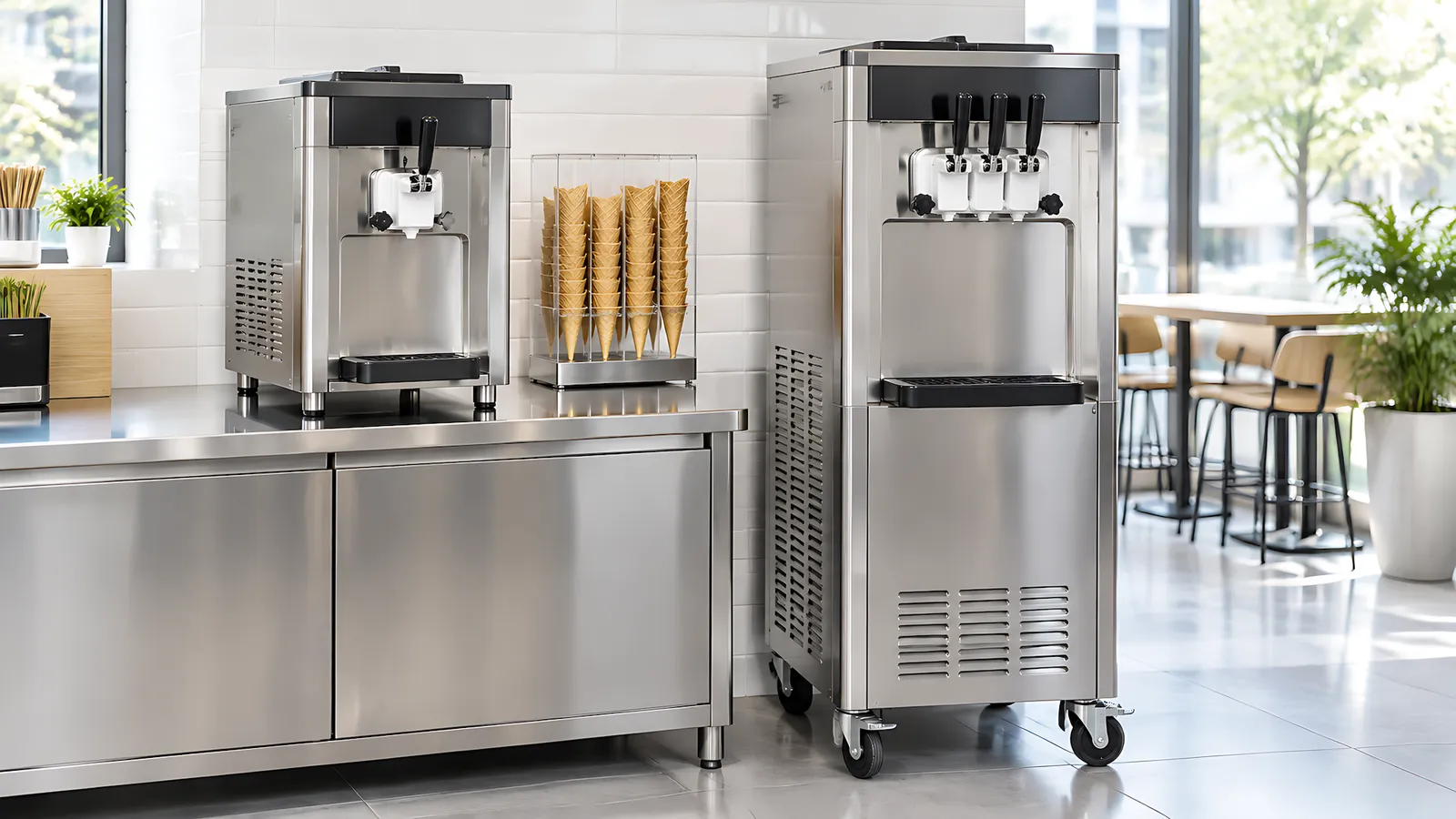
Countertop soft serve machine or floor model? Compare output, voltage, space, health-code clearance, cleaning and downtime, with real spec examples.
A countertop soft serve machine sits on an existing counter, usually runs on a standard 110 to 115V circuit and suits soft serve as a side menu item or a single-flavor counter. A floor model soft serve machine stands on its own footprint, can add heads, hopper volume and a second refrigeration system, and suits operations where soft serve is a core revenue line. The right choice depends less on the label than on four numbers: the servings you need in your busiest hour, the circuit you can supply, the space and clearance you have, and the cleaning time your staff can give it each night. This guide compares the two formats on each of those points, using published specs from Smartool’s own range as worked examples.
Part of our commercial soft serve machine buying guide series.
Countertop vs floor soft serve machines at a glance
| Factor | Countertop (tabletop) | Floor model (vertical) |
|---|---|---|
| Typical role | Add-on dessert, single-flavor or small multi-flavor menu | Core product line, long peak periods, several flavors |
| Output | Lower to mid range; triple-head countertop units narrow the gap | Highest, often with two independent refrigeration systems |
| Power | Many single-head units run on 110 to 115V/60Hz | Often a higher-voltage circuit; Smartool’s vertical model lists 220V/60Hz |
| Space | Counter depth, load rating and clearance around vents | Floor footprint, aisle space and clearance to walls |
| Installation | Legs or sealing to the counter for cleaning access | Legs or sealing to the floor for cleaning access |
| Cleaning load | Fewer parts on single-head units | More parts per night, but one side can keep serving if the other is down on dual-system designs |
What “countertop” and “floor” actually mean
There is no industry standard for either term. Manufacturers use “countertop,” “desktop” and “tabletop” for any machine designed to stand on a work surface, and “floor,” “floor-standing” or “vertical” for machines with their own base. Size within each group varies a lot, so compare dimensions rather than labels.
Smartool’s range shows the spread. Its multifunctional hard and soft machine is listed as a countertop unit at 340 × 455 × 380 mm and 26 kg. The BT742SR2JL-F is also sold as a countertop triple-head machine, but its page lists 570 × 770 × 974 mm. On a 36-inch counter, a machine 974 mm tall puts the top of the unit roughly 74 inches off the floor, which matters for whoever lifts mix into the hopper. The vertical BT768CRJL-TF shares the same 570 × 770 mm footprint at 1,567 mm tall, so it stands on the floor instead of a counter.
Output: match the format to your busiest hour
Output is the first filter. Average daily sales matter less than the 30 to 60 minutes when the line is longest. Count the servings you expect in that window, multiply by your serving size, and compare the result with the machine’s rated hourly output. Then leave margin. Ratings are measured under set conditions: the SW26RJL-F and SW52REL-TF pages, for example, state their output at 23°C ambient and 23°C mix temperature. A hotter room or warmer mix will slow freezing.
Published specs from Smartool’s range give a sense of where each format lands:
| Model (format on its page) | Rated output | Power | Voltage |
|---|---|---|---|
| GT18ERLW-F (countertop, single head) | 18 to 24 L/h | 1,580 W | 110V/60Hz |
| SW26RJL-F (desktop, single head) | 22 to 30 L/h | 1,600 W, 16 A | 115V/60Hz |
| BT742SR2JL-F (countertop, triple head, single system) | 42 L/h | 3,800 W | 220V/60Hz |
| BT768CRJL-TF (vertical, triple head, dual system) | 68 L/h | 4,600 W | 220V/60Hz |
The pattern is clear. Single-head countertop machines cover small and medium demand. A triple-head countertop unit adds flavors and output without moving to the floor. The floor model nearly doubles output again. One model sits between the categories: the SW52REL-TF lists 48 to 52 L/h on 110V/60Hz, but its page does not say whether it is meant for a counter or a stand, and it weighs 127 kg. Confirm the intended installation with sales before you plan around it.
Output is also shaped by how mix enters the cylinder. Our comparison of gravity-fed vs pump soft serve machines explains how the feed system changes overrun, servings per gallon and cleaning work.
Power: the decision is often made at the electrical panel
Check your circuits before you fall for a spec sheet. Single-head countertop units in Smartool’s range list 110V or 115V at 60Hz, and the SW26RJL-F page gives a 16 A rated current. Smartool’s factory-direct page recommends a dedicated 20 to 30 A circuit per unit for its 110V SW52REL-TF and GT18ERLW-F. Higher-output machines move to 220V: both triple-head models list 220V/60Hz. That may mean a new circuit, a different receptacle and an electrician’s visit, which belongs in the budget alongside the machine.
Watch the frequency as well as the voltage. Smartool’s multifunctional hard and soft machine page lists AC220 to 240V/50Hz. U.S. power is 60Hz, so confirm a U.S.-voltage version with sales before ordering that model.
Space, airflow and cleaning clearance
Both formats need room to breathe. Smartool’s ice cream machine maintenance guide recommends more than 30 cm (12 in) of clearance at the back and both sides, away from heat sources. Then check which way each machine moves air, because it decides what can sit next to it:
- Bottom intake, rear-top exhaust: listed for the SW26RJL-F and SW52REL-TF. Keep the counter surface under the machine clear and leave space behind it.
- Side intake, side exhaust: listed for the BT742SR2JL-F and BT768CRJL-TF. Do not tuck these between other appliances.
- Alternative bottom intake and rear exhaust: listed as an installation option on the BT768CRJL-TF, which helps in a row of equipment.

Legs, sealing and the health inspector
Health codes care about the space under the machine because that is where spills collect. Many states base these rules on the FDA Food Code. Minnesota’s version, Minnesota Rules 4626.0730, is a clear example. Counter-mounted equipment that is not easily movable must sit on legs giving at least 4 inches (10 cm) of clearance above the table, with smaller gaps allowed only when the cleaning reach is short. Floor-mounted equipment that is not easily movable must be sealed to the floor or raised on legs with at least 6 inches (15 cm) of clearance.
“Easily movable” has a specific meaning in the same code: portable or mounted on casters, gliders or rollers, and with no utility connection, a quick-disconnect, or a flexible line long enough to move the unit for cleaning. A floor machine on casters with a long cord can qualify. A heavy countertop unit sitting flat on the counter usually will not, so check its feet against your local code before installation day.
Counter strength and self-serve reach
Countertop does not mean light. The SW26RJL-F lists 77 kg (about 170 lb) net, and the GT18ERLW-F lists 48 kg. Confirm the counter is rated for the machine plus a full hopper.
If customers will pull their own soft serve, as at a buffet, reach matters too. Under the 2010 ADA Standards, self-service dispensing devices in food service lines must meet the reach ranges in section 308. For an unobstructed forward reach, that means operable parts no higher than 48 inches and no lower than 15 inches above the floor. A tall machine on a standard counter can put handles out of range, so measure before you choose the format and the counter height together.
Cleaning and downtime
More heads and cylinders mean more parts to take apart, wash, sanitize and reassemble at close. A single-head countertop unit is the quickest to clean, and the GT18ERLW-F adds a one-touch cleaning function, although removable parts still need hand washing. Floor models take longer each night but can offer resilience. The BT768CRJL-TF lists dual compressors, dual motors and independent dual-system power control that “can be operated separately,” so a fault on one side does not have to stop all service.
Downtime is the hidden cost in this comparison. If one countertop machine is your only source of soft serve, a single failed seal closes the dessert menu. One alternative is to run two countertop units instead of one floor model, accepting a second set of parts to clean in exchange for backup. Put the numbers side by side with our soft serve machine cost and ROI worksheet.
Which format fits your business?
| Business | Better starting point | Why |
|---|---|---|
| Café or coffee shop adding dessert | Single-head countertop | Fits existing counters and 110V circuits; low cleaning load |
| Convenience store or gas station | Single-head countertop | Small footprint near the register; simple for rotating staff |
| Food truck or kiosk | Compact countertop | Space and power are the limits; check generator or shore power capacity |
| Restaurant with a dessert menu | Triple-head countertop | Two flavors plus twist without giving up floor space |
| Dedicated soft serve or dessert shop | Floor model, dual system | Highest output and one side can keep serving during a fault |
| Buffet with self-serve | Either, chosen for reach height and simple handles | Customer use adds ADA reach and handling considerations |
Countertop and floor model questions
Is a countertop soft serve machine strong enough for a restaurant?
Often, yes, if soft serve is one dessert among several. Size it by your busiest hour. When dessert sales cluster into short rushes, a triple-head countertop unit or a floor model gives more headroom than a single-head machine.
Do countertop soft serve machines need a 220V outlet?
Not always. Several single-head models are listed at 110V or 115V/60Hz, while higher-output countertop machines such as the BT742SR2JL-F list 220V/60Hz. Check the rated voltage and current on the product page and have an electrician confirm the circuit.
How much space does a countertop soft serve machine need?
Add the machine’s footprint to the vent clearance, more than 30 cm (12 in) at the back and sides on Smartool’s guidance, plus working space in front for cups and cones. Allow for legs that meet your local health code’s clearance under the machine.
Can a floor model soft serve machine be moved for cleaning?
It depends on how it is installed. Under Food Code-based rules like Minnesota’s, a unit on casters with a flexible or quick-disconnect power connection counts as easily movable. Otherwise it must be sealed to the floor or raised on legs with at least 6 inches of clearance.
Compare countertop and vertical formats side by side in our soft serve and ice cream machine range, including the BT768CRJL-TF vertical triple-head machine. Send us your peak-hour servings, available circuit and counter or floor dimensions to request a factory-direct quote.
Factory-direct from Smartool
Planning a commercial equipment purchase?
Share your site conditions, daily output and budget. Our team will match a model, send the spec sheets and quote factory-direct pricing.

Written by
Senior Engineer, Smartool
Jason is a senior engineer at Smartool. He works on the commercial ice machines, soft serve and slushy machines, and refrigerated prep tables Smartool builds for restaurants, bars, hotels and dessert shops. His guides look at equipment from the engineering side: how to size a machine for a site, what it needs for power, water and airflow, and how to keep it running through busy service. He also helps buyers match the right model to their kitchen before they request a quote.
.elementor-76528 .elementor-element.elementor-element-5c7a0d0{--display:flex;--flex-direction:column;--container-widget-width:100%;--container-widget-height:initial;--container-widget-flex-grow:0;--container-widget-align-self:initial;--flex-wrap-mobile:wrap;}.elementor-76528 .elementor-element.elementor-element-5c7a0d1 .elementor-toc__header-title{text-align:start;}.elementor-76528 .elementor-element.elementor-element-5c7a0d1 .elementor-toc__header{flex-direction:row;}.elementor-76528 .elementor-element.elementor-element-5c7a0d1{--item-text-hover-decoration:underline;}
On this page
Need pricing for your project?
Get a factory-direct quote on commercial ice makers, soft serve and slushy machines, and refrigerated prep tables.
✓ Model matching and spec sheets for your site
✓ US office in City of Industry, CA
✓ Talk to an expert: +1 (872) 221-0051
Browse by topic
Ice Machine Guides
Soft Serve & Ice Cream
Slushy & Frozen Drinks
Buying & Sourcing
Compliance & Maintenance
Related posts

Countertop vs Floor Soft Serve Machines: How to Choose
Countertop soft serve machine or floor model? Compare output, voltage, space, health-code clearance, cleaning and downtime, with real spec examples.

Hotel Ice Machines: Sizing per Room, Placement and Upkeep
Plan hotel ice machines by room count: about 5 lb per room, station placement, dispensers vs bins, guest safety and a cleaning schedule.