




Blog
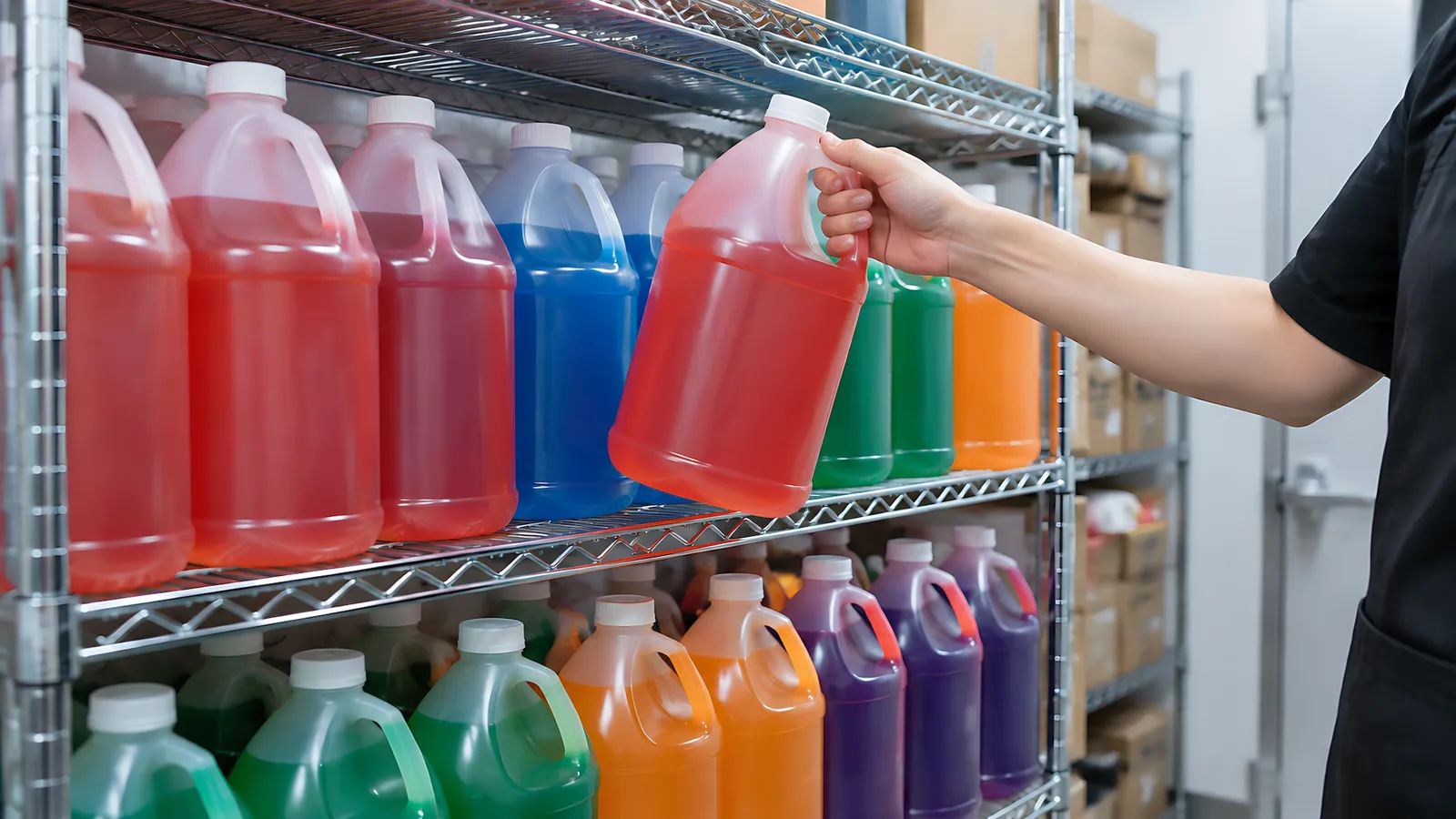
Slushie machine mix guide: types of slush syrup, how to read the label, dilution ratios by batch size, Brix checks, cost per cup and storage.
A slushie machine mix is a sweetened, flavored liquid with enough dissolved sugar to freeze into soft crystals instead of solid ice. Most commercial operators buy a concentrated slush syrup and dilute it with water at the ratio printed on the label, then check that the prepared batch reads about 12–18 Brix before it goes in the bowl. Get the ratio and the sugar level right and almost any mix will run well; stretch it or pick the wrong product and it freezes hard or never sets. This guide covers the types of mix, how to read a label, dilution math for each batch size, cost per cup, and storage.
Part of our commercial slush machine buying guide series.
Types of mixes for slushie machines
The product on the shelf matters less than how it is meant to be prepared. These are the main formats you will see from foodservice suppliers:
| Mix type | How you prepare it | Strengths | Watch for |
|---|---|---|---|
| Liquid concentrate (jug) | Dilute with water at the label ratio | Lowest storage space per cup; wide flavor range | Staff “stretching” it with extra water |
| Bag-in-box concentrate | Drawn and diluted by an autofill system | No hand mixing at high-volume stations | Needs a machine and pump set up for it |
| Ready-to-use mix | Pour straight into the bowl | No measuring; consistent every time | Ships and stores mostly water, so it takes more space |
| Powder mix | Dissolve fully in water | Light to ship; long shelf life before mixing | Undissolved powder settles and reads wrong on a refractometer |
| House syrup | Sugar, water and your own flavors | Full control of flavor and cost | You own the Brix check every time |
| Juice-based | Juice plus syrup to reach the sugar target | Premium menu appeal | Natural sugar varies by batch; pulp can collect at the tap |
| Sugar-free (frozen-machine formula) | Dilute per label | Lower-calorie menu option | Use only products made for frozen beverage machines |
| Cocktail mix | Dilute per label, then add spirits | Frozen margaritas and daiquiris | Only in a machine approved for alcohol |
Snow cone and shaved ice syrups are made to pour over ice at the cup, so they are not set up for a slush bowl as sold. If you use one, dilute it and measure the result like any other concentrate.
How to read a slush syrup label
Before you order a new slush syrup, check five things on the label or spec sheet:
- The use statement. Look for wording that the product is for frozen beverage, granita or slush machines. A syrup made for sodas or coffee is usually set up for a different dilution.
- The dilution ratio. For example, “1 part concentrate to 5 parts water.” Note whether it is by volume or by weight; most labels mean volume.
- The ingredient order. Under 21 CFR 101.4, ingredients are listed in descending order by weight. If sugar or a syrup comes first, the sugar is doing the freezing work. If water leads and a high-intensity sweetener appears near the end, it is a sugar-free formula.
- The juice declaration. Under 21 CFR 101.30, a drink that looks or tastes like fruit juice must state its juice percentage, including “contains 0% juice.” That tells you whether a “mango” mix is fruit or flavoring, and whether it can carry a juice claim on your menu.
- Storage after opening. Some concentrates are shelf-stable until opened and then need refrigeration; others are fine at room temperature. Write the open date on the jug.
A quick sugar check from the nutrition panel
For any ready-to-drink product you are thinking of pouring straight in, such as juice drinks, sports drinks or bottled lemonade, divide the grams of total sugars per serving by the serving size in milliliters and multiply by 100. That gives an approximate sugar percentage, which is close to Brix for a thin drink. A drink near 6% is about half the low end of the 12–18 window and will freeze hard unless you add syrup. It is only a screen; the refractometer reading is what counts.
Slush machine mixture ratios by batch size
Once you know the label ratio, the batch math is fixed. Concentrate per batch = batch volume ÷ (1 + water parts). The table converts the common label ratios into amounts for a 1-gallon and a 4-gallon batch, and shows how many cups one gallon of concentrate makes.
| Label ratio (concentrate : water) | 1-gallon batch | 4-gallon batch | Prepared mix per gallon of concentrate | 16 oz cups per gallon of concentrate |
|---|---|---|---|---|
| 1 : 3 | 32 fl oz + 96 fl oz water | 128 fl oz + 384 fl oz water | 4 gal | 32 |
| 1 : 4 | 25.6 fl oz + 102.4 fl oz water | 102 fl oz + 410 fl oz water | 5 gal | 40 |
| 1 : 5 | 21.3 fl oz + 106.7 fl oz water | 85 fl oz + 427 fl oz water | 6 gal | 48 |
| 1 : 6 | 18.3 fl oz + 109.7 fl oz water | 73 fl oz + 439 fl oz water | 7 gal | 56 |
Cup counts are liquid volume, rounded down, before any loss in the bowl or at the tap. Fill only to the maximum line on your bowl. For reference, Smartool lists 16.5 L (about 4.4 gallons) per tank on the RL18-3 three-cylinder slushy machine and its single-tank RLC18-1.

Brix: the check that keeps any mix consistent
Sugar decides texture. Smartool’s slush machine troubleshooting guide recommends 12–18 Brix: a mix that is too thin will not form slush, and one that is too concentrated can stick to the auger and strain it. One degree Brix is roughly 1% dissolved sugar by weight.
- Read every new product and every new staff member’s first batch with a handheld refractometer. Washington State University’s guide to measuring Brix with a refractometer shows the technique.
- Write the reading on the batch label and keep the readings from batches that ran well as your house standard for that product.
- Do not stretch concentrate. Adding an extra part of water to save syrup lowers the Brix, and the batch freezes hard and icy. The cost of a strained auger or a clogged tap is higher than the syrup saved.
To build your own flavors from a house syrup, or to correct a batch that reads high or low, see our slushie machine recipes, which give syrup-to-liquid ratios and adjustment amounts.
Cost per cup worksheet
Mix price per jug is a poor way to compare products, because a cheaper jug at 1:3 can cost more per cup than a dearer one at 1:5. Compare per cup instead:
- Cups per jug = jug volume in fl oz × (1 + water parts) ÷ cup size in fl oz.
- Mix cost per cup = jug price ÷ cups per jug.
- Total cost per cup = mix cost + cup, lid and straw.
Worked example with a 1-gallon jug: at 1:5 it makes 48 cups of 16 oz, so mix cost per cup is the jug price divided by 48. A competing 1-gallon jug at 1:3 makes 32 cups, so it has to cost about two-thirds as much just to break even. Run the same math for ready-to-use mixes, where the ratio is 1:0.
Storing and handling slush mix
- Rotate stock first in, first out, and follow each product’s own dating after opening.
- Mix in a clean, sanitized container, not in the bowl, so you can check the ratio and Brix first.
- Pre-chill prepared mix in the walk-in and label it with flavor, time and Brix. Cold mix reaches serving texture sooner and holds texture through a refill.
- Do not top an old batch with a new flavor. Change flavors only after the bowl, auger and tap are drained, washed and sanitized. Colors and allergens carry over otherwise.
- Keep dairy out of the bowl unless the machine’s manufacturer approves it. Smartool’s slush machine pages list slushies, cider slushes, margaritas and frozen cocktails as intended drinks.
Our guide on how to use a slush machine covers filling, freeze times and refills in service, and Smartool’s slushy machine maintenance steps cover the daily clean.
Matching mixes to your machine
Different mixes set best at slightly different settings. A tart lemonade and a sweet fruit blend rarely want the same consistency. On a multi-tank machine with separate controls, such as the RL18-3 with independent electronic temperature control on each of its three tanks, each mix can run at its own setting. Cocktail mixes need a machine whose maker lists alcohol as an intended use; confirm the alcohol ratio with your sales rep before you add spirits. To plan tank count around your flavor list, compare models in Smartool’s slushy machine range.
Slush machine mix FAQs
What is the ratio for slushie machine mix?
Use the ratio on the concentrate label; it differs by product. Then confirm the prepared batch reads 12–18 Brix. For a house syrup made from equal weights of sugar and water, 3 parts syrup to 7 parts water by weight lands near 15 Brix.
How much syrup do you put in a slush machine?
Divide the batch volume by one plus the water parts on the label. At 1:5, a 4-gallon batch takes about 85 fl oz of concentrate and 427 fl oz of water.
Can you use sugar-free syrup in a slush machine?
Only a sugar-free mix formulated for frozen beverage machines. Ordinary sugar-free coffee or soda syrups give sweetness without the dissolved solids that keep slush soft, so they tend to freeze into ice.
Can you put a sports drink or juice in a slushie machine?
You can, if it reaches the sugar range. Check the label math above or take a refractometer reading. Drinks built for hydration are usually lightly sweetened, so expect to add syrup; 100% juices vary by fruit.
Building a slush menu across several stores? Our factory-direct slushy machines program covers multi-unit orders. Tell us your flavor count and peak-hour cups to request a factory-direct quote.
Factory-direct from Smartool
Planning a commercial equipment purchase?
Share your site conditions, daily output and budget. Our team will match a model, send the spec sheets and quote factory-direct pricing.

Written by
Senior Engineer, Smartool
Jason is a senior engineer at Smartool. He works on the commercial ice machines, soft serve and slushy machines, and refrigerated prep tables Smartool builds for restaurants, bars, hotels and dessert shops. His guides look at equipment from the engineering side: how to size a machine for a site, what it needs for power, water and airflow, and how to keep it running through busy service. He also helps buyers match the right model to their kitchen before they request a quote.
.elementor-76528 .elementor-element.elementor-element-5c7a0d0{--display:flex;--flex-direction:column;--container-widget-width:100%;--container-widget-height:initial;--container-widget-flex-grow:0;--container-widget-align-self:initial;--flex-wrap-mobile:wrap;}.elementor-76528 .elementor-element.elementor-element-5c7a0d1 .elementor-toc__header-title{text-align:start;}.elementor-76528 .elementor-element.elementor-element-5c7a0d1 .elementor-toc__header{flex-direction:row;}.elementor-76528 .elementor-element.elementor-element-5c7a0d1{--item-text-hover-decoration:underline;}
On this page
Need pricing for your project?
Get a factory-direct quote on commercial ice makers, soft serve and slushy machines, and refrigerated prep tables.
✓ Model matching and spec sheets for your site
✓ US office in City of Industry, CA
✓ Talk to an expert: +1 (872) 221-0051
Browse by topic
Ice Machine Guides
Soft Serve & Ice Cream
Slushy & Frozen Drinks
Buying & Sourcing
Compliance & Maintenance
Related posts

Slush Machine Mix Guide: Syrup Ratios and Brix
Slushie machine mix guide: types of slush syrup, how to read the label, dilution ratios by batch size, Brix checks, cost per cup and storage.

Countertop vs Floor Soft Serve Machines: How to Choose
Countertop soft serve machine or floor model? Compare output, voltage, space, health-code clearance, cleaning and downtime, with real spec examples.