The other day, a chain store client related a scenario which was both amusing and maddening.
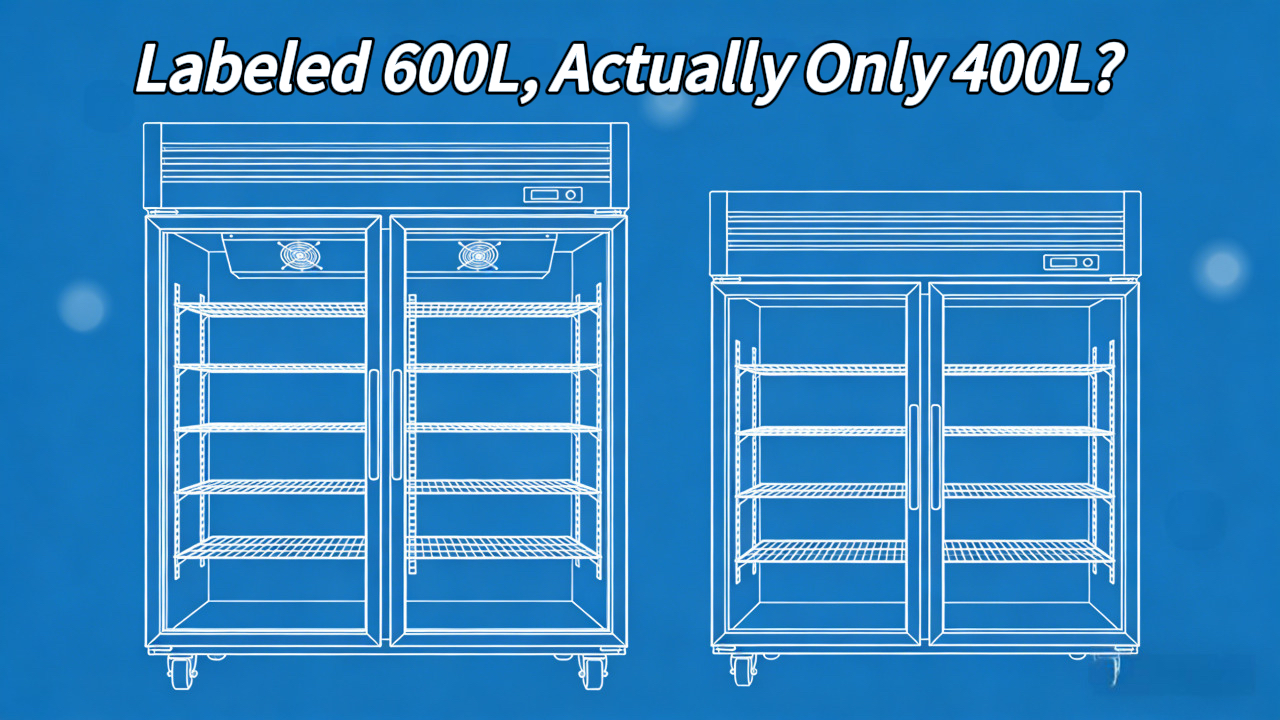
He purchased a new freezer with an advertisement of a 600L capacity to stock up for the peak season. The warehouse clerk pushed the tray in and less than half a minute later, he uttered one sentence that silenced all: “Boss…had this machine consumed 200 liters?” The tray wouldn’t go in; the food couldn’t be put inside as it should be, and at once, the kitchen became chaotic.
What appears as a minor issue now becomes routine bother every day in B2B operation.
Mislabeled capacity is the kind of “open secret” in the industry.
We have spoken to a number of overseas distributors and restaurant owners, and they too have almost all experienced similar situations.
As one distributor put it bluntly: “Among low-priced models, about 30% are somewhat ‘larger than advertised’.” More realistically, these misleading labeling methods come in all shapes and sizes: the outer shell looks huge, but the inner liner is noticeably smaller; the theoretical capacity looks good, but in reality, a large portion of the space is squeezed out by the air duct/compressor. In pictures, trays are neatly arranged, but in reality, they can’t fit at all; molds for the same cabinet are reused, with one outer shell being labeled with multiple different capacity models. It sounds ridiculous, but for the food delivery business, it all boils down to one thing: “If it can’t fit, it won’t work.”
Why inflate the capacity advertisement so much?
In short, it is rather simple and realistic:
1. Specifications are easier to make appear competitive than actual experience.
The variation of 50L or 100L can be easily noticed by a customer on the product page. But whether it can fit a tray isn’t something everybody is going to scrutinize.
Therefore, some manufacturers list the “theoretical volume” as the “actual capacity.”
2. Solutions “made-to-order” with cost pressure.
One mold alone is extremely costly. To save on this cost, some manufacturers use the same mold to produce “several different capacities.”
The advertised capacity looks impressing, but the actual space doesn’t match.
But capacity for a real kitchen is not just a number, it’s about workflow.
Catering itself is an industry that is racing against time: food preparation, cold chain logistics of stock-the list of things that have to be efficiently done is endless.
The most direct result of inflated capacity is: insufficient stock, extra trips by staff, food piling up affecting refrigeration efficiency, and a sudden “overcrowding” during peak hours that wholly disrupts the rhythm. The busier the restaurant, the more magnified is the problem. A kitchen doesn’t need impressive capacity numbers; it only needs one thing: “This stuff can fit.”
Smartool’s principle is simple: what’s written is what you can use.
When labeling capacity, we have only one standard: how much it can actually hold, that is how much we write. We will show you actual photos of trays it can hold.
Before each unit leaves the factory, we measure: usable width/depth/height, the actual number of trays that can be placed, space occupied by air duct, evaporator, and back structure, and actual effective volume for different freezing/refrigeration modes. The numbers do not have to be “pretty,” but they must be realistically usable.
Have you experienced any similar problems?
Stories ahead, please. Have you ever purchased some device that was “highly advertised” but clearly too insufficient for use?
Have you ever felt that awkward moment when trays couldn’t fit, or found out when peak season arrives that the capacity was just not enough? We would like to hear from you about problems that occur. Your honest feedback is helping us improve our products faster and help more competitors avoid these pitfalls.